
How to Express Ability in Japanese
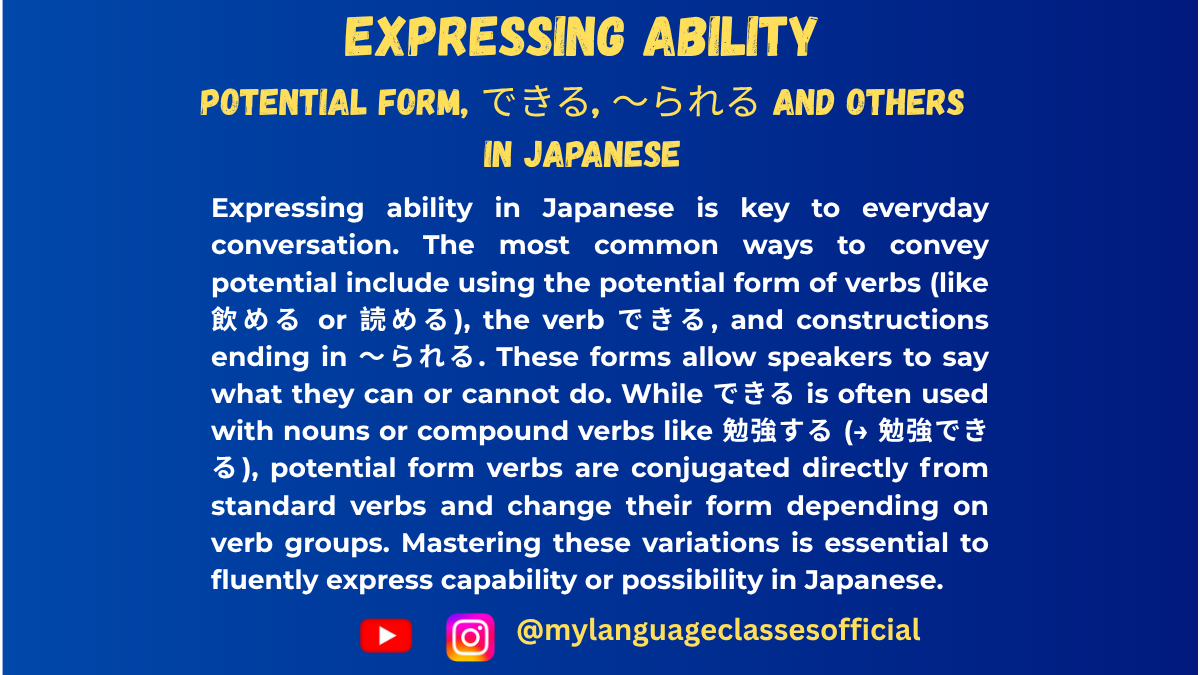
When learning Japanese, expressing ability is an essential skill. Japanese uses specific grammatical structures to indicate whether you can do something. These expressions differ depending on the type of verb, politeness level, and context. This blog post will cover all the patterns and nuances you need to know.
1. Using Potential Form (可能形, Kanoukei)
The potential form of verbs is the most common way to express ability in Japanese. This form modifies the verb to mean “can” or “be able to.”
Formation Rules:
- Group 1 Verbs (五段動詞): Change the last “u” sound to its corresponding “e” sound and add -る.
- 書く (kaku, to write) → 書ける (kakeru, can write)
- 飲む (nomu, to drink) → 飲める (nomeru, can drink)
- Group 2 Verbs (一段動詞): Simply replace -る with -られる.
- 食べる (taberu, to eat) → 食べられる (taberareru, can eat)
- Irregular Verbs:
- する (suru, to do) → できる (dekiru, can do)
- 来る (kuru, to come) → 来られる (korareru, can come)
Usage in Sentences:
- ピアノを弾けますか? (Piano o hikemasu ka?)
Can you play the piano? - 日本語が話せます。 (Nihongo ga hanasemasu.)
I can speak Japanese.
Note: For Group 2 verbs, the shortened form 食べれる is often used in casual speech, but it may be considered grammatically incorrect in formal contexts.
2. Using the Verb できる (Dekiru)
できる is a versatile verb that expresses general ability or possibility. It is often used with nouns or “nominalized verbs” (verbs turned into nouns).
Formation Rules:
- [Noun] + ができる
- スキーができる (Sukī ga dekiru) → I can ski.
- [Verb in dictionary form] + ことができる
- 本を読むことができる (Hon o yomu koto ga dekiru) → I can read books.
Usage in Sentences:
- 私は泳ぐことができません。 (Watashi wa oyogu koto ga dekimasen.)
I cannot swim. - 新しいゲームができる。 (Atarashii geemu ga dekiru.)
I can play a new game.
Tip: Use できる for broader abilities or formal contexts, while the potential form of verbs is more direct.
3. Expressing Inability with できない and Potential Form
The negative forms of できる and potential verbs are used to express inability.
- 書けない (kakenai, cannot write)
- 飲めない (nomenai, cannot drink)
- できない (dekinai, cannot do)
Examples:
- 車を運転できません。 (Kuruma o unten dekimasen.)
I cannot drive a car. - 漢字が読めない。 (Kanji ga yomenai.)
I cannot read kanji.
4. Using Expressions with 〜られる in Daily Conversation
In casual conversation, 〜られる forms often sound softer and less assertive. You can use them to express possibilities or abilities politely.
Examples:
- この本、読めますか? (Kono hon, yomemasu ka?)
Can you read this book? - 外国語は難しいけど、頑張れば話せるよ! (Gaikokugo wa muzukashii kedo, ganbareba hanaseru yo!)
Foreign languages are hard, but you can speak them if you try!
5. Using ~ことがある to Talk About Situational Ability
You can also use ~ことがある to describe situations where something is possible or permissible.
Examples:
- 会議室を使うことができますか? (Kaigishitsu o tsukau koto ga dekimasu ka?)
Is it possible to use the meeting room? - この公園で遊ぶことができます。 (Kono kōen de asobu koto ga dekimasu.)
You can play in this park.
6. Things to Keep in Mind
- Politeness Levels:
Adjust the verb endings according to the situation. For example:- Polite: 話せます (hanasemasu)
- Casual: 話せる (hanaseru)
- Using が vs. を:
When expressing ability, the object marker changes from を to が:- ピアノを弾く → ピアノが弾ける
- Cultural Sensitivity:
Japanese speakers often avoid being overly assertive about their abilities. Phrases like ちょっと難しいです (chotto muzukashii desu, “It’s a bit difficult”) can soften the tone.
7. Practice Sentences for Learners
- 明日、山に登れますか? (Ashita, yama ni noboremasu ka?)
Can you climb the mountain tomorrow? - 子どもの時、泳ぐことができました。 (Kodomo no toki, oyogu koto ga dekimashita.)
When I was a child, I could swim. - 日本語でメールを書けますか? (Nihongo de mēru o kakemasu ka?)
Can you write an email in Japanese?
Expressing ability in Japanese can feel tricky at first, but with practice, it becomes natural. Master these forms, and you’ll be able to communicate your skills and understand others effortlessly!
Have questions or want more examples? Share them in the comments below! 🌸

Vikas Kumar is the founder of My Language Classes, a language learning platform dedicated to helping learners develop practical communication skills in Spanish, Japanese, and English through comprehensive grammar guides, structured learning resources, books, and evidence-informed educational content.
At My Language Classes, we believe that successful language learning is built on clarity, consistency, meaningful practice, and a deep understanding of how languages work. Every article is carefully researched and created to simplify complex concepts, provide practical guidance, and help learners develop confidence through real-world communication.
Inspired by the principles behind How Language Learning Really Works, our mission is to make high-quality language learning accessible to learners around the world by providing accurate, trustworthy, and comprehensive resources that support lasting progress, lifelong learning, and meaningful communication.
Leave a Reply