

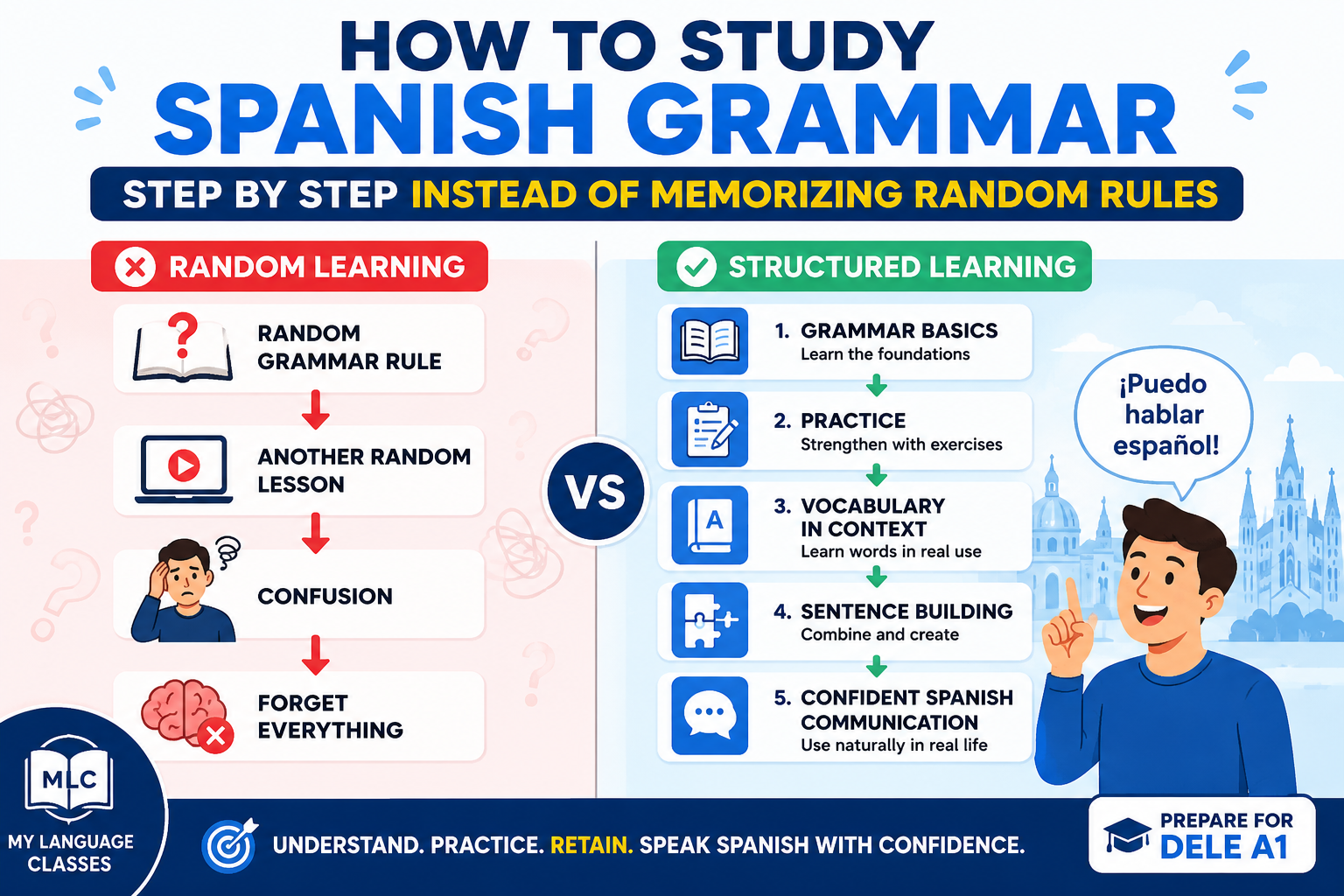
Stop Memorizing, Start Understanding Spanish Grammar
If you’ve ever felt like you’re learning the same Spanish grammar rules repeatedly but still can’t remember them a few days later, you’re not alone. Many beginners spend hours reading grammar explanations, watching videos, or memorizing conjugation charts, only to discover that they struggle to use those rules when speaking or writing.
The problem usually isn’t a lack of effort or ability. It’s the way grammar is being studied.
Spanish grammar is often presented as hundreds of separate rules that need to be memorized. In reality, grammar works as a connected system. Each concept supports another, and the more connections your brain makes, the easier it becomes to understand and remember the language. Instead of trying to store isolated facts, successful learners recognise patterns, practise them in meaningful sentences, and revisit them until they become natural.
This is why some learners make steady progress even with limited study time, while others spend months memorizing rules but continue to feel stuck. Understanding creates lasting knowledge, whereas memorization alone often creates short-term recall that fades quickly.
In this guide, you’ll learn a more effective way to study Spanish grammar. We’ll explore why memorization often fails, how the brain develops long-term grammar knowledge, and the practical study techniques that help transform grammar rules into confident communication.
If you’re looking for a structured learning system that follows this approach, The Complete Spanish DELE A1 Course by My Language Classes combines clear grammar lessons, extensive guided practice, vocabulary development, and continuous reinforcement to help beginners build genuine understanding rather than relying on memorization. The Complete Spanish DELE A1 Course is available on the My Language Classes website, and the Complete Spanish DELE A1 Course Series (3 book series) is available on Amazon in Kindle, Paperback, and Hardcover formats.
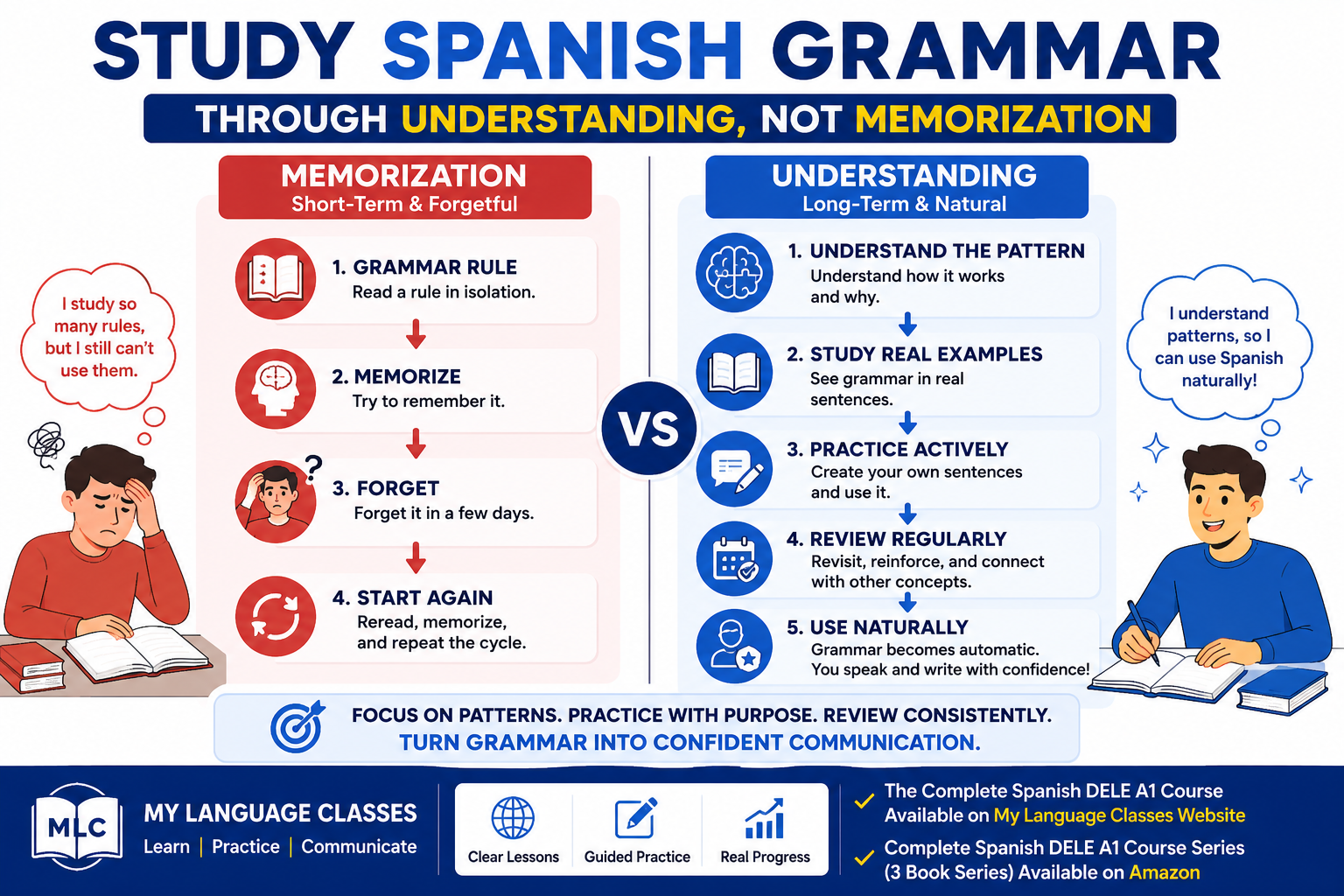
Why Memorizing Spanish Grammar Rarely Works
Many learners believe that if they can remember enough grammar rules, they’ll eventually become fluent. This approach feels logical because grammar is often taught as a collection of definitions, conjugation tables, and exceptions that need to be memorized. Unfortunately, that’s not how lasting language learning usually happens.
When you memorize a grammar rule without understanding how it works, your brain stores it as an isolated piece of information. It may help you answer a quiz immediately after studying, but that knowledge is often difficult to retrieve during a real conversation. As a result, learners frequently recognise a rule on paper but struggle to apply it when they need to speak or write.
Another challenge is cognitive overload. Every new grammar rule competes with dozens of others for your attention. Without meaningful connections between concepts, your brain has no efficient way to organise what you’ve learned. Instead of building a clear understanding of Spanish, you end up collecting unrelated facts that are easy to confuse and easy to forget.
This explains why many learners find themselves revisiting the same grammar topics over and over again. The issue is rarely poor memory. More often, the information was never integrated into a larger system of knowledge.
Understanding changes this completely. When you recognise how grammar patterns work together, every new concept strengthens what you already know. Instead of memorizing isolated rules, you begin building a network of connected ideas that becomes easier to recall and apply in real communication.
For this reason, effective Spanish learners spend less time trying to remember individual rules and more time understanding relationships, recognising patterns, and using grammar in meaningful contexts. That approach creates stronger retention and makes learning feel much more natural.
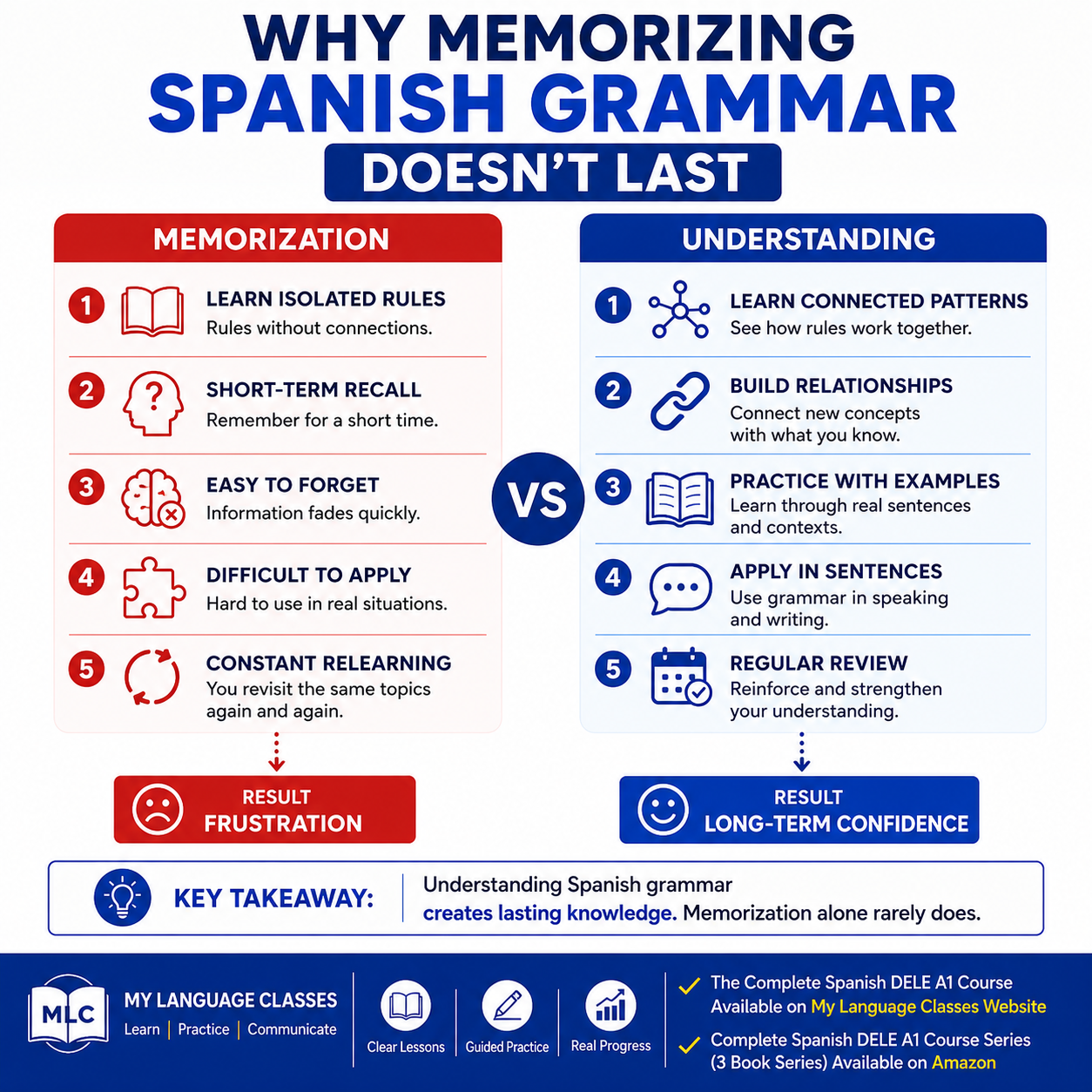
How the Brain Actually Learns Spanish Grammar Patterns
Many learners assume that remembering Spanish grammar depends on having a good memory. In reality, the brain learns grammar by recognising patterns, making connections, and strengthening those connections through repeated use. The goal is not to store hundreds of individual rules but to develop a system that allows those rules to work together naturally.
Think about how you recognise familiar faces or common phrases. You don’t consciously analyse every detail each time you see them because your brain has already identified the pattern. Language learning works in a similar way. The more often you encounter the same grammar structures in meaningful situations, the more familiar those patterns become.
This is why reading one grammar rule repeatedly is usually less effective than seeing that rule used across many different sentences. Every new example reinforces the same underlying pattern while showing how it works in different contexts. Gradually, your brain stops focusing on the rule itself and starts recognising how the language naturally fits together.
Another important part of learning is repeated retrieval. Every time you recall a grammar concept without immediately looking at your notes, your brain strengthens that memory. Each successful recall makes the information easier to access in the future, whether you’re writing a sentence or responding in a conversation.
Consistent exposure also helps move grammar from conscious effort to automatic recognition. At first, you may need to think carefully before choosing the correct verb form or article. After enough meaningful practice, those choices become quicker and require much less mental effort because the patterns have become familiar.
This is one reason structured learning produces better long-term results than studying random grammar topics. When each lesson builds upon earlier concepts, the brain creates stronger links between ideas instead of storing them as separate pieces of information. Over time, these connected patterns become the foundation for confident Spanish communication.
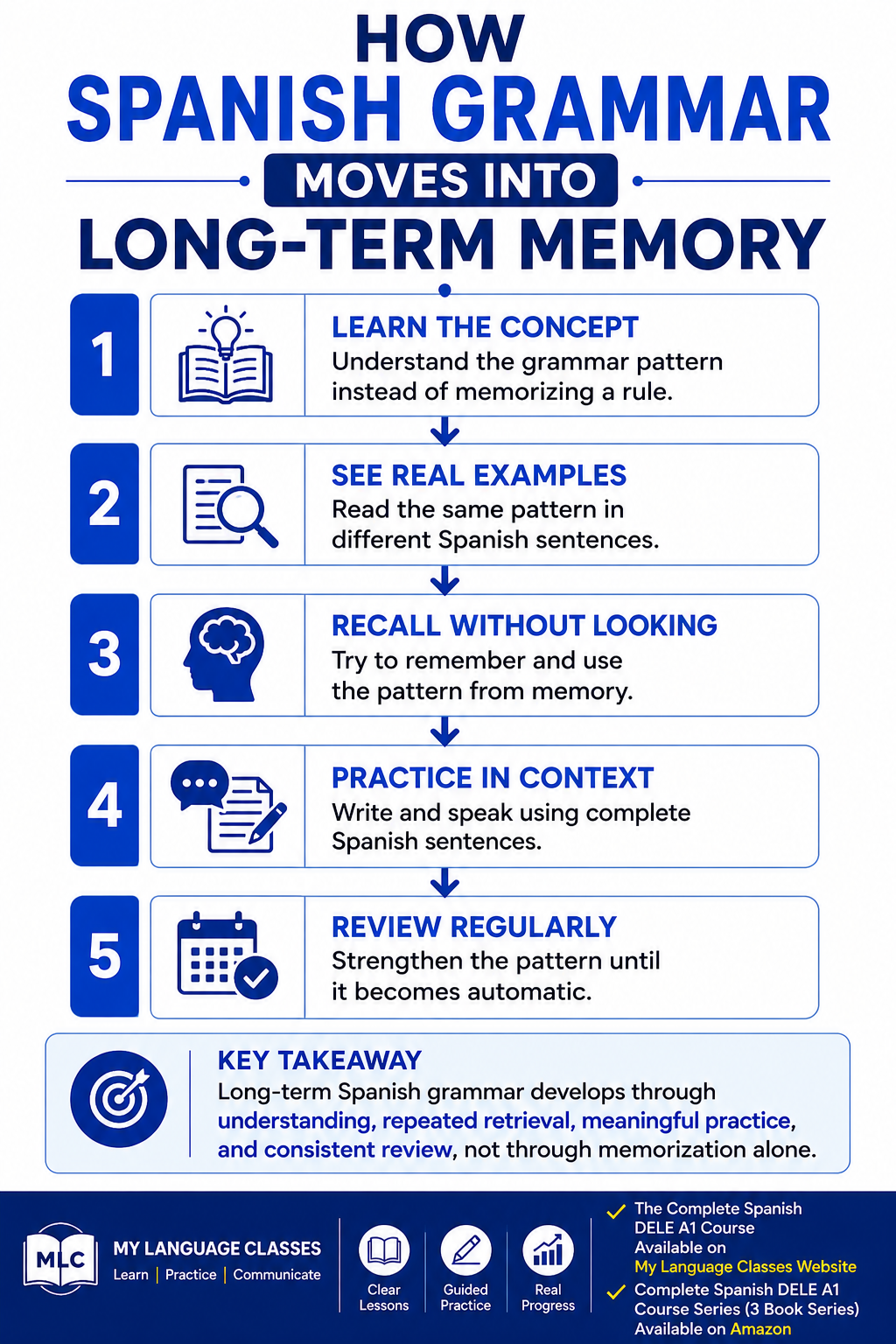
Learn Spanish Grammar as Connected Ideas, Not Separate Rules
One of the most effective ways to improve your Spanish grammar is to stop thinking of each grammar topic as an independent lesson. In Spanish, grammar concepts work together. Learning one idea helps you understand several others because they are part of the same language system.
For example, when you learn how articles work, you’ll naturally begin to notice how they agree with nouns. As you become familiar with nouns, it becomes easier to understand why adjectives change their endings. When you practise complete sentences, you’ll see how verbs, pronouns, and sentence structure interact. Instead of memorizing dozens of separate rules, you begin recognising relationships that make the language easier to understand.
This connected approach also reduces the amount of information you need to remember. Rather than recalling every rule individually, your brain starts recognising familiar patterns. Once you understand how one pattern works, similar structures become easier to learn because they fit into a framework you already know.
A helpful habit is to ask yourself how every new grammar concept relates to something you’ve already studied. Instead of treating each lesson as a fresh start, look for similarities, repeated structures, and shared patterns. This strengthens your understanding and makes future learning much faster.
Studying complete sentences is especially valuable because they show multiple grammar concepts working together. A single sentence may reinforce articles, nouns, adjectives, verbs, and word order at the same time. This gives your brain richer information than studying isolated grammar rules, making recall more natural when you need to communicate.
This connected learning philosophy is central to The Complete Spanish DELE A1 Course by My Language Classes. Rather than presenting grammar as unrelated lessons, each topic builds on previous concepts and is reinforced through guided practice, helping learners understand how Spanish works as a complete system. For learners who prefer studying with books, the Complete Spanish DELE A1 Course Series (3 book series) follows the same structured methodology, allowing you to strengthen your understanding one concept at a time.
Replace Memorization with Active Practice
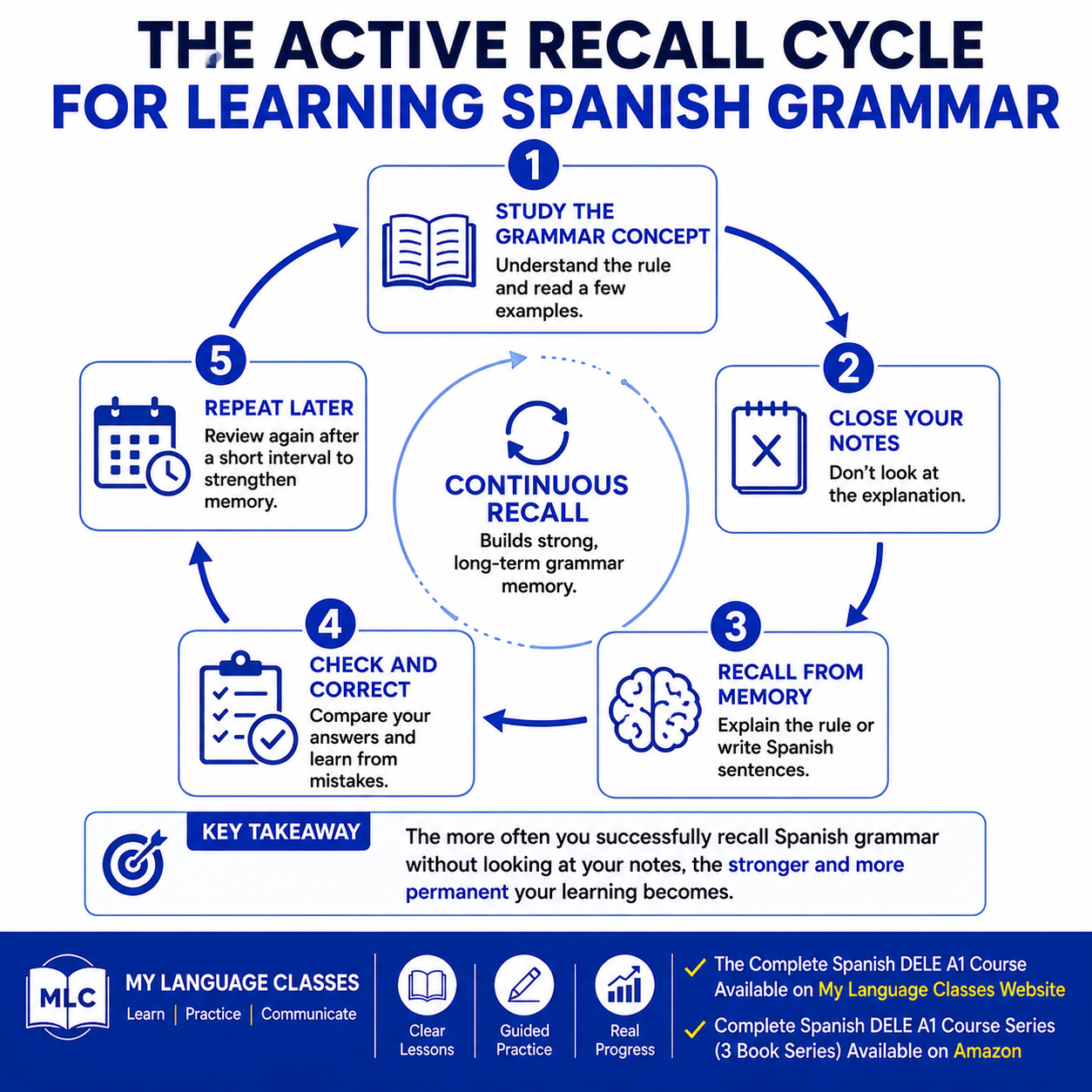
Reading a grammar explanation several times may help you recognise a rule, but recognition is very different from being able to use it. The real learning begins when you actively retrieve information from memory instead of simply looking at it.
One of the most effective techniques is active recall. Rather than rereading your notes, close the book and try to explain the grammar concept in your own words. Write a few sentences using the new structure or answer a question without checking the rule first. Even if you make mistakes, the effort of retrieving the information strengthens your memory far more than passive reading.
Another useful strategy is retrieval practice. After completing a lesson, revisit it a day or two later without reviewing your notes first. Try to remember the rule, write a few examples, and then compare your answers with the correct ones. Every successful recall reinforces the grammar pattern and makes it easier to use naturally in future conversations.
Creating your own examples is equally valuable. Instead of copying sentences from a textbook, write sentences about your own life, daily routine, family, hobbies, or work. Personal examples are more meaningful, making them easier to remember and easier to reuse when speaking Spanish.
You can also explain a grammar concept as if you were teaching someone else. If you can clearly describe how a structure works and demonstrate it with your own examples, you’ve moved beyond memorization to genuine understanding.
The key is to make grammar an active process. Every time you think, write, speak, or explain without immediately looking at the answer, you’re strengthening the neural pathways that support long-term learning. Over time, these repeated retrievals make Spanish grammar feel increasingly familiar and automatic.
Learn Spanish Grammar Through Sentence Patterns
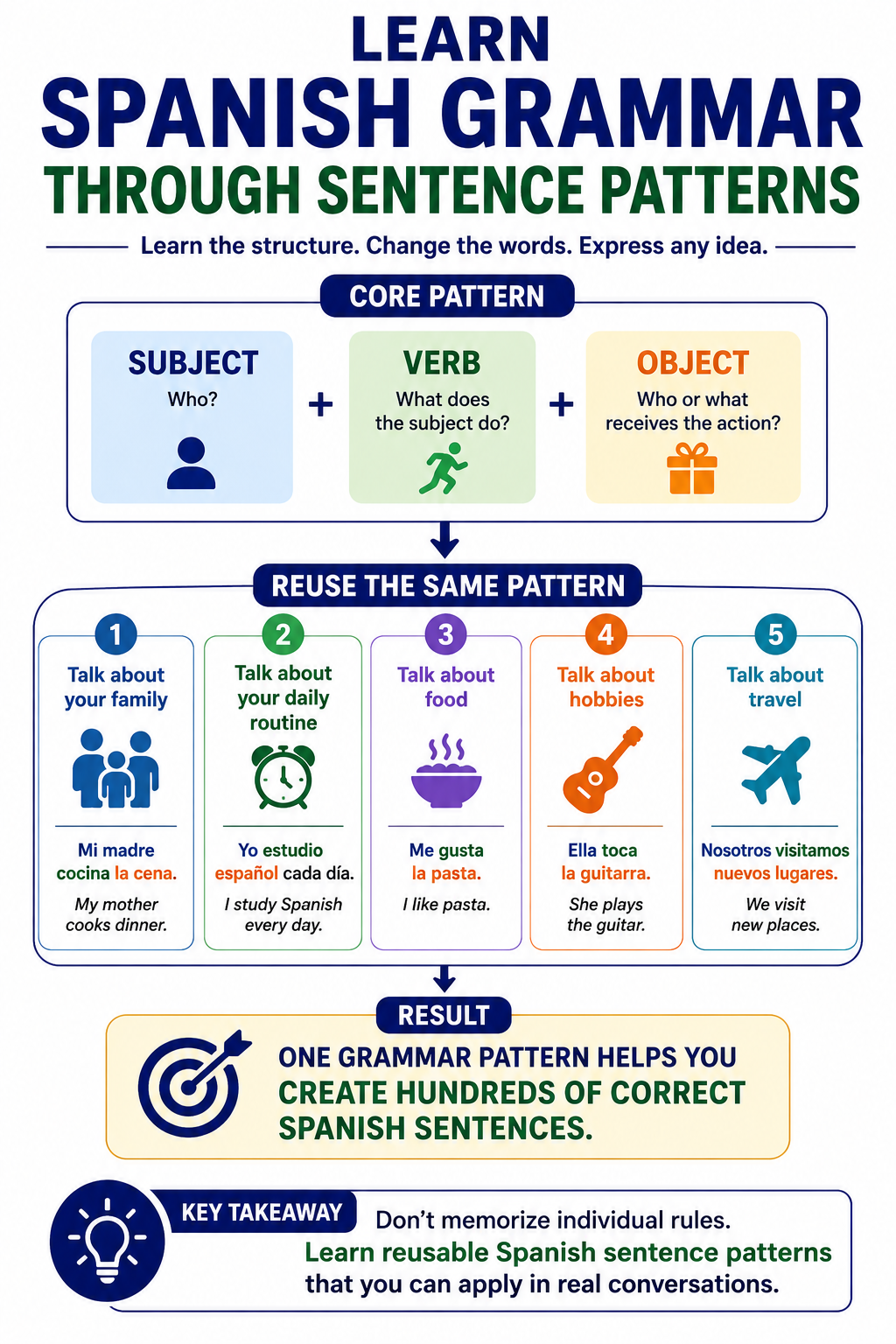
Many beginners study grammar by memorizing individual rules, but fluent speakers don’t think in isolated rules when they communicate. They recognise familiar sentence patterns and naturally adapt them to express new ideas. Developing this habit is one of the most effective ways to make Spanish grammar feel easier and more intuitive.
A sentence pattern is simply a structure that you can reuse with different vocabulary. Instead of creating every sentence from scratch, you learn a reliable framework and replace only the words that change. For example, once you become comfortable with a basic sentence structure, you can use the same pattern to talk about your family, hobbies, work, food, travel, or daily activities. The grammar remains consistent while the meaning changes.
Learning through patterns also helps you notice how different grammar concepts work together. Rather than studying articles, nouns, adjectives, and verbs as separate lessons, you see them functioning as parts of one complete sentence. This gives every grammar rule a purpose and makes it much easier to remember because you are learning how the language is actually used.
Another advantage of sentence patterns is that they encourage active communication. Instead of asking yourself which rule applies, you begin recognising structures you’ve seen and practised before. Over time, your brain retrieves these patterns automatically, allowing you to focus more on expressing your ideas than recalling grammar rules.
This pattern-based approach is a key part of The Complete Spanish DELE A1 Course by My Language Classes. Every grammar lesson is reinforced with carefully designed practice exercises that encourage learners to build and reuse complete Spanish sentences. The same practical learning philosophy is reflected in the Complete Spanish DELE A1 Course Series (3 book series), helping learners develop confidence through repeated exposure to meaningful sentence patterns rather than isolated grammar rules.
Build a Simple Review System That Helps You Remember
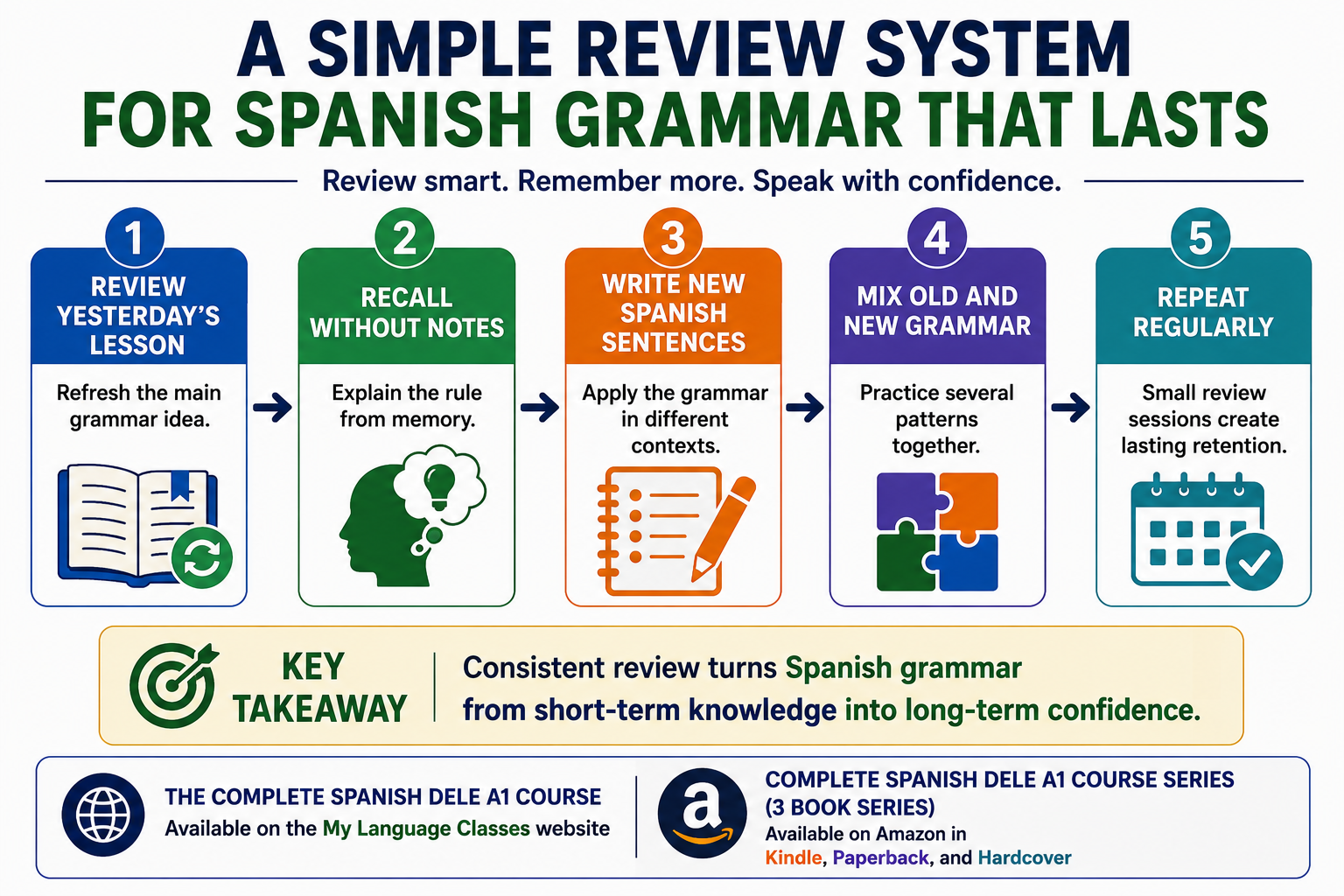
Learning Spanish grammar isn’t just about how you study. It’s also about how you review. Many learners spend hours learning something new but very little time revisiting it. As a result, grammar that seemed clear one week often feels unfamiliar the next.
A better approach is to think of review as reinforcement rather than repetition. Every time you revisit a grammar concept, you strengthen the connections your brain has already formed. This takes far less effort than learning the topic again from the beginning.
Instead of reviewing every lesson in the same way, vary your practice. Read a few example sentences, write your own versions, explain the grammar aloud, and test yourself without looking at your notes. Using the same concept in different ways creates multiple memory pathways, making it easier to recall later.
Keeping a dedicated Spanish grammar notebook can also make review more effective. Rather than copying long explanations, record the key idea, one or two example sentences, and any patterns you’ve noticed. Over time, your notebook becomes a personalised reference built from your own understanding instead of copied definitions.
As your knowledge grows, don’t review grammar topics in isolation. Mix previously learned concepts together in short practice sessions. This helps your brain distinguish between similar structures and improves your ability to choose the correct form naturally during real communication.
This review-focused approach is integrated throughout The Complete Spanish DELE A1 Course, where each new lesson reinforces previously learned concepts through structured exercises, helping learners strengthen their understanding over time. Learners who prefer books can apply the same review strategy with the Complete Spanish DELE A1 Course Series (3 book series), using the progressive lessons and practice activities to revisit grammar patterns and build lasting confidence.
The Complete Spanish DELE A1 Course is available on the My Language Classes website, and the Complete Spanish DELE A1 Course Series (3 book series) is available on Amazon in Kindle, Paperback, and Hardcover formats.
Use Structured Resources Instead of Random Lessons
The way you study is often more important than the number of hours you spend studying. Many learners collect grammar lessons from videos, websites, social media posts, mobile apps, and printable worksheets. While each resource may be useful on its own, switching constantly between different teaching styles and sequences often creates confusion rather than progress.
A structured learning resource solves this problem by giving every lesson a clear purpose. Instead of introducing disconnected grammar rules, it builds new concepts on top of what you’ve already learned. Each explanation, example, and practice activity reinforces previous knowledge, allowing your understanding to grow naturally over time.
This is why consistency is so important. Following one well-designed learning system helps you spend more time practising and less time deciding what to study next. Rather than repeating the same beginner topics from multiple sources, you can focus on applying what you’ve learned and steadily building your confidence.
If you’re looking for that kind of structured approach, The Complete Spanish DELE A1 Course by My Language Classes is designed around the learning principles discussed throughout this guide. The course combines 44 carefully structured grammar lessons, more than 4,300 fill-in-the-blank practice exercises with complete answers and English translations, and over 2,000 Spanish vocabulary words organised into practical categories. Every lesson builds on previous concepts, helping learners develop genuine understanding through guided practice instead of memorization.
For learners who enjoy studying from books, the Complete Spanish DELE A1 Course Series (3 book series) follows the same structured methodology, allowing you to progress through the material in a logical sequence while reinforcing grammar, vocabulary, and sentence-building skills.
The Complete Spanish DELE A1 Course is available on the My Language Classes website, and the Complete Spanish DELE A1 Course Series (3 book series) is available on Amazon in Kindle, Paperback, and Hardcover formats.
Key Takeaways
➜ Understanding Spanish grammar is far more effective than memorizing isolated rules.
➜ Your brain learns grammar by recognizing patterns and strengthening them through repeated use.
➜ Active recall and retrieval practice help move grammar into long-term memory.
➜ Learning through complete sentence patterns makes grammar easier to remember and apply.
➜ Regular speaking and writing practice reinforce grammar more effectively than passive reading.
➜ A simple review system strengthens what you’ve already learned and reduces the need to relearn grammar.
➜ Following one structured learning resource is more effective than jumping between unrelated lessons.
➜ Consistent practice and meaningful review lead to lasting confidence in Spanish grammar.
Conclusion
Studying Spanish grammar step by step doesn’t mean memorizing hundreds of rules in a particular order. It means building understanding gradually, practising actively, reviewing consistently, and recognising the patterns that make the language work.
When you shift your focus from remembering rules to understanding how Spanish grammar functions, learning becomes more enjoyable, more efficient, and much more sustainable. Instead of constantly starting over, you’ll build knowledge that stays with you and becomes easier to use in real conversations and writing.
Whether you choose a complete online programme or structured learning books, the most important decision is to follow one consistent system that encourages understanding, meaningful practice, and regular review. That’s the approach that turns grammar from something you study into something you naturally use.

Vikas Kumar is the founder of My Language Classes, a language learning platform dedicated to helping learners develop practical communication skills in Spanish, Japanese, and English through comprehensive grammar guides, structured learning resources, books, and evidence-informed educational content.
At My Language Classes, we believe that successful language learning is built on clarity, consistency, meaningful practice, and a deep understanding of how languages work. Every article is carefully researched and created to simplify complex concepts, provide practical guidance, and help learners develop confidence through real-world communication.
Inspired by the principles behind How Language Learning Really Works, our mission is to make high-quality language learning accessible to learners around the world by providing accurate, trustworthy, and comprehensive resources that support lasting progress, lifelong learning, and meaningful communication.
Leave a Reply