
How to Talk About Frequency in Japanese
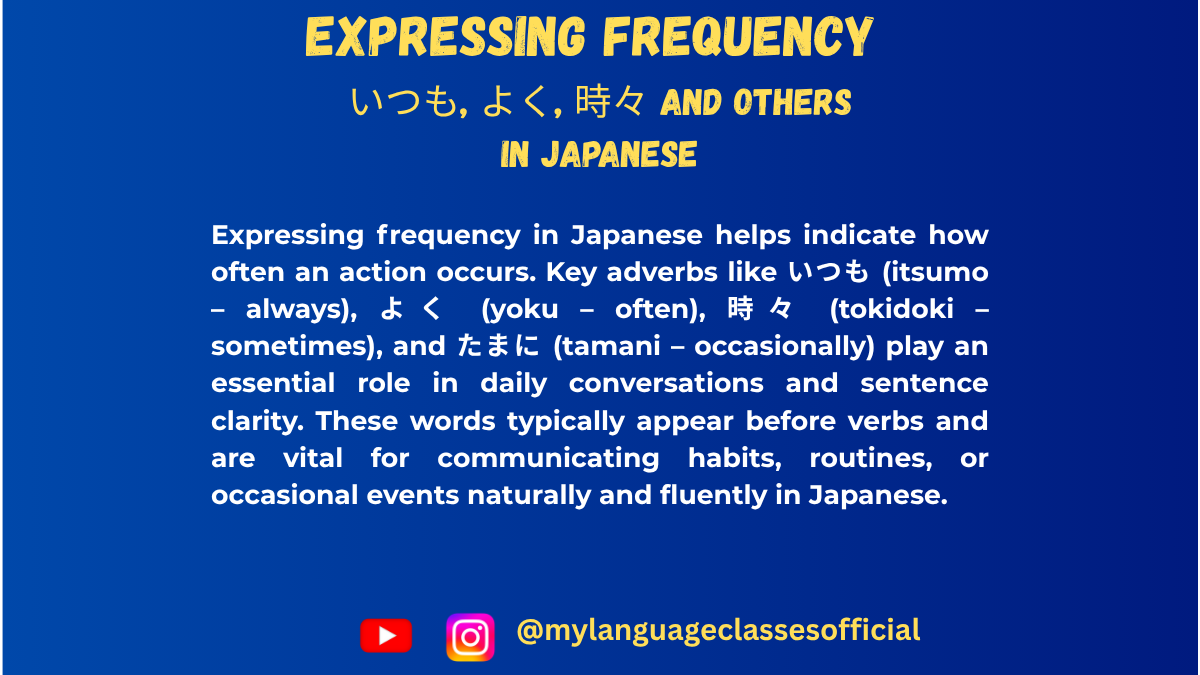
Learning how to express frequency is an essential part of mastering any language. In Japanese, there are various ways to indicate how often something happens, ranging from daily habits to rare occurrences. This guide will provide all the patterns and tips you need to express frequency like a native speaker.
Basic Frequency Vocabulary
Here are some common adverbs used to express frequency in Japanese:
| Japanese | Romaji | English Translation | Example Sentence |
|---|---|---|---|
| いつも | itsumo | always | 私はいつも朝ごはんを食べます。 (Watashi wa itsumo asagohan o tabemasu.) I always eat breakfast. |
| よく | yoku | often | 彼はよく映画を見ます。 (Kare wa yoku eiga o mimasu.) He often watches movies. |
| 時々 | tokidoki | sometimes | 私は時々本を読みます。 (Watashi wa tokidoki hon o yomimasu.) I sometimes read books. |
| たまに | tamani | occasionally | たまに外食します。 (Tamani gaishoku shimasu.) I occasionally eat out. |
| あまり | amari | not often (with negation) | 私はあまりテレビを見ません。 (Watashi wa amari terebi o mimasen.) I don’t watch TV often. |
| 全然 | zenzen | never (with negation) | 彼女は全然運動しません。 (Kanojo wa zenzen undou shimasen.) She never exercises. |
Patterns for Expressing Frequency
- Using Adverbs
Frequency adverbs are usually placed before the verb they modify.- Example: 私はよくカフェに行きます。
(Watashi wa yoku kafe ni ikimasu.)
I often go to cafes.
- Example: 私はよくカフェに行きます。
- Time Expressions with Frequency Indicators
To specify how often something happens, combine time expressions with frequency words like 回 (kai, “times”) or 度 (do, “times”).- Pattern:
- Time + に (ni) + Number + 回 (kai)
- Example: 一週間に三回ジムに行きます。
(Isshuukan ni sankai jimu ni ikimasu.)
I go to the gym three times a week.
- Pattern:
- Using 毎 (mai) for Recurring Activities
The prefix 毎 (mai) means “every” and is used to indicate regularity.- Examples:
- 毎日 (mainichi) – every day
- 毎週 (maishuu) – every week
- 毎月 (maigetsu/maitsuki) – every month
- 毎年 (mainen/maitoshi) – every year
- Example Sentence: 私は毎朝ジョギングをします。
(Watashi wa maiasa jogingu o shimasu.)
I jog every morning.
- Examples:
- Using ~ごとに (~goto ni)
This suffix indicates regular intervals.- Example: 二日ごとに掃除します。
(Futsuka goto ni souji shimasu.)
I clean every two days.
- Example: 二日ごとに掃除します。
- Expressing Negative Frequency
When using words like あまり (amari) or 全然 (zenzen), they must be paired with a verb in the negative form.- Examples:
- 彼はあまり勉強しません。
(Kare wa amari benkyou shimasen.)
He doesn’t study much. - 私は全然泳ぎません。
(Watashi wa zenzen oyogimasen.)
I never swim.
- 彼はあまり勉強しません。
- Examples:
Things to Keep in Mind
- Context Matters
- The frequency you use depends on the situation. For instance, using “always” (いつも) too often might make you sound exaggerated or unnatural in casual speech.
- Cultural Nuances
- Japanese people often use frequency expressions to politely imply how often they perform an action, even if it’s not true all the time. For instance, saying “よくやります” (I often do it) can sometimes serve as a polite expression rather than an exact frequency.
- Differentiating 回 (kai) and 度 (do)
- 回 (kai) is more common in casual speech, while 度 (do) can feel more formal or traditional.
- Practice Pronunciation
- Properly enunciate frequency adverbs for clarity. For instance, たまに (tamani) and 時々 (tokidoki) should not be rushed when speaking.
Practical Exercises
- Fill in the blanks with the correct frequency adverb:
- 私は(____)カラオケに行きます。
- Hint: If you go “sometimes,” use 時々.
- Translate the sentences into Japanese:
- I clean my room every week.
- He rarely eats sushi.
- Create Your Own Sentences:
- Write three sentences using different frequency adverbs. Share them with a friend or teacher for feedback!
By mastering these expressions and patterns, you’ll be well on your way to sounding natural and fluent in Japanese. Remember, practice makes perfect—so use these structures in your daily conversations and writing!
Have questions or need more practice examples? Let me know in the comments below!
Happy learning! 😊

Vikas Kumar is the founder of My Language Classes, a language learning platform dedicated to helping learners develop practical communication skills in Spanish, Japanese, and English through comprehensive grammar guides, structured learning resources, books, and evidence-informed educational content.
At My Language Classes, we believe that successful language learning is built on clarity, consistency, meaningful practice, and a deep understanding of how languages work. Every article is carefully researched and created to simplify complex concepts, provide practical guidance, and help learners develop confidence through real-world communication.
Inspired by the principles behind How Language Learning Really Works, our mission is to make high-quality language learning accessible to learners around the world by providing accurate, trustworthy, and comprehensive resources that support lasting progress, lifelong learning, and meaningful communication.
Leave a Reply