
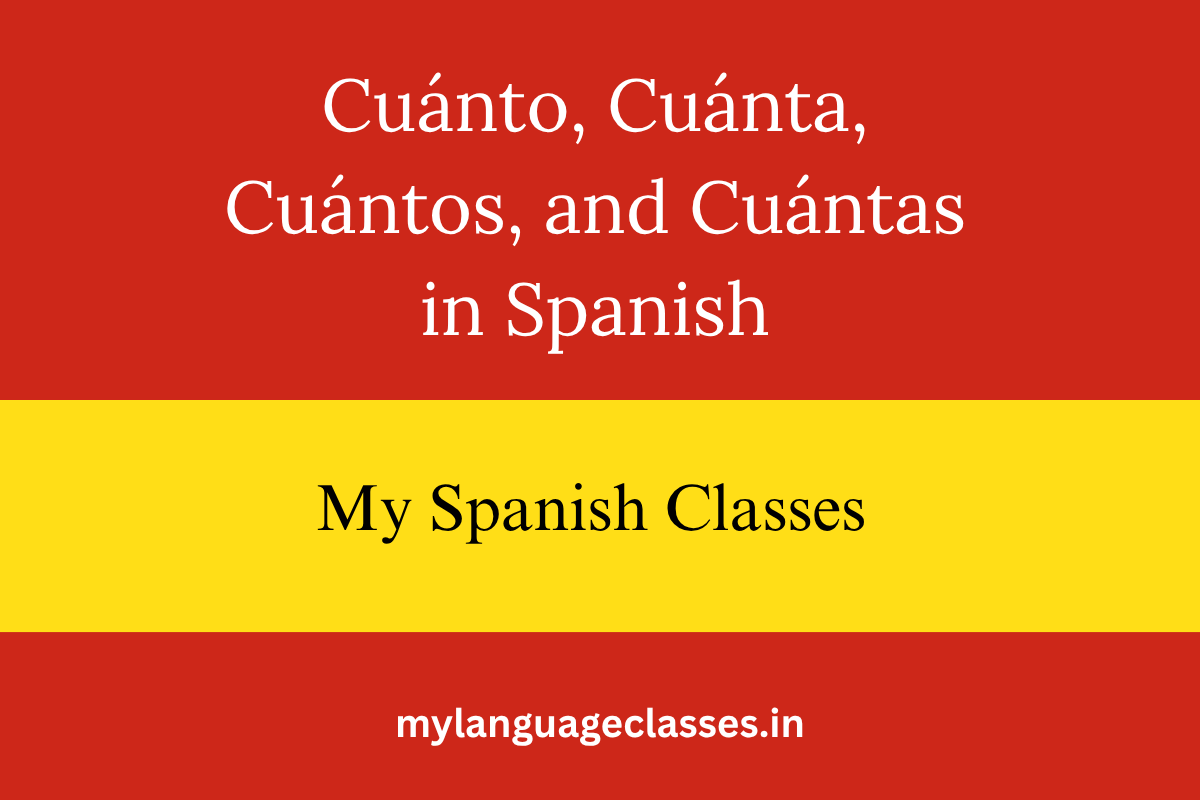
Spanish has four forms of the question word meaning “how much” or “how many.”
The form you choose depends on the gender and number of the noun that follows.
Complete Spanish DELE A1 Course
Cuánto is used with singular masculine nouns.
For example:
¿Cuánto dinero tienes?
(How much money do you have?)
¿Cuánto tiempo necesitas?
(How much time do you need?)
Complete Spanish DELE A1 Package 7 book Series
Cuánta is used with singular feminine nouns.
For example:
¿Cuánta agua bebes al día?
(How much water do you drink each day?)
¿Cuánta leche quieres?
(How much milk do you want?)
Spanish DELE A1 Grammar Workbook – Part 4: Key Sentence Structures
Cuántos is used with plural masculine nouns.
For example:
¿Cuántos estudiantes hay en la clase?
(How many students are there in the class?)
¿Cuántos idiomas hablas?
(How many languages do you speak?)
Mastering Spanish Grammar for DELE A1
Cuántas is used with plural feminine nouns.
For example:
¿Cuántas hermanas tienes?
(How many sisters do you have?)
¿Cuántas casas hay en esta calle?
(How many houses are there on this street?)
Complete Spanish DELE A1 Course Series (3 book series)
Unlike English, these question words must agree with the noun they describe.
A simple way to remember them is:
→ Cuánto – singular masculine
→ Cuánta – singular feminine
→ Cuántos – plural masculine
→ Cuántas – plural feminine
Using the correct form is an important part of Spanish grammar and helps make your questions both natural and grammatically correct.
Questions with Interrogative Words in Spanish

Vikas Kumar is the founder of My Language Classes, a language learning platform dedicated to helping learners develop practical communication skills in Spanish, Japanese, and English through comprehensive grammar guides, structured learning resources, books, and evidence-informed educational content.
At My Language Classes, we believe that successful language learning is built on clarity, consistency, meaningful practice, and a deep understanding of how languages work. Every article is carefully researched and created to simplify complex concepts, provide practical guidance, and help learners develop confidence through real-world communication.
Inspired by the principles behind How Language Learning Really Works, our mission is to make high-quality language learning accessible to learners around the world by providing accurate, trustworthy, and comprehensive resources that support lasting progress, lifelong learning, and meaningful communication.
Leave a Reply