
One of the first things that surprises English speakers when they begin learning Spanish is the punctuation.
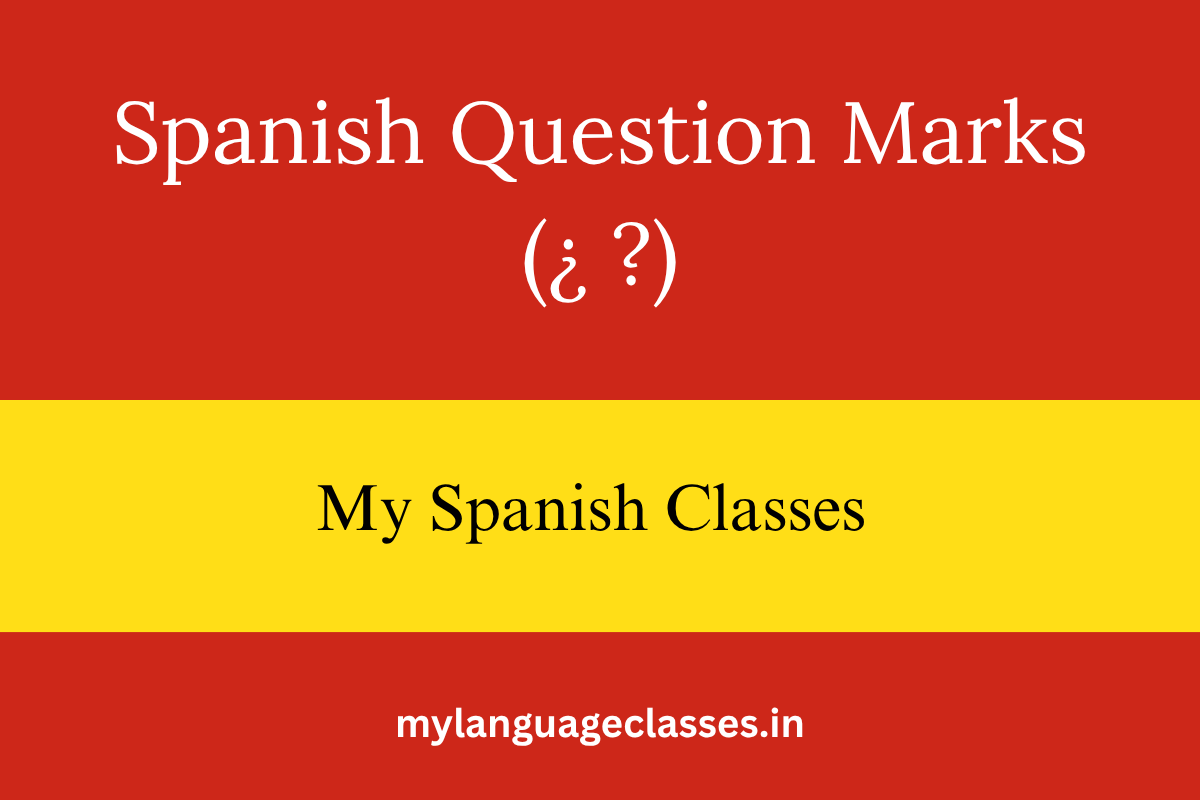
Spanish doesn’t use just one question mark.
It uses two.
Complete Spanish DELE A1 Course
Every direct question begins with an opening inverted question mark (¿) and ends with the standard closing question mark (?).
For example:
¿Cómo estás? (How are you?)
¿Dónde está el hotel? (Where is the hotel?)
¿Qué hora es? (What time is it?)
Complete Spanish DELE A1 Package 7 book Series
Both question marks are required in standard written Spanish. The opening question mark tells the reader from the very beginning that the sentence is a question.
English only signals this at the end of the sentence.
Spanish makes it clear from the very first word.
Mastering Spanish Grammar for DELE A1
Sometimes only part of a sentence is a question. In those cases, only the question itself is enclosed by the question marks.
For example:
Si tienes tiempo, ¿puedes ayudarme?
(If you have time, can you help me?)
Notice that the first part of the sentence is not a question, so it remains outside the question marks.
Spanish DELE A1 Grammar Workbook – Part 4: Key Sentence Structures
One of the most common mistakes beginners make is forgetting the opening question mark because it doesn’t exist in English.
For example:
Incorrect:
Cómo estás?
Correct:
¿Cómo estás?
Although native speakers will usually understand the meaning, omitting the opening question mark is considered incorrect in standard written Spanish.
It is a small punctuation mark, but it is an essential part of writing correct Spanish.
Questions with Interrogative Words in Spanish

Vikas Kumar is the founder of My Language Classes, a language learning platform dedicated to helping learners develop practical communication skills in Spanish, Japanese, and English through comprehensive grammar guides, structured learning resources, books, and evidence-informed educational content.
At My Language Classes, we believe that successful language learning is built on clarity, consistency, meaningful practice, and a deep understanding of how languages work. Every article is carefully researched and created to simplify complex concepts, provide practical guidance, and help learners develop confidence through real-world communication.
Inspired by the principles behind How Language Learning Really Works, our mission is to make high-quality language learning accessible to learners around the world by providing accurate, trustworthy, and comprehensive resources that support lasting progress, lifelong learning, and meaningful communication.
Leave a Reply