

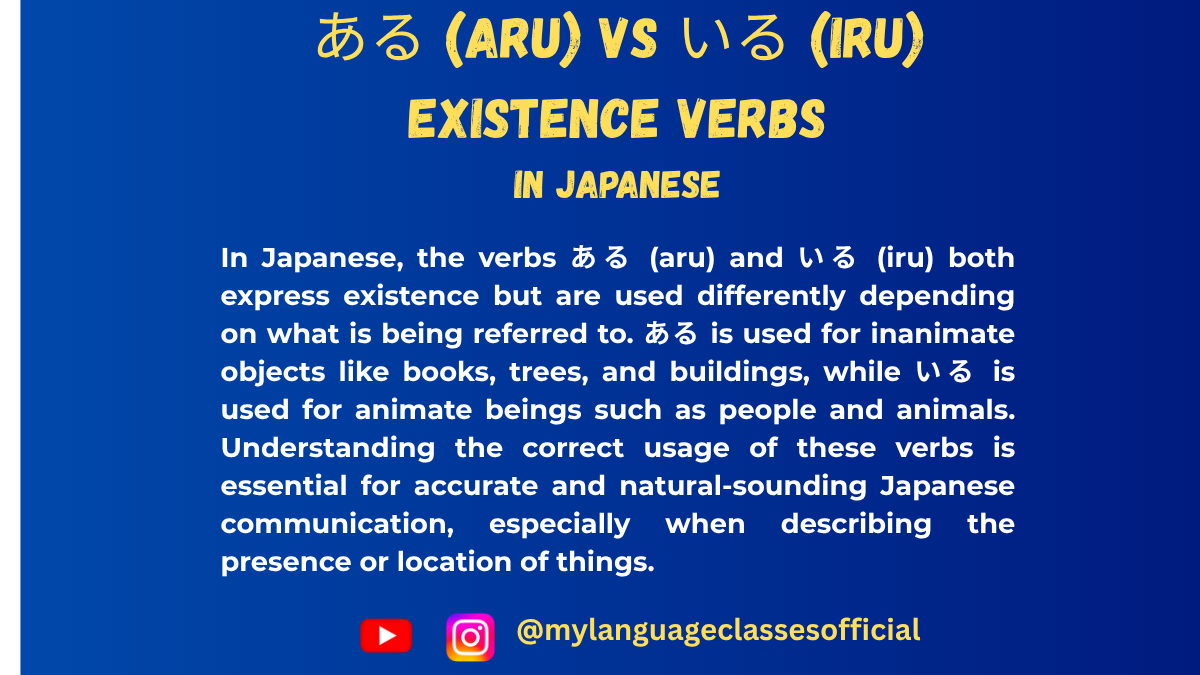
Japanese Existence Verbs: ある (Aru) vs いる (Iru)
In Japanese, one of the fundamental concepts is the idea of existence, or being. Just like in any language, expressing whether something exists or is present is crucial to communication. In Japanese, this is expressed using two key verbs: ある (aru) and いる (iru).
Though both words translate as “to be” or “to exist,” their usage depends on the type of subject you’re referring to. This difference can be tricky for learners, but once you grasp it, you’ll find yourself speaking more naturally in Japanese.
1. ある (Aru) — Used for Inanimate Objects or Abstract Concepts
The verb ある (aru) is used to express the existence of inanimate objects, things, places, or abstract concepts. If the subject is something that doesn’t have life (like a chair, book, or idea), ある is the correct verb to use.
Examples:
- 本がある。
(Hon ga aru)
“There is a book.” - 学校がある。
(Gakkou ga aru)
“There is a school.”
(Literally, “A school exists.”) - 問題がある。
(Mondai ga aru)
“There is a problem.”
(Literally, “A problem exists.”)
As you can see, ある applies to non-living things—whether they are physical objects, places, or even abstract ideas like problems or opportunities.
2. いる (Iru) — Used for Living Things
On the other hand, いる (iru) is used to indicate the existence of living things, such as people, animals, or any other beings that can move or have consciousness. This includes everything from pets to people to animals.
Examples:
- 犬がいる。
(Inu ga iru)
“There is a dog.”
(Literally, “A dog exists.”) - 先生がいる。
(Sensei ga iru)
“There is a teacher.”
(Literally, “A teacher exists.”) - 友達がいる。
(Tomodachi ga iru)
“I have friends.”
(Literally, “Friends exist.”)
The verb いる is also commonly used to refer to living things when you’re describing their existence in a particular place or context. It’s important to note that いる is for beings that can move, think, or live.
The Difference Between ある and いる
To put it simply:
- Use ある when talking about inanimate objects, things, or places.
- Use いる when talking about living things—people, animals, etc.
How to Make Sentences Negative: ない (Nai)
Just like with other verbs in Japanese, you can make sentences negative by adding ない (nai), which is the negative form of both ある and いる.
- ある becomes ない:
本がない。 (Hon ga nai) — “There is no book.” - いる becomes いない:
犬がいない。 (Inu ga inai) — “There is no dog.”
These negative forms are essential for talking about the absence of something or someone.
Other Uses of ある and いる
- Existence in the Past (だった / いた) Just like in English, we can also talk about past existence in Japanese. あった (atta) and いた (ita) are the past tense forms of ある and いる, respectively.
- 本があった。
(Hon ga atta)
“There was a book.” - 犬がいた。
(Inu ga ita)
“There was a dog.”
- 本があった。
- Describing Location Both ある and いる are also used when talking about the location of things or people. The particles に (ni) or で (de) are typically used to indicate where the subject exists.
- 机の上に本がある。
(Tsukue no ue ni hon ga aru)
“There is a book on the desk.” - 公園に犬がいる。
(Kouen ni inu ga iru)
“There is a dog in the park.”
- 机の上に本がある。
A Helpful Trick to Remember
A simple trick to remember the difference between ある and いる is to think of the phrase “Life is moving.”
- いる for living things = I for I (living being, me, you, animals).
- ある for inanimate things = A for A object.
This small mnemonic can help keep the two verbs straight as you practice!
Conclusion
Understanding ある (aru) and いる (iru) is an essential part of learning Japanese, as it helps you express existence in various contexts. Whether you’re talking about inanimate objects, people, animals, or abstract concepts, knowing when to use each verb will make your Japanese sound more fluent and natural.
If you’re new to learning Japanese, start practicing these verbs with simple sentences and gradually increase complexity. With a little practice, expressing existence will become second nature to you!

Vikas Kumar is the founder of My Language Classes, a language learning platform dedicated to helping learners develop practical communication skills in Spanish, Japanese, and English through comprehensive grammar guides, structured learning resources, books, and evidence-informed educational content.
At My Language Classes, we believe that successful language learning is built on clarity, consistency, meaningful practice, and a deep understanding of how languages work. Every article is carefully researched and created to simplify complex concepts, provide practical guidance, and help learners develop confidence through real-world communication.
Inspired by the principles behind How Language Learning Really Works, our mission is to make high-quality language learning accessible to learners around the world by providing accurate, trustworthy, and comprehensive resources that support lasting progress, lifelong learning, and meaningful communication.
Leave a Reply