

Mastering Present Progressive in Spanish
The present progressive tense (or continuous tense) is one of the most practical and dynamic structures in Spanish. It’s the equivalent of the English “present continuous” tense and is used to describe actions happening right now. If you’ve ever said something like “I am studying” in English, you’ve used a structure similar to Spanish: “Estoy estudiando.”
In this guide, you’ll learn what the present progressive is, how to form it correctly, when to use it, common irregularities, and common mistakes to avoid. Let’s dive in!
What is the Present Progressive?
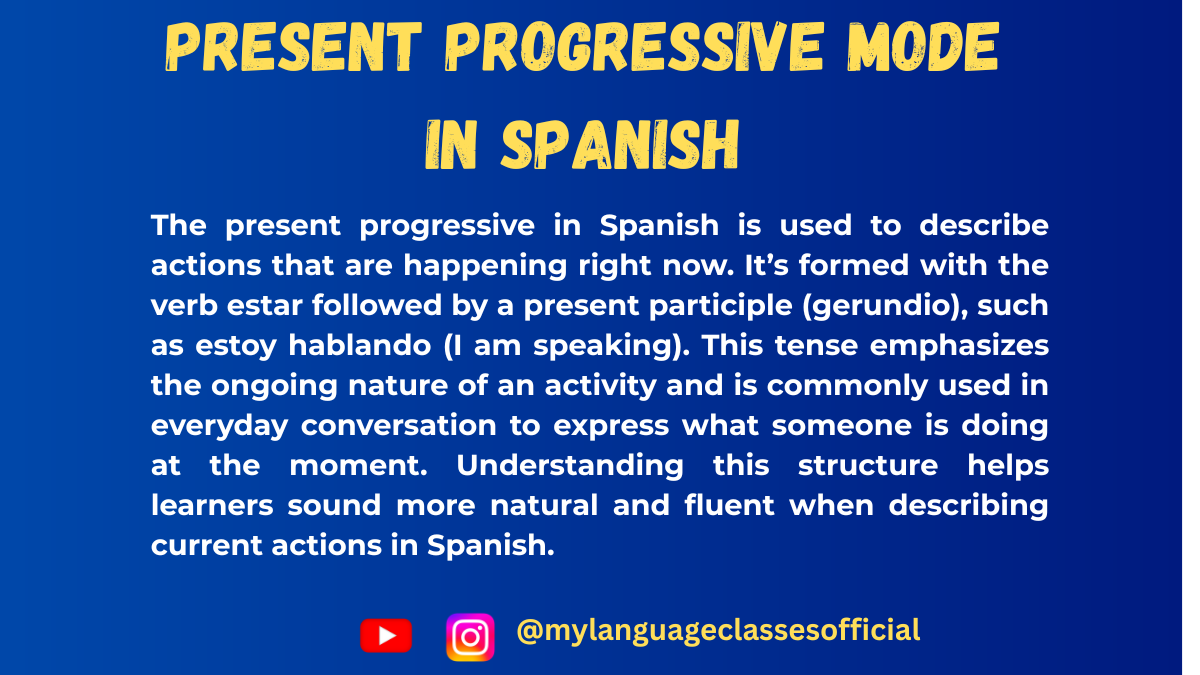
The present progressive is used to describe actions that are happening right now. It combines the verb estar (to be) as an auxiliary with another verb in its gerund form.
For example:
- Estoy escribiendo (I am writing).
- Estamos aprendiendo español (We are learning Spanish).
How to Form the Present Progressive
1. Conjugate the Verb “Estar”
First, conjugate estar in the present tense according to the subject. Here’s a quick review:
| Subject | Conjugation of “Estar” |
|---|---|
| Yo | estoy |
| Tú | estás |
| Él/Ella/Usted | está |
| Nosotros/as | estamos |
| Vosotros/as | estáis |
| Ellos/Ellas/Ustedes | están |
2. Add the Gerund Form of the Main Verb
The gerund (or present participle) is formed by adding -ando to the stem of -ar verbs and -iendo to the stem of -er and -ir verbs.
| Verb Type | Example Verb | Gerund Form | Example |
|---|---|---|---|
| -AR | Hablar | Hablando | Estoy hablando (I am speaking). |
| -ER | Comer | Comiendo | Estás comiendo (You are eating). |
| -IR | Vivir | Viviendo | Ellos están viviendo (They are living). |
Irregularities in Present Progressive Formation
While most verbs follow the standard -ando/-iendo pattern, some verbs have irregular gerund forms. These can be categorized based on their unique characteristics:
1. Verbs with Spelling Changes
Some verbs change spelling in the gerund to maintain proper pronunciation or avoid awkward letter combinations.
| Verb | Gerund Form | Example |
|---|---|---|
| Leer | Leyendo | Estoy leyendo (I am reading). |
| Construir | Construyendo | Están construyendo (They are building). |
| Oír | Oyendo | Está oyendo (He/She is hearing). |
| Caer | Cayendo | Estoy cayendo (I am falling). |
2. Stem-Changing Verbs in -IR
Stem-changing verbs that end in -ir modify their stem vowel in the gerund form. These changes occur in verbs that have e → i or o → u shifts in the present tense.
| Verb | Gerund Form | Example |
|---|---|---|
| Dormir | Durmiendo | Estoy durmiendo (I am sleeping). |
| Morir | Muriendo | Está muriendo (He/She is dying). |
| Servir | Sirviendo | Están sirviendo (They are serving). |
| Pedir | Pidiendo | Estoy pidiendo (I am requesting). |
3. Irregular Verbs with Unique Forms
Certain highly irregular verbs have gerunds that do not follow standard rules.
| Verb | Gerund Form | Example |
|---|---|---|
| Ir | Yendo | Estoy yendo (I am going). |
| Poder | Pudiendo | Está pudiendo (He/She is able to). |
| Venir | Viniendo | Estamos viniendo (We are coming). |
When to Use the Present Progressive
Use the present progressive when describing actions that are happening right now or in the immediate present. Examples include:
- ¿Qué estás haciendo? (What are you doing?)
- Estoy estudiando para un examen. (I am studying for a test.)
- Estamos trabajando en un proyecto. (We are working on a project.)
Common Mistakes to Avoid
- Overusing the Present Progressive In Spanish, the simple present tense is often used instead of the present progressive for habitual actions or near-future events. For example:
- English: I am going to the store tomorrow.
- Correct Spanish: Voy a la tienda mañana. (Not Estoy yendo a la tienda mañana.)
- Incorrect Gerund Formation Remember the spelling and stem changes discussed above. For example:
- Incorrect: Están leiendo.
- Correct: Están leyendo.
- Forgetting to Conjugate “Estar” Always ensure that estar matches the subject of the sentence. For example:
- Incorrect: Ellos está comiendo.
- Correct: Ellos están comiendo.
Practice Exercises
Try these sentences and check your understanding:
- I am listening to music. → (Translate to Spanish)
- We are running in the park. → (Translate to Spanish)
- What are you writing? → (Translate to Spanish)
Conclusion
The present progressive is an essential tool for Spanish learners, especially when you want to describe ongoing actions. By mastering estar + gerundio and learning how to handle irregular verbs, you’ll speak Spanish with greater fluency and confidence. Practice regularly, and don’t be afraid to make mistakes—they are part of the learning process!
¿Qué estás esperando? (What are you waiting for?) Start using the present progressive in your Spanish conversations today!

Vikas Kumar is the founder of My Language Classes, a language learning platform dedicated to helping learners develop practical communication skills in Spanish, Japanese, and English through comprehensive grammar guides, structured learning resources, books, and evidence-informed educational content.
At My Language Classes, we believe that successful language learning is built on clarity, consistency, meaningful practice, and a deep understanding of how languages work. Every article is carefully researched and created to simplify complex concepts, provide practical guidance, and help learners develop confidence through real-world communication.
Inspired by the principles behind How Language Learning Really Works, our mission is to make high-quality language learning accessible to learners around the world by providing accurate, trustworthy, and comprehensive resources that support lasting progress, lifelong learning, and meaningful communication.
Leave a Reply