

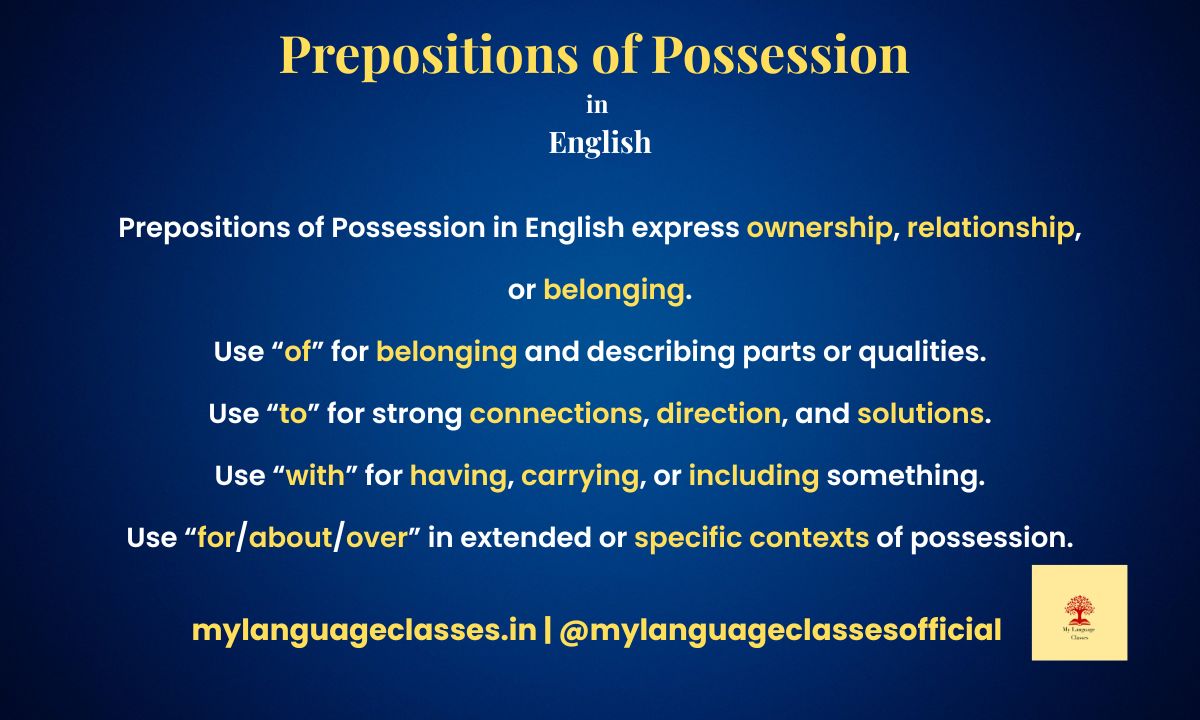
Prepositions of Possession in English are words and structures used to show ownership, relationships, belonging, or connections between people and things. The most important preposition for expressing these relationships is of, as in “the cover of the book” or “the name of the student.” English also uses other prepositions and phrases, including with, to, belonging to, and owned by, depending on the meaning.
These structures are often grouped together because they help answer questions about ownership or association. However, they do not all express possession in the same way. For example, of can show ownership, a relationship, or a part-whole connection. With can describe something that a person has or carries, without necessarily showing ownership. To appears in certain fixed relationships, such as “the key to the door,” while belonging to and owned by identify an owner more directly.
Compare these examples:
The cover of the book is blue.
The woman with the red bag is my teacher.
The key to the house is on the table.
The car belongs to my brother.
The house is owned by my family.
Each sentence shows a different type of relationship between nouns. Learning these patterns helps you choose the correct structure instead of translating directly from another language.
For a more structured study of these and other important English preposition patterns, The Complete English Prepositions Mastery Guide provides clear rules, explanations, and examples for learners who want to understand how English prepositions work in real sentences.
What Are Prepositions of Possession in English?
Prepositions of possession are words and structures used to show ownership, belonging, relationships, or connections between nouns. They help explain how one person or thing is related to another.
The most common preposition used for possession is of. For example:
The cover of the book is torn.
The owner of the car is waiting outside.
In these sentences, of connects two nouns and shows their relationship. The cover belongs to the book, and the owner has a relationship with the car.
However, possession in English is broader than legal ownership. A phrase can show that one thing is part of another, that a person is connected to something, or that someone has something without actually owning it.
For example:
The pages of the book are missing.
The woman with the umbrella is my neighbor.
The key to the door is on the table.
The first sentence uses of to show a part-whole relationship. The second uses with to show that the woman has or is carrying an umbrella. The third uses to as part of a specific relationship between a key and a door.
English also uses phrases such as belonging to and owned by when the owner needs to be identified more clearly.
This bicycle belongs to my brother.
This bicycle is owned by my brother.
The bicycle belonging to my brother is new.
These expressions can communicate similar ideas, but their grammatical structures and natural uses are different. Understanding those differences is important because English does not use one preposition for every type of possession.
For a more complete study of these structures and other essential English preposition patterns, The Complete English Prepositions Mastery Guide provides structured lessons, explanations, and examples for building stronger accuracy in English.
Which Prepositions Are Used to Show Possession in English?
English uses several prepositions and prepositional structures to show possession, ownership, belonging, or another close relationship between people and things. However, these forms do not all have the same function.
The main structures are:
→ of for ownership, relationships, and part-whole connections
→ with for having, carrying, or containing something
→ to in certain established relationships between nouns
→ belonging to for identifying ownership
→ owned by for showing direct or formal ownership
The most important of these is of. It is the main preposition used in many standard possessive relationships.
For example:
The roof of the house needs repair.
The name of the student is on the list.
The daughter of my friend lives nearby.
In each sentence, of connects two nouns and explains their relationship.
With has a different function:
The man with the blue umbrella is my teacher.
The phrase tells us that the man has or is carrying a blue umbrella. It does not necessarily mean that he owns it.
To appears in certain established expressions:
The key to the door is missing.
The answer to the question is correct.
Here, to shows a specific relationship or connection. It cannot generally replace of, and of cannot always replace to.
English also uses longer structures when the identity of the owner needs to be stated clearly:
The car belonging to my uncle is parked outside.
The building is owned by the university.
These expressions focus more directly on ownership than a phrase with of or with.
For a complete study of these patterns and other common English prepositions, The Complete English Prepositions Mastery Guide provides structured explanations, grammar rules, examples, and common usage points. The guide covers the different relationships that English prepositions express, helping learners understand which form is appropriate in each context.
How Do You Use Of to Show Possession?
Of is the most common preposition used to show possession, ownership, or a close relationship between two nouns. The basic structure is:
the + noun + of + noun
The first noun is usually the thing being described, while the noun after of identifies the person, thing, or idea connected to it.
For example:
The cover of the book is damaged.
Here, the cover belongs to or is part of the book.
The color of the car is blue.
The car is connected to the color, and the phrase tells us which car’s color is being discussed.
The name of the student is on the list.
The student is the person connected to the name.
Of can express different types of relationships, including:
→ ownership: the owner of the house
→ association: the name of the company
→ part-whole relationships: the pages of the book
→ family and personal relationships: the daughter of my friend
→ abstract relationships: the meaning of the word
One important point is that an of phrase does not always show literal ownership. For example, the title of the book does not mean that the title owns the book or that the book owns the title. The phrase simply shows the relationship between the two nouns.
Compare:
The car of my neighbor is new.
My neighbor’s car is new.
Both sentences are grammatically correct and express possession. However, the possessive form with ’s is usually more natural when referring to a person. English often uses of more naturally with things, abstract ideas, longer noun phrases, and part-whole relationships.
For example:
The door of the house is open.
The history of the country is complex.
The beginning of the movie was exciting.
The responsibility of the committee is clearly defined.
These examples show why of is such an important part of expressing possession and related relationships in English. It allows speakers and writers to connect nouns clearly without relying on the possessive apostrophe in every situation.
How Do You Use Of for Relationships?
Of is also widely used to show relationships between people, groups, organizations, and other connected nouns. In these cases, the relationship does not always involve physical ownership. Instead, of identifies how one person or thing is connected to another.
Consider these examples:
The son of my friend is studying abroad.
The manager of the company is in a meeting.
The leader of the team made the final decision.
The member of the group arrived late.
In each example, the noun before of has a relationship with the noun that follows it. A son is related to a friend, a manager is connected to a company, and a leader belongs to or is associated with a team.
How Do You Use Of to Show Family and Personal Relationships?
Of is common when describing family relationships, especially when the person or noun phrase is longer or more detailed.
For example:
The daughter of my neighbor works as a doctor.
The brother of the woman standing near the door is my colleague.
The father of the child is waiting outside.
In everyday English, possessive forms are often more natural with simple personal names:
Maria’s daughter
John’s brother
my neighbor’s daughter
However, an of phrase can be useful when the noun phrase is longer or when the relationship itself is the main focus.
What Does A Friend of Mine Mean?
English also uses of in an important possessive structure called the double possessive:
a/an + noun + of + possessive pronoun
Examples include:
A friend of mine lives in Boston.
A colleague of hers called yesterday.
An idea of ours was accepted.
A photograph of yours is on my desk.
A friend of mine means “one of my friends.” It is not exactly the same as my friend. The expression often introduces an individual as one member of a larger group.
Compare:
My friend is a doctor.
A friend of mine is a doctor.
The first sentence usually refers to a particular friend whose identity may already be known. The second introduces one person from the speaker’s group of friends.
The same pattern can also be used with possessive nouns:
A friend of John’s is visiting us.
A student of the teacher’s asked a question.
This structure should not be confused with an ordinary of phrase. In a double possessive, the noun after of appears in a possessive form.
For a detailed explanation of of, possessive structures, and other essential preposition patterns, The Complete English Prepositions Mastery Guide provides structured lessons and examples that help learners use English prepositions more accurately in different contexts.
How Do You Use Of for Part-Whole Relationships?
Of is one of the most common prepositions used to show that one thing is part of another. This is known as a part-whole relationship.
The basic pattern is:
the + part + of + the whole
For example:
The door of the house is open.
The door is part of the house.
The pages of the book are missing.
The pages are part of the book.
The wheels of the car need to be replaced.
The wheels are parts of the car.
In these examples, of connects a smaller part to the larger thing it belongs to.
How Does Of Show a Part of Something?
Of can connect many different types of parts to the whole.
Examples include:
The beginning of the movie was interesting.
The end of the road is near the river.
The top of the building is difficult to see.
The center of the city is very crowded.
The handle of the door is broken.
The meaning of the sentence is clear.
The members of the group are ready.
Some of these examples describe physical parts, while others describe an abstract relationship. The beginning and end are parts of a period of time or an event, while the meaning is connected to a word or sentence.
Is Of Always About Physical Possession?
No. An of phrase can show that something belongs to a larger whole without suggesting ownership.
For example:
The capital of Japan is Tokyo.
Tokyo does not belong to Japan in the same way that a person owns a car. Instead, of identifies the relationship between a capital and a country.
Similarly:
The result of the meeting was unexpected.
The meeting does not own the result. The phrase simply shows that the result came from the meeting.
Other common examples include:
The history of the country
The population of the city
The purpose of the project
The conclusion of the report
The importance of the issue
These structures are especially common with places, objects, events, abstract nouns, and larger noun phrases.
When Is an Of Phrase More Natural Than the Possessive Form?
Of is often more natural when the relationship involves a physical object, an abstract idea, or a part of something.
Compare:
The roof of the building
The building’s roof
The history of the country
The country’s history
Both versions can be correct. However, the of structure often gives the sentence a more natural or formal flow, especially when the noun phrase is long.
For example:
The name of the company that developed the software is not mentioned.
Using a possessive form here can make the structure heavier:
The company that developed the software’s name is not mentioned.
This is one reason why of is especially useful in English. It allows complex relationships between nouns to be expressed clearly without making the sentence difficult to follow.
When Should You Use Of Instead of the Possessive Apostrophe?
Both of and the possessive apostrophe can express possession in English, but they are not always equally natural. The choice often depends on the type of noun, the length of the noun phrase, and the relationship between the two nouns.
Compare:
John’s book is on the table.
The book of John is on the table.
Both sentences are grammatically understandable, but John’s book is far more natural in everyday English. English generally prefers the possessive apostrophe with people and animals, especially when the possessive noun is short and simple.
For example:
Maria’s car is new.
The dog’s tail is wagging.
My friend’s sister lives in Canada.
In these examples, the possessive form sounds natural because the owner is a person or an animal.
When Is Of More Natural?
Of is often more natural when the relationship involves things, places, organizations, abstract ideas, or part-whole relationships.
For example:
The roof of the house needs repair.
The history of the country is interesting.
The manager of the company is on vacation.
The meaning of the word is unclear.
The beginning of the movie was slow.
In many of these examples, the possessive form is possible:
The house’s roof
The country’s history
The company’s manager
The word’s meaning
However, the of structure is often more common or natural, especially when the sentence focuses on the relationship rather than on ownership.
What Happens with Long Noun Phrases?
An of phrase is often easier to understand when the possessive noun is long.
For example:
The name of the company that developed the software is not mentioned.
This is clearer than:
The company that developed the software’s name is not mentioned.
The second sentence is grammatically possible, but the possessive phrase is long and can be harder to process. Using of keeps the relationship between the nouns clear.
Another example is:
The opinion of the students who attended the conference was positive.
The of structure is often more natural than placing an apostrophe after a long phrase.
Can Things Use the Possessive Apostrophe?
Yes. A common learner mistake is to believe that only people can use the possessive apostrophe. English also uses ’s with many things, organizations, places, periods of time, and abstract nouns.
For example:
The company’s decision surprised everyone.
The book’s ending was unexpected.
India’s population is large.
Today’s meeting was canceled.
The city’s public transportation system is improving.
The choice between of and the possessive apostrophe is therefore not based only on whether the noun refers to a person or a thing.
A Simple Guide for Choosing Of or the Possessive Apostrophe
Use the possessive apostrophe when:
→ the possessor is a person or animal
→ the possessive phrase is short
→ the relationship sounds natural with ’s
Use of when:
→ describing a part-whole relationship
→ discussing abstract ideas or characteristics
→ the noun phrase is long
→ the of structure creates a clearer sentence
The two structures can sometimes express the same basic meaning, but natural English often depends on choosing the form that fits the noun and the context best.
How Do You Use With to Express Possession?
With can express a type of possession, but it works differently from of. Instead of usually showing ownership or a direct relationship between two nouns, with often describes a person or thing that has, carries, contains, or is characterized by something.
For example:
A man with a hat is standing outside.
The phrase with a hat tells us that the man has or is wearing a hat.
A woman with a red bag is waiting for the bus.
Here, with identifies the woman by something she has or carries.
A house with a large garden is for sale.
In this sentence, with shows that the house has a large garden as one of its features.
What Does With Show in These Sentences?
With can express several related ideas.
It can show that someone is carrying something:
A student with a backpack is waiting outside.
It can show that someone is wearing something:
The woman with glasses is my teacher.
It can show that a person or thing has a particular feature:
A child with blue eyes smiled at me.
It can also show that something contains another thing:
I bought a box with twelve chocolates.
In all of these examples, with connects a noun to something associated with it. The connection is close enough to help describe or identify the person or thing.
Does With Always Show Ownership?
No. This is an important difference between with and other expressions of possession.
Consider:
The man with the blue car is my neighbor.
This sentence does not necessarily mean that the man owns the car. He may be driving it, standing beside it, or simply using it at that moment. The sentence identifies the man through his association with the car.
Compare this with:
The man owns the blue car.
The blue car belongs to the man.
The blue car is owned by the man.
These sentences directly identify the man as the owner.
How Is With Different from Of?
Compare:
The color of the car is red.
The car with the red color is parked outside.
The first sentence is natural because of shows the relationship between the color and the car. The second sentence is grammatically understandable, but English speakers would usually say:
The red car is parked outside.
With is more natural when it introduces something the main noun has, carries, contains, or is identified by.
For example:
The woman with the umbrella is my neighbor.
The house with three bedrooms is for sale.
The book with a blue cover belongs to my sister.
A useful rule is to remember that with usually describes possession as something a person or thing has, while of more commonly describes the relationship between two nouns.
How Do You Use With for Physical and Temporary Possession?
With is often used to describe a person who has, carries, or is associated with something at a particular moment. This is especially common when the item helps identify the person.
For example:
The woman with the umbrella is waiting outside.
The sentence tells us which woman we are talking about. She has an umbrella, but we do not know whether she owns it.
The man with the blue backpack is my brother.
Here, with the blue backpack identifies the man through something he is carrying or has with him.
The child with the toy is crying.
The toy may belong to the child, but the sentence does not tell us that. It only establishes that the child has the toy.
How Does With Show Temporary Possession?
With can describe something a person has with them temporarily.
For example:
I spoke to a woman with a large suitcase.
The woman may own the suitcase, but she may also be carrying someone else’s suitcase. The phrase only describes what she has at that moment.
Another example is:
Who is the man with the black umbrella?
The speaker uses the umbrella to identify the man. The sentence does not make a claim about ownership.
This use of with is common in descriptions:
The girl with the red jacket is my cousin.
The student with the laptop is waiting for the teacher.
The man with the documents has an appointment.
In each sentence, with helps identify the person by referring to something associated with them.
How Is Physical Possession Different from Ownership?
Physical possession means that a person has something with them or is currently holding, carrying, or using it. Ownership means that the item legally or personally belongs to that person.
Compare:
The woman with the car is waiting outside.
The woman owns the car.
The first sentence shows association or physical possession. The second directly states ownership.
The difference is also clear in these examples:
The student with the book is my brother.
The book belongs to the student.
The first sentence describes the student through their association with the book. The second sentence states that the book is the student’s property.
For this reason, with should not be used when you specifically need to state who owns something. In those situations, belong to, belonging to, owned by, or a possessive form may be more accurate.
A useful distinction is:
→ with shows what someone has, carries, holds, or is associated with
→ belong to and owned by identify ownership
→ of shows a relationship between nouns, including many possessive and part-whole relationships
This difference helps explain why English uses several structures to express possession rather than relying on one preposition in every situation.
How Is To Used in Expressions of Possession?
To can appear in certain English expressions that show a close relationship, connection, or association between two nouns. However, to is not a general preposition of possession and cannot usually replace of.
For example:
The key to the door is missing.
The key is connected to and used for the door. English uses to in this established relationship.
Other common examples include:
The answer to the question is correct.
The solution to the problem is simple.
Access to the building is restricted.
The entrance to the hotel is on the left.
The invitation to the event arrived yesterday.
In these examples, to connects two related nouns. The relationship is different from ordinary ownership. A question does not own an answer, and a problem does not own a solution. Instead, to shows that one noun is connected to or directed toward the other.
Why Do We Say The Key to the Door?
Some English noun combinations use to as part of their standard pattern.
For example:
the key to the house
the answer to the question
the solution to the problem
the entrance to the building
the invitation to the party
The choice of to is based on the relationship expressed by the main noun. A key is used to open something, an answer responds to something, and a solution solves something.
For this reason, learners should learn these expressions as natural noun and preposition combinations.
Can You Use Of Instead of To?
Usually, no.
Compare:
The key to the door is missing.
The key of the door is missing.
The second sentence is not natural in standard English when you are referring to a key that opens the door.
The same applies to other common expressions:
Correct:
The answer to the question is clear.
Incorrect:
The answer of the question is clear.
Correct:
The solution to the problem is simple.
Incorrect:
The solution of the problem is simple.
Does To Always Express Possession?
No. In these expressions, to shows a specific connection rather than ownership.
For example:
The owner of the house is waiting outside.
The key to the house is on the table.
The first sentence uses of because the owner has an ownership relationship with the house. The second uses to because a key has a functional relationship with the house.
This distinction is important because English prepositions often depend on the exact relationship between two nouns. Of, with, and to may all connect nouns, but they do not express the same type of connection.
For a deeper study of these patterns and other essential noun-preposition combinations, The Complete English Prepositions Mastery Guide provides structured explanations and examples to help learners understand why English uses different prepositions in different contexts.
What Does Belonging To Mean in English?
Belonging to is a phrase used to identify who owns something. It comes from the verb belong and is useful when you want to describe a noun by naming its owner.
The basic structure is:
noun + belonging to + person, group, or organization
For example:
The car belonging to my uncle is parked outside.
The books belonging to the library must be returned.
The house belonging to the family was sold last year.
In each sentence, belonging to directly connects the thing with its owner.
How Is Belonging To Different from Belongs To?
Belonging to and belongs to come from the same verb, but they appear in different grammatical structures.
Use belongs to as the main verb in a complete sentence:
This car belongs to my uncle.
These books belong to the library.
That house belongs to the family.
Use belonging to as part of a phrase that describes a noun:
The car belonging to my uncle is parked outside.
The books belonging to the library are on the table.
The house belonging to the family was sold.
The phrase belonging to my uncle describes which car is being discussed.
How Does Belonging To Compare with Other Possessive Structures?
The same possessive relationship can often be expressed in several ways.
Consider:
The car belongs to my uncle.
The car is my uncle’s.
This is my uncle’s car.
This is the car belonging to my uncle.
These sentences express ownership, but the grammar is different.
Belongs to is often the simplest way to state ownership. The possessive form with ’s is often more natural in everyday English when the owner is a person. Belonging to is particularly useful when the phrase needs to modify a noun.
For example:
The files belonging to the company were moved to a secure folder.
This structure clearly identifies which files are being discussed.
When Is Belonging To Useful?
Belonging to is especially useful when the owner needs to be identified as part of a longer noun phrase.
For example:
The documents belonging to the employees who left the company were stored separately.
The phrase belonging to the employees who left the company clearly identifies the documents.
However, with short and simple possessive relationships, an apostrophe is often more natural:
My uncle’s car
The teacher’s book
Maria’s phone
A useful guide is:
→ Use belongs to to state ownership directly.
→ Use belonging to to describe a noun and identify its owner.
→ Use a possessive form when a shorter and more natural structure is appropriate.
→ Do not use belonging to as a complete verb phrase by itself.
For example:
Incorrect:
This car belonging to my uncle.
Correct:
This car belongs to my uncle.
Correct:
The car belonging to my uncle is outside.
How Do You Use Owned By to Show Ownership?
Owned by is used to identify who legally, formally, or directly owns something. It is formed with the past participle owned and the preposition by.
The basic structure is:
noun + is/are + owned by + person, group, or organization
For example:
The house is owned by my parents.
The company is owned by a private group.
The land is owned by the government.
In each sentence, the owner appears after by, while the thing being owned appears at the beginning of the sentence.
How Is Owned By Different from Owns?
Owned by is the passive form of the verb own. The active form puts the owner first:
My parents own the house.
A private group owns the company.
The government owns the land.
The passive form puts the focus on the thing being owned:
The house is owned by my parents.
The company is owned by a private group.
The land is owned by the government.
Both forms express the same basic ownership relationship. The choice depends on which part of the information you want to emphasize.
When Is Owned By More Useful Than Belonging To?
Both owned by and belonging to can show ownership, but their meanings and usage can differ slightly.
Owned by usually focuses directly on ownership:
The property is owned by the company.
Belonging to can express ownership or possession:
The property belongs to the company.
Owned by is often more natural when discussing official, legal, financial, or formal ownership. It is common when the ownership of a business, property, land, or organization is important.
For example:
The building is owned by the university.
The company is owned by its founders.
The website is owned by a private organization.
How Do You Use Owned By in a Noun Phrase?
Owned by can also appear as part of a phrase that describes a noun:
a house owned by my parents
a company owned by a private group
land owned by the government
For example:
The house owned by my parents is near the beach.
The company owned by the family has been operating for many years.
The land owned by the government is protected.
This structure works in a similar way to belonging to:
The house belonging to my parents is near the beach.
However, owned by often sounds more formal and places clearer emphasis on direct ownership.
A useful comparison is:
→ own expresses ownership as an active verb
→ owned by expresses ownership in a passive structure
→ belong to states who something belongs to
→ belonging to describes a noun by identifying its owner
For a complete study of by, of, with, to, and other important English prepositions, The Complete English Prepositions Mastery Guide provides structured lessons and examples covering the grammar and usage of English preposition patterns.
What Is the Difference Between Of, With, To, and Belonging To?
Of, with, to, and belonging to can all connect two nouns, but they express different relationships. Using the correct one depends on what kind of connection you want to show.
| Structure | Main Use | Example |
|---|---|---|
| of | Possession, relationship, or part-whole connection | the roof of the house |
| with | Having, carrying, containing, or being associated with something | the woman with the bag |
| to | A specific connection in established expressions | the key to the door |
| belonging to | Direct ownership or possession | a book belonging to Maria |
| owned by | Formal or direct ownership | a house owned by Maria |
How Is Of Different from With?
Of usually shows a direct relationship between two nouns. This relationship may involve ownership, a part of something, or an abstract connection.
For example:
The cover of the book is torn.
The pages of the book are missing.
The name of the company has changed.
With usually describes something that a person or thing has or is associated with.
The woman with the book is waiting outside.
The house with the large garden is for sale.
The car with the damaged door needs repair.
The main difference is that of identifies the relationship between two nouns, while with often describes one noun through something it has or contains.
How Is Of Different from To?
Of is commonly used for possession and related relationships:
The owner of the house is here.
The beginning of the movie was interesting.
To is used in specific established relationships:
The key to the house is missing.
The answer to the question is correct.
The solution to the problem was simple.
The choice is determined by the relationship expressed by the first noun. A key has a functional connection to a house, while an owner has a possessive relationship with a house.
How Is Of Different from Belonging To?
Of can show many types of relationships, while belonging to specifically identifies ownership.
Compare:
The cover of the book is blue.
The book belonging to Maria is on the table.
The first sentence describes a part-whole relationship. The second directly identifies Maria as the owner of the book.
For this reason, belonging to is useful when the owner must be stated clearly.
The same relationship can often be expressed in different ways:
This is Maria’s book.
This book belongs to Maria.
The book belonging to Maria is on the table.
Each sentence expresses ownership, but the grammatical structure is different.
How Should You Choose the Correct Structure?
A practical way to choose is to first identify the relationship between the nouns.
Use of when you want to show ownership, a relationship, or a part-whole connection.
Use with when describing something that a person or thing has, carries, wears, or contains.
Use to when the nouns form an established connection, such as the key to the door or the answer to the question.
Use belonging to when you want to identify who owns something.
Use owned by when direct or formal ownership is the main point.
English does not use one preposition for every type of possession. The relationship between the nouns determines which structure is appropriate.
What Is the Difference Between Prepositions of Possession and Possessive Nouns?
Prepositions of possession and possessive nouns can both express ownership or relationships, but they use different grammatical structures. English learners often know what they want to say but need to choose between an of phrase, a possessive noun with an apostrophe, or another structure such as belonging to or owned by.
Compare these examples:
The book of the teacher is on the desk.
The teacher’s book is on the desk.
The book belonging to the teacher is on the desk.
The book is owned by the teacher.
All four sentences connect the book with the teacher, but they do not use the same grammar, and they are not equally natural in every context.
What Is a Possessive Noun?
A possessive noun usually uses an apostrophe to show that something belongs to or is connected with another noun.
The basic structure is:
possessive noun + noun
Examples include:
Maria’s phone is on the table.
The teacher’s book is missing.
The children’s toys are in the box.
The company’s decision surprised everyone.
Possessive nouns are especially common with people, animals, organizations, and time expressions.
How Is an Of Phrase Different?
An of phrase uses the structure:
noun + of + noun
For example:
The title of the book is interesting.
The roof of the building needs repair.
The beginning of the movie was slow.
Of phrases are especially common with part-whole relationships, things, abstract nouns, and longer noun phrases.
Compare:
Maria’s phone
The phone of Maria
Both are grammatically possible, but Maria’s phone is much more natural in ordinary English.
Now compare:
The roof of the building
The building’s roof
Both are natural, although the choice may depend on the context and style of the sentence.
How Are Possessive Determiners Different?
English also uses possessive determiners:
my
your
his
her
its
our
their
For example:
My book is on the table.
Her car is outside.
Their house is near the station.
These words appear before a noun and show possession or association. They are different from prepositional structures because they do not use of, with, to, or another preposition.
Compare:
My friend
A friend of mine
The first uses a possessive determiner. The second uses a double possessive structure with of.
How Are Possessive Pronouns Different?
Possessive pronouns can replace a possessive noun phrase.
Examples include:
mine
yours
his
hers
ours
theirs
For example:
This book is mine.
That car is hers.
The house is ours.
These forms can also appear in double possessive structures:
A friend of mine
A colleague of yours
An idea of ours
The main difference is that possessive pronouns can stand alone, while possessive determiners normally come before a noun.
Which Structure Should You Use?
The best choice depends on the relationship you want to express and the type of noun you are using.
Use a possessive noun when a person, animal, or short noun phrase has a natural possessive relationship:
The student’s answer
My brother’s car
The dog’s tail
Use of for many part-whole relationships, abstract connections, and longer noun phrases:
The answer to the question
The cover of the book
The history of the country
Use possessive determiners when directly identifying who something belongs to:
My book
Her phone
Their house
Use possessive pronouns when the noun does not need to be repeated:
This book is mine.
That bag is hers.
Prepositions of possession are therefore only one part of the larger system English uses to express ownership and relationships. Learning the differences helps you choose the structure that sounds most natural in each sentence.
Common Mistakes with Prepositions of Possession
English learners often understand the general idea of possession but choose the wrong structure for the relationship they want to express. The most common mistakes involve confusing of, with, to, belong to, and possessive nouns.
Mistake 1: Using To Instead of Of
To is not a general replacement for of.
Incorrect:
The color to the car is red.
Correct:
The color of the car is red.
Of is used here because color is a characteristic or attribute of the car.
The same rule applies to many similar expressions:
The name of the company is changing.
The roof of the house is damaged.
The history of the country is interesting.
However, some nouns naturally take to:
The key to the door is missing.
The answer to the question is correct.
The solution to the problem is clear.
The preposition depends on the relationship expressed by the main noun.
Mistake 2: Using With to State Ownership
With often shows that someone has, carries, wears, or is associated with something. It does not necessarily mean that the person owns it.
For example:
The man with the car is my neighbor.
This sentence does not tell us whether the car belongs to the man.
If ownership is important, use a clearer structure:
The man owns the car.
The car belongs to the man.
The car is owned by the man.
The man’s car is parked outside.
Use with when you are describing or identifying someone through something associated with them.
The woman with the umbrella is my teacher.
The student with the laptop is waiting outside.
Mistake 3: Using Of When a Possessive Form Is More Natural
An of phrase can be grammatically possible but still sound unnatural.
For example:
The book of John is on the table.
A more natural sentence is:
John’s book is on the table.
English generally prefers the possessive apostrophe with people and other short possessive noun phrases.
For example:
Maria’s phone
my brother’s car
the teacher’s desk
Of is often more natural with things, part-whole relationships, abstract ideas, and longer noun phrases:
The cover of the book
The meaning of the word
The history of the country
The name of the company that developed the software
Mistake 4: Confusing Belong To and Belonging To
Belong to is a verb phrase that can form the main part of a sentence:
This book belongs to me.
Those keys belong to my sister.
Belonging to is usually part of a phrase that describes a noun:
The book belonging to me is on the table.
The keys belonging to my sister are missing.
Do not use belonging to as the main verb of a complete sentence.
Incorrect:
This book belonging to me.
Correct:
This book belongs to me.
Mistake 5: Using Double Possessives Incorrectly
English uses double possessives in structures such as:
a friend of mine
a colleague of hers
a book of John’s
The noun after of must be in a possessive form.
Incorrect:
A friend of me
Correct:
A friend of mine
Incorrect:
A colleague of her
Correct:
A colleague of hers
These expressions usually mean “one of” a larger group:
A friend of mine means one of my friends.
A colleague of hers means one of her colleagues.
Mistake 6: Confusing Possession with Other Types of Relationships
Not every noun phrase that uses a preposition expresses ownership.
Consider:
The key to the door
The roof of the house
The woman with the umbrella
The first shows a functional relationship. The second shows a part-whole relationship. The third shows association or physical possession.
A useful question is: What is the actual relationship between these two nouns?
If one thing is part of another, of may be appropriate.
If someone has or carries something, with may be appropriate.
If the nouns form an established connection, to may be required.
If you need to identify the owner clearly, belong to, belonging to, owned by, or a possessive form may be the better choice.
Understanding the relationship first makes it much easier to choose the correct preposition of possession in English.
How Do You Choose the Correct Preposition of Possession?
Choosing the correct preposition of possession becomes easier when you first identify the relationship between the two nouns. The words may appear to express a similar idea, but they are used for different types of relationships.
Use Of for Possession, Relationships, and Part-Whole Connections
Use of when one noun has a direct relationship with another noun. This relationship may involve possession, family relationships, parts of something, characteristics, or abstract connections.
For example:
The cover of the book is blue.
The daughter of my friend is a doctor.
The beginning of the movie was interesting.
The name of the company has changed.
Ask yourself: Does the phrase describe what one noun belongs to, comes from, or forms part of?
If yes, of may be the correct choice.
Use With for What Someone or Something Has
Use with when describing a person or thing through something they have, carry, wear, contain, or are associated with.
For example:
The woman with the red bag is my teacher.
The student with the laptop is waiting outside.
I bought a house with a large garden.
Ask yourself: Does the phrase describe what someone or something has?
If yes, with may be appropriate.
Remember that with does not necessarily show ownership.
Use To in Established Noun Relationships
Use to in specific noun combinations where English requires a relationship or connection between two things.
For example:
The key to the door is missing.
The answer to the question is correct.
The solution to the problem is simple.
These combinations should be learned as standard English patterns. You generally cannot replace to with of simply because two nouns are related.
Use Belonging To When You Need to Identify the Owner
Use belonging to when the owner needs to be clearly identified as part of a noun phrase.
For example:
The documents belonging to the company are confidential.
The house belonging to my uncle was sold.
This structure is especially useful when the phrase identifying the owner is longer.
Use Owned By When Direct Ownership Is Important
Use owned by when you want to state direct or formal ownership.
For example:
The building is owned by the university.
The company is owned by a private group.
The property owned by my family is outside the city.
This structure is common when discussing businesses, property, land, and other situations where ownership is an important fact.
A Simple Decision Guide
A practical way to choose is:
→ Is it a possessive, relationship, or part-whole connection? Use of.
→ Is it something a person or thing has, carries, wears, or contains? Use with.
→ Is it an established noun relationship, such as key to or answer to? Use to.
→ Do you need to identify who something belongs to? Use belonging to or belong to.
→ Do you need to emphasize direct or formal ownership? Use owned by.
The most important step is to understand the relationship between the nouns before choosing the preposition. English uses different structures because possession can mean ownership, association, physical possession, part-whole connection, or another type of relationship.
Key Takeaway
→ Prepositions of possession in English help express ownership, belonging, relationships, and other connections between people and things.
→ Of is the main preposition used for many possessive relationships, part-whole connections, and abstract relationships.
→ With describes what a person or thing has, carries, wears, contains, or is associated with, but it does not always show ownership.
→ To appears in specific established noun relationships, such as “the key to the door” and “the answer to the question.”
→ Belong to and belonging to identify who owns or possesses something.
→ Owned by emphasizes direct, formal, or legal ownership.
→ Possessive nouns with an apostrophe often sound more natural with people, animals, and short possessive phrases.
→ Of is often useful with things, abstract ideas, part-whole relationships, and longer noun phrases.
→ A phrase with of does not always show literal ownership. It can also express relationships such as part-whole, association, or connection.
→ With should not be used when you specifically need to prove ownership.
→ To cannot usually replace of, and of cannot always replace to.
→ The best choice depends on the exact relationship between the two nouns.
→ Understanding the relationship first is the most reliable way to choose the correct preposition or possessive structure.
Conclusion
Prepositions of Possession in English help express several different relationships, including ownership, belonging, association, and part-whole connections. The most important structure is of, but English uses other prepositions and phrases when the relationship requires a different meaning.
Use of for many possessive relationships, parts of a whole, characteristics, and abstract connections. Use with to describe something that a person or thing has, carries, wears, contains, or is associated with. Use to in established noun relationships such as “the key to the door” and “the answer to the question.”
When you need to state ownership clearly, belong to, belonging to, and owned by are useful structures. Possessive nouns and possessive pronouns can also express similar meanings, although their grammar is different.
The most reliable way to choose the correct form is to identify the exact relationship between the nouns. Once you understand whether the connection involves ownership, association, a part of something, a specific function, or temporary possession, the correct structure becomes much easier to choose.
For a deeper and more structured study of these patterns, The Complete English Prepositions Mastery Guide provides comprehensive explanations of English prepositions, their functions, grammar rules, and common usage patterns across a wide range of contexts.

Vikas Kumar is the founder of My Language Classes, a language learning platform dedicated to helping learners develop practical communication skills in Spanish, Japanese, and English through comprehensive grammar guides, structured learning resources, books, and evidence-informed educational content.
At My Language Classes, we believe that successful language learning is built on clarity, consistency, meaningful practice, and a deep understanding of how languages work. Every article is carefully researched and created to simplify complex concepts, provide practical guidance, and help learners develop confidence through real-world communication.
Inspired by the principles behind How Language Learning Really Works, our mission is to make high-quality language learning accessible to learners around the world by providing accurate, trustworthy, and comprehensive resources that support lasting progress, lifelong learning, and meaningful communication.
Leave a Reply