

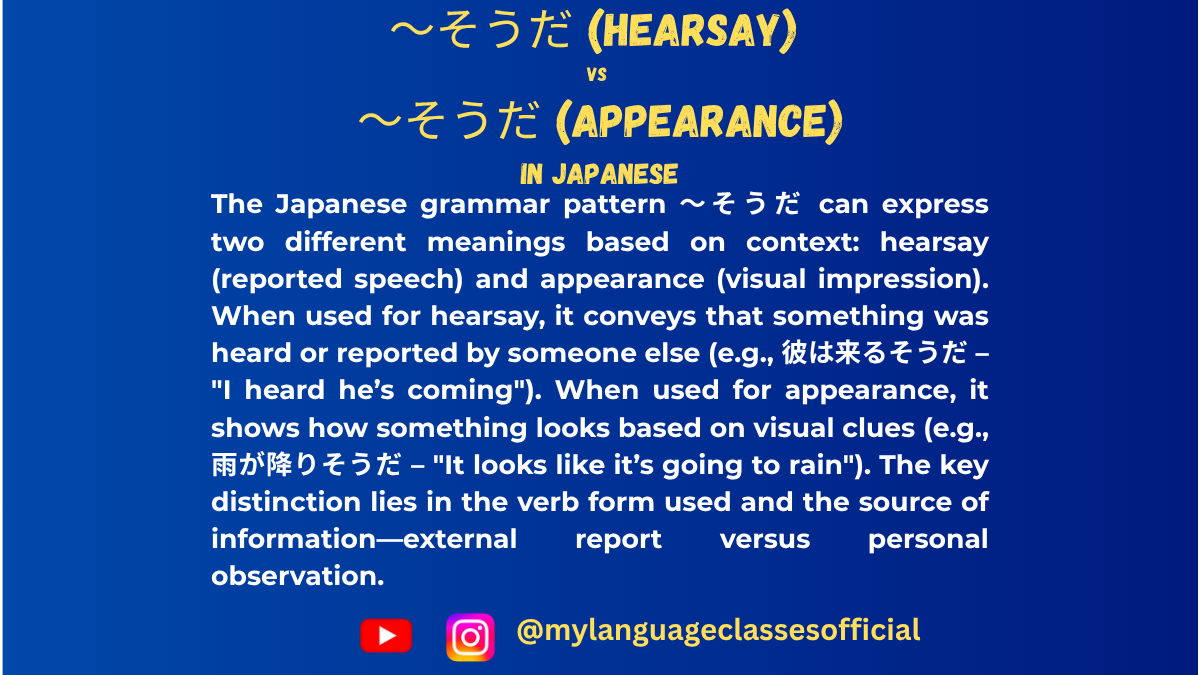
〜そうだ (Hearsay) vs (Appearance): Understanding the Difference
In Japanese, the grammatical pattern 〜そうだ is used in two different ways: Hearsay (伝聞: denbun) and Appearance (様子: yousu).
- Hearsay (〜そうだ) conveys reported speech or second-hand information, meaning that the speaker is relaying information they have heard from another source.
- Appearance (〜そうだ) expresses how something looks based on visual or sensory perception.
Despite their identical forms, these two patterns function differently and follow distinct grammatical structures. Let’s break them down.
Formation
Formation of 〜そうだ (Hearsay)
This form is used to report information obtained from another source.
- Verbs (Dictionary Form) + そうだ
- 例: 彼は日本へ行くそうだ。(Kare wa Nihon e iku sou da.)
“I heard that he is going to Japan.”
- 例: 彼は日本へ行くそうだ。(Kare wa Nihon e iku sou da.)
- い-adjectives (Plain Form) + そうだ
- 例: この映画は面白いそうだ。(Kono eiga wa omoshiroi sou da.)
“I heard this movie is interesting.”
- 例: この映画は面白いそうだ。(Kono eiga wa omoshiroi sou da.)
- な-adjectives (だ → だそうだ)
- 例: 彼は元気だそうだ。(Kare wa genki da sou da.)
“I heard he is energetic.”
- 例: 彼は元気だそうだ。(Kare wa genki da sou da.)
- Nouns (だ → だそうだ)
- 例: 彼は先生だそうだ。(Kare wa sensei da sou da.)
“I heard he is a teacher.”
- 例: 彼は先生だそうだ。(Kare wa sensei da sou da.)
Formation of 〜そうだ (Appearance)
This form is used to express the appearance of something.
- Verb (Stem) + そうだ
- 例: 雨が降りそうだ。(Ame ga furisou da.)
“It looks like it will rain.”
- 例: 雨が降りそうだ。(Ame ga furisou da.)
- い-adjectives (Drop い, add そうだ)
- 例: このケーキは美味しそうだ。(Kono keeki wa oishisou da.)
“This cake looks delicious.”
- 例: このケーキは美味しそうだ。(Kono keeki wa oishisou da.)
- な-adjectives + そうだ
- 例: 彼は元気そうだ。(Kare wa genki sou da.)
“He looks energetic.”
- 例: 彼は元気そうだ。(Kare wa genki sou da.)
Usage
Usage of 〜そうだ (Hearsay)
- Used when reporting something heard from another source.
- Cannot be used for personal opinions or firsthand information.
- Often used in news reports, gossip, or relaying messages.
Usage of 〜そうだ (Appearance)
- Used when making judgments based on appearance.
- Cannot be used when the speaker has factual information.
- Commonly used for food, weather, people’s emotions, or impending actions.
Things to Keep in Mind
- Context is important: The meaning of 〜そうだ changes depending on the sentence.
- Be careful with negation:
- For hearsay, use 〜そうではない.
- For appearance, use 〜そうにない.
Example Sentences
Usage of 〜そうだ (Hearsay)
- 天気予報によると、明日は雨が降るそうだ。
(Tenki yohou ni yoru to, ashita wa ame ga furu sou da.)
“According to the weather forecast, it will rain tomorrow.” - 田中さんは結婚するそうだ。
(Tanaka-san wa kekkon suru sou da.)
“I heard that Tanaka-san is getting married.” - 先生によると、来週テストがあるそうだ。
(Sensei ni yoru to, raishuu tesuto ga aru sou da.)
“According to the teacher, there will be a test next week.” - 彼は昨日病気だったそうだ。
(Kare wa kinou byouki datta sou da.)
“I heard he was sick yesterday.” - ニュースで、新しいレストランがオープンするそうだ。
(Nyuusu de, atarashii resutoran ga oopun suru sou da.)
“I heard from the news that a new restaurant is opening.” - 友達によると、彼はフランスに引っ越すそうだ。
(Tomodachi ni yoru to, kare wa Furansu ni hikkosu sou da.)
“According to my friend, he is moving to France.” - 彼は有名な作家だそうだ。
(Kare wa yuumei na sakka da sou da.)
“I heard he is a famous writer.” - 彼女は明日来るそうだ。
(Kanojo wa ashita kuru sou da.)
“I heard she is coming tomorrow.” - 彼は泳げないそうだ。
(Kare wa oyogenai sou da.)
“I heard he can’t swim.” - 彼は英語が得意だそうだ。
(Kare wa eigo ga tokui da sou da.)
“I heard he is good at English.”
Usage of 〜そうだ (Appearance)
- 彼は疲れていそうだ。 (Kare wa tsukareteisou da.)
“He looks tired.” - このスープは熱そうだ。 (Kono suupu wa atsusou da.)
“This soup looks hot.” - 彼女は悲しそうだ。 (Kanojo wa kanashisou da.)
“She looks sad.” - 空が暗くて、すぐに雨が降りそうだ。 (Sora ga kurakute, sugu ni ame ga furisou da.)
“The sky is dark, and it looks like it’s going to rain soon.” - そのケーキは美味しそうだ。 (Sono keeki wa oishisou da.)
“That cake looks delicious.” - 彼は怒っていそうだ。 (Kare wa okotteisou da.)
“He looks angry.” - この本は難しそうだ。 (Kono hon wa muzukashisou da.)
“This book looks difficult.” - あの犬は優しそうだ。 (Ano inu wa yasashisou da.)
“That dog looks gentle.” - 彼女は幸せそうだ。 (Kanojo wa shiawasesou da.)
“She looks happy.” - このコートは暖かそうだ。 (Kono kooto wa atatakakusou da.)
“This coat looks warm.”
Fill in the Blanks
Fill in the blanks with the appropriate form of 〜そうだ (Hearsay) or 〜そうだ (Appearance).
- 天気予報によると、明日は雪が____。
(According to the weather forecast, it will snow tomorrow.) - そのスープはとても熱____から、気をつけてね。
(That soup looks very hot, so be careful.) - 彼女は新しい仕事がとても楽しい____よ。
(I heard that she really enjoys her new job.) - 彼はお腹が空いてい____。
(He looks hungry.) - 先生によると、来週の試験は難しい____。
(According to the teacher, next week’s test will be difficult.) - 彼女は昨日熱があった____。
(I heard she had a fever yesterday.) - その映画はとても面白い____よ。
(I heard that the movie is very interesting.) - 彼は今にも泣き____。
(He looks like he’s about to cry.) - 空が暗いから、雨が降り____ね。
(The sky is dark, so it looks like it’s going to rain.) - 友達によると、彼はスペイン語が話せる____。
(According to my friend, he can speak Spanish.)
Answers
- 降るそうだ
- そうだ
- そうだ
- そうだ
- そうだ
- そうだ
- そうだ
- そうだ
- そうだ
- そうだ
Conclusion
Understanding the difference between 〜そうだ (Hearsay) and 〜そうだ (Appearance) is crucial for proper Japanese communication. By distinguishing between reported speech and perceived appearance, learners can use these patterns naturally in conversations. Keep practicing, and soon, you’ll be using 〜そうだ like a native speaker!
Happy learning! 😊

Vikas Kumar is the founder of My Language Classes, a language learning platform dedicated to helping learners develop practical communication skills in Spanish, Japanese, and English through comprehensive grammar guides, structured learning resources, books, and evidence-informed educational content.
At My Language Classes, we believe that successful language learning is built on clarity, consistency, meaningful practice, and a deep understanding of how languages work. Every article is carefully researched and created to simplify complex concepts, provide practical guidance, and help learners develop confidence through real-world communication.
Inspired by the principles behind How Language Learning Really Works, our mission is to make high-quality language learning accessible to learners around the world by providing accurate, trustworthy, and comprehensive resources that support lasting progress, lifelong learning, and meaningful communication.
Leave a Reply