

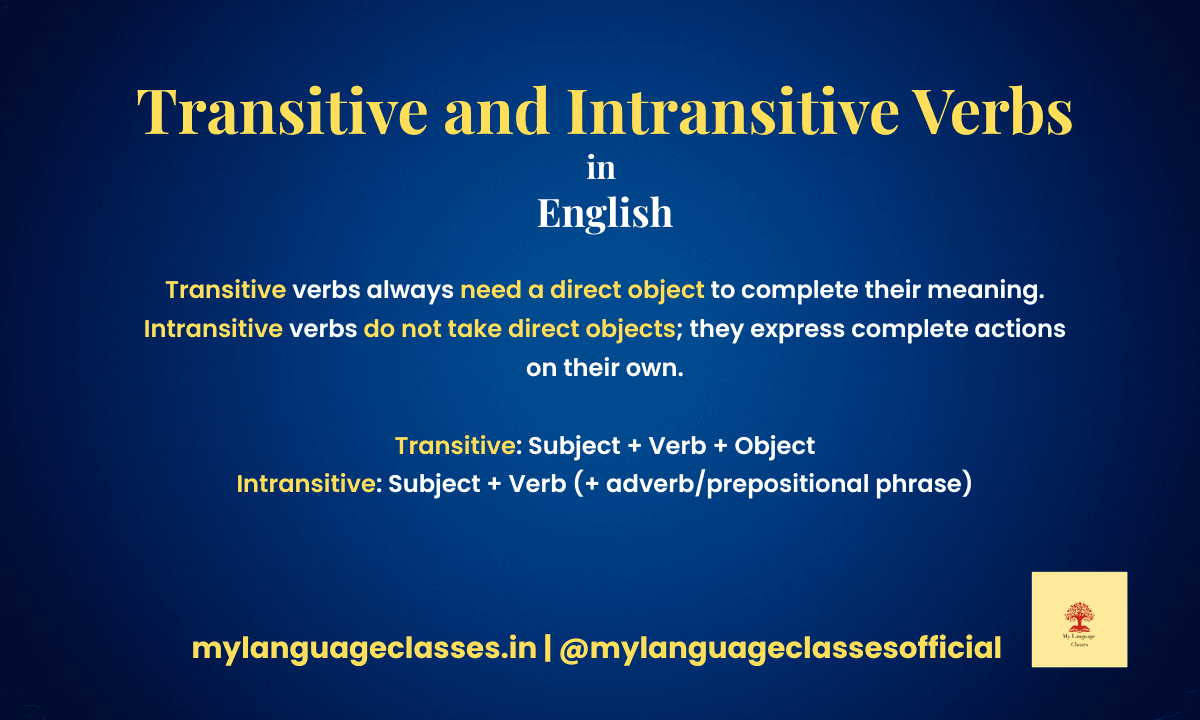
Transitive and intransitive verbs in English are two major categories of verbs that determine how actions function within a sentence. The distinction between them is based on one key question: does the verb require a direct object to complete its meaning?
A transitive verb requires a direct object. The action performed by the subject transfers to a person, thing, place, or idea that receives the action.
Examples:
→ She bought a laptop.
→ They watched a movie.
→ We completed the project.
In each sentence, the action moves from the subject to an object. The words laptop, movie, and project receive the action of the verb.
An intransitive verb, on the other hand, does not require a direct object. The action remains with the subject, and the sentence is complete without an object.
Examples:
→ The baby cried.
→ We arrived.
→ She laughed.
→ They slept.
These sentences express complete thoughts even though no direct object is present.
Because of this distinction, verbs in English are often classified according to whether they need a direct object. Understanding this classification is one of the most important steps in mastering English sentence structure because it affects how sentences are formed, how objects function, how passive voice works, and how meaning is conveyed.
At the center of this topic is the concept of the direct object. A direct object receives the action of a transitive verb. If you can identify the direct object in a sentence, you can often determine whether the verb is being used transitively. If no direct object exists and the sentence is still complete, the verb is likely functioning intransitively.
The distinction is not always straightforward because some English verbs can function as both transitive and intransitive verbs depending on how they are used.
Consider the verb read:
→ She read the newspaper. (Transitive)
→ She read for an hour. (Intransitive)
In the first sentence, newspaper is the direct object. In the second sentence, no direct object is present, so the verb functions differently.
The same pattern can be seen with many common English verbs:
→ He ate lunch. (Transitive)
→ He ate early. (Intransitive)
→ She wrote a report. (Transitive)
→ She wrote all evening. (Intransitive)
→ They cooked dinner. (Transitive)
→ They cooked together. (Intransitive)
This flexibility makes understanding verb classification especially important for learners who want to analyze sentences accurately and use English naturally.
In this comprehensive guide, you will learn what transitive and intransitive verbs are, how direct objects work, how to identify each verb type, the key differences between them, common examples used in everyday English, verbs that can belong to both categories, direct and indirect objects, passive voice relationships, common learner mistakes, and detailed sentence analysis. By the end of the article, you will have a complete understanding of how transitive and intransitive verbs function in English grammar.
| Verb Type | Direct Object Required | Example |
|---|---|---|
| Transitive Verb | Yes | She bought a laptop. |
| Transitive Verb | Yes | They watched a movie. |
| Transitive Verb | Yes | We completed the project. |
| Intransitive Verb | No | The baby cried. |
| Intransitive Verb | No | We arrived. |
| Intransitive Verb | No | She laughed. |
Understanding this simple distinction provides the foundation for everything else you will learn about transitive and intransitive verbs throughout this guide.
What Are Transitive and Intransitive Verbs in English?
English verbs can be classified into different categories based on how they function within a sentence. One of the most important classifications is the distinction between transitive and intransitive verbs.
This distinction is based on whether a verb requires a direct object to complete its meaning. Some verbs transfer their action to an object, while others express a complete action without needing one.
Understanding this difference helps you analyze sentence structure, identify direct objects correctly, avoid common grammar mistakes, and use English more accurately in both speaking and writing.
Definition of a Transitive Verb
A transitive verb is a verb that requires a direct object. The action performed by the subject passes to a person, thing, place, or idea that receives the action.
In other words, a transitive verb transfers its action to an object.
Consider the following examples:
→ She bought a laptop.
→ They watched a movie.
→ We completed the project.
→ He answered the question.
→ I opened the window.
In each sentence, the verb performs an action that affects something else.
Let’s identify the objects:
| Sentence | Verb | Direct Object |
|---|---|---|
| She bought a laptop. | bought | laptop |
| They watched a movie. | watched | movie |
| We completed the project. | completed | project |
| He answered the question. | answered | question |
| I opened the window. | opened | window |
Notice that the object receives the action of the verb.
For example:
→ She bought what? → a laptop
→ They watched what? → a movie
→ He answered what? → the question
The answers to these questions are the direct objects.
Without the object, the meaning is often incomplete.
Compare:
→ She bought. ❌
→ She bought a laptop. ✅
→ They watched. ❌
→ They watched a movie. ✅
→ He answered. ❌
→ He answered the question. ✅
The direct object completes the meaning of the transitive verb.
How Action Transfers to an Object
One useful way to understand transitive verbs is to think of the action moving from the subject to an object.
Consider this sentence:
→ Maria kicked the ball.
The action begins with Maria and moves to the ball.
Visualized:
Maria → kicked → ball
Another example:
→ The teacher explained the lesson.
Visualized:
Teacher → explained → lesson
Another example:
→ The company launched a new product.
Visualized:
Company → launched → product
This transfer of action is the defining characteristic of transitive verbs.
Examples:
| Subject | Verb | Object |
|---|---|---|
| Maria | kicked | the ball |
| The teacher | explained | the lesson |
| The company | launched | a new product |
| John | repaired | the bicycle |
| Sarah | wrote | a report |
In each sentence, the object receives the action.
Basic Examples of Transitive Verbs
Here are additional examples of transitive verbs used in complete sentences:
→ She cleaned the room.
→ He repaired the car.
→ They discussed the proposal.
→ We organized the event.
→ I signed the contract.
→ She prepared dinner.
→ He carried the bags.
→ They built a house.
→ We solved the problem.
→ I sent an email.
Table analysis:
| Sentence | Transitive Verb | Direct Object |
|---|---|---|
| She cleaned the room. | cleaned | room |
| He repaired the car. | repaired | car |
| They discussed the proposal. | discussed | proposal |
| We organized the event. | organized | event |
| I signed the contract. | signed | contract |
| She prepared dinner. | prepared | dinner |
| He carried the bags. | carried | bags |
| They built a house. | built | house |
| We solved the problem. | solved | problem |
| I sent an email. | sent |
Definition of an Intransitive Verb
An intransitive verb is a verb that does not require a direct object.
The action remains with the subject and does not transfer to another person or thing.
Examples:
→ The baby cried.
→ We arrived.
→ She laughed.
→ They slept.
→ He smiled.
These sentences are complete without any direct object.
Let’s analyze them:
| Sentence | Verb | Direct Object |
|---|---|---|
| The baby cried. | cried | None |
| We arrived. | arrived | None |
| She laughed. | laughed | None |
| They slept. | slept | None |
| He smiled. | smiled | None |
Unlike transitive verbs, there is no object receiving the action.
How Action Remains with the Subject
The defining characteristic of an intransitive verb is that the action stays with the subject.
Consider:
→ The baby cried.
The action begins and ends with the baby.
Visualized:
Baby → cried
Another example:
→ The audience laughed.
Visualized:
Audience → laughed
Another example:
→ The train arrived.
Visualized:
Train → arrived
There is no object receiving the action.
Compare these with transitive verbs:
| Transitive Sentence | Action Receiver |
|---|---|
| She bought a laptop. | laptop |
| He repaired the bicycle. | bicycle |
| They watched a movie. | movie |
Now compare intransitive verbs:
| Intransitive Sentence | Action Receiver |
|---|---|
| The baby cried. | None |
| We arrived. | None |
| She laughed. | None |
The action remains with the subject.
Basic Examples of Intransitive Verbs
Here are additional examples:
→ The flowers bloomed.
→ The leaves fell.
→ The patient recovered.
→ The audience applauded.
→ The sun rose.
→ The meeting ended.
→ The guests arrived.
→ The dog barked.
→ The children played.
→ The train departed.
Table analysis:
| Sentence | Intransitive Verb | Direct Object |
|---|---|---|
| The flowers bloomed. | bloomed | None |
| The leaves fell. | fell | None |
| The patient recovered. | recovered | None |
| The audience applauded. | applauded | None |
| The sun rose. | rose | None |
| The meeting ended. | ended | None |
| The guests arrived. | arrived | None |
| The dog barked. | barked | None |
| The children played. | played | None |
| The train departed. | departed | None |
The Fundamental Difference Between the Two
The fundamental difference between transitive and intransitive verbs is whether the action moves beyond the subject to a direct object.
Transitive verbs transfer action.
Intransitive verbs do not transfer action.
Compare:
→ She wrote a report.
→ The direct object is report.
→ The action transfers from the subject to the report.
Now compare:
→ She wrote all evening.
→ No direct object is present.
→ The action remains with the subject.
The same verb can sometimes function in both ways.
Examples:
| Verb | Transitive Example | Intransitive Example |
|---|---|---|
| read | She read the newspaper. | She read for an hour. |
| write | He wrote a report. | He wrote all evening. |
| eat | They ate lunch. | They ate early. |
| drive | She drove the car. | She drove carefully. |
| sing | He sang a song. | He sang beautifully. |
The Sentence Structure Difference
The difference can also be seen through sentence structure.
Transitive verbs usually follow this pattern:
Subject + Verb + Direct Object
Examples:
→ Sarah wrote a report.
→ John repaired the bicycle.
→ The company launched a product.
Intransitive verbs usually follow this pattern:
Subject + Verb
Examples:
→ Sarah laughed.
→ John arrived.
→ The company expanded.
Comparison:
| Structure | Example |
|---|---|
| Subject + Verb + Object | She bought a laptop. |
| Subject + Verb + Object | They watched a movie. |
| Subject + Verb + Object | We completed the project. |
| Subject + Verb | The baby cried. |
| Subject + Verb | She laughed. |
| Subject + Verb | They arrived. |
Comparison Table
| Feature | Transitive | Intransitive |
|---|---|---|
| Requires a direct object | Yes | No |
| Action transfers to an object | Yes | No |
| Object receives the action | Yes | No |
| Can answer “what?” or “whom?” after the verb | Usually yes | Usually no |
| Typical structure | Subject + Verb + Object | Subject + Verb |
| Complete without an object | Usually no | Yes |
| Examples | buy, write, watch, complete, answer | arrive, sleep, laugh, cry, smile |
| Action remains with the subject | No | Yes |
| Action moves beyond the subject | Yes | No |
Understanding this distinction is the foundation for identifying direct objects, analyzing sentence structure, recognizing passive voice patterns, and determining how English verbs function in real communication.
Understanding the Role of Direct Objects
If transitive and intransitive verbs are the main topic of this article, then direct objects are the foundation on which the entire topic is built.
In fact, the easiest and most reliable way to distinguish between transitive and intransitive verbs is to understand what a direct object is and how it functions within a sentence.
A transitive verb requires a direct object.
An intransitive verb does not.
Because of this relationship, direct objects play a central role in English sentence structure, verb classification, passive voice formation, and grammatical analysis.
Before learning how to identify different types of verbs, it is important to understand exactly what a direct object is and how it works.
What Is a Direct Object?
A direct object is a noun, pronoun, noun phrase, or other word group that directly receives the action of a transitive verb.
The direct object answers the questions:
→ What?
→ Whom?
after the verb.
Consider the following sentence:
→ Sarah wrote a report.
Ask:
→ Sarah wrote what?
Answer:
→ a report
The phrase a report is the direct object because it receives the action of the verb wrote.
Another example:
→ The teacher praised the student.
Ask:
→ The teacher praised whom?
Answer:
→ the student
The student is the direct object.
Examples:
| Sentence | Verb | Direct Object |
|---|---|---|
| Sarah wrote a report. | wrote | a report |
| The teacher praised the student. | praised | the student |
| John repaired the bicycle. | repaired | the bicycle |
| They watched a movie. | watched | a movie |
| We completed the project. | completed | the project |
In every sentence, the direct object receives the action of the verb.
Without the direct object, many of these sentences feel incomplete.
Compare:
→ Sarah wrote. ❌
→ Sarah wrote a report. ✅
→ They watched. ❌
→ They watched a movie. ✅
→ We completed. ❌
→ We completed the project. ✅
The direct object completes the meaning of the transitive verb.
How Direct Objects Receive the Action
A direct object receives the action that originates from the subject and is performed through the verb.
Think of the sentence as a chain of action:
Subject → Verb → Object
Example:
→ Maria kicked the ball.
The action begins with Maria.
The verb kicked expresses the action.
The ball receives the action.
Visual representation:
Maria → kicked → ball
Another example:
→ The company launched a new product.
Visual representation:
Company → launched → product
Another example:
→ The chef prepared dinner.
Visual representation:
Chef → prepared → dinner
Table analysis:
| Subject | Verb | Direct Object |
|---|---|---|
| Maria | kicked | the ball |
| Company | launched | a new product |
| Chef | prepared | dinner |
| Teacher | explained | the lesson |
| Doctor | examined | the patient |
The action flows from left to right.
This transfer of action is what makes these verbs transitive.
Now compare an intransitive verb:
→ The baby cried.
Visual representation:
Baby → cried
There is no object receiving the action.
Another example:
→ We arrived.
Visual representation:
We → arrived
Again, no object receives the action.
This difference is the primary distinction between transitive and intransitive verbs.
Questions Used to Find Direct Objects
The easiest way to locate a direct object is to ask specific questions after the verb.
The two most important questions are:
→ What?
→ Whom?
If the sentence provides an answer, that answer is usually the direct object.
Using “What?”
Examples:
→ She bought a laptop.
Question:
→ She bought what?
Answer:
→ a laptop
→ They watched a movie.
Question:
→ They watched what?
Answer:
→ a movie
→ We completed the assignment.
Question:
→ We completed what?
Answer:
→ the assignment
Table:
| Sentence | Question | Answer |
|---|---|---|
| She bought a laptop. | Bought what? | a laptop |
| They watched a movie. | Watched what? | a movie |
| We completed the assignment. | Completed what? | the assignment |
| He repaired the car. | Repaired what? | the car |
| I signed the contract. | Signed what? | the contract |
The answers are direct objects.
Using “Whom?”
Examples:
→ The manager praised the employee.
Question:
→ The manager praised whom?
Answer:
→ the employee
→ The coach encouraged the players.
Question:
→ The coach encouraged whom?
Answer:
→ the players
→ The teacher helped the students.
Question:
→ The teacher helped whom?
Answer:
→ the students
Table:
| Sentence | Question | Answer |
|---|---|---|
| The manager praised the employee. | Praised whom? | the employee |
| The coach encouraged the players. | Encouraged whom? | the players |
| The teacher helped the students. | Helped whom? | the students |
| The company hired new workers. | Hired whom? | new workers |
| The doctor treated the patient. | Treated whom? | the patient |
Again, the answers are direct objects.
What Happens When There Is No Answer?
Now examine some intransitive verbs.
→ The baby cried.
Question:
→ Cried what?
Answer:
→ No answer
→ We arrived.
Question:
→ Arrived what?
Answer:
→ No answer
→ She laughed.
Question:
→ Laughed whom?
Answer:
→ No answer
Table:
| Sentence | Question | Answer |
|---|---|---|
| The baby cried. | Cried what? | No answer |
| We arrived. | Arrived what? | No answer |
| She laughed. | Laughed whom? | No answer |
| They slept. | Slept what? | No answer |
| He smiled. | Smiled whom? | No answer |
Since there is no direct object, these verbs are intransitive.
Direct Objects vs Other Sentence Elements
Many learners assume that every word appearing after a verb must be a direct object.
This is one of the most common mistakes in English grammar.
Words and phrases can appear after a verb for many reasons:
→ Direct object
→ Adverb
→ Prepositional phrase
→ Complement
→ Time expression
→ Place expression
Only one of these is a direct object.
Consider the following examples.
| Element | Example | Direct Object? |
|---|---|---|
| Direct Object | She opened the door. | Yes |
| Direct Object | They watched a movie. | Yes |
| Adverb | He slept peacefully. | No |
| Time Expression | She arrived yesterday. | No |
| Place Expression | They stayed in London. | No |
| Prepositional Phrase | We arrived at the station. | No |
| Complement | She became a doctor. | No |
Let’s examine these in detail.
Direct Objects
Examples:
→ She opened the door.
→ They watched a movie.
→ We completed the assignment.
The words door, movie, and assignment receive the action.
These are direct objects.
Adverbs
Examples:
→ He slept peacefully.
→ She laughed loudly.
→ They worked efficiently.
The words peacefully, loudly, and efficiently describe how the action happened.
They do not receive the action.
Therefore, they are not direct objects.
Time Expressions
Examples:
→ She arrived yesterday.
→ They left last week.
→ We met this morning.
The expressions yesterday, last week, and this morning indicate time.
They are not direct objects.
Place Expressions
Examples:
→ They stayed in London.
→ She lives in New York.
→ We traveled across Europe.
These expressions indicate location.
They are not direct objects.
Prepositional Phrases
Examples:
→ We arrived at the station.
→ She walked through the park.
→ They listened to the teacher.
The phrases at the station, through the park, and to the teacher are prepositional phrases.
Because the noun follows a preposition, it cannot be a direct object.
Subject Complements
Examples:
→ She became a doctor.
→ He remained calm.
→ They seemed happy.
The words doctor, calm, and happy describe the subject.
They do not receive the action of a verb.
Therefore, they are complements, not direct objects.
Quick Comparison Table
| Sentence | Word After Verb | Direct Object? |
|---|---|---|
| She bought a laptop. | laptop | Yes |
| They watched a movie. | movie | Yes |
| He repaired the car. | car | Yes |
| She laughed loudly. | loudly | No |
| We arrived yesterday. | yesterday | No |
| They stayed in London. | in London | No |
| She became a doctor. | a doctor | No |
| We arrived at the station. | at the station | No |
| He slept peacefully. | peacefully | No |
| They listened to the teacher. | to the teacher | No |
Understanding direct objects is the single most important skill for identifying transitive and intransitive verbs. Once you can reliably recognize whether a direct object is present, determining the type of verb becomes much easier and more accurate.
Understanding the Structure of English Sentences
Before learning how to identify transitive and intransitive verbs, it is important to understand how English sentences are built. Every sentence follows a structure, and the position of the verb within that structure often determines whether an object is required.
Many learners struggle with verb classification because they focus only on the verb itself. In reality, verbs function as part of a larger sentence pattern. Understanding these patterns makes it much easier to recognize direct objects, identify verb types, and analyze sentence structure accurately.
At the most basic level, English sentences are built around two essential elements:
→ Subject
→ Verb
Everything else in the sentence expands upon this foundation.
The two most important sentence patterns for understanding transitive and intransitive verbs are:
→ Subject + Verb
→ Subject + Verb + Object
These two patterns form the basis of most English sentences.
Subject + Verb
The simplest complete sentence in English consists of a subject and a verb.
Structure:
Subject + Verb
The subject performs the action, and the verb expresses that action.
Examples:
→ The baby cried.
→ We arrived.
→ She laughed.
→ They slept.
→ He smiled.
In these examples, the sentence is complete even though no object follows the verb.
Analysis:
| Subject | Verb |
|---|---|
| The baby | cried |
| We | arrived |
| She | laughed |
| They | slept |
| He | smiled |
Notice that the action begins and ends with the subject.
Example:
→ The baby cried.
The action does not move to another person or thing.
Another example:
→ They slept.
Nothing receives the action.
The sentence is complete exactly as it is.
Many intransitive verbs commonly appear in this structure.
Examples:
→ The train departed.
→ The flowers bloomed.
→ The audience applauded.
→ The patient recovered.
→ The sun rose.
Table:
| Sentence | Structure |
|---|---|
| The baby cried. | Subject + Verb |
| We arrived. | Subject + Verb |
| She laughed. | Subject + Verb |
| The train departed. | Subject + Verb |
| The flowers bloomed. | Subject + Verb |
| The patient recovered. | Subject + Verb |
| The audience applauded. | Subject + Verb |
| The sun rose. | Subject + Verb |
These sentences demonstrate the most common structure used with intransitive verbs.
Subject + Verb + Object
Many English verbs cannot form a complete sentence without an object.
These verbs follow a different pattern:
Subject + Verb + Object
The object receives the action of the verb.
Examples:
→ She bought a laptop.
→ They watched a movie.
→ We completed the project.
→ He repaired the bicycle.
→ I answered the question.
Analysis:
| Subject | Verb | Object |
|---|---|---|
| She | bought | a laptop |
| They | watched | a movie |
| We | completed | the project |
| He | repaired | the bicycle |
| I | answered | the question |
Unlike the Subject + Verb pattern, these sentences depend on an object to complete their meaning.
Compare:
→ She bought. ❌
→ She bought a laptop. ✅
→ They watched. ❌
→ They watched a movie. ✅
→ We completed. ❌
→ We completed the project. ✅
The object completes the action.
Without it, the sentence sounds incomplete or unnatural.
Many transitive verbs commonly appear in this pattern.
Examples:
→ The teacher explained the lesson.
→ Sarah wrote a report.
→ The company launched a product.
→ John carried the bags.
→ The chef prepared dinner.
Table:
| Sentence | Structure |
|---|---|
| The teacher explained the lesson. | Subject + Verb + Object |
| Sarah wrote a report. | Subject + Verb + Object |
| The company launched a product. | Subject + Verb + Object |
| John carried the bags. | Subject + Verb + Object |
| The chef prepared dinner. | Subject + Verb + Object |
These sentences illustrate the most common structure used with transitive verbs.
Why Some Sentences Need Objects and Others Do Not
This question lies at the heart of understanding transitive and intransitive verbs.
Some actions naturally affect something else.
For example:
→ She opened the door.
The action of opening affects the door.
→ He repaired the car.
The action of repairing affects the car.
→ They watched a movie.
The action of watching affects the movie.
Because the action transfers to an object, these verbs require one.
Visual representation:
She → opened → door
He → repaired → car
They → watched → movie
These are transitive verb structures.
Other actions do not transfer to an object.
Examples:
→ The baby cried.
→ We arrived.
→ She laughed.
→ The flowers bloomed.
→ The train departed.
The action remains with the subject.
Visual representation:
Baby → cried
We → arrived
Flowers → bloomed
Train → departed
No object receives the action.
Therefore, these verbs do not require one.
These are intransitive verb structures.
Comparing the Two Sentence Patterns
The difference becomes clearer when the two structures are viewed side by side.
| Structure | Example |
|---|---|
| Subject + Verb | The baby cried. |
| Subject + Verb | We arrived. |
| Subject + Verb | She laughed. |
| Subject + Verb | They slept. |
| Subject + Verb | The flowers bloomed. |
| Subject + Verb + Object | She bought a laptop. |
| Subject + Verb + Object | They watched a movie. |
| Subject + Verb + Object | We completed the project. |
| Subject + Verb + Object | He repaired the bicycle. |
| Subject + Verb + Object | I answered the question. |
Sentences Can Be Expanded
A common misconception is that any word appearing after a verb must be an object.
This is not true.
Even intransitive verbs can be followed by additional information.
Examples:
→ She laughed loudly.
→ We arrived yesterday.
→ They traveled across Europe.
→ The baby slept peacefully.
→ He worked all night.
These sentences still follow an intransitive pattern because the words after the verb are not direct objects.
Analysis:
| Sentence | Word After Verb | Direct Object? |
|---|---|---|
| She laughed loudly. | loudly | No |
| We arrived yesterday. | yesterday | No |
| They traveled across Europe. | across Europe | No |
| The baby slept peacefully. | peacefully | No |
| He worked all night. | all night | No |
The verb remains intransitive because nothing receives the action.
Sentence Structure and Verb Classification
Understanding sentence structure provides a practical method for identifying verb types.
When analyzing a sentence:
→ Find the subject.
→ Find the verb.
→ Look for a direct object.
→ Determine whether the action transfers to that object.
If an object receives the action, the verb is transitive.
If no object receives the action and the sentence is complete, the verb is intransitive.
This simple process forms the basis for every section that follows and will be used repeatedly when examining transitive verbs, intransitive verbs, direct objects, indirect objects, passive voice, and sentence analysis throughout this guide.
How to Identify a Transitive Verb
One of the most important grammar skills in English is the ability to identify whether a verb is transitive or intransitive. Fortunately, identifying a transitive verb is usually straightforward once you understand the role of direct objects.
A transitive verb transfers its action to a person, thing, place, or idea that receives that action. Therefore, the key to identifying a transitive verb is finding the direct object.
Rather than memorizing long lists of verbs, it is more effective to learn a systematic method that can be applied to any sentence.
Step-by-Step Identification Method
When analyzing a sentence, follow these steps:
→ Find the subject.
→ Find the verb.
→ Ask “What?” or “Whom?” after the verb.
→ Look for a direct object.
→ Determine whether the object receives the action.
If the sentence contains a direct object receiving the action, the verb is transitive.
Let’s see how this works.
Example 1:
→ Sarah wrote a report.
Step 1:
Subject = Sarah
Step 2:
Verb = wrote
Step 3:
Ask:
→ Sarah wrote what?
Answer:
→ a report
Step 4:
The report receives the action.
Conclusion:
→ Wrote is a transitive verb.
Example 2:
→ The teacher praised the student.
Step 1:
Subject = teacher
Step 2:
Verb = praised
Step 3:
Ask:
→ Praised whom?
Answer:
→ the student
Conclusion:
→ Praised is a transitive verb.
Example 3:
→ We completed the project.
Ask:
→ Completed what?
Answer:
→ the project
Conclusion:
→ Completed is a transitive verb.
This process works for nearly every transitive verb in English.
Looking for the Receiver of the Action
Another reliable way to identify a transitive verb is to determine whether something receives the action.
Every transitive verb involves three components:
→ Subject
→ Verb
→ Receiver of the action
Examples:
→ Maria kicked the ball.
The ball receives the action.
→ The company launched a product.
The product receives the action.
→ The chef prepared dinner.
Dinner receives the action.
Visual representation:
Maria → kicked → ball
Company → launched → product
Chef → prepared → dinner
Table analysis:
| Subject | Verb | Receiver of Action |
|---|---|---|
| Maria | kicked | the ball |
| Company | launched | a product |
| Chef | prepared | dinner |
| Teacher | explained | the lesson |
| Doctor | examined | the patient |
Whenever you can clearly identify a receiver of the action, you are usually dealing with a transitive verb.
Now compare:
→ The baby cried.
Who or what receives the action?
→ No one.
→ Nothing.
Therefore, cried is not functioning as a transitive verb.
Another example:
→ We arrived.
Who or what receives the action?
→ No one.
→ Nothing.
Again, there is no receiver of the action.
This distinction provides a simple test for identifying verb types.
Asking the Right Questions
The most effective questions for finding direct objects are:
→ What?
→ Whom?
Ask these questions immediately after the verb.
Using “What?”
Examples:
→ She bought a laptop.
Question:
→ Bought what?
Answer:
→ a laptop
→ They watched a movie.
Question:
→ Watched what?
Answer:
→ a movie
→ We completed the assignment.
Question:
→ Completed what?
Answer:
→ the assignment
→ He repaired the car.
Question:
→ Repaired what?
Answer:
→ the car
→ I signed the contract.
Question:
→ Signed what?
Answer:
→ the contract
Using “Whom?”
Examples:
→ The manager praised the employee.
Question:
→ Praised whom?
Answer:
→ the employee
→ The coach encouraged the players.
Question:
→ Encouraged whom?
Answer:
→ the players
→ The teacher helped the students.
Question:
→ Helped whom?
Answer:
→ the students
→ The company hired new workers.
Question:
→ Hired whom?
Answer:
→ new workers
→ The doctor treated the patient.
Question:
→ Treated whom?
Answer:
→ the patient
Whenever these questions produce a clear answer, the answer is usually the direct object and the verb is transitive.
Common Sentence Patterns
Most transitive verbs appear in recognizable sentence patterns.
Subject + Verb + Noun
Examples:
→ She bought a laptop.
→ They watched a movie.
→ We completed a project.
Subject + Verb + Pronoun
Examples:
→ She helped him.
→ I called her.
→ They invited us.
Subject + Verb + Noun Phrase
Examples:
→ He repaired the old bicycle.
→ They organized the annual conference.
→ We completed the final assignment.
Subject + Verb + Proper Noun
Examples:
→ They visited Paris.
→ We contacted Microsoft.
→ She called Sarah.
Table:
| Pattern | Example |
|---|---|
| Subject + Verb + Noun | She bought a laptop. |
| Subject + Verb + Pronoun | I called her. |
| Subject + Verb + Noun Phrase | He repaired the old bicycle. |
| Subject + Verb + Proper Noun | They visited Paris. |
These patterns frequently indicate transitive verb usage.
Large Analysis Table
The following examples demonstrate how to identify transitive verbs using direct objects.
| Sentence | Verb | Direct Object | Transitive? |
|---|---|---|---|
| She bought a laptop. | bought | a laptop | Yes |
| They watched a movie. | watched | a movie | Yes |
| We completed the project. | completed | the project | Yes |
| He repaired the bicycle. | repaired | the bicycle | Yes |
| I answered the question. | answered | the question | Yes |
| She opened the window. | opened | the window | Yes |
| They visited Paris. | visited | Paris | Yes |
| We discussed the proposal. | discussed | the proposal | Yes |
| He signed the contract. | signed | the contract | Yes |
| I sent an email. | sent | an email | Yes |
| The teacher explained the lesson. | explained | the lesson | Yes |
| The company launched a product. | launched | a product | Yes |
| She prepared dinner. | prepared | dinner | Yes |
| They organized the event. | organized | the event | Yes |
| We solved the problem. | solved | the problem | Yes |
| He carried the bags. | carried | the bags | Yes |
| The doctor treated the patient. | treated | the patient | Yes |
| The manager praised the employee. | praised | the employee | Yes |
| The coach encouraged the players. | encouraged | the players | Yes |
| I read the article. | read | the article | Yes |
| She wrote a report. | wrote | a report | Yes |
| They built a house. | built | a house | Yes |
| We reviewed the document. | reviewed | the document | Yes |
| He translated the sentence. | translated | the sentence | Yes |
| The professor taught grammar. | taught | grammar | Yes |
Quick Recognition Strategy
When examining any sentence, remember this sequence:
→ Identify the verb.
→ Ask “What?” or “Whom?” after the verb.
→ Find the receiver of the action.
→ Confirm that the object receives the action directly.
→ If a direct object exists, the verb is transitive.
This method works consistently across simple sentences, complex sentences, academic writing, workplace communication, and everyday English, making it the most reliable way to identify transitive verbs.
How to Identify an Intransitive Verb
Just as direct objects help identify transitive verbs, the absence of a direct object is one of the strongest indicators that a verb is functioning intransitively.
An intransitive verb expresses a complete action without transferring that action to a person, thing, place, or idea. The action begins and ends with the subject, and no direct object is required to complete the meaning.
Many learners mistakenly assume that every action verb needs an object. However, some of the most common English verbs are intransitive and form complete sentences on their own.
Learning how to identify intransitive verbs will help you analyze sentence structure more accurately and distinguish them from transitive verbs that require direct objects.
Step-by-Step Identification Method
The easiest way to identify an intransitive verb is to follow a systematic process.
Step 1:
→ Find the subject.
Step 2:
→ Find the verb.
Step 3:
→ Ask “What?” or “Whom?” after the verb.
Step 4:
→ Look for a direct object.
Step 5:
→ Determine whether the sentence remains complete without one.
If there is no direct object and the sentence expresses a complete thought, the verb is functioning intransitively.
Example 1:
→ The baby cried.
Step 1:
Subject = The baby
Step 2:
Verb = cried
Step 3:
Ask:
→ Cried what?
Answer:
→ No answer
Step 4:
No direct object exists.
Conclusion:
→ Cried is an intransitive verb.
Example 2:
→ We arrived.
Ask:
→ Arrived what?
Answer:
→ No answer
Conclusion:
→ Arrived is an intransitive verb.
Example 3:
→ She laughed.
Ask:
→ Laughed whom?
Answer:
→ No answer
Conclusion:
→ Laughed is an intransitive verb.
This method works for most intransitive verbs in English.
Recognizing Complete Actions
One of the defining characteristics of an intransitive verb is that it expresses a complete action without requiring anything else.
Consider the following sentences:
→ The baby cried.
→ She laughed.
→ We arrived.
→ They slept.
→ He smiled.
Each sentence communicates a complete idea.
Nothing is missing.
No additional object is necessary.
Table analysis:
| Sentence | Complete Without Object? |
|---|---|
| The baby cried. | Yes |
| She laughed. | Yes |
| We arrived. | Yes |
| They slept. | Yes |
| He smiled. | Yes |
Now compare these with transitive verbs:
→ She bought.
→ They watched.
→ We completed.
These sentences feel incomplete because the action needs a receiver.
Compare:
| Sentence | Complete? |
|---|---|
| She bought. | No |
| They watched. | No |
| We completed. | No |
| He repaired. | No |
| I answered. | No |
The need for a direct object is what separates transitive verbs from intransitive verbs.
With intransitive verbs, the action is already complete.
Examples:
→ The flowers bloomed.
→ The audience applauded.
→ The patient recovered.
→ The train departed.
→ The meeting ended.
Each sentence stands on its own.
Identifying Sentences Without Direct Objects
Many learners believe that if words appear after a verb, the verb cannot be intransitive.
This is incorrect.
An intransitive verb can be followed by many types of sentence elements without becoming transitive.
Examples:
→ She laughed loudly.
→ We arrived yesterday.
→ They traveled across Europe.
→ He slept peacefully.
→ The guests arrived late.
Words such as loudly, yesterday, across Europe, peacefully, and late provide additional information, but they are not direct objects.
Analysis:
| Sentence | Word After Verb | Direct Object? |
|---|---|---|
| She laughed loudly. | loudly | No |
| We arrived yesterday. | yesterday | No |
| They traveled across Europe. | across Europe | No |
| He slept peacefully. | peacefully | No |
| The guests arrived late. | late | No |
The verbs remain intransitive because nothing receives the action.
Let’s examine more examples:
→ The children played outside.
→ She smiled warmly.
→ We traveled during the summer.
→ The patient recovered quickly.
→ The audience applauded enthusiastically.
Again, none of the words after the verb function as direct objects.
Table:
| Sentence | Direct Object Present? |
|---|---|
| The children played outside. | No |
| She smiled warmly. | No |
| We traveled during the summer. | No |
| The patient recovered quickly. | No |
| The audience applauded enthusiastically. | No |
This is why identifying direct objects is more important than simply looking for words after a verb.
Common Sentence Patterns
Most intransitive verbs appear in a limited number of sentence patterns.
Subject + Verb
Examples:
→ The baby cried.
→ We arrived.
→ She laughed.
→ They slept.
→ He smiled.
Subject + Verb + Adverb
Examples:
→ She laughed loudly.
→ He smiled warmly.
→ They worked efficiently.
→ We traveled frequently.
→ The patient recovered quickly.
Subject + Verb + Time Expression
Examples:
→ We arrived yesterday.
→ They left last week.
→ She graduated last year.
→ The meeting ended early.
→ He retired recently.
Subject + Verb + Place Expression
Examples:
→ They stayed in London.
→ She lives in Canada.
→ We traveled across Europe.
→ He walked through the park.
→ The guests arrived at the hotel.
Subject + Verb + Prepositional Phrase
Examples:
→ We arrived at the station.
→ She walked through the park.
→ They listened to the teacher.
→ He reacted to the news.
→ The children played in the garden.
Table:
| Pattern | Example |
|---|---|
| Subject + Verb | The baby cried. |
| Subject + Verb + Adverb | She laughed loudly. |
| Subject + Verb + Time Expression | We arrived yesterday. |
| Subject + Verb + Place Expression | They stayed in London. |
| Subject + Verb + Prepositional Phrase | We arrived at the station. |
These patterns frequently indicate intransitive verb usage.
Large Analysis Table
The following examples demonstrate how to identify intransitive verbs by checking whether a direct object is present.
| Sentence | Verb | Direct Object | Intransitive? |
|---|---|---|---|
| The baby cried. | cried | None | Yes |
| We arrived. | arrived | None | Yes |
| She laughed. | laughed | None | Yes |
| They slept. | slept | None | Yes |
| He smiled. | smiled | None | Yes |
| The flowers bloomed. | bloomed | None | Yes |
| The leaves fell. | fell | None | Yes |
| The patient recovered. | recovered | None | Yes |
| The audience applauded. | applauded | None | Yes |
| The sun rose. | rose | None | Yes |
| The train departed. | departed | None | Yes |
| The meeting ended. | ended | None | Yes |
| The guests arrived. | arrived | None | Yes |
| The dog barked. | barked | None | Yes |
| The children played. | played | None | Yes |
| She laughed loudly. | laughed | None | Yes |
| We arrived yesterday. | arrived | None | Yes |
| They traveled across Europe. | traveled | None | Yes |
| He slept peacefully. | slept | None | Yes |
| The audience cheered enthusiastically. | cheered | None | Yes |
| The company expanded rapidly. | expanded | None | Yes |
| Sales increased significantly. | increased | None | Yes |
| The workers cooperated fully. | cooperated | None | Yes |
| The conference began. | began | None | Yes |
| The ceremony concluded successfully. | concluded | None | Yes |
Quick Recognition Strategy
When examining a sentence, use the following sequence:
→ Find the verb.
→ Ask “What?” or “Whom?” after the verb.
→ Look for a direct object.
→ Check whether the action transfers to something else.
→ Determine whether the sentence is complete without an object.
If no direct object exists and the sentence still expresses a complete thought, the verb is functioning as an intransitive verb.
This method provides a reliable way to identify intransitive verbs across everyday conversations, academic writing, workplace communication, and formal English grammar analysis.
Key Differences Between Transitive and Intransitive Verbs
Although transitive and intransitive verbs are both used to express actions, they function in fundamentally different ways within a sentence. Understanding these differences is essential because they affect sentence structure, object usage, passive voice formation, and grammatical analysis.
Many learners can identify simple examples such as “She bought a laptop” and “She laughed,” but difficulties often arise when sentences become longer or more complex. By examining the major differences systematically, it becomes much easier to classify verbs accurately.
Direct Object Requirement
The most important difference between transitive and intransitive verbs is the direct object.
A transitive verb requires a direct object because the action must be transferred to someone or something.
Examples:
→ She bought a laptop.
→ They watched a movie.
→ We completed the project.
→ He repaired the bicycle.
→ I answered the question.
In each sentence, the direct object receives the action.
Analysis:
| Sentence | Verb | Direct Object |
|---|---|---|
| She bought a laptop. | bought | laptop |
| They watched a movie. | watched | movie |
| We completed the project. | completed | project |
| He repaired the bicycle. | repaired | bicycle |
| I answered the question. | answered | question |
Now compare intransitive verbs.
Examples:
→ The baby cried.
→ We arrived.
→ She laughed.
→ They slept.
→ He smiled.
These sentences do not require direct objects.
Analysis:
| Sentence | Verb | Direct Object |
|---|---|---|
| The baby cried. | cried | None |
| We arrived. | arrived | None |
| She laughed. | laughed | None |
| They slept. | slept | None |
| He smiled. | smiled | None |
This direct-object requirement is the primary distinction between the two verb types.
Sentence Structure Differences
Because transitive verbs require direct objects, they usually appear in a different sentence pattern from intransitive verbs.
The most common structure for transitive verbs is:
→ Subject + Verb + Object
Examples:
→ Sarah wrote a report.
→ John repaired the bicycle.
→ The company launched a product.
→ The teacher explained the lesson.
→ We solved the problem.
Table:
| Subject | Verb | Object |
|---|---|---|
| Sarah | wrote | a report |
| John | repaired | the bicycle |
| Company | launched | a product |
| Teacher | explained | the lesson |
| We | solved | the problem |
The most common structure for intransitive verbs is:
→ Subject + Verb
Examples:
→ Sarah laughed.
→ John arrived.
→ The company expanded.
→ The meeting ended.
→ The flowers bloomed.
Table:
| Subject | Verb |
|---|---|
| Sarah | laughed |
| John | arrived |
| Company | expanded |
| Meeting | ended |
| Flowers | bloomed |
However, intransitive verbs can still be followed by additional information.
Examples:
→ Sarah laughed loudly.
→ John arrived yesterday.
→ The company expanded rapidly.
→ The meeting ended early.
→ The flowers bloomed beautifully.
These words add information but do not function as direct objects.
Meaning Differences
Another important distinction involves meaning.
Transitive verbs describe actions that affect a person, thing, place, or idea.
Examples:
→ She opened the door.
→ He repaired the car.
→ They built a house.
→ We discussed the proposal.
→ I signed the contract.
In each sentence, something experiences the action.
Visual representation:
She → opened → door
He → repaired → car
They → built → house
The action moves beyond the subject.
Intransitive verbs function differently.
Examples:
→ She laughed.
→ He arrived.
→ They slept.
→ We traveled.
→ The flowers bloomed.
Visual representation:
She → laughed
He → arrived
They → slept
The action remains with the subject.
Nothing receives the action.
This difference explains why direct objects are necessary for transitive verbs but unnecessary for intransitive verbs.
Compare:
| Meaning Type | Example |
|---|---|
| Action affects something else | She opened the door. |
| Action affects something else | They built a house. |
| Action remains with the subject | She laughed. |
| Action remains with the subject | They slept. |
Passive Voice Differences
One of the most significant grammatical differences between transitive and intransitive verbs involves passive voice.
A passive sentence requires a direct object in the active sentence because that object becomes the subject of the passive sentence.
Because transitive verbs have direct objects, they can usually form passive constructions.
Examples:
Active:
→ She wrote a report.
Passive:
→ A report was written by her.
Active:
→ The company launched a product.
Passive:
→ A product was launched by the company.
Active:
→ The teacher praised the student.
Passive:
→ The student was praised by the teacher.
Table:
| Active Sentence | Passive Sentence |
|---|---|
| She wrote a report. | A report was written by her. |
| The company launched a product. | A product was launched by the company. |
| The teacher praised the student. | The student was praised by the teacher. |
| We completed the project. | The project was completed by us. |
| He repaired the bicycle. | The bicycle was repaired by him. |
Now consider intransitive verbs.
Examples:
→ The baby cried.
→ We arrived.
→ She laughed.
→ They slept.
These sentences have no direct object.
Since there is no object available to become the subject of a passive sentence, passive voice is generally impossible.
Incorrect examples:
→ The baby was cried. ❌
→ We were arrived. ❌
→ She was laughed. ❌
→ They were slept. ❌
These sentences are grammatically incorrect.
This is one of the quickest ways to distinguish transitive and intransitive verbs.
If a normal passive construction can be formed, the verb is probably transitive.
If passive voice is impossible because no direct object exists, the verb is likely intransitive.
Grammar Testing Methods
Several practical tests can be used to determine whether a verb is transitive or intransitive.
Test 1: Ask “What?” or “Whom?”
Examples:
→ She bought a laptop.
Question:
→ Bought what?
Answer:
→ a laptop
Result:
→ Transitive
Another example:
→ The baby cried.
Question:
→ Cried what?
Answer:
→ No answer
Result:
→ Intransitive
Test 2: Find the Receiver of the Action
Examples:
→ He repaired the bicycle.
Receiver:
→ bicycle
Result:
→ Transitive
Another example:
→ He slept.
Receiver:
→ None
Result:
→ Intransitive
Test 3: Remove the Object
Examples:
→ She bought a laptop.
Remove object:
→ She bought.
Result:
→ Incomplete
Likely transitive.
Now compare:
→ She laughed.
Remove object:
→ She laughed.
Result:
→ Still complete
Likely intransitive.
Test 4: Check Passive Voice Possibility
Examples:
→ The teacher praised the student.
Passive:
→ The student was praised by the teacher.
Result:
→ Transitive
Now compare:
→ The students laughed.
Passive attempt:
→ The students were laughed.
Result:
→ Incorrect
Likely intransitive.
Test 5: Examine Sentence Structure
Examples:
→ Subject + Verb + Object
Usually indicates a transitive verb.
→ Subject + Verb
Often indicates an intransitive verb.
While this test is useful, it should always be combined with the direct-object test for accuracy.
Master Comparison Table
| Feature | Transitive Verb | Intransitive Verb |
|---|---|---|
| Requires a direct object | Yes | No |
| Action transfers to an object | Yes | No |
| Object receives the action | Yes | No |
| Typical sentence structure | Subject + Verb + Object | Subject + Verb |
| Complete without an object | Usually no | Yes |
| Answers “What?” or “Whom?” after the verb | Usually yes | Usually no |
| Receiver of action exists | Yes | No |
| Can normally form passive voice | Yes | Usually no |
| Action remains with the subject | No | Yes |
| Action extends beyond the subject | Yes | No |
| Examples | buy, write, repair, watch, complete | arrive, sleep, laugh, cry, smile |
| Direct object required for meaning | Yes | No |
| Common grammar test | Find the direct object | Confirm no direct object exists |
| Passive transformation possible | Usually yes | Usually no |
| Meaning focus | Action affecting something | Action occurring without an object |
Understanding these differences provides a complete framework for distinguishing between transitive and intransitive verbs. Once you can recognize direct objects, sentence structures, action transfer, and passive voice behavior, identifying verb types becomes a straightforward process even in complex sentences.
Common Transitive Verbs in English
Transitive verbs are among the most frequently used verbs in English because they allow speakers and writers to express actions that affect people, objects, places, ideas, and situations. These verbs require a direct object to complete their meaning, making them essential for constructing clear and complete sentences.
Many everyday conversations, academic discussions, workplace communications, reports, emails, presentations, and formal documents rely heavily on transitive verbs.
The following sections group common transitive verbs according to their most typical usage contexts.
Everyday Transitive Verbs
These verbs frequently appear in daily conversations and routine activities.
| Verb | Meaning | Example |
|---|---|---|
| buy | to purchase something | She bought a laptop. |
| bring | to carry something to a place | He brought the documents. |
| carry | to transport something | She carried the bags. |
| clean | to make something clean | They cleaned the room. |
| close | to shut something | He closed the door. |
| cook | to prepare food | She cooked dinner. |
| cut | to divide something with a sharp tool | He cut the paper. |
| drink | to consume a liquid | She drank the juice. |
| eat | to consume food | They ate lunch. |
| find | to discover something | He found the keys. |
| fix | to repair something | She fixed the bicycle. |
| hold | to keep something in one’s hand | He held the umbrella. |
| keep | to continue having something | She kept the receipt. |
| leave | to place something somewhere | He left the package. |
| make | to create something | They made a cake. |
| open | to make something accessible | She opened the window. |
| pack | to place items into a container | He packed his suitcase. |
| prepare | to get something ready | She prepared breakfast. |
| repair | to restore something | He repaired the car. |
| save | to keep something for future use | She saved the file. |
| send | to transmit something | He sent an email. |
| take | to move something from one place | She took the book. |
| use | to employ something for a purpose | They used the computer. |
| wash | to clean with water | He washed the dishes. |
| wear | to have clothing on the body | She wore a jacket. |
Examples:
→ She bought a new phone.
→ He repaired the car.
→ They prepared dinner.
→ We washed the dishes.
→ I opened the window.
Academic Transitive Verbs
Academic English relies heavily on transitive verbs because most learning activities involve acting upon information, concepts, texts, or ideas.
| Verb | Meaning | Example |
|---|---|---|
| analyze | to examine in detail | Students analyzed the results. |
| answer | to respond to something | She answered the question. |
| calculate | to determine mathematically | He calculated the total. |
| compare | to examine similarities and differences | They compared the two theories. |
| complete | to finish something | She completed the assignment. |
| define | to explain the meaning of something | He defined the term. |
| describe | to explain characteristics | She described the process. |
| discuss | to talk about something | They discussed the topic. |
| evaluate | to assess something | Students evaluated the evidence. |
| explain | to make something clear | The professor explained the concept. |
| identify | to recognize something | They identified the problem. |
| interpret | to explain meaning | She interpreted the data. |
| learn | to acquire knowledge | He learned the lesson. |
| memorize | to commit something to memory | She memorized the vocabulary. |
| observe | to watch carefully | Students observed the experiment. |
| practice | to repeat for improvement | They practiced the dialogue. |
| read | to examine written material | She read the article. |
| review | to examine again | He reviewed the chapter. |
| solve | to find an answer | They solved the equation. |
| study | to learn about a subject | She studied grammar. |
| summarize | to present the main points | He summarized the report. |
| teach | to provide instruction | The teacher taught grammar. |
| translate | to convert between languages | She translated the sentence. |
| understand | to comprehend something | They understood the concept. |
| write | to produce written content | He wrote an essay. |
Examples:
→ She analyzed the data.
→ He completed the assignment.
→ They translated the paragraph.
→ We reviewed the lesson.
→ The professor explained the concept.
For learners who want a deeper understanding of verb patterns, sentence structures, direct and indirect objects, verb forms, and advanced verb usage, Complete English Verbs Mastery Guide provides comprehensive coverage of English verbs with detailed explanations and practical examples.
Workplace Transitive Verbs
Workplace communication frequently depends on transitive verbs because business activities usually involve actions performed on tasks, projects, documents, clients, products, or systems.
| Verb | Meaning | Example |
|---|---|---|
| approve | to officially accept something | The manager approved the budget. |
| assign | to give a task to someone | She assigned the project. |
| build | to create or construct | They built the application. |
| check | to verify something | He checked the report. |
| collect | to gather something | They collected the data. |
| create | to make something new | She created a presentation. |
| deliver | to provide something | He delivered the presentation. |
| design | to plan and create | They designed the website. |
| develop | to build or improve | She developed the software. |
| distribute | to give out something | They distributed the materials. |
| edit | to revise content | He edited the document. |
| launch | to introduce a product | The company launched a product. |
| manage | to oversee something | She managed the project. |
| organize | to arrange systematically | They organized the conference. |
| present | to show information | He presented the findings. |
| produce | to create something | The company produced the report. |
| promote | to support or advertise | They promoted the campaign. |
| recommend | to suggest something | She recommended the solution. |
| schedule | to arrange a time | He scheduled the meeting. |
| sign | to officially approve with a signature | She signed the contract. |
| submit | to provide officially | They submitted the proposal. |
| support | to assist someone or something | The team supported the initiative. |
| update | to make current | He updated the database. |
| verify | to confirm accuracy | She verified the information. |
| review | to examine carefully | The manager reviewed the proposal. |
Examples:
→ The manager approved the budget.
→ She organized the conference.
→ They submitted the proposal.
→ He updated the database.
→ We reviewed the contract.
Master Reference Table of Common Transitive Verbs
The following table provides a quick reference list of more than fifty commonly used transitive verbs covered in this section.
| Verb | Meaning | Example |
|---|---|---|
| buy | purchase | She bought a laptop. |
| bring | carry to a place | He brought the documents. |
| carry | transport | She carried the bags. |
| clean | make clean | They cleaned the room. |
| close | shut | He closed the door. |
| cook | prepare food | She cooked dinner. |
| cut | divide | He cut the paper. |
| drink | consume liquid | She drank the juice. |
| eat | consume food | They ate lunch. |
| find | discover | He found the keys. |
| fix | repair | She fixed the bicycle. |
| hold | keep in hand | He held the umbrella. |
| keep | continue having | She kept the receipt. |
| make | create | They made a cake. |
| open | make accessible | She opened the window. |
| prepare | get ready | She prepared breakfast. |
| repair | restore | He repaired the car. |
| save | store for future use | She saved the file. |
| send | transmit | He sent an email. |
| take | move from one place | She took the book. |
| use | employ | They used the computer. |
| wash | clean with water | He washed the dishes. |
| wear | have on the body | She wore a jacket. |
| analyze | examine in detail | Students analyzed the results. |
| answer | respond to | She answered the question. |
| calculate | determine mathematically | He calculated the total. |
| compare | examine similarities | They compared the theories. |
| complete | finish | She completed the assignment. |
| define | explain meaning | He defined the term. |
| describe | explain characteristics | She described the process. |
| discuss | talk about | They discussed the topic. |
| evaluate | assess | Students evaluated the evidence. |
| explain | make clear | The professor explained the concept. |
| identify | recognize | They identified the problem. |
| interpret | explain meaning | She interpreted the data. |
| learn | acquire knowledge | He learned the lesson. |
| memorize | commit to memory | She memorized the vocabulary. |
| observe | watch carefully | Students observed the experiment. |
| practice | repeat for improvement | They practiced the dialogue. |
| read | examine written text | She read the article. |
| review | examine again | He reviewed the chapter. |
| solve | find an answer | They solved the equation. |
| study | learn about | She studied grammar. |
| summarize | present main points | He summarized the report. |
| teach | instruct | The teacher taught grammar. |
| translate | convert languages | She translated the sentence. |
| understand | comprehend | They understood the concept. |
| write | produce text | He wrote an essay. |
| approve | officially accept | The manager approved the budget. |
| assign | give a task | She assigned the project. |
| build | construct | They built the application. |
| create | make something new | She created a presentation. |
| design | plan and create | They designed the website. |
| launch | introduce | The company launched a product. |
| manage | oversee | She managed the project. |
| organize | arrange systematically | They organized the conference. |
| submit | provide officially | They submitted the proposal. |
| update | make current | He updated the database. |
These verbs represent some of the most frequently used transitive verbs in everyday English, academic communication, and professional environments. Each requires a direct object to complete its meaning and therefore serves as a useful model for understanding how transitive verbs function within English sentence structure.
Common Intransitive Verbs in English
Intransitive verbs are extremely common in English because many actions, events, reactions, and states do not require a direct object. These verbs express complete actions on their own, allowing a sentence to be grammatically complete without transferring the action to another person or thing.
Many everyday conversations rely heavily on intransitive verbs. Whether describing movement, emotions, communication, natural events, or changes of state, intransitive verbs appear constantly in spoken and written English.
The following sections group common intransitive verbs according to their most typical usage categories.
Movement Verbs
Movement verbs describe motion, travel, position changes, or physical movement. Most of these verbs are naturally intransitive because the action does not transfer to a direct object.
| Verb | Meaning | Example |
|---|---|---|
| arrive | to reach a destination | We arrived early. |
| come | to move toward the speaker | She came yesterday. |
| go | to move from one place to another | They went home. |
| leave | to depart | He left suddenly. |
| depart | to leave a place | The train departed on time. |
| travel | to move between places | We traveled frequently. |
| walk | to move on foot | She walked slowly. |
| run | to move quickly on foot | He ran daily. |
| jog | to run slowly for exercise | She jogged every morning. |
| swim | to move through water | They swam regularly. |
| fly | to move through the air | The bird flew away. |
| crawl | to move on hands and knees | The baby crawled across the floor. |
| climb | to move upward | He climbed carefully. |
| move | to change position | They moved recently. |
| return | to come back | We returned late. |
| travel | to journey | She traveled abroad. |
| wander | to move without a fixed destination | They wandered through the city. |
| march | to walk in formation | The soldiers marched proudly. |
| rush | to move quickly | He rushed inside. |
| proceed | to continue forward | The guests proceeded quietly. |
Examples:
→ We arrived early.
→ She walked slowly.
→ The bird flew away.
→ They returned yesterday.
→ He rushed inside.
Emotion and Reaction Verbs
These verbs express feelings, emotional responses, physical reactions, and personal responses. Most do not require direct objects and therefore function intransitively.
| Verb | Meaning | Example |
|---|---|---|
| laugh | to express amusement | She laughed loudly. |
| smile | to show happiness | He smiled warmly. |
| cry | to shed tears | The baby cried all night. |
| grieve | to feel sorrow | They grieved deeply. |
| worry | to feel concern | She worried constantly. |
| panic | to experience sudden fear | He panicked immediately. |
| rejoice | to feel great happiness | The crowd rejoiced. |
| hesitate | to pause before acting | She hesitated briefly. |
| relax | to become less tense | They relaxed afterward. |
| recover | to return to health | The patient recovered quickly. |
| complain | to express dissatisfaction | He complained frequently. |
| protest | to express opposition | The citizens protested peacefully. |
| react | to respond emotionally | She reacted strongly. |
| agree | to share the same opinion | We agreed immediately. |
| disagree | to hold a different opinion | They disagreed respectfully. |
| celebrate | to express joy | The crowd celebrated enthusiastically. |
| mourn | to express grief | The family mourned quietly. |
| tremble | to shake slightly | He trembled nervously. |
| blush | to become red in the face | She blushed suddenly. |
| sigh | to exhale audibly | He sighed deeply. |
Examples:
→ She laughed loudly.
→ He sighed deeply.
→ They agreed immediately.
→ The patient recovered quickly.
→ We celebrated enthusiastically.
Event and Change-of-State Verbs
These verbs describe events, occurrences, beginnings, endings, growth, decline, and changes in condition. Many of them are naturally intransitive because no object receives the action.
| Verb | Meaning | Example |
|---|---|---|
| happen | to occur | An accident happened. |
| occur | to take place | The event occurred yesterday. |
| begin | to start | The meeting began late. |
| start | to commence | The show started early. |
| end | to finish | The ceremony ended. |
| continue | to keep going | The discussion continued. |
| stop | to cease | The rain stopped suddenly. |
| grow | to develop | The plant grew rapidly. |
| expand | to become larger | The company expanded quickly. |
| increase | to become greater | Sales increased significantly. |
| decline | to become smaller | Profits declined slightly. |
| improve | to become better | Conditions improved gradually. |
| deteriorate | to become worse | The situation deteriorated rapidly. |
| change | to become different | The weather changed suddenly. |
| disappear | to cease being visible | The clouds disappeared. |
| appear | to become visible | A rainbow appeared. |
| bloom | to produce flowers | The roses bloomed beautifully. |
| die | to cease living | The plant died. |
| survive | to remain alive | The animal survived. |
| evolve | to develop gradually | The language evolved over time. |
Examples:
→ The meeting began late.
→ The weather changed suddenly.
→ Sales increased significantly.
→ The roses bloomed beautifully.
→ The clouds disappeared.
Communication Verbs
Many communication verbs can function intransitively when the focus is on the act of communicating rather than the content being communicated.
| Verb | Meaning | Example |
|---|---|---|
| speak | to communicate verbally | She spoke confidently. |
| talk | to converse | They talked for hours. |
| listen | to pay attention to sound | The students listened carefully. |
| respond | to reply | He responded quickly. |
| reply | to answer | She replied politely. |
| communicate | to exchange information | They communicated effectively. |
| argue | to disagree verbally | The politicians argued publicly. |
| chat | to talk informally | We chatted for a while. |
| converse | to engage in conversation | They conversed comfortably. |
| whisper | to speak softly | She whispered quietly. |
| shout | to speak loudly | He shouted angrily. |
| yell | to call out loudly | They yelled excitedly. |
| announce | to make a public statement | The speaker announced confidently. |
| apologize | to express regret | He apologized sincerely. |
| complain | to express dissatisfaction | She complained repeatedly. |
| protest | to express opposition | The workers protested peacefully. |
| negotiate | to discuss terms | The teams negotiated successfully. |
| interact | to communicate with others | Students interacted regularly. |
| participate | to take part | Everyone participated actively. |
| collaborate | to work together | The teams collaborated effectively. |
Examples:
→ She spoke confidently.
→ They talked for hours.
→ The students listened carefully.
→ He apologized sincerely.
→ The teams collaborated effectively.
Master Reference Table of Common Intransitive Verbs
| Verb | Meaning | Example |
|---|---|---|
| arrive | reach a destination | We arrived early. |
| come | move toward the speaker | She came yesterday. |
| go | move away | They went home. |
| leave | depart | He left suddenly. |
| depart | leave a place | The train departed on time. |
| travel | journey | We traveled frequently. |
| walk | move on foot | She walked slowly. |
| run | move quickly | He ran daily. |
| swim | move through water | They swam regularly. |
| fly | move through the air | The bird flew away. |
| move | change position | They moved recently. |
| return | come back | We returned late. |
| laugh | express amusement | She laughed loudly. |
| smile | show happiness | He smiled warmly. |
| cry | shed tears | The baby cried all night. |
| worry | feel concern | She worried constantly. |
| panic | feel sudden fear | He panicked immediately. |
| relax | become less tense | They relaxed afterward. |
| recover | return to health | The patient recovered quickly. |
| agree | share the same opinion | We agreed immediately. |
| disagree | hold a different opinion | They disagreed respectfully. |
| happen | occur | An accident happened. |
| occur | take place | The event occurred yesterday. |
| begin | start | The meeting began late. |
| start | commence | The show started early. |
| end | finish | The ceremony ended. |
| continue | keep going | The discussion continued. |
| stop | cease | The rain stopped suddenly. |
| grow | develop | The plant grew rapidly. |
| expand | become larger | The company expanded quickly. |
| increase | become greater | Sales increased significantly. |
| decline | become smaller | Profits declined slightly. |
| improve | become better | Conditions improved gradually. |
| change | become different | The weather changed suddenly. |
| disappear | cease being visible | The clouds disappeared. |
| appear | become visible | A rainbow appeared. |
| bloom | produce flowers | The roses bloomed beautifully. |
| die | cease living | The plant died. |
| survive | remain alive | The animal survived. |
| evolve | develop gradually | The language evolved over time. |
| speak | communicate verbally | She spoke confidently. |
| talk | converse | They talked for hours. |
| listen | pay attention to sound | The students listened carefully. |
| respond | reply | He responded quickly. |
| reply | answer | She replied politely. |
| communicate | exchange information | They communicated effectively. |
| argue | disagree verbally | The politicians argued publicly. |
| chat | talk informally | We chatted for a while. |
| apologize | express regret | He apologized sincerely. |
| interact | communicate with others | Students interacted regularly. |
| participate | take part | Everyone participated actively. |
| collaborate | work together | The teams collaborated effectively. |
These verbs represent some of the most frequently used intransitive verbs in English. Unlike transitive verbs, they do not require direct objects to complete their meaning, making them ideal examples for understanding how intransitive sentence structures function in real-world communication.
Transitive Verbs with Direct Objects
One of the defining characteristics of a transitive verb is that it requires a direct object. However, many learners assume that direct objects are always simple nouns such as book, car, or laptop.
In reality, direct objects can take several different forms. They may be single nouns, pronouns, noun phrases, or even entire clauses.
Understanding these different object types is important because transitive verbs appear in a wide variety of sentence structures. Recognizing the form of the direct object makes it much easier to analyze sentences accurately and identify transitive verbs in both simple and advanced English.
Nouns as Direct Objects
The most common type of direct object is a noun.
A noun functions as the receiver of the action performed by the verb.
Examples:
→ She bought a laptop.
→ He repaired the bicycle.
→ They watched a movie.
→ We completed the project.
→ I opened the window.
Analysis:
| Sentence | Verb | Direct Object |
|---|---|---|
| She bought a laptop. | bought | laptop |
| He repaired the bicycle. | repaired | bicycle |
| They watched a movie. | watched | movie |
| We completed the project. | completed | project |
| I opened the window. | opened | window |
In each example, the noun directly receives the action.
Consider another set of examples:
→ The teacher explained the lesson.
→ The company launched a product.
→ She prepared dinner.
→ He carried the bags.
→ We discussed the proposal.
Again, lesson, product, dinner, bags, and proposal are nouns functioning as direct objects.
Table:
| Sentence | Direct Object Type |
|---|---|
| She bought a laptop. | Noun |
| He repaired the bicycle. | Noun |
| They watched a movie. | Noun |
| The teacher explained the lesson. | Noun |
| The company launched a product. | Noun |
Nouns are the most straightforward and frequently encountered direct objects in English.
Pronouns as Direct Objects
A direct object does not always have to be a noun. Pronouns can also function as direct objects.
Object pronouns include:
→ me
→ you
→ him
→ her
→ it
→ us
→ them
These pronouns receive the action of the verb just like nouns do.
Examples:
→ She called him.
→ I invited them.
→ They helped us.
→ He recognized her.
→ We saw it.
Analysis:
| Sentence | Verb | Direct Object |
|---|---|---|
| She called him. | called | him |
| I invited them. | invited | them |
| They helped us. | helped | us |
| He recognized her. | recognized | her |
| We saw it. | saw | it |
Notice that the pronouns answer the questions “what?” or “whom?” after the verb.
Example:
→ She called whom?
→ him
Example:
→ They helped whom?
→ us
Example:
→ We saw what?
→ it
More examples:
→ The manager promoted her.
→ The teacher encouraged them.
→ I thanked him.
→ She invited us.
→ They supported me.
Table:
| Sentence | Direct Object Type |
|---|---|
| The manager promoted her. | Pronoun |
| The teacher encouraged them. | Pronoun |
| I thanked him. | Pronoun |
| She invited us. | Pronoun |
| They supported me. | Pronoun |
Pronouns frequently replace nouns to avoid repetition while still functioning as direct objects.
Noun Phrases as Direct Objects
A direct object may consist of more than a single word.
When a noun and its modifiers function together as the object, the entire group forms a noun phrase.
Examples:
→ She bought a brand-new laptop.
→ They watched an exciting movie.
→ We completed the final project.
→ He repaired the damaged bicycle.
→ The company launched a revolutionary product.
Analysis:
| Sentence | Direct Object |
|---|---|
| She bought a brand-new laptop. | a brand-new laptop |
| They watched an exciting movie. | an exciting movie |
| We completed the final project. | the final project |
| He repaired the damaged bicycle. | the damaged bicycle |
| The company launched a revolutionary product. | a revolutionary product |
Notice that the entire phrase functions as a single direct object.
The object is not just laptop.
The object is:
→ a brand-new laptop
Similarly:
→ an exciting movie
→ the final project
→ the damaged bicycle
→ a revolutionary product
More examples:
→ The teacher explained a difficult grammar concept.
→ We reviewed the latest research findings.
→ She prepared a delicious homemade meal.
→ They discussed a complex business strategy.
→ He carried several heavy boxes.
Table:
| Sentence | Direct Object Type |
|---|---|
| The teacher explained a difficult grammar concept. | Noun Phrase |
| We reviewed the latest research findings. | Noun Phrase |
| She prepared a delicious homemade meal. | Noun Phrase |
| They discussed a complex business strategy. | Noun Phrase |
| He carried several heavy boxes. | Noun Phrase |
Noun phrases are extremely common in academic, professional, and formal writing because they provide more detailed information than simple nouns.
Clauses as Direct Objects
At a more advanced level, an entire clause can function as the direct object of a transitive verb.
A clause contains its own subject and verb but functions as a single unit within the larger sentence.
Examples:
→ I know that she is right.
→ We believe that the project will succeed.
→ She explained why the meeting was canceled.
→ They discovered that the system had failed.
→ He admitted that he was wrong.
Analysis:
| Sentence | Direct Object Clause |
|---|---|
| I know that she is right. | that she is right |
| We believe that the project will succeed. | that the project will succeed |
| She explained why the meeting was canceled. | why the meeting was canceled |
| They discovered that the system had failed. | that the system had failed |
| He admitted that he was wrong. | that he was wrong |
The clause receives the action of the verb.
Example:
→ I know what?
→ that she is right
Example:
→ We believe what?
→ that the project will succeed
The answer is an entire clause rather than a single noun.
More examples:
→ The teacher explained how the process works.
→ She remembered what he had said.
→ We understood why the results changed.
→ They noticed that sales were increasing.
→ He confirmed that the report was accurate.
Table:
| Sentence | Direct Object Type |
|---|---|
| The teacher explained how the process works. | Clause |
| She remembered what he had said. | Clause |
| We understood why the results changed. | Clause |
| They noticed that sales were increasing. | Clause |
| He confirmed that the report was accurate. | Clause |
Clauses as direct objects are especially common in academic writing, formal communication, reporting, journalism, and advanced English grammar.
Comparison of Direct Object Types
The following table summarizes the four major forms of direct objects discussed in this section.
| Sentence | Direct Object Type |
|---|---|
| She bought a laptop. | Noun |
| He repaired the bicycle. | Noun |
| She called him. | Pronoun |
| They helped us. | Pronoun |
| She bought a brand-new laptop. | Noun Phrase |
| We completed the final project. | Noun Phrase |
| I know that she is right. | Clause |
| We believe that the project will succeed. | Clause |
| She explained why the meeting was canceled. | Clause |
| They discovered that the system had failed. | Clause |
Understanding these different forms of direct objects is essential because transitive verbs are not limited to simple noun objects. The direct object may be a single word, a pronoun, a detailed noun phrase, or even a complete clause. Recognizing these patterns makes it much easier to identify transitive verbs accurately in both simple and complex English sentences.
Intransitive Verbs with Adverbs and Prepositional Phrases
One of the most common mistakes learners make when studying transitive and intransitive verbs is assuming that any word or phrase appearing after a verb must be a direct object.
This misunderstanding often leads to incorrect verb classification.
In reality, many intransitive verbs are followed by adverbs, time expressions, place expressions, and prepositional phrases. These elements add information to the sentence, but they do not receive the action of the verb and therefore are not direct objects.
Understanding this distinction is essential because an intransitive verb remains intransitive even when additional words follow it.
Intransitive Verbs with Adverbs
An adverb modifies a verb by describing how, when, where, or to what extent an action occurs.
Adverbs do not receive the action of the verb.
Therefore, they cannot function as direct objects.
Examples:
→ She laughed loudly.
→ He smiled warmly.
→ They worked efficiently.
→ The patient recovered quickly.
→ We traveled frequently.
Analysis:
| Sentence | Adverb | Direct Object? |
|---|---|---|
| She laughed loudly. | loudly | No |
| He smiled warmly. | warmly | No |
| They worked efficiently. | efficiently | No |
| The patient recovered quickly. | quickly | No |
| We traveled frequently. | frequently | No |
Let’s test one example:
→ She laughed loudly.
Ask:
→ Laughed what?
Answer:
→ No answer
The word loudly describes how she laughed.
It does not receive the action.
Therefore, laughed remains an intransitive verb.
More examples:
→ The audience applauded enthusiastically.
→ The children played happily.
→ The company expanded rapidly.
→ He responded politely.
→ The flowers bloomed beautifully.
Table:
| Sentence | Verb | Adverb |
|---|---|---|
| The audience applauded enthusiastically. | applauded | enthusiastically |
| The children played happily. | played | happily |
| The company expanded rapidly. | expanded | rapidly |
| He responded politely. | responded | politely |
| The flowers bloomed beautifully. | bloomed | beautifully |
In each sentence, the verb remains intransitive.
Intransitive Verbs with Time Expressions
Time expressions tell us when an action happens.
Although they often appear after the verb, they are not direct objects.
Examples:
→ We arrived yesterday.
→ She graduated last year.
→ They left this morning.
→ The meeting ended early.
→ He retired recently.
Analysis:
| Sentence | Time Expression | Direct Object? |
|---|---|---|
| We arrived yesterday. | yesterday | No |
| She graduated last year. | last year | No |
| They left this morning. | this morning | No |
| The meeting ended early. | early | No |
| He retired recently. | recently | No |
Consider the sentence:
→ We arrived yesterday.
Ask:
→ Arrived what?
Answer:
→ No answer
Yesterday tells us when the action occurred.
It does not receive the action.
More examples:
→ The train departed at noon.
→ The conference began yesterday.
→ She returned last week.
→ The ceremony concluded this evening.
→ Sales increased this quarter.
Table:
| Sentence | Time Expression |
|---|---|
| The train departed at noon. | at noon |
| The conference began yesterday. | yesterday |
| She returned last week. | last week |
| The ceremony concluded this evening. | this evening |
| Sales increased this quarter. | this quarter |
These expressions provide timing information only.
Intransitive Verbs with Place Expressions
Place expressions indicate location or destination.
Many learners incorrectly identify these as objects because nouns appear within them.
However, location information is not the same as a direct object.
Examples:
→ They stayed in London.
→ She lives in Canada.
→ We traveled across Europe.
→ He walked through the park.
→ The guests arrived at the hotel.
Analysis:
| Sentence | Place Expression | Direct Object? |
|---|---|---|
| They stayed in London. | in London | No |
| She lives in Canada. | in Canada | No |
| We traveled across Europe. | across Europe | No |
| He walked through the park. | through the park | No |
| The guests arrived at the hotel. | at the hotel | No |
Let’s examine one example:
→ The guests arrived at the hotel.
Ask:
→ Arrived what?
Answer:
→ No answer
The phrase at the hotel tells us where they arrived.
It does not receive the action.
Therefore, arrived remains an intransitive verb.
More examples:
→ She worked in New York.
→ They traveled around Asia.
→ We stayed near the beach.
→ He walked along the river.
→ The visitors gathered outside the museum.
Table:
| Sentence | Place Expression |
|---|---|
| She worked in New York. | in New York |
| They traveled around Asia. | around Asia |
| We stayed near the beach. | near the beach |
| He walked along the river. | along the river |
| The visitors gathered outside the museum. | outside the museum |
All of these verbs remain intransitive.
Intransitive Verbs with Prepositional Phrases
Prepositional phrases are one of the biggest sources of confusion when identifying direct objects.
A prepositional phrase begins with a preposition such as:
→ at
→ in
→ on
→ to
→ for
→ with
→ through
→ across
→ during
→ after
The noun that follows the preposition is called the object of the preposition, not the direct object of the verb.
Examples:
→ We arrived at the station.
→ She walked through the park.
→ They listened to the teacher.
→ He reacted to the news.
→ The children played in the garden.
Analysis:
| Sentence | Prepositional Phrase | Direct Object? |
|---|---|---|
| We arrived at the station. | at the station | No |
| She walked through the park. | through the park | No |
| They listened to the teacher. | to the teacher | No |
| He reacted to the news. | to the news | No |
| The children played in the garden. | in the garden | No |
Consider this sentence:
→ They listened to the teacher.
Many learners assume teacher is the direct object.
However, teacher follows the preposition to.
Therefore, teacher is the object of the preposition, not the direct object of listened.
Another example:
→ He reacted to the news.
News follows the preposition to.
Therefore, it is not a direct object.
More examples:
→ She agreed with the proposal.
→ They participated in the event.
→ We laughed at the joke.
→ He apologized for the mistake.
→ The team collaborated on the project.
Table:
| Sentence | Prepositional Phrase |
|---|---|
| She agreed with the proposal. | with the proposal |
| They participated in the event. | in the event |
| We laughed at the joke. | at the joke |
| He apologized for the mistake. | for the mistake |
| The team collaborated on the project. | on the project |
Even though nouns appear after the verbs, the verbs remain intransitive because the nouns belong to prepositional phrases.
Comparison Table
The following examples illustrate why words appearing after an intransitive verb are not automatically direct objects.
| Sentence | Object Present? |
|---|---|
| She laughed loudly. | No |
| We arrived yesterday. | No |
| They stayed in London. | No |
| He walked through the park. | No |
| The guests arrived at the hotel. | No |
| She smiled warmly. | No |
| They traveled across Europe. | No |
| The audience applauded enthusiastically. | No |
| He reacted to the news. | No |
| We listened to the teacher. | No |
| She agreed with the proposal. | No |
| The team collaborated on the project. | No |
| The children played in the garden. | No |
| He apologized for the mistake. | No |
| They participated in the event. | No |
Key Observation
When analyzing a sentence, do not assume that every word following a verb is a direct object.
Instead:
→ Identify the verb.
→ Ask “What?” or “Whom?” after the verb.
→ Determine whether something directly receives the action.
→ Check whether the word belongs to an adverb, time expression, place expression, or prepositional phrase.
If nothing directly receives the action, the verb remains intransitive, even when several words follow it. This distinction is essential for accurately identifying transitive and intransitive verbs in English grammar.
Verbs That Can Be Both Transitive and Intransitive
One of the most interesting features of English grammar is that some verbs can function as both transitive and intransitive verbs. The classification depends on how the verb is used within a sentence rather than the verb itself.
When the verb has a direct object, it functions as a transitive verb.
When the same verb appears without a direct object and the sentence remains complete, it functions as an intransitive verb.
This flexibility is common among many high-frequency English verbs and is one of the reasons why learners should focus on sentence structure rather than memorizing fixed verb categories.
Why Some Verbs Belong to Both Categories
English verbs describe actions, and some actions can be expressed either generally or toward a specific object.
Consider the verb read:
→ She read for an hour.
The sentence focuses on the activity itself.
No direct object is present.
The verb is intransitive.
Now compare:
→ She read the newspaper.
The newspaper receives the action.
The verb is transitive.
The same principle applies to many common verbs.
Examples:
→ He ate early. (Intransitive)
→ He ate lunch. (Transitive)
→ She wrote all evening. (Intransitive)
→ She wrote a report. (Transitive)
→ They cooked together. (Intransitive)
→ They cooked dinner. (Transitive)
The presence or absence of a direct object determines the classification.
Read
Intransitive Usage
The verb read is intransitive when the focus is on the activity of reading rather than the material being read.
Examples:
→ She read for an hour.
→ He read every evening.
→ They read regularly.
Transitive Usage
The verb becomes transitive when a specific text receives the action.
Examples:
→ She read the newspaper.
→ He read the article.
→ They read the instructions.
Meaning Difference
→ Intransitive: Focuses on the activity of reading.
→ Transitive: Focuses on what is being read.
| Usage Type | Example |
|---|---|
| Intransitive | She read for an hour. |
| Transitive | She read the newspaper. |
Write
Intransitive Usage
Examples:
→ He wrote all evening.
→ She wrote regularly.
→ They wrote professionally.
Transitive Usage
Examples:
→ He wrote a report.
→ She wrote a letter.
→ They wrote an article.
Meaning Difference
→ Intransitive: Focuses on the act of writing.
→ Transitive: Focuses on the written product.
| Usage Type | Example |
|---|---|
| Intransitive | He wrote all evening. |
| Transitive | He wrote a report. |
Eat
Intransitive Usage
Examples:
→ They ate early.
→ She already ate.
→ We ate before leaving.
Transitive Usage
Examples:
→ They ate lunch.
→ She ate an apple.
→ We ate dinner.
Meaning Difference
→ Intransitive: Focuses on the act of eating.
→ Transitive: Focuses on the food consumed.
| Usage Type | Example |
|---|---|
| Intransitive | They ate early. |
| Transitive | They ate lunch. |
Drive
Intransitive Usage
Examples:
→ She drove carefully.
→ He drove slowly.
→ They drove all night.
Transitive Usage
Examples:
→ She drove the car.
→ He drove a truck.
→ They drove the vehicle.
Meaning Difference
→ Intransitive: Focuses on the act of driving.
→ Transitive: Focuses on the vehicle being driven.
| Usage Type | Example |
|---|---|
| Intransitive | She drove carefully. |
| Transitive | She drove the car. |
Sing
Intransitive Usage
Examples:
→ He sang beautifully.
→ She sang loudly.
→ They sang throughout the evening.
Transitive Usage
Examples:
→ He sang a song.
→ She sang the national anthem.
→ They sang a hymn.
Meaning Difference
→ Intransitive: Focuses on the act of singing.
→ Transitive: Focuses on the song being sung.
| Usage Type | Example |
|---|---|
| Intransitive | He sang beautifully. |
| Transitive | He sang a song. |
Study
Intransitive Usage
Examples:
→ She studied all night.
→ He studied regularly.
→ They studied together.
Transitive Usage
Examples:
→ She studied grammar.
→ He studied mathematics.
→ They studied Japanese.
Meaning Difference
→ Intransitive: Focuses on the act of studying.
→ Transitive: Focuses on the subject being studied.
| Usage Type | Example |
|---|---|
| Intransitive | She studied all night. |
| Transitive | She studied grammar. |
Learn
Intransitive Usage
Examples:
→ He learned quickly.
→ She learned gradually.
→ They learned independently.
Transitive Usage
Examples:
→ He learned Spanish.
→ She learned the rules.
→ They learned a new skill.
Meaning Difference
→ Intransitive: Focuses on the learning process.
→ Transitive: Focuses on what is learned.
| Usage Type | Example |
|---|---|
| Intransitive | He learned quickly. |
| Transitive | He learned Spanish. |
Teach
Intransitive Usage
Examples:
→ She taught for ten years.
→ He taught professionally.
→ They taught abroad.
Transitive Usage
Examples:
→ She taught English.
→ He taught mathematics.
→ They taught grammar.
Meaning Difference
→ Intransitive: Focuses on the profession or activity of teaching.
→ Transitive: Focuses on the subject being taught.
| Usage Type | Example |
|---|---|
| Intransitive | She taught for ten years. |
| Transitive | She taught English. |
Cook
Intransitive Usage
Examples:
→ He cooked every day.
→ She cooked professionally.
→ They cooked together.
Transitive Usage
Examples:
→ He cooked dinner.
→ She cooked pasta.
→ They cooked breakfast.
Meaning Difference
→ Intransitive: Focuses on the activity of cooking.
→ Transitive: Focuses on the food being prepared.
| Usage Type | Example |
|---|---|
| Intransitive | He cooked every day. |
| Transitive | He cooked dinner. |
Speak
Intransitive Usage
Examples:
→ She spoke confidently.
→ He spoke clearly.
→ They spoke frequently.
Transitive Usage
Examples:
→ She spoke English.
→ He spoke Spanish.
→ They spoke Japanese.
Meaning Difference
→ Intransitive: Focuses on the act of speaking.
→ Transitive: Focuses on the language being spoken.
| Usage Type | Example |
|---|---|
| Intransitive | She spoke confidently. |
| Transitive | She spoke English. |
Master Table
| Verb | Intransitive Example | Transitive Example |
|---|---|---|
| Read | She read for an hour. | She read the newspaper. |
| Write | He wrote all evening. | He wrote a report. |
| Eat | They ate early. | They ate lunch. |
| Drive | She drove carefully. | She drove the car. |
| Sing | He sang beautifully. | He sang a song. |
| Study | She studied all night. | She studied grammar. |
| Learn | He learned quickly. | He learned Spanish. |
| Teach | She taught for ten years. | She taught English. |
| Cook | He cooked every day. | He cooked dinner. |
| Speak | She spoke confidently. | She spoke English. |
These examples demonstrate an important principle of English grammar: a verb is not always permanently transitive or permanently intransitive. Many common verbs can function as either type depending on whether a direct object is present. When analyzing a sentence, always examine the verb’s actual usage within the sentence rather than relying solely on the verb itself.
Transitive Verbs with Direct and Indirect Objects
Not all transitive verbs take only one object. Some transitive verbs can take two objects in the same sentence:
→ A direct object
→ An indirect object
These verbs allow the action to be transferred not only to a thing but also to a person who receives that thing.
Understanding direct and indirect objects is important because these structures are extremely common in everyday English, academic writing, workplace communication, and formal grammar.
Examples:
→ She gave me a book.
→ The teacher taught us grammar.
→ He sent her an email.
→ They offered us a discount.
→ I showed him the report.
In each sentence, two different objects appear after the verb.
One receives the thing being transferred.
The other receives the action directly.
What Is an Indirect Object?
An indirect object identifies the person, animal, or thing that receives the direct object.
In most cases, the indirect object answers the question:
→ To whom?
→ For whom?
the action is performed.
Consider the sentence:
→ She gave me a book.
Analysis:
Verb:
→ gave
Direct Object:
→ a book
Indirect Object:
→ me
Question:
→ She gave a book to whom?
Answer:
→ me
Another example:
→ He sent her an email.
Question:
→ He sent an email to whom?
Answer:
→ her
Table:
| Sentence | Indirect Object | Direct Object |
|---|---|---|
| She gave me a book. | me | a book |
| He sent her an email. | her | an email |
| The teacher taught us grammar. | us | grammar |
| They offered him a job. | him | a job |
| I showed her the document. | her | the document |
The indirect object usually appears before the direct object.
Common pattern:
Subject + Verb + Indirect Object + Direct Object
Examples:
→ She gave me a book.
→ He sent her a message.
→ They offered us a discount.
→ The teacher taught the students grammar.
→ I showed him the report.
Direct Object vs Indirect Object
Because both objects appear in the same sentence, learners sometimes confuse them.
The easiest way to distinguish them is to identify what is being transferred and who receives it.
Consider:
→ She gave me a book.
Ask:
→ What was given?
Answer:
→ a book
Direct Object = a book
Ask:
→ To whom was it given?
Answer:
→ me
Indirect Object = me
Another example:
→ He sent her an email.
Ask:
→ What was sent?
Answer:
→ an email
Direct Object = an email
Ask:
→ To whom was it sent?
Answer:
→ her
Indirect Object = her
Comparison table:
| Question | Answer Type |
|---|---|
| What? | Direct Object |
| Whom? / To whom? | Indirect Object |
Examples:
| Sentence | Direct Object | Indirect Object |
|---|---|---|
| She gave me a book. | book | me |
| He sent her an email. | her | |
| They offered us a discount. | discount | us |
| I showed him the report. | report | him |
| The teacher taught students grammar. | grammar | students |
Another useful way to identify indirect objects is by rewriting the sentence using a prepositional phrase.
Examples:
→ She gave me a book.
→ She gave a book to me.
→ He sent her an email.
→ He sent an email to her.
→ They offered us a discount.
→ They offered a discount to us.
The meaning remains essentially the same.
This test often helps identify the indirect object.
Ditransitive Verbs
Verbs that can take both a direct object and an indirect object are called ditransitive verbs.
The term comes from:
→ di = two
→ transitive = transferring action
A ditransitive verb transfers something from one participant to another.
Common ditransitive verbs include:
→ give
→ send
→ offer
→ teach
→ show
→ tell
→ bring
→ lend
→ pass
→ write
These verbs frequently appear with both direct and indirect objects.
Give
Examples:
→ She gave me a book.
→ They gave him a gift.
→ We gave the children prizes.
Analysis:
| Sentence | Indirect Object | Direct Object |
|---|---|---|
| She gave me a book. | me | a book |
| They gave him a gift. | him | a gift |
| We gave the children prizes. | the children | prizes |
Send
Examples:
→ He sent her an email.
→ I sent my friend a message.
→ They sent us the documents.
Analysis:
| Sentence | Indirect Object | Direct Object |
|---|---|---|
| He sent her an email. | her | an email |
| I sent my friend a message. | my friend | a message |
| They sent us the documents. | us | the documents |
Offer
Examples:
→ They offered us a discount.
→ She offered him assistance.
→ The company offered employees training.
Analysis:
| Sentence | Indirect Object | Direct Object |
|---|---|---|
| They offered us a discount. | us | a discount |
| She offered him assistance. | him | assistance |
| The company offered employees training. | employees | training |
Teach
Examples:
→ The teacher taught us grammar.
→ She taught the children mathematics.
→ He taught me English.
Analysis:
| Sentence | Indirect Object | Direct Object |
|---|---|---|
| The teacher taught us grammar. | us | grammar |
| She taught the children mathematics. | the children | mathematics |
| He taught me English. | me | English |
Show
Examples:
→ I showed him the report.
→ She showed us the results.
→ They showed visitors the museum.
Analysis:
| Sentence | Indirect Object | Direct Object |
|---|---|---|
| I showed him the report. | him | the report |
| She showed us the results. | us | the results |
| They showed visitors the museum. | visitors | the museum |
Tell
Examples:
→ She told me the story.
→ He told us the truth.
→ They told the students the rules.
Analysis:
| Sentence | Indirect Object | Direct Object |
|---|---|---|
| She told me the story. | me | the story |
| He told us the truth. | us | the truth |
| They told the students the rules. | the students | the rules |
Bring
Examples:
→ She brought me coffee.
→ He brought us lunch.
→ They brought the guests refreshments.
Analysis:
| Sentence | Indirect Object | Direct Object |
|---|---|---|
| She brought me coffee. | me | coffee |
| He brought us lunch. | us | lunch |
| They brought the guests refreshments. | the guests | refreshments |
Lend
Examples:
→ She lent me her book.
→ He lent us his notes.
→ They lent the company money.
Analysis:
| Sentence | Indirect Object | Direct Object |
|---|---|---|
| She lent me her book. | me | her book |
| He lent us his notes. | us | his notes |
| They lent the company money. | the company | money |
Pass
Examples:
→ She passed me the salt.
→ He passed us the menu.
→ They passed the teacher the papers.
Analysis:
| Sentence | Indirect Object | Direct Object |
|---|---|---|
| She passed me the salt. | me | the salt |
| He passed us the menu. | us | the menu |
| They passed the teacher the papers. | the teacher | the papers |
Write
Examples:
→ She wrote me a letter.
→ He wrote his friend a note.
→ They wrote us a recommendation.
Analysis:
| Sentence | Indirect Object | Direct Object |
|---|---|---|
| She wrote me a letter. | me | a letter |
| He wrote his friend a note. | his friend | a note |
| They wrote us a recommendation. | us | a recommendation |
Master Table
| Sentence | Indirect Object | Direct Object |
|---|---|---|
| She gave me a book. | me | a book |
| He sent her an email. | her | an email |
| They offered us a discount. | us | a discount |
| The teacher taught us grammar. | us | grammar |
| I showed him the report. | him | the report |
| She told me the story. | me | the story |
| He brought us lunch. | us | lunch |
| She lent me her book. | me | her book |
| He passed us the menu. | us | the menu |
| She wrote me a letter. | me | a letter |
| They gave the children prizes. | the children | prizes |
| I sent my friend a message. | my friend | a message |
| The company offered employees training. | employees | training |
| She taught the children mathematics. | the children | mathematics |
| They showed visitors the museum. | visitors | the museum |
Understanding direct and indirect objects provides a deeper understanding of transitive verbs and English sentence structure. While ordinary transitive verbs transfer an action to a single object, ditransitive verbs transfer something to a recipient, creating sentences that contain both a direct object and an indirect object.
Passive Voice and Verb Types
The relationship between passive voice and verb types is one of the most important concepts in English grammar. However, many articles discuss transitive and intransitive verbs without explaining how they affect passive sentence formation.
Understanding this relationship provides another powerful method for identifying verb types.
In general:
→ Transitive verbs can form passive voice.
→ Intransitive verbs usually cannot form passive voice.
The reason is directly connected to the presence or absence of a direct object.
Since passive voice is built around the direct object of an active sentence, only verbs that have direct objects can normally become passive.
Why Only Transitive Verbs Form True Passive Voice
A passive sentence is created when the direct object of an active sentence becomes the subject of the passive sentence.
Because transitive verbs have direct objects, they can usually form passive constructions.
Consider this active sentence:
→ She wrote a report.
Analysis:
Subject:
→ She
Verb:
→ wrote
Direct Object:
→ a report
To create a passive sentence, the direct object moves into the subject position.
Passive version:
→ A report was written by her.
Notice what happened:
Active:
She → wrote → report
Passive:
Report → was written → by her
The direct object became the grammatical subject.
This transformation is possible only because a direct object exists.
Another example:
→ The company launched a product.
Passive:
→ A product was launched by the company.
Again, the direct object became the subject.
Table:
| Active Sentence | Direct Object | Passive Sentence |
|---|---|---|
| She wrote a report. | a report | A report was written by her. |
| The company launched a product. | a product | A product was launched by the company. |
| He repaired the bicycle. | the bicycle | The bicycle was repaired by him. |
| They completed the project. | the project | The project was completed by them. |
| The teacher praised the student. | the student | The student was praised by the teacher. |
Without a direct object, this transformation is impossible.
Passive Voice with Direct Objects
The direct object is the foundation of passive voice.
Every standard passive sentence begins as a transitive active sentence.
Active Pattern:
→ Subject + Verb + Direct Object
Passive Pattern:
→ Direct Object + Passive Verb + By + Subject
Examples:
Example 1
Active:
→ The manager approved the proposal.
Direct Object:
→ the proposal
Passive:
→ The proposal was approved by the manager.
Example 2
Active:
→ The scientist conducted the experiment.
Direct Object:
→ the experiment
Passive:
→ The experiment was conducted by the scientist.
Example 3
Active:
→ The company released the report.
Direct Object:
→ the report
Passive:
→ The report was released by the company.
Table:
| Active Sentence | Passive Sentence |
|---|---|
| The manager approved the proposal. | The proposal was approved by the manager. |
| The scientist conducted the experiment. | The experiment was conducted by the scientist. |
| The company released the report. | The report was released by the company. |
| The teacher explained the lesson. | The lesson was explained by the teacher. |
| The doctor treated the patient. | The patient was treated by the doctor. |
| The team completed the project. | The project was completed by the team. |
| She wrote a letter. | A letter was written by her. |
| They built a bridge. | A bridge was built by them. |
| He cleaned the room. | The room was cleaned by him. |
| We solved the problem. | The problem was solved by us. |
Notice that every active sentence contains a direct object.
That direct object becomes the subject of the passive sentence.
Passive Voice with Ditransitive Verbs
Some transitive verbs have both direct and indirect objects.
These are called ditransitive verbs.
Examples:
→ give
→ send
→ teach
→ offer
→ tell
→ show
Such verbs can sometimes form two passive constructions.
Active:
→ She gave me a book.
Direct Object:
→ a book
Indirect Object:
→ me
Passive Option 1:
→ A book was given to me by her.
Passive Option 2:
→ I was given a book by her.
Another example:
Active:
→ The teacher taught us grammar.
Passive Option 1:
→ Grammar was taught to us by the teacher.
Passive Option 2:
→ We were taught grammar by the teacher.
Table:
| Active Sentence | Passive Sentence |
|---|---|
| She gave me a book. | A book was given to me by her. |
| She gave me a book. | I was given a book by her. |
| The teacher taught us grammar. | Grammar was taught to us by the teacher. |
| The teacher taught us grammar. | We were taught grammar by the teacher. |
| He sent her an email. | An email was sent to her by him. |
| He sent her an email. | She was sent an email by him. |
This flexibility exists because these verbs contain two objects.
Why Most Intransitive Verbs Cannot Become Passive
Intransitive verbs generally cannot form passive voice because they do not have direct objects.
Without a direct object, there is nothing available to become the subject of a passive sentence.
Consider the following intransitive verbs:
→ arrive
→ sleep
→ laugh
→ cry
→ smile
→ travel
→ happen
→ occur
→ bloom
→ disappear
Examples:
→ The baby cried.
→ We arrived.
→ She laughed.
→ They slept.
→ The flowers bloomed.
Each sentence lacks a direct object.
Because no direct object exists, passive transformation cannot occur.
Attempted passive versions:
→ The baby was cried. ❌
→ We were arrived. ❌
→ She was laughed. ❌
→ They were slept. ❌
→ The flowers were bloomed. ❌
These sentences are grammatically incorrect.
Table:
| Active Sentence | Passive Possible? |
|---|---|
| The baby cried. | No |
| We arrived. | No |
| She laughed. | No |
| They slept. | No |
| The flowers bloomed. | No |
| The train departed. | No |
| The meeting ended. | No |
| The audience applauded. | No |
| Sales increased. | No |
| The patient recovered. | No |
The absence of a direct object prevents passive voice formation.
Common Learner Errors
Many learners attempt to create passive sentences from intransitive verbs because they misunderstand how passive voice works.
Incorrect examples:
→ He was arrived yesterday. ❌
Correct:
→ He arrived yesterday. ✅
Incorrect:
→ The audience was laughed loudly. ❌
Correct:
→ The audience laughed loudly. ✅
Incorrect:
→ The guests were arrived late. ❌
Correct:
→ The guests arrived late. ✅
Incorrect:
→ The child was slept peacefully. ❌
Correct:
→ The child slept peacefully. ✅
Incorrect:
→ The flowers were bloomed in spring. ❌
Correct:
→ The flowers bloomed in spring. ✅
Error analysis table:
| Incorrect | Correct | Explanation |
|---|---|---|
| He was arrived yesterday. | He arrived yesterday. | Arrive is intransitive. |
| The audience was laughed loudly. | The audience laughed loudly. | Laugh is intransitive. |
| The guests were arrived late. | The guests arrived late. | No direct object exists. |
| The child was slept peacefully. | The child slept peacefully. | Sleep is intransitive. |
| The flowers were bloomed in spring. | The flowers bloomed in spring. | Bloom is intransitive. |
| We were happened to be there. | We happened to be there. | Happen is intransitive. |
| The meeting was begun late. | The meeting began late. | Begin is often intransitive in this structure. |
| The patient was recovered quickly. | The patient recovered quickly. | Recover is intransitive here. |
Passive Voice as a Grammar Test
Passive voice can be used as a practical test for determining whether a verb is transitive.
Testing process:
→ Identify the direct object.
→ Move the direct object into subject position.
→ Create a passive sentence.
If the passive sentence works naturally, the verb is probably transitive.
Examples:
→ She wrote a report.
Passive:
→ A report was written by her.
Result:
→ Transitive
→ The company launched a product.
Passive:
→ A product was launched by the company.
Result:
→ Transitive
Now compare:
→ She laughed.
Attempted passive:
→ She was laughed.
Result:
→ Incorrect
→ Intransitive
→ We arrived.
Attempted passive:
→ We were arrived.
Result:
→ Incorrect
→ Intransitive
This test is not perfect for every verb in English, but it is one of the most reliable methods for distinguishing transitive and intransitive verbs.
Comparison Table
| Active Sentence | Passive Sentence |
|---|---|
| She wrote a report. | A report was written by her. |
| The company launched a product. | A product was launched by the company. |
| He repaired the bicycle. | The bicycle was repaired by him. |
| They completed the project. | The project was completed by them. |
| The teacher praised the student. | The student was praised by the teacher. |
| The doctor treated the patient. | The patient was treated by the doctor. |
| The baby cried. | Not possible |
| We arrived. | Not possible |
| She laughed. | Not possible |
| They slept. | Not possible |
| The flowers bloomed. | Not possible |
| The train departed. | Not possible |
The connection between passive voice and direct objects provides one of the clearest demonstrations of the difference between transitive and intransitive verbs. Transitive verbs can usually form passive constructions because they contain direct objects, while most intransitive verbs cannot because no direct object exists to become the subject of a passive sentence.
Transitive and Intransitive Verb Examples by Context
Understanding verb types becomes easier when they are seen in real-world situations. The following examples demonstrate how transitive and intransitive verbs function across different contexts. Each example identifies the verb and shows whether it is being used transitively or intransitively.
Everyday English
| Sentence | Verb | Type |
|---|---|---|
| She bought a new phone. | bought | Transitive |
| He repaired the bicycle. | repaired | Transitive |
| They watched a movie. | watched | Transitive |
| We completed the task. | completed | Transitive |
| I opened the window. | opened | Transitive |
| The baby cried. | cried | Intransitive |
| She laughed loudly. | laughed | Intransitive |
| We arrived early. | arrived | Intransitive |
| They slept peacefully. | slept | Intransitive |
| He smiled warmly. | smiled | Intransitive |
School and Learning
| Sentence | Verb | Type |
|---|---|---|
| The students studied grammar. | studied | Transitive |
| She completed the assignment. | completed | Transitive |
| He answered the question. | answered | Transitive |
| They translated the paragraph. | translated | Transitive |
| We reviewed the lesson. | reviewed | Transitive |
| The students listened carefully. | listened | Intransitive |
| She graduated last year. | graduated | Intransitive |
| The class began late. | began | Intransitive |
| He learned quickly. | learned | Intransitive |
| They participated actively. | participated | Intransitive |
Workplace English
| Sentence | Verb | Type |
|---|---|---|
| The manager approved the proposal. | approved | Transitive |
| She submitted the report. | submitted | Transitive |
| They organized the conference. | organized | Transitive |
| We reviewed the contract. | reviewed | Transitive |
| He updated the database. | updated | Transitive |
| The meeting ended early. | ended | Intransitive |
| Sales increased significantly. | increased | Intransitive |
| The team collaborated effectively. | collaborated | Intransitive |
| She responded quickly. | responded | Intransitive |
| The company expanded rapidly. | expanded | Intransitive |
Travel and Transportation
| Sentence | Verb | Type |
|---|---|---|
| She booked a hotel room. | booked | Transitive |
| He purchased a train ticket. | purchased | Transitive |
| They rented a car. | rented | Transitive |
| We packed our luggage. | packed | Transitive |
| I checked the schedule. | checked | Transitive |
| The train arrived on time. | arrived | Intransitive |
| The plane landed safely. | landed | Intransitive |
| They traveled across Europe. | traveled | Intransitive |
| We departed early. | departed | Intransitive |
| The passengers waited patiently. | waited | Intransitive |
Communication and Relationships
| Sentence | Verb | Type |
|---|---|---|
| She sent an email. | sent | Transitive |
| He told a story. | told | Transitive |
| They shared the information. | shared | Transitive |
| We discussed the issue. | discussed | Transitive |
| I invited my friends. | invited | Transitive |
| They talked for hours. | talked | Intransitive |
| She apologized sincerely. | apologized | Intransitive |
| He agreed immediately. | agreed | Intransitive |
| We disagreed respectfully. | disagreed | Intransitive |
| They chatted online. | chatted | Intransitive |
Media and Technology
| Sentence | Verb | Type |
|---|---|---|
| She uploaded the file. | uploaded | Transitive |
| He downloaded the software. | downloaded | Transitive |
| They edited the video. | edited | Transitive |
| We created a presentation. | created | Transitive |
| I saved the document. | saved | Transitive |
| The website loaded slowly. | loaded | Intransitive |
| The application crashed unexpectedly. | crashed | Intransitive |
| The video streamed smoothly. | streamed | Intransitive |
| The system restarted automatically. | restarted | Intransitive |
| The device connected successfully. | connected | Intransitive |
Combined Reference Table
| Sentence | Verb | Type |
|---|---|---|
| She bought a new phone. | bought | Transitive |
| He repaired the bicycle. | repaired | Transitive |
| They watched a movie. | watched | Transitive |
| We completed the task. | completed | Transitive |
| I opened the window. | opened | Transitive |
| The baby cried. | cried | Intransitive |
| She laughed loudly. | laughed | Intransitive |
| We arrived early. | arrived | Intransitive |
| They slept peacefully. | slept | Intransitive |
| He smiled warmly. | smiled | Intransitive |
| The students studied grammar. | studied | Transitive |
| She completed the assignment. | completed | Transitive |
| He answered the question. | answered | Transitive |
| They translated the paragraph. | translated | Transitive |
| We reviewed the lesson. | reviewed | Transitive |
| The students listened carefully. | listened | Intransitive |
| She graduated last year. | graduated | Intransitive |
| The class began late. | began | Intransitive |
| He learned quickly. | learned | Intransitive |
| They participated actively. | participated | Intransitive |
| The manager approved the proposal. | approved | Transitive |
| She submitted the report. | submitted | Transitive |
| They organized the conference. | organized | Transitive |
| We reviewed the contract. | reviewed | Transitive |
| He updated the database. | updated | Transitive |
| The meeting ended early. | ended | Intransitive |
| Sales increased significantly. | increased | Intransitive |
| The team collaborated effectively. | collaborated | Intransitive |
| She responded quickly. | responded | Intransitive |
| The company expanded rapidly. | expanded | Intransitive |
| She booked a hotel room. | booked | Transitive |
| He purchased a train ticket. | purchased | Transitive |
| They rented a car. | rented | Transitive |
| We packed our luggage. | packed | Transitive |
| I checked the schedule. | checked | Transitive |
| The train arrived on time. | arrived | Intransitive |
| The plane landed safely. | landed | Intransitive |
| They traveled across Europe. | traveled | Intransitive |
| We departed early. | departed | Intransitive |
| The passengers waited patiently. | waited | Intransitive |
| She sent an email. | sent | Transitive |
| He told a story. | told | Transitive |
| They shared the information. | shared | Transitive |
| We discussed the issue. | discussed | Transitive |
| I invited my friends. | invited | Transitive |
| They talked for hours. | talked | Intransitive |
| She apologized sincerely. | apologized | Intransitive |
| He agreed immediately. | agreed | Intransitive |
| We disagreed respectfully. | disagreed | Intransitive |
| They chatted online. | chatted | Intransitive |
| She uploaded the file. | uploaded | Transitive |
| He downloaded the software. | downloaded | Transitive |
| They edited the video. | edited | Transitive |
| We created a presentation. | created | Transitive |
| I saved the document. | saved | Transitive |
| The website loaded slowly. | loaded | Intransitive |
| The application crashed unexpectedly. | crashed | Intransitive |
| The video streamed smoothly. | streamed | Intransitive |
| The system restarted automatically. | restarted | Intransitive |
| The device connected successfully. | connected | Intransitive |
These examples show that transitive and intransitive verbs appear across every area of English communication. The key distinction remains the same in every context: transitive verbs act upon a direct object, while intransitive verbs express a complete action without requiring one.
Common Errors When Identifying Verb Types
Identifying transitive and intransitive verbs becomes much easier once you understand direct objects. However, learners still make several recurring mistakes when analyzing sentences.
Most errors occur because learners focus on the meaning of a verb rather than its grammatical function within a specific sentence. A verb’s classification depends on how it is used, not simply on what it means.
Understanding these common errors will help you analyze sentence structure more accurately and avoid incorrect classifications.
Assuming Every Action Verb Is Transitive
One of the most common mistakes is assuming that every action verb must have a direct object.
Many learners believe that if a verb describes an action, it must automatically be transitive.
This is incorrect.
Many action verbs are naturally intransitive.
Examples:
→ The baby cried.
→ She laughed.
→ We arrived.
→ They slept.
→ The flowers bloomed.
Each verb describes an action, but none requires a direct object.
Incorrect thinking:
→ “Cried is an action, so it must be transitive.”
Correct analysis:
→ No direct object exists.
→ The verb is intransitive.
Compare:
| Sentence | Verb Type |
|---|---|
| The baby cried. | Intransitive |
| She laughed. | Intransitive |
| We arrived. | Intransitive |
| They slept. | Intransitive |
| The flowers bloomed. | Intransitive |
Action alone does not determine verb type.
The presence or absence of a direct object determines verb type.
Ignoring Direct Objects
Another common mistake is classifying verbs without checking whether a direct object exists.
Consider:
→ She wrote a report.
Some learners focus only on the verb wrote and ignore the object.
Correct analysis:
Verb:
→ wrote
Direct Object:
→ a report
Result:
→ Transitive
Another example:
→ They completed the assignment.
Direct Object:
→ the assignment
Result:
→ Transitive
If learners ignore the object, they may misclassify the verb.
Always identify the direct object before determining the verb type.
Examples:
| Sentence | Direct Object |
|---|---|
| She wrote a report. | a report |
| They completed the assignment. | the assignment |
| He repaired the bicycle. | the bicycle |
| We discussed the proposal. | the proposal |
| I answered the question. | the question |
Each verb is transitive because a direct object receives the action.
Confusing Objects and Complements
Many learners incorrectly treat complements as direct objects.
A complement describes or identifies the subject.
A direct object receives the action of the verb.
Compare:
→ She became a doctor.
Many learners assume doctor is the direct object.
However, doctor describes who she became.
It does not receive the action.
Doctor is a subject complement.
Another example:
→ He remained calm.
Calm describes the subject.
It is not a direct object.
More examples:
→ They seemed happy.
→ She became a manager.
→ He stayed quiet.
→ The sky turned dark.
Table:
| Sentence | Complement | Direct Object? |
|---|---|---|
| She became a doctor. | doctor | No |
| He remained calm. | calm | No |
| They seemed happy. | happy | No |
| She became a manager. | manager | No |
| The sky turned dark. | dark | No |
These verbs are linking verbs, not transitive verbs.
Confusing Objects and Prepositional Phrases
This is one of the most frequent grammar mistakes.
Learners often assume that nouns inside prepositional phrases are direct objects.
Consider:
→ We arrived at the station.
Many learners identify station as the direct object.
This is incorrect.
Station follows the preposition at.
Therefore, it is the object of a preposition, not the direct object of the verb.
Another example:
→ They listened to the teacher.
Teacher follows the preposition to.
Therefore, teacher is not a direct object.
Examples:
→ She reacted to the news.
→ We agreed with the proposal.
→ They participated in the event.
→ He apologized for the mistake.
Table:
| Sentence | Noun After Preposition | Direct Object? |
|---|---|---|
| We arrived at the station. | station | No |
| They listened to the teacher. | teacher | No |
| She reacted to the news. | news | No |
| We agreed with the proposal. | proposal | No |
| They participated in the event. | event | No |
A noun that follows a preposition cannot function as the direct object of the verb.
Misclassifying Dual-Purpose Verbs
Some verbs can function as either transitive or intransitive depending on the sentence.
Learners often memorize the verb and assume it always belongs to one category.
This leads to incorrect analysis.
Consider:
→ She read the newspaper.
Direct Object:
→ the newspaper
Result:
→ Transitive
Now compare:
→ She read for an hour.
Direct Object:
→ None
Result:
→ Intransitive
The same verb changes category based on usage.
More examples:
→ He ate lunch. (Transitive)
→ He ate early. (Intransitive)
→ She wrote a report. (Transitive)
→ She wrote all evening. (Intransitive)
→ They cooked dinner. (Transitive)
→ They cooked together. (Intransitive)
Table:
| Verb | Transitive Example | Intransitive Example |
|---|---|---|
| read | She read the newspaper. | She read for an hour. |
| write | He wrote a report. | He wrote all evening. |
| eat | They ate lunch. | They ate early. |
| cook | She cooked dinner. | She cooked professionally. |
| study | He studied grammar. | He studied all night. |
Always analyze the sentence, not just the verb.
Large Analysis Table
| Sentence | Incorrect Analysis | Correct Analysis |
|---|---|---|
| The baby cried. | Transitive because it is an action verb. | Intransitive because no direct object exists. |
| She laughed loudly. | Transitive because words follow the verb. | Intransitive because loudly is an adverb. |
| We arrived at the station. | Station is the direct object. | At the station is a prepositional phrase. |
| They listened to the teacher. | Teacher is the direct object. | Teacher is the object of the preposition to. |
| She became a doctor. | Doctor is the direct object. | Doctor is a subject complement. |
| He remained calm. | Calm is the direct object. | Calm is a complement describing the subject. |
| They seemed happy. | Happy is the direct object. | Happy is a complement. |
| She wrote a report. | Intransitive because write can be intransitive. | Transitive because report is the direct object. |
| She wrote all evening. | Transitive because write is usually transitive. | Intransitive because no direct object exists. |
| He ate lunch. | Intransitive because eat can be used alone. | Transitive because lunch is the direct object. |
| He ate early. | Transitive because eat is usually transitive. | Intransitive because no direct object exists. |
| They cooked dinner. | Intransitive because cooking is an activity. | Transitive because dinner receives the action. |
| They cooked together. | Transitive because cook is often transitive. | Intransitive because no direct object exists. |
| We traveled across Europe. | Europe is the direct object. | Across Europe is a prepositional phrase. |
| She smiled warmly. | Warmly is the direct object. | Warmly is an adverb. |
| The meeting ended early. | Early is the direct object. | Early is an adverb. |
| The company expanded rapidly. | Rapidly is the direct object. | Rapidly is an adverb. |
| He reacted to the news. | News is the direct object. | News belongs to a prepositional phrase. |
| They agreed with the proposal. | Proposal is the direct object. | Proposal is the object of a preposition. |
| The guests arrived yesterday. | Yesterday is the direct object. | Yesterday is a time expression. |
Key Principle
When identifying verb types, always follow the same process:
→ Find the verb.
→ Ask “What?” or “Whom?” after the verb.
→ Look for a direct object.
→ Ignore adverbs, complements, time expressions, place expressions, and prepositional phrases.
→ Analyze the sentence rather than memorizing the verb category.
This approach eliminates most errors and provides a reliable method for distinguishing between transitive and intransitive verbs in any English sentence.
Common Grammar Mistakes with Transitive and Intransitive Verbs
Even learners who understand the difference between transitive and intransitive verbs can make mistakes when using them in real sentences. These errors often occur because a verb is used without the required object, an unnecessary object is added, the wrong preposition is chosen, passive voice is formed incorrectly, or sentence structure is arranged improperly.
Understanding these mistakes helps reinforce the grammatical rules that govern transitive and intransitive verbs.
Missing Direct Objects
A transitive verb normally requires a direct object to complete its meaning.
When the object is omitted, the sentence may sound incomplete or unnatural.
Incorrect examples:
→ She bought. ❌
→ He repaired. ❌
→ They completed. ❌
→ We discussed. ❌
→ I answered. ❌
Correct versions:
→ She bought a laptop. ✅
→ He repaired the bicycle. ✅
→ They completed the project. ✅
→ We discussed the proposal. ✅
→ I answered the question. ✅
Analysis:
| Verb | Required Object Example |
|---|---|
| buy | She bought a laptop. |
| repair | He repaired the bicycle. |
| complete | They completed the project. |
| discuss | We discussed the proposal. |
| answer | I answered the question. |
Always check whether the transitive verb needs an object to complete its meaning.
Adding Unnecessary Direct Objects
The opposite problem occurs when learners add direct objects to verbs that are functioning intransitively.
Examples:
→ The baby cried tears. ❌ (in basic verb classification)
→ We arrived the station. ❌
→ She laughed the joke. ❌
→ They slept the bed. ❌
→ He smiled his friend. ❌
Correct versions:
→ The baby cried. ✅
→ We arrived at the station. ✅
→ She laughed at the joke. ✅
→ They slept. ✅
→ He smiled at his friend. ✅
The verbs arrive, laugh, sleep, and smile are typically intransitive in these structures and therefore do not take direct objects.
Examples:
| Incorrect | Correct |
|---|---|
| We arrived the station. | We arrived at the station. |
| She laughed the joke. | She laughed at the joke. |
| He smiled his friend. | He smiled at his friend. |
| They slept the bed. | They slept. |
| We arrived the airport. | We arrived at the airport. |
Incorrect Prepositions
Many intransitive verbs require specific prepositions when additional information follows them.
Learners often omit the preposition or choose the wrong one.
Incorrect examples:
→ We arrived to the station. ❌
→ She listened the teacher. ❌
→ He apologized the mistake. ❌
→ They agreed the proposal. ❌
→ I reacted the news. ❌
Correct versions:
→ We arrived at the station. ✅
→ She listened to the teacher. ✅
→ He apologized for the mistake. ✅
→ They agreed with the proposal. ✅
→ I reacted to the news. ✅
Common combinations:
| Verb | Correct Preposition |
|---|---|
| arrive | at / in |
| listen | to |
| react | to |
| agree | with |
| apologize | for |
| participate | in |
| belong | to |
| depend | on |
| focus | on |
| laugh | at |
Examples:
→ She listened to the lecture.
→ We agreed with the recommendation.
→ They participated in the competition.
→ He focused on the task.
→ The students laughed at the joke.
Incorrect prepositions often make sentences sound unnatural or grammatically incorrect.
Incorrect Passive Voice
A very common grammar mistake occurs when learners attempt to create passive sentences from intransitive verbs.
Because intransitive verbs lack direct objects, they usually cannot form passive voice.
Incorrect examples:
→ He was arrived yesterday. ❌
→ She was laughed loudly. ❌
→ They were slept peacefully. ❌
→ The guests were arrived late. ❌
→ The flowers were bloomed in spring. ❌
Correct versions:
→ He arrived yesterday. ✅
→ She laughed loudly. ✅
→ They slept peacefully. ✅
→ The guests arrived late. ✅
→ The flowers bloomed in spring. ✅
Compare with legitimate passive voice:
Active:
→ She wrote a report.
Passive:
→ A report was written by her. ✅
Active:
→ The company launched a product.
Passive:
→ A product was launched by the company. ✅
The difference is that wrote and launched have direct objects, while arrived and laughed do not.
Examples:
| Active Sentence | Passive Possible? |
|---|---|
| She wrote a report. | Yes |
| They completed the project. | Yes |
| He repaired the bicycle. | Yes |
| We arrived early. | No |
| She laughed loudly. | No |
| They slept peacefully. | No |
Word Order Errors
Incorrect word order can make it difficult to identify the direct object and may result in ungrammatical sentences.
Incorrect examples:
→ She a book gave me. ❌
→ They the report submitted. ❌
→ He the bicycle repaired. ❌
→ We the project completed. ❌
→ She English teaches students. ❌
Correct versions:
→ She gave me a book. ✅
→ They submitted the report. ✅
→ He repaired the bicycle. ✅
→ We completed the project. ✅
→ She teaches students English. ✅
Standard transitive verb patterns:
→ Subject + Verb + Object
→ Subject + Verb + Indirect Object + Direct Object
Examples:
→ She bought a laptop.
→ He repaired the car.
→ They completed the assignment.
→ I sent her an email.
→ The teacher taught us grammar.
Correct word order helps reveal whether a verb is transitive and whether direct or indirect objects are present.
Large Correction Table
| Incorrect | Correct | Explanation |
|---|---|---|
| She bought. | She bought a laptop. | Buy normally requires a direct object. |
| He repaired. | He repaired the bicycle. | Repair requires a direct object. |
| They completed. | They completed the project. | Complete usually requires an object. |
| We discussed. | We discussed the proposal. | Discuss requires a direct object. |
| I answered. | I answered the question. | Answer normally requires an object. |
| We arrived the station. | We arrived at the station. | Arrive is intransitive and requires a preposition. |
| She laughed the joke. | She laughed at the joke. | Laugh is typically intransitive. |
| He smiled his friend. | He smiled at his friend. | Smile usually takes a prepositional phrase. |
| They slept the bed. | They slept. | Sleep is generally intransitive. |
| We arrived the airport. | We arrived at the airport. | Arrive does not take a direct object. |
| She listened the teacher. | She listened to the teacher. | Listen requires the preposition to. |
| He apologized the mistake. | He apologized for the mistake. | Apologize requires for. |
| They agreed the proposal. | They agreed with the proposal. | Agree commonly requires with. |
| I reacted the news. | I reacted to the news. | React requires to. |
| We participated the event. | We participated in the event. | Participate requires in. |
| He was arrived yesterday. | He arrived yesterday. | Arrive cannot normally form passive voice. |
| She was laughed loudly. | She laughed loudly. | Laugh is intransitive. |
| They were slept peacefully. | They slept peacefully. | Sleep is intransitive. |
| The guests were arrived late. | The guests arrived late. | No passive form is possible. |
| The flowers were bloomed in spring. | The flowers bloomed in spring. | Bloom is intransitive. |
| She a book gave me. | She gave me a book. | Incorrect word order. |
| They the report submitted. | They submitted the report. | Object should follow the verb. |
| He the bicycle repaired. | He repaired the bicycle. | Standard English word order required. |
| We the project completed. | We completed the project. | Verb should precede the object. |
| She English teaches students. | She teaches students English. | Incorrect placement of verb and objects. |
The majority of errors involving transitive and intransitive verbs can be avoided by following a simple process:
→ Identify the verb.
→ Check whether a direct object is required.
→ Verify whether a direct object is actually present.
→ Distinguish direct objects from complements and prepositional phrases.
→ Confirm that passive voice is only used when a direct object exists.
→ Maintain standard English word order.
Transitive vs Intransitive Verbs Summary Table
The following table summarizes the most important differences between transitive and intransitive verbs covered throughout this guide. It serves as a quick-reference resource for identifying verb types, understanding sentence structure, and avoiding common grammar mistakes.
| Feature | Transitive | Intransitive |
|---|---|---|
| Definition | A verb that transfers its action to a direct object. | A verb that expresses a complete action without a direct object. |
| Direct Object Required | Yes | No |
| Direct Object Present | Usually required | Usually absent |
| Action Transfers to an Object | Yes | No |
| Action Remains with the Subject | No | Yes |
| Typical Sentence Pattern | Subject + Verb + Object | Subject + Verb |
| Answers “What?” After the Verb | Usually yes | Usually no |
| Answers “Whom?” After the Verb | Usually yes | Usually no |
| Receiver of Action Exists | Yes | No |
| Meaning Completion Without Object | Often incomplete | Usually complete |
| Can Form Passive Voice | Yes, in most cases | Usually no |
| Direct Object Can Become Passive Subject | Yes | No |
| Common Grammar Test | Find the direct object | Confirm no direct object exists |
| Object Receives the Action | Yes | No |
| Can Have an Indirect Object | Yes | Sometimes, if functioning transitively |
| Common with Ditransitive Structures | Yes | No |
| Frequently Used in Passive Sentences | Yes | Rarely |
| Can Be Followed by Adverbs | Yes | Yes |
| Can Be Followed by Time Expressions | Yes | Yes |
| Can Be Followed by Place Expressions | Yes | Yes |
| Can Be Followed by Prepositional Phrases | Yes | Yes |
| Presence of Words After the Verb Guarantees an Object | No | No |
| Direct Object Can Be a Noun | Yes | No |
| Direct Object Can Be a Pronoun | Yes | No |
| Direct Object Can Be a Noun Phrase | Yes | No |
| Direct Object Can Be a Clause | Yes | No |
| Common Error | Omitting the required object | Adding an unnecessary object |
| Example Question | Bought what? Watched what? | Arrived what? Slept what? (no answer) |
| Example Verb Types | buy, write, watch, repair, complete | arrive, sleep, laugh, cry, smile |
| Example Sentence | She bought a laptop. | She laughed loudly. |
| Example Direct Object | laptop | None |
| Passive Example | A laptop was bought by her. | Not possible |
| Common Identification Method | Find the receiver of the action. | Confirm that no receiver exists. |
| Relationship with Direct Objects | Requires them | Does not require them |
| Relationship with Passive Voice | Usually allows passive constructions | Usually prevents passive constructions |
| Learning Focus | Identify the object receiving the action. | Identify the complete action without an object. |
Quick Examples
| Verb Type | Example Sentence | Direct Object |
|---|---|---|
| Transitive | She wrote a report. | report |
| Transitive | They completed the project. | project |
| Transitive | He repaired the bicycle. | bicycle |
| Transitive | We discussed the proposal. | proposal |
| Transitive | I answered the question. | question |
| Intransitive | She laughed. | None |
| Intransitive | We arrived. | None |
| Intransitive | They slept. | None |
| Intransitive | He smiled. | None |
| Intransitive | The flowers bloomed. | None |
One-Sentence Rule
→ A transitive verb transfers its action to a direct object, while an intransitive verb expresses a complete action without requiring a direct object.
Frequently Asked Questions About Transitive and Intransitive Verbs
What Are Transitive and Intransitive Verbs?
Transitive and intransitive verbs are two major categories of English verbs. They are classified based on whether they require a direct object to complete their meaning.
A transitive verb transfers its action to a person, thing, place, or idea that receives the action. Because of this, a transitive verb requires a direct object.
Examples:
→ She bought a laptop.
→ They watched a movie.
→ We completed the project.
In these sentences, the words laptop, movie, and project are direct objects because they receive the action of the verb.
Analysis:
| Sentence | Verb | Direct Object |
|---|---|---|
| She bought a laptop. | bought | laptop |
| They watched a movie. | watched | movie |
| We completed the project. | completed | project |
An intransitive verb, on the other hand, does not require a direct object. The action remains with the subject, and the sentence is complete without an object.
Examples:
→ The baby cried.
→ She laughed.
→ We arrived.
→ They slept.
Analysis:
| Sentence | Verb | Direct Object |
|---|---|---|
| The baby cried. | cried | None |
| She laughed. | laughed | None |
| We arrived. | arrived | None |
| They slept. | slept | None |
The easiest way to understand the difference is to ask whether something receives the action.
Compare:
| Sentence | Receives the Action? | Verb Type |
|---|---|---|
| She bought a laptop. | Yes, laptop receives the action. | Transitive |
| He repaired the bicycle. | Yes, bicycle receives the action. | Transitive |
| The baby cried. | No receiver exists. | Intransitive |
| We arrived. | No receiver exists. | Intransitive |
Some verbs can function as both transitive and intransitive depending on how they are used.
Examples:
→ She read a book. (Transitive)
→ She read for an hour. (Intransitive)
→ They ate dinner. (Transitive)
→ They ate early. (Intransitive)
In summary, transitive verbs require a direct object that receives the action, while intransitive verbs express a complete action without requiring a direct object
How Can I Identify a Transitive Verb?
A transitive verb can be identified by determining whether its action is transferred to a direct object. If a person, thing, place, or idea receives the action of the verb, the verb is transitive.
The most reliable method is to find the verb and then ask:
→ What?
→ Whom?
If these questions produce a direct object, the verb is transitive.
Step-by-Step Method
Step 1:
→ Identify the verb.
Step 2:
→ Ask “What?” or “Whom?” after the verb.
Step 3:
→ Look for the direct object.
Step 4:
→ Confirm that the object receives the action.
If all of these conditions are met, the verb is transitive.
Example 1
Sentence:
→ She bought a laptop.
Question:
→ She bought what?
Answer:
→ a laptop
Analysis:
| Verb | Direct Object | Transitive? |
|---|---|---|
| bought | laptop | Yes |
Example 2
Sentence:
→ The teacher praised the student.
Question:
→ The teacher praised whom?
Answer:
→ the student
Analysis:
| Verb | Direct Object | Transitive? |
|---|---|---|
| praised | the student | Yes |
Example 3
Sentence:
→ We completed the project.
Question:
→ We completed what?
Answer:
→ the project
Analysis:
| Verb | Direct Object | Transitive? |
|---|---|---|
| completed | the project | Yes |
Looking for the Receiver of the Action
Another useful method is to identify whether something receives the action.
Examples:
→ Maria kicked the ball.
→ The company launched a product.
→ The doctor treated the patient.
Analysis:
| Sentence | Receiver of Action |
|---|---|
| Maria kicked the ball. | the ball |
| The company launched a product. | a product |
| The doctor treated the patient. | the patient |
Because the action transfers to an object, these verbs are transitive.
Visual pattern:
Subject → Verb → Object
Maria → kicked → ball
Company → launched → product
Doctor → treated → patient
Common Sentence Patterns of Transitive Verbs
Most transitive verbs appear in one of the following patterns:
| Pattern | Example |
|---|---|
| Subject + Verb + Object | She bought a laptop. |
| Subject + Verb + Pronoun Object | He called her. |
| Subject + Verb + Noun Phrase | They completed the final project. |
| Subject + Verb + Clause | I believe that she is right. |
Examples:
→ She opened the door.
→ They watched a movie.
→ He repaired the bicycle.
→ We discussed the proposal.
→ I answered the question.
Each sentence contains a direct object.
Quick Identification Table
| Sentence | Verb | Direct Object | Transitive? |
|---|---|---|---|
| She bought a laptop. | bought | laptop | Yes |
| They watched a movie. | watched | movie | Yes |
| We completed the project. | completed | project | Yes |
| He repaired the bicycle. | repaired | bicycle | Yes |
| I answered the question. | answered | question | Yes |
| The teacher explained the lesson. | explained | lesson | Yes |
| She prepared dinner. | prepared | dinner | Yes |
| They built a house. | built | house | Yes |
| He signed the contract. | signed | contract | Yes |
| We reviewed the report. | reviewed | report | Yes |
Quick Rule
A verb is transitive if:
→ It has a direct object.
→ The direct object receives the action.
→ You can answer “What?” or “Whom?” after the verb.
Examples:
→ She wrote a report. (Transitive)
→ They solved the problem. (Transitive)
→ He carried the bags. (Transitive)
If no direct object exists, the verb is not functioning transitively in that sentence.
How Can I Identify an Intransitive Verb?
An intransitive verb can be identified by checking whether it functions without a direct object. If the action is complete by itself and does not transfer to a person, thing, place, or idea, the verb is functioning intransitively.
Unlike transitive verbs, intransitive verbs do not require a direct object to complete their meaning.
Examples:
→ The baby cried.
→ She laughed.
→ We arrived.
→ They slept.
→ He smiled.
Each sentence is complete even though no direct object is present.
Step-by-Step Method
Step 1:
→ Identify the verb.
Step 2:
→ Ask “What?” or “Whom?” after the verb.
Step 3:
→ Look for a direct object.
Step 4:
→ Check whether the sentence remains complete without one.
If there is no direct object and the sentence still expresses a complete idea, the verb is intransitive.
Example 1
Sentence:
→ The baby cried.
Question:
→ The baby cried what?
Answer:
→ No answer
Analysis:
| Verb | Direct Object | Intransitive? |
|---|---|---|
| cried | None | Yes |
Example 2
Sentence:
→ We arrived.
Question:
→ We arrived what?
Answer:
→ No answer
Analysis:
| Verb | Direct Object | Intransitive? |
|---|---|---|
| arrived | None | Yes |
Example 3
Sentence:
→ She laughed.
Question:
→ She laughed whom?
Answer:
→ No answer
Analysis:
| Verb | Direct Object | Intransitive? |
|---|---|---|
| laughed | None | Yes |
Recognizing Complete Actions
One of the clearest signs of an intransitive verb is that the action is complete without an object.
Examples:
→ The flowers bloomed.
→ The meeting ended.
→ The train departed.
→ The audience applauded.
→ The patient recovered.
Each sentence communicates a complete thought.
Nothing is missing.
No direct object is required.
Analysis:
| Sentence | Complete Without Object? |
|---|---|
| The flowers bloomed. | Yes |
| The meeting ended. | Yes |
| The train departed. | Yes |
| The audience applauded. | Yes |
| The patient recovered. | Yes |
Words After the Verb Do Not Always Mean There Is an Object
A common mistake is assuming that any word after a verb must be a direct object.
Many intransitive verbs are followed by adverbs, time expressions, place expressions, or prepositional phrases.
Examples:
→ She laughed loudly.
→ We arrived yesterday.
→ They traveled across Europe.
→ He slept peacefully.
→ The guests arrived at the hotel.
Analysis:
| Sentence | Word After Verb | Direct Object? |
|---|---|---|
| She laughed loudly. | loudly | No |
| We arrived yesterday. | yesterday | No |
| They traveled across Europe. | across Europe | No |
| He slept peacefully. | peacefully | No |
| The guests arrived at the hotel. | at the hotel | No |
The verbs remain intransitive because nothing receives the action.
Common Sentence Patterns of Intransitive Verbs
| Pattern | Example |
|---|---|
| Subject + Verb | The baby cried. |
| Subject + Verb + Adverb | She laughed loudly. |
| Subject + Verb + Time Expression | We arrived yesterday. |
| Subject + Verb + Place Expression | They stayed in London. |
| Subject + Verb + Prepositional Phrase | We arrived at the station. |
Examples:
→ He smiled warmly.
→ They traveled abroad.
→ The conference began yesterday.
→ She lives in Canada.
→ The children played in the garden.
In each case, the verb remains intransitive.
Quick Identification Table
| Sentence | Verb | Direct Object | Intransitive? |
|---|---|---|---|
| The baby cried. | cried | None | Yes |
| We arrived. | arrived | None | Yes |
| She laughed. | laughed | None | Yes |
| They slept. | slept | None | Yes |
| He smiled. | smiled | None | Yes |
| The flowers bloomed. | bloomed | None | Yes |
| The train departed. | departed | None | Yes |
| The meeting ended. | ended | None | Yes |
| The audience applauded. | applauded | None | Yes |
| The patient recovered. | recovered | None | Yes |
Quick Rule
A verb is intransitive if:
→ It does not have a direct object.
→ Nothing receives the action.
→ The sentence remains complete without an object.
→ Asking “What?” or “Whom?” after the verb produces no direct-object answer.
Examples:
→ She laughed. (Intransitive)
→ We arrived. (Intransitive)
→ They slept. (Intransitive)
→ The flowers bloomed. (Intransitive)
→ The meeting ended. (Intransitive)
If no direct object exists and the action is complete, the verb is functioning as an intransitive verb.
What Is a Direct Object?
A direct object is a word, phrase, or clause that directly receives the action of a transitive verb.
In a sentence, the direct object answers the questions:
→ What?
→ Whom?
after the verb.
Without understanding direct objects, it is impossible to fully understand the difference between transitive and intransitive verbs because the presence or absence of a direct object is the primary factor that determines a verb’s classification.
Basic Definition
Consider the sentence:
→ She bought a laptop.
Verb:
→ bought
Question:
→ She bought what?
Answer:
→ a laptop
Therefore, laptop is the direct object.
Another example:
→ The teacher praised the student.
Question:
→ The teacher praised whom?
Answer:
→ the student
Therefore, student is the direct object.
Analysis:
| Sentence | Verb | Direct Object |
|---|---|---|
| She bought a laptop. | bought | laptop |
| The teacher praised the student. | praised | student |
| He repaired the bicycle. | repaired | bicycle |
| They watched a movie. | watched | movie |
| We completed the project. | completed | project |
In every sentence, the direct object receives the action of the verb.
How a Direct Object Receives the Action
A direct object is the receiver of the action performed by the subject.
Examples:
→ Maria kicked the ball.
The action starts with Maria and moves to the ball.
Visual representation:
Maria → kicked → ball
Another example:
→ The company launched a product.
Visual representation:
Company → launched → product
Another example:
→ The doctor treated the patient.
Visual representation:
Doctor → treated → patient
Table:
| Subject | Verb | Direct Object |
|---|---|---|
| Maria | kicked | the ball |
| Company | launched | a product |
| Doctor | treated | the patient |
| Teacher | explained | the lesson |
| Chef | prepared | dinner |
The direct object is always the receiver of the action.
Questions Used to Find a Direct Object
The easiest way to identify a direct object is by asking specific questions after the verb.
Question 1: What?
Examples:
→ She opened the window.
Question:
→ Opened what?
Answer:
→ the window
→ They completed the assignment.
Question:
→ Completed what?
Answer:
→ the assignment
→ He repaired the car.
Question:
→ Repaired what?
Answer:
→ the car
Table:
| Sentence | Question | Answer |
|---|---|---|
| She opened the window. | Opened what? | the window |
| They completed the assignment. | Completed what? | the assignment |
| He repaired the car. | Repaired what? | the car |
| We discussed the proposal. | Discussed what? | the proposal |
| I signed the contract. | Signed what? | the contract |
Question 2: Whom?
Examples:
→ The manager praised the employee.
Question:
→ Praised whom?
Answer:
→ the employee
→ The coach encouraged the players.
Question:
→ Encouraged whom?
Answer:
→ the players
→ The doctor treated the patient.
Question:
→ Treated whom?
Answer:
→ the patient
Table:
| Sentence | Question | Answer |
|---|---|---|
| The manager praised the employee. | Praised whom? | the employee |
| The coach encouraged the players. | Encouraged whom? | the players |
| The doctor treated the patient. | Treated whom? | the patient |
| The teacher helped the students. | Helped whom? | the students |
| The company hired new workers. | Hired whom? | new workers |
The answers are the direct objects.
Different Forms of Direct Objects
A direct object is not always a single noun.
It can take several forms.
Noun as Direct Object
Examples:
→ She bought a laptop.
→ They watched a movie.
→ He repaired the bicycle.
| Sentence | Direct Object Type |
|---|---|
| She bought a laptop. | Noun |
| They watched a movie. | Noun |
| He repaired the bicycle. | Noun |
Pronoun as Direct Object
Examples:
→ She called him.
→ They invited us.
→ We helped them.
| Sentence | Direct Object Type |
|---|---|
| She called him. | Pronoun |
| They invited us. | Pronoun |
| We helped them. | Pronoun |
Noun Phrase as Direct Object
Examples:
→ She bought a new laptop.
→ They completed the final project.
→ He repaired the damaged bicycle.
| Sentence | Direct Object Type |
|---|---|
| She bought a new laptop. | Noun Phrase |
| They completed the final project. | Noun Phrase |
| He repaired the damaged bicycle. | Noun Phrase |
Clause as Direct Object
Examples:
→ I know that she is right.
→ We believe that the plan will work.
→ She explained why the meeting was canceled.
| Sentence | Direct Object Type |
|---|---|
| I know that she is right. | Clause |
| We believe that the plan will work. | Clause |
| She explained why the meeting was canceled. | Clause |
Direct Objects vs Other Sentence Elements
Many learners incorrectly assume that any word after a verb is a direct object.
This is not true.
Compare the following examples.
| Element | Example | Direct Object? |
|---|---|---|
| Direct Object | She opened the door. | Yes |
| Direct Object | They watched a movie. | Yes |
| Adverb | He slept peacefully. | No |
| Time Expression | We arrived yesterday. | No |
| Place Expression | They stayed in London. | No |
| Prepositional Phrase | We arrived at the station. | No |
| Subject Complement | She became a doctor. | No |
Examples:
→ He slept peacefully.
The word peacefully describes the action.
It does not receive the action.
→ We arrived at the station.
The phrase at the station shows location.
It is not a direct object.
→ She became a doctor.
Doctor describes the subject.
It is a complement, not a direct object.
Direct Objects and Verb Types
Direct objects are the foundation for distinguishing between transitive and intransitive verbs.
A transitive verb requires a direct object.
Examples:
→ She wrote a report.
→ They built a house.
→ We completed the project.
An intransitive verb does not require a direct object.
Examples:
→ She laughed.
→ We arrived.
→ They slept.
Comparison:
| Sentence | Direct Object Present? | Verb Type |
|---|---|---|
| She wrote a report. | Yes | Transitive |
| They built a house. | Yes | Transitive |
| We completed the project. | Yes | Transitive |
| She laughed. | No | Intransitive |
| We arrived. | No | Intransitive |
| They slept. | No | Intransitive |
Quick Rule
A direct object:
→ Receives the action of a transitive verb.
→ Answers “What?” or “Whom?” after the verb.
→ Can be a noun, pronoun, noun phrase, or clause.
→ Is required by most transitive verbs.
→ Does not appear with most intransitive verbs.
Examples:
→ She bought a laptop. (Direct object: laptop)
→ The teacher praised the student. (Direct object: student)
→ They completed the project. (Direct object: project)
→ We arrived. (No direct object)
→ She laughed. (No direct object)
Can a Verb Be Both Transitive and Intransitive?
Yes. Many English verbs can function as both transitive and intransitive verbs. The classification depends on how the verb is used in a particular sentence, not on the verb itself.
This is one of the most important concepts in English grammar because learners often assume that every verb belongs permanently to only one category.
In reality, many common verbs can be either transitive or intransitive depending on whether a direct object is present.
Examples include:
→ read
→ write
→ eat
→ drive
→ sing
→ study
→ learn
→ teach
→ cook
→ speak
The key question is:
→ Does the verb have a direct object in this sentence?
If yes, the verb is functioning transitively.
If no, the verb is functioning intransitively.
How the Same Verb Can Change Type
Consider the verb read.
Transitive Usage
→ She read the newspaper.
Question:
→ She read what?
Answer:
→ the newspaper
Direct object exists.
Result:
→ Transitive
Intransitive Usage
→ She read for an hour.
Question:
→ She read what?
Answer:
→ No direct object
Result:
→ Intransitive
Analysis:
| Sentence | Direct Object | Verb Type |
|---|---|---|
| She read the newspaper. | the newspaper | Transitive |
| She read for an hour. | None | Intransitive |
The same verb changes category because the sentence structure changes.
Examples with Common Verbs
Write
Transitive:
→ He wrote a report.
Intransitive:
→ He wrote all evening.
| Sentence | Verb Type |
|---|---|
| He wrote a report. | Transitive |
| He wrote all evening. | Intransitive |
Eat
Transitive:
→ They ate lunch.
Intransitive:
→ They ate early.
| Sentence | Verb Type |
|---|---|
| They ate lunch. | Transitive |
| They ate early. | Intransitive |
Drive
Transitive:
→ She drove the car.
Intransitive:
→ She drove carefully.
| Sentence | Verb Type |
|---|---|
| She drove the car. | Transitive |
| She drove carefully. | Intransitive |
Sing
Transitive:
→ He sang a song.
Intransitive:
→ He sang beautifully.
| Sentence | Verb Type |
|---|---|
| He sang a song. | Transitive |
| He sang beautifully. | Intransitive |
Study
Transitive:
→ She studied grammar.
Intransitive:
→ She studied all night.
| Sentence | Verb Type |
|---|---|
| She studied grammar. | Transitive |
| She studied all night. | Intransitive |
Meaning Differences
When a dual-purpose verb is used transitively, the sentence usually focuses on what receives the action.
When the same verb is used intransitively, the sentence usually focuses on the activity itself.
Compare:
| Verb | Intransitive Meaning | Transitive Meaning |
|---|---|---|
| read | focus on reading activity | focus on reading material |
| write | focus on writing activity | focus on written content |
| eat | focus on eating activity | focus on food consumed |
| drive | focus on driving activity | focus on vehicle driven |
| sing | focus on singing activity | focus on song performed |
Examples:
→ She wrote all evening.
Focus: writing activity
→ She wrote a report.
Focus: the report
→ They ate early.
Focus: eating activity
→ They ate dinner.
Focus: the dinner
How to Identify Which Usage Is Being Used
Always analyze the sentence rather than memorizing the verb category.
Follow these steps:
→ Find the verb.
→ Ask “What?” or “Whom?” after the verb.
→ Look for a direct object.
→ Determine whether the action transfers to something.
Examples:
Sentence:
→ She cooked dinner.
Question:
→ Cooked what?
Answer:
→ dinner
Result:
→ Transitive
Sentence:
→ She cooked professionally.
Question:
→ Cooked what?
Answer:
→ No direct object
Result:
→ Intransitive
Common Dual-Purpose Verbs
| Verb | Transitive Example | Intransitive Example |
|---|---|---|
| read | She read the article. | She read for an hour. |
| write | He wrote a report. | He wrote all evening. |
| eat | They ate lunch. | They ate early. |
| drive | She drove the car. | She drove carefully. |
| sing | He sang a song. | He sang beautifully. |
| study | She studied grammar. | She studied all night. |
| learn | He learned Spanish. | He learned quickly. |
| teach | She taught English. | She taught abroad. |
| cook | They cooked dinner. | They cooked together. |
| speak | She spoke English. | She spoke confidently. |
Quick Rule
A verb can be both transitive and intransitive when:
→ It sometimes takes a direct object.
→ It sometimes appears without a direct object.
→ The sentence remains complete in both forms.
Examples:
→ She read a book. (Transitive)
→ She read for an hour. (Intransitive)
→ They ate dinner. (Transitive)
→ They ate early. (Intransitive)
→ He cooked breakfast. (Transitive)
→ He cooked professionally. (Intransitive)
For this reason, verbs should always be classified according to their usage in a specific sentence rather than being labeled permanently as transitive or intransitive.
Can Intransitive Verbs Have Objects?
Generally, no. A true intransitive verb does not take a direct object.
This is one of the defining characteristics of an intransitive verb. The action is complete by itself and does not transfer to a person, thing, place, or idea.
Examples:
→ The baby cried.
→ She laughed.
→ We arrived.
→ They slept.
→ He smiled.
In each sentence, no direct object exists.
Analysis:
| Sentence | Direct Object |
|---|---|
| The baby cried. | None |
| She laughed. | None |
| We arrived. | None |
| They slept. | None |
| He smiled. | None |
Because no direct object receives the action, these verbs are intransitive.
Why Learners Get Confused
Many learners think intransitive verbs can have objects because they often see words appearing after the verb.
Examples:
→ She laughed loudly.
→ We arrived yesterday.
→ They stayed in London.
→ He walked through the park.
→ The guests arrived at the hotel.
At first glance, it may appear that words after the verb are objects.
However, these are not direct objects.
Analysis:
| Sentence | Word After Verb | Direct Object? |
|---|---|---|
| She laughed loudly. | loudly | No |
| We arrived yesterday. | yesterday | No |
| They stayed in London. | in London | No |
| He walked through the park. | through the park | No |
| The guests arrived at the hotel. | at the hotel | No |
The verb remains intransitive because nothing receives the action.
Intransitive Verbs Can Have Adverbs
Adverbs frequently follow intransitive verbs.
Examples:
→ She laughed loudly.
→ He smiled warmly.
→ They worked efficiently.
→ The patient recovered quickly.
→ We traveled frequently.
Table:
| Sentence | Adverb | Direct Object? |
|---|---|---|
| She laughed loudly. | loudly | No |
| He smiled warmly. | warmly | No |
| They worked efficiently. | efficiently | No |
| The patient recovered quickly. | quickly | No |
| We traveled frequently. | frequently | No |
Adverbs describe the action but do not receive it.
Intransitive Verbs Can Have Time Expressions
Examples:
→ We arrived yesterday.
→ She graduated last year.
→ They left this morning.
→ The meeting ended early.
→ He retired recently.
Table:
| Sentence | Time Expression | Direct Object? |
|---|---|---|
| We arrived yesterday. | yesterday | No |
| She graduated last year. | last year | No |
| They left this morning. | this morning | No |
| The meeting ended early. | early | No |
| He retired recently. | recently | No |
These expressions tell us when the action happened.
They are not direct objects.
Intransitive Verbs Can Have Prepositional Phrases
This is one of the most common sources of confusion.
Examples:
→ We arrived at the station.
→ She listened to the teacher.
→ They reacted to the news.
→ He apologized for the mistake.
→ We agreed with the proposal.
Many learners incorrectly identify station, teacher, news, mistake, and proposal as direct objects.
They are not.
These nouns belong to prepositional phrases.
Table:
| Sentence | Prepositional Phrase | Direct Object? |
|---|---|---|
| We arrived at the station. | at the station | No |
| She listened to the teacher. | to the teacher | No |
| They reacted to the news. | to the news | No |
| He apologized for the mistake. | for the mistake | No |
| We agreed with the proposal. | with the proposal | No |
A noun following a preposition is the object of the preposition, not the direct object of the verb.
What Happens If You Add a Direct Object?
When a true intransitive verb is given a direct object, the result is usually ungrammatical.
Incorrect examples:
→ We arrived the station. ❌
→ She laughed the joke. ❌
→ He smiled his friend. ❌
→ They slept the bed. ❌
→ We arrived the airport. ❌
Correct versions:
→ We arrived at the station. ✅
→ She laughed at the joke. ✅
→ He smiled at his friend. ✅
→ They slept. ✅
→ We arrived at the airport. ✅
Table:
| Incorrect | Correct |
|---|---|
| We arrived the station. | We arrived at the station. |
| She laughed the joke. | She laughed at the joke. |
| He smiled his friend. | He smiled at his friend. |
| They slept the bed. | They slept. |
| We arrived the airport. | We arrived at the airport. |
What About Verbs That Can Be Both?
Some verbs can function as either transitive or intransitive depending on the sentence.
Examples:
→ She read a book. (Transitive)
→ She read for an hour. (Intransitive)
→ They ate dinner. (Transitive)
→ They ate early. (Intransitive)
→ He cooked breakfast. (Transitive)
→ He cooked professionally. (Intransitive)
In these cases, the verb can take a direct object in one sentence but not in another.
Analysis:
| Sentence | Direct Object | Verb Type |
|---|---|---|
| She read a book. | book | Transitive |
| She read for an hour. | None | Intransitive |
| They ate dinner. | dinner | Transitive |
| They ate early. | None | Intransitive |
| He cooked breakfast. | breakfast | Transitive |
| He cooked professionally. | None | Intransitive |
The verb is not functioning as a true intransitive verb when it takes a direct object.
Instead, it is functioning transitively in that particular sentence.
Quick Answer
A true intransitive verb does not take a direct object.
However, an intransitive verb may be followed by:
→ Adverbs
→ Time expressions
→ Place expressions
→ Prepositional phrases
These elements add information to the sentence but are not direct objects.
Examples:
→ She laughed loudly.
→ We arrived yesterday.
→ They stayed in London.
→ He reacted to the news.
→ The guests arrived at the hotel.
In all of these examples, the verbs remain intransitive because no direct object receives the action.
Can Intransitive Verbs Be Used in Passive Voice?
In most cases, no. Intransitive verbs cannot be used in passive voice because they do not have direct objects.
This is one of the most important differences between transitive and intransitive verbs.
To understand why, it is necessary to understand how passive voice is formed.
A passive sentence is created when the direct object of an active sentence becomes the subject of the passive sentence.
Because intransitive verbs do not have direct objects, there is usually nothing available to become the subject of a passive construction.
How Passive Voice Works
Consider a transitive verb:
Active:
→ She wrote a report.
Analysis:
Subject:
→ She
Verb:
→ wrote
Direct Object:
→ a report
Passive:
→ A report was written by her.
The direct object a report becomes the subject of the passive sentence.
This transformation is possible because a direct object exists.
Another example:
Active:
→ The company launched a product.
Passive:
→ A product was launched by the company.
Again, the direct object becomes the subject.
Table:
| Active Sentence | Direct Object | Passive Sentence |
|---|---|---|
| She wrote a report. | a report | A report was written by her. |
| The company launched a product. | a product | A product was launched by the company. |
| He repaired the bicycle. | the bicycle | The bicycle was repaired by him. |
| They completed the project. | the project | The project was completed by them. |
| The teacher praised the student. | the student | The student was praised by the teacher. |
All of these verbs are transitive.
Why Intransitive Verbs Usually Cannot Form Passive Voice
Now consider some common intransitive verbs:
→ arrive
→ laugh
→ sleep
→ cry
→ smile
→ travel
→ happen
→ occur
Examples:
→ We arrived early.
→ She laughed loudly.
→ They slept peacefully.
→ The baby cried.
→ He smiled warmly.
None of these sentences contains a direct object.
Analysis:
| Sentence | Direct Object |
|---|---|
| We arrived early. | None |
| She laughed loudly. | None |
| They slept peacefully. | None |
| The baby cried. | None |
| He smiled warmly. | None |
Since there is no direct object, there is nothing that can become the subject of a passive sentence.
As a result, passive voice is normally impossible.
Common Incorrect Passive Constructions
Learners sometimes attempt to create passive sentences from intransitive verbs.
Incorrect examples:
→ We were arrived early. ❌
→ She was laughed at the party. ❌
→ They were slept peacefully. ❌
→ The baby was cried all night. ❌
→ He was smiled warmly. ❌
Correct versions:
→ We arrived early. ✅
→ She laughed at the party. ✅
→ They slept peacefully. ✅
→ The baby cried all night. ✅
→ He smiled warmly. ✅
Table:
| Incorrect | Correct |
|---|---|
| We were arrived early. | We arrived early. |
| She was laughed at the party. | She laughed at the party. |
| They were slept peacefully. | They slept peacefully. |
| The baby was cried all night. | The baby cried all night. |
| He was smiled warmly. | He smiled warmly. |
These passive constructions fail because the original verbs are intransitive.
Using Passive Voice as a Grammar Test
Passive voice can be used as a quick test to help identify transitive and intransitive verbs.
If a natural passive sentence can be formed, the verb is probably transitive.
Example:
Active:
→ The teacher explained the lesson.
Passive:
→ The lesson was explained by the teacher.
Result:
→ Transitive
Another example:
Active:
→ She completed the assignment.
Passive:
→ The assignment was completed by her.
Result:
→ Transitive
Now compare:
Active:
→ She laughed.
Attempted passive:
→ She was laughed.
Result:
→ Incorrect
→ Intransitive
Active:
→ We arrived.
Attempted passive:
→ We were arrived.
Result:
→ Incorrect
→ Intransitive
Table:
| Active Sentence | Passive Possible? | Verb Type |
|---|---|---|
| She wrote a report. | Yes | Transitive |
| They completed the project. | Yes | Transitive |
| He repaired the bicycle. | Yes | Transitive |
| We arrived early. | No | Intransitive |
| She laughed loudly. | No | Intransitive |
| They slept peacefully. | No | Intransitive |
Are There Any Exceptions?
In modern English grammar, true passive voice generally requires a transitive verb.
However, learners may occasionally encounter expressions that look passive but are not examples of ordinary passive voice.
For example:
→ He was born in London.
The verb born appears in a passive-like structure, but this is a special fixed expression rather than a normal passive transformation from an active sentence.
Similarly:
→ She was gone by noon.
→ The meeting was finished.
These expressions do not change the basic rule:
→ Standard passive voice requires a direct object.
→ Most intransitive verbs do not have direct objects.
→ Therefore, most intransitive verbs cannot form passive voice.
Comparison Table
| Active Sentence | Passive Sentence |
|---|---|
| She wrote a report. | A report was written by her. |
| The company launched a product. | A product was launched by the company. |
| He repaired the bicycle. | The bicycle was repaired by him. |
| They completed the project. | The project was completed by them. |
| The teacher praised the student. | The student was praised by the teacher. |
| We arrived early. | Not possible |
| She laughed loudly. | Not possible |
| They slept peacefully. | Not possible |
| The baby cried. | Not possible |
| He smiled warmly. | Not possible |
Quick Answer
Most intransitive verbs cannot be used in passive voice because they do not have direct objects.
Since passive voice requires a direct object to become the subject of the passive sentence, only transitive verbs normally form true passive constructions.
Examples:
→ She wrote a report. → A report was written by her. ✅
→ The company launched a product. → A product was launched by the company. ✅
→ We arrived early. → Passive not possible. ❌
→ She laughed loudly. → Passive not possible. ❌
→ They slept peacefully. → Passive not possible. ❌
What Is a Ditransitive Verb?
A ditransitive verb is a type of transitive verb that can take two objects in the same sentence:
→ A direct object
→ An indirect object
The direct object is the thing being transferred, given, shown, taught, sent, or communicated.
The indirect object is the person, animal, or thing that receives the direct object.
Because these verbs involve two objects, they are called ditransitive verbs.
The term comes from:
→ di = two
→ transitive = transferring action
In simple terms, a ditransitive verb transfers something to someone.
The Structure of Ditransitive Verbs
The most common pattern is:
Subject + Verb + Indirect Object + Direct Object
Examples:
→ She gave me a book.
→ He sent her an email.
→ The teacher taught us grammar.
→ They offered him a job.
→ I showed her the report.
Analysis:
| Sentence | Indirect Object | Direct Object |
|---|---|---|
| She gave me a book. | me | a book |
| He sent her an email. | her | an email |
| The teacher taught us grammar. | us | grammar |
| They offered him a job. | him | a job |
| I showed her the report. | her | the report |
The direct object is the thing being transferred.
The indirect object is the recipient.
Direct Object vs Indirect Object
Consider:
→ She gave me a book.
Ask:
→ What was given?
Answer:
→ a book
Direct Object = a book
Ask:
→ To whom was it given?
Answer:
→ me
Indirect Object = me
Another example:
→ He sent her an email.
Ask:
→ What was sent?
Answer:
→ an email
Direct Object = an email
Ask:
→ To whom was it sent?
Answer:
→ her
Indirect Object = her
Table:
| Question | Object Type |
|---|---|
| What? | Direct Object |
| To whom? | Indirect Object |
| For whom? | Indirect Object |
Common Ditransitive Verbs
Some English verbs are frequently used with both direct and indirect objects.
Common examples include:
→ give
→ send
→ offer
→ teach
→ show
→ tell
→ bring
→ lend
→ pass
→ write
These verbs often involve the transfer of an object, message, idea, service, or information from one person to another.
Examples of Common Ditransitive Verbs
Give
→ She gave me a gift.
→ They gave the children prizes.
| Indirect Object | Direct Object |
|---|---|
| me | a gift |
| the children | prizes |
Send
→ He sent her an email.
→ We sent our clients invoices.
| Indirect Object | Direct Object |
|---|---|
| her | an email |
| our clients | invoices |
Teach
→ The teacher taught us grammar.
→ She taught the students mathematics.
| Indirect Object | Direct Object |
|---|---|
| us | grammar |
| the students | mathematics |
Show
→ I showed him the report.
→ They showed visitors the museum.
| Indirect Object | Direct Object |
|---|---|
| him | the report |
| visitors | the museum |
Tell
→ She told me the story.
→ He told us the truth.
| Indirect Object | Direct Object |
|---|---|
| me | the story |
| us | the truth |
Alternative Structure with Prepositions
Many ditransitive verbs can also be written using a prepositional phrase.
Original structure:
Subject + Verb + Indirect Object + Direct Object
Alternative structure:
Subject + Verb + Direct Object + to/for + Indirect Object
Examples:
→ She gave me a book.
→ She gave a book to me.
→ He sent her an email.
→ He sent an email to her.
→ They offered us a discount.
→ They offered a discount to us.
Comparison:
| Standard Structure | Alternative Structure |
|---|---|
| She gave me a book. | She gave a book to me. |
| He sent her an email. | He sent an email to her. |
| They offered us a discount. | They offered a discount to us. |
| I showed him the report. | I showed the report to him. |
| The teacher taught us grammar. | The teacher taught grammar to us. |
The meaning remains essentially the same.
Ditransitive Verbs and Passive Voice
Ditransitive verbs are unusual because they can sometimes form two different passive sentences.
Active:
→ She gave me a book.
Passive Option 1:
→ A book was given to me by her.
Passive Option 2:
→ I was given a book by her.
Another example:
Active:
→ The teacher taught us grammar.
Passive Option 1:
→ Grammar was taught to us by the teacher.
Passive Option 2:
→ We were taught grammar by the teacher.
Table:
| Active Sentence | Passive Sentence |
|---|---|
| She gave me a book. | A book was given to me by her. |
| She gave me a book. | I was given a book by her. |
| The teacher taught us grammar. | Grammar was taught to us by the teacher. |
| The teacher taught us grammar. | We were taught grammar by the teacher. |
| He sent her an email. | An email was sent to her by him. |
| He sent her an email. | She was sent an email by him. |
This flexibility comes from the presence of both direct and indirect objects.
Ditransitive Verbs vs Ordinary Transitive Verbs
Not all transitive verbs are ditransitive.
An ordinary transitive verb takes only one object.
Examples:
→ She bought a laptop.
→ He repaired the bicycle.
→ They watched a movie.
These verbs have direct objects but no indirect objects.
Comparison:
| Feature | Ordinary Transitive Verb | Ditransitive Verb |
|---|---|---|
| Direct Object | Yes | Yes |
| Indirect Object | No | Yes |
| Number of Objects | One | Two |
| Example | She bought a laptop. | She gave me a laptop. |
Master Table
| Sentence | Indirect Object | Direct Object |
|---|---|---|
| She gave me a book. | me | a book |
| He sent her an email. | her | an email |
| They offered us a discount. | us | a discount |
| The teacher taught us grammar. | us | grammar |
| I showed him the report. | him | the report |
| She told me the story. | me | the story |
| He brought us lunch. | us | lunch |
| She lent me her book. | me | her book |
| He passed us the menu. | us | the menu |
| She wrote me a letter. | me | a letter |
Quick Answer
A ditransitive verb is a verb that takes two objects:
→ An indirect object (recipient)
→ A direct object (thing received)
Examples:
→ She gave me a book.
→ He sent her an email.
→ The teacher taught us grammar.
→ I showed him the report.
→ They offered us a discount.
These verbs are a special type of transitive verb because they transfer something to someone, resulting in two objects within the same sentence.
Key Takeaways
→ Transitive verbs require a direct object.
→ Intransitive verbs do not require a direct object.
→ A direct object receives the action of a transitive verb.
→ Direct objects answer the questions “what?” or “whom?” after the verb.
→ The basic transitive pattern is Subject + Verb + Object.
→ The basic intransitive pattern is Subject + Verb.
→ A transitive verb transfers its action to a person, thing, place, or idea.
→ An intransitive verb expresses a complete action without transferring it to an object.
→ Direct objects can be nouns, pronouns, noun phrases, or clauses.
→ Adverbs are not direct objects.
→ Time expressions are not direct objects.
→ Place expressions are not direct objects.
→ Objects of prepositions are not direct objects.
→ Subject complements are not direct objects.
→ Ditransitive verbs take both a direct object and an indirect object.
→ Common ditransitive verbs include give, send, teach, show, tell, offer, lend, pass, bring, and write.
→ Indirect objects typically answer the questions “to whom?” or “for whom?”.
→ Most passive sentences are formed from transitive verbs.
→ The direct object of an active sentence becomes the subject of a passive sentence.
→ Most intransitive verbs cannot form passive voice because they lack direct objects.
→ Verbs such as arrive, sleep, laugh, cry, smile, and happen are commonly intransitive.
→ Verbs such as buy, watch, repair, complete, discuss, and answer are commonly transitive.
→ Some verbs can function as both transitive and intransitive depending on usage.
→ Common dual-purpose verbs include read, write, eat, drive, sing, study, learn, teach, cook, and speak.
→ The same verb may be transitive in one sentence and intransitive in another.
→ Passive voice can often be used as a test for identifying transitive verbs.
→ The presence of words after a verb does not automatically mean a direct object is present.
→ Sentence analysis determines whether a verb is transitive or intransitive, not the verb alone.
→ Transitive and intransitive classifications depend on how the verb functions within a specific sentence.
Conclusion
Transitive and intransitive verbs are two fundamental categories of English verbs. A transitive verb requires a direct object and transfers its action to a person, thing, place, or idea. An intransitive verb expresses a complete action without requiring a direct object.
Direct objects are the key to distinguishing between these two verb types. They receive the action of a transitive verb and typically answer the questions “what?” or “whom?” after the verb. If no direct object exists and the sentence remains complete, the verb is functioning intransitively.
The major difference between transitive and intransitive verbs lies in sentence structure. Transitive verbs require an object to complete their meaning, while intransitive verbs do not. This difference also affects passive voice, since only verbs with direct objects can normally form passive constructions.
English also contains many verbs that can function as both transitive and intransitive depending on usage. Verbs such as read, write, eat, drive, study, and cook may take a direct object in one sentence and appear without one in another.
Some transitive verbs are further classified as ditransitive verbs, meaning they can take both a direct object and an indirect object. Common examples include give, send, teach, show, and tell.
Understanding the relationship between direct objects, indirect objects, verb classification, and passive voice provides a complete foundation for analyzing English sentence structure. Accurate sentence analysis ultimately depends on identifying how a verb functions within a specific sentence rather than relying on the verb alone.

Vikas Kumar is the founder of My Language Classes, a language learning platform dedicated to helping learners develop practical communication skills in Spanish, Japanese, and English through comprehensive grammar guides, structured learning resources, books, and evidence-informed educational content.
At My Language Classes, we believe that successful language learning is built on clarity, consistency, meaningful practice, and a deep understanding of how languages work. Every article is carefully researched and created to simplify complex concepts, provide practical guidance, and help learners develop confidence through real-world communication.
Inspired by the principles behind How Language Learning Really Works, our mission is to make high-quality language learning accessible to learners around the world by providing accurate, trustworthy, and comprehensive resources that support lasting progress, lifelong learning, and meaningful communication.
Leave a Reply