

English sentences can be classified in more than one way, and understanding these classifications makes it much easier to read, write, and speak English accurately. The two most common ways to classify sentences are by their purpose, which explains what a sentence is meant to do, and by their structure, which explains how a sentence is built. Although these two systems are closely related, they answer different questions and work together to give you a complete understanding of English sentence grammar.
By purpose, English has four main sentence types: declarative, interrogative, imperative, and exclamatory. Each one serves a different function, such as making a statement, asking a question, giving a command, or expressing strong emotion. By structure, sentences are classified as simple, compound, complex, or compound-complex, depending on the number and type of clauses they contain.
Many learners confuse these two systems because a single sentence belongs to both at the same time. For example, a sentence can be declarative because it makes a statement and simple because it contains only one independent clause. Learning to recognize both classifications helps you understand how English sentences work and how to choose the most effective sentence for different situations.
If you are building a strong grammar foundation, Communicative English Foundation, available on My Language Classes website and on Amazon, provides a structured approach to developing practical English communication skills alongside essential grammar concepts like sentence types.
In this guide, you’ll learn the four sentence types by purpose, the four sentence types by structure, the differences between these two classification systems, common learner mistakes, and practical ways to identify and use each type confidently in both writing and everyday communication.
What Are the Different Types of Sentences in English?
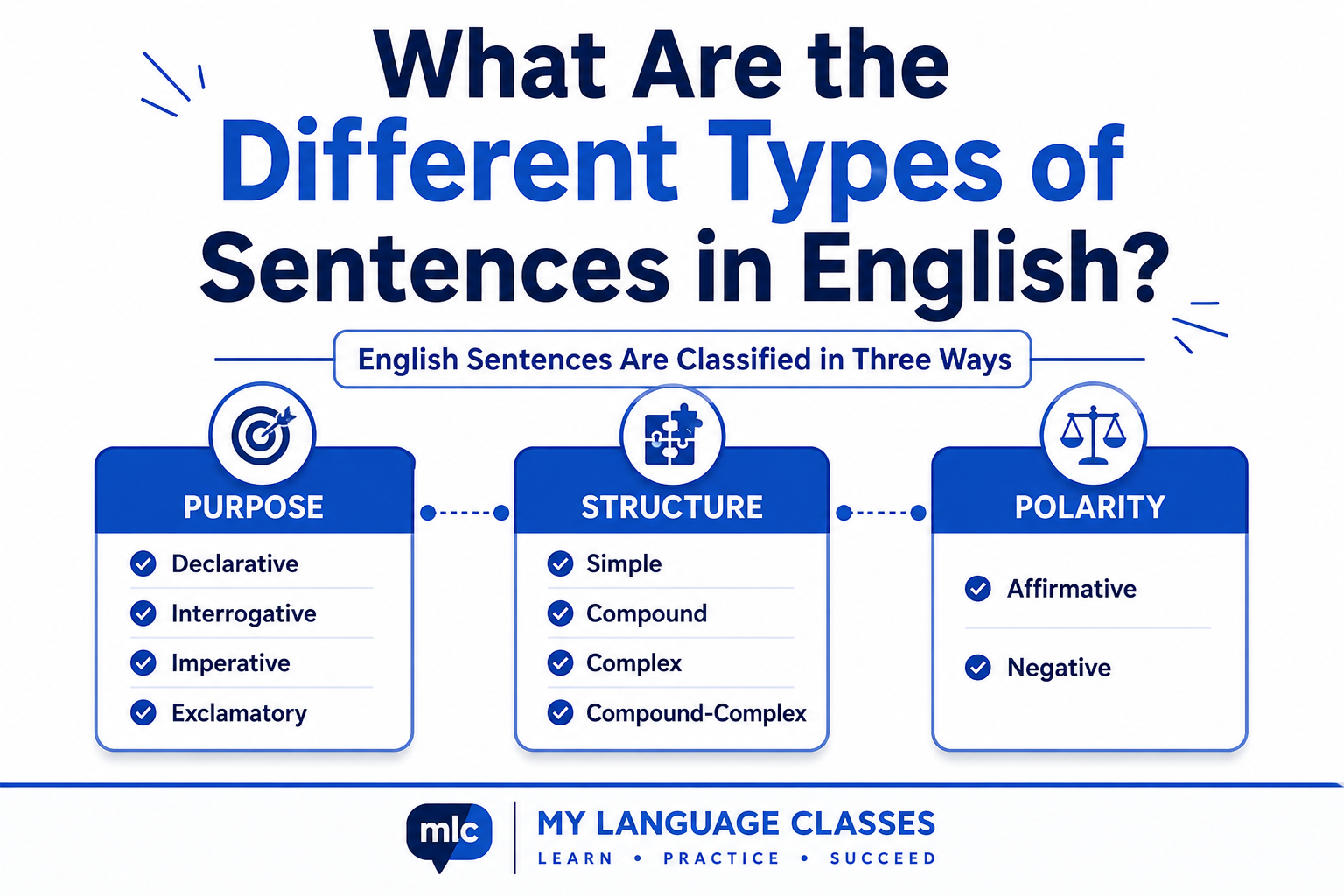
English sentences can be classified in several ways, depending on what aspect of the sentence you want to examine. Some classifications focus on the sentence’s purpose, while others focus on its grammatical structure or whether it expresses a positive or negative idea. Understanding these different classification systems helps you analyze sentences more accurately and use them effectively in both writing and conversation.
The three most common ways to classify English sentences are by purpose, structure, and polarity. Each system answers a different question about the sentence.
→ Purpose asks, “What is the sentence trying to do?” A sentence may make a statement, ask a question, give a command, or express strong emotion.
→ Structure asks, “How is the sentence built?” This depends on the number and types of clauses the sentence contains.
→ Polarity asks, “Is the sentence positive or negative?” This classification distinguishes between affirmative and negative sentences and helps learners understand how meaning changes when negation is introduced.
These three systems work independently, which means every English sentence belongs to one category in each system. For example, consider the sentence She doesn’t like coffee.
→ By purpose: Declarative, because it makes a statement.
→ By structure: Simple, because it contains one independent clause.
→ By polarity: Negative, because it contains the negative marker doesn’t.
Now look at another example:
Does she like coffee?
→ By purpose: Interrogative, because it asks a question.
→ By structure: Simple, because it contains one independent clause.
→ By polarity: Affirmative, because it does not contain a negative marker.
The following table summarizes these three classification systems.
| Classification | Question It Answers | Types |
|---|---|---|
| By Purpose | What does the sentence do? | Declarative, Interrogative, Imperative, Exclamatory |
| By Structure | How is the sentence built? | Simple, Compound, Complex, Compound-Complex |
| By Polarity | Is the sentence positive or negative? | Affirmative, Negative |
Learning these three ways of classifying sentences gives you a much deeper understanding of English grammar. Instead of looking at a sentence from only one perspective, you’ll be able to identify its function, understand its grammatical construction, and recognize whether it presents information in a positive or negative form. This broader understanding also makes it easier to study more advanced grammar topics, such as clauses, sentence transformations, reported speech, and question formation.
What Are the Four Types of Sentences by Purpose?
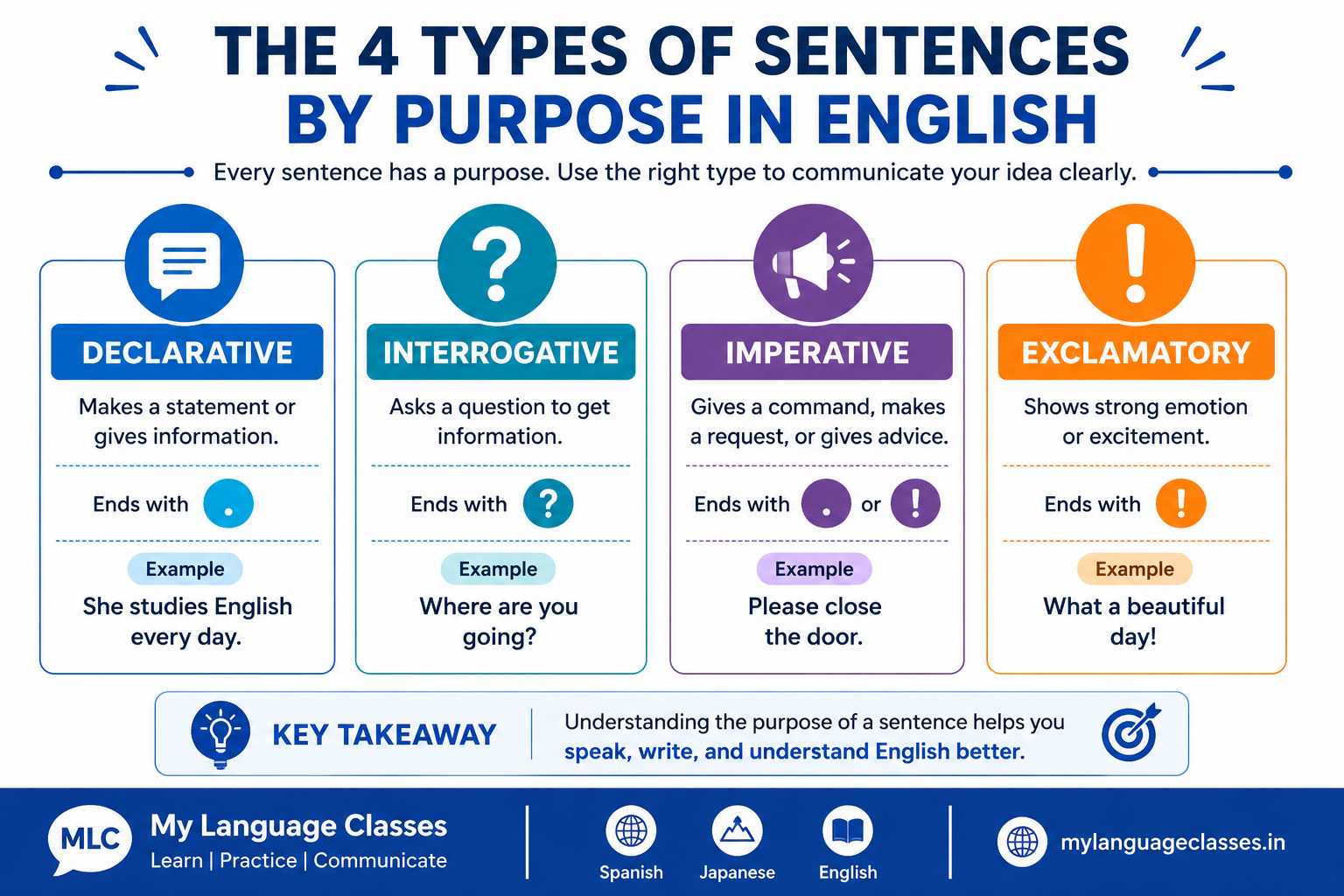
When sentences are classified by purpose, the focus is on what the speaker or writer wants to communicate. Every sentence has a communicative function. It may provide information, ask for information, give directions, or express feelings. Based on this function, English has four main sentence types: declarative, interrogative, imperative, and exclamatory.
Although these sentence types differ in purpose, they all follow the same grammatical principles of sentence formation. Recognizing their purpose helps you choose the right sentence for the situation and communicate your ideas more effectively.
What Is a Declarative Sentence?
A declarative sentence is the most common type of sentence in English. It is used to make a statement, share information, express an opinion, describe a situation, or present a fact. Most sentences you read in books, newspapers, websites, and academic writing are declarative sentences.
Declarative sentences usually end with a period and follow the standard word order of subject + verb + object or complement. They can be either affirmative or negative.
Examples:
→ The meeting starts at nine o’clock.
→ She enjoys reading historical novels.
→ We don’t have enough time today.
→ English is spoken in many countries.
What Is an Interrogative Sentence?
An interrogative sentence is used to ask a question. The speaker expects information, confirmation, or clarification from the listener. Interrogative sentences usually end with a question mark.
English uses several kinds of questions, including yes/no questions, WH-questions, choice questions, and question tags. Most interrogative sentences begin with an auxiliary verb or a question word such as who, what, where, when, why, or how.
Examples:
→ Are you ready for the exam?
→ Where do you live?
→ Which book do you recommend?
→ Did they arrive on time?
What Is an Imperative Sentence?
An imperative sentence is used to give a command, make a request, offer advice, provide instructions, or issue a warning. In most imperative sentences, the subject you is understood rather than stated explicitly.
Depending on the speaker’s tone, an imperative sentence can sound direct, polite, encouraging, or formal. Many instructions in manuals, recipes, classroom activities, and workplace procedures are written as imperative sentences.
Examples:
→ Please close the window.
→ Turn left at the next intersection.
→ Remember to save your work.
→ Don’t forget your passport.
What Is an Exclamatory Sentence?
An exclamatory sentence expresses strong emotion, surprise, excitement, admiration, disappointment, or another intense feeling. These sentences often end with an exclamation mark, although the emotion is conveyed primarily through the wording rather than the punctuation alone.
In formal writing, exclamation marks should be used sparingly. Overusing them can reduce their impact and make the writing appear less professional.
Examples:
→ What a beautiful sunset!
→ How quickly the children have grown!
→ That was an incredible performance!
→ I can’t believe we won!
How Do These Four Sentence Types Compare?
The following table highlights the main differences between the four sentence types by purpose.
| Sentence Type | Primary Purpose | Typical Ending | Example |
|---|---|---|---|
| Declarative | Makes a statement or provides information | Period (.) | The train arrives at six. |
| Interrogative | Asks a question | Question mark (?) | When does the train arrive? |
| Imperative | Gives a command, request, advice, or instruction | Period (.) or Exclamation mark (!) | Please arrive early. |
| Exclamatory | Expresses strong emotion | Exclamation mark (!) | What an amazing trip! |
Understanding these four sentence types helps you communicate with greater precision. Instead of relying on one kind of sentence, you can choose the form that best matches your purpose. Effective communication depends not only on correct grammar but also on selecting the appropriate sentence type for the message you want to convey.
If you want to strengthen your understanding of sentence formation and other essential grammar topics, Mastering English Grammar for A1 Level, available on My Language Classes website and on Amazon, provides structured lessons with clear explanations and practical examples designed for beginner learners.
What Are the Four Types of Sentences by Structure?
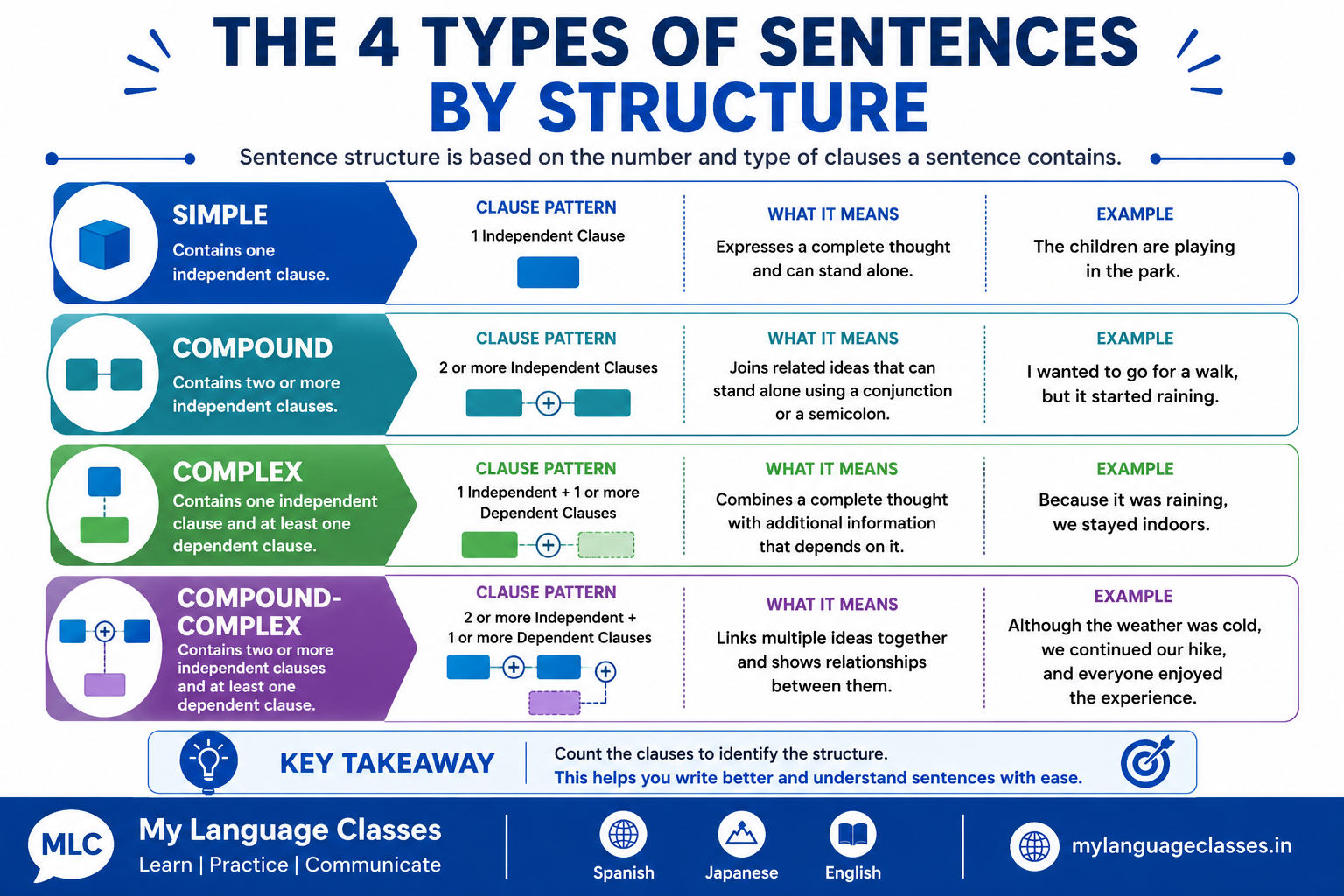
While sentence types by purpose explain what a sentence is trying to communicate, sentence types by structure explain how a sentence is grammatically constructed. This classification is based on the number and types of clauses a sentence contains. Every English sentence belongs to one of four structural categories: simple, compound, complex, or compound-complex.
Understanding sentence structure helps you write with greater variety and clarity. It also makes it easier to analyze grammar, improve sentence flow, and recognize how ideas are connected.
What Is a Simple Sentence?
A simple sentence contains one independent clause. An independent clause expresses a complete thought and can stand alone as a sentence. Although simple sentences have only one independent clause, they can still contain compound subjects, compound verbs, objects, complements, modifiers, and prepositional phrases.
Examples:
→ Emma reads every evening.
→ The children are playing in the park.
→ My brother and my sister enjoy classical music.
→ We packed our bags and left early.
In the last example, the sentence has one subject and a compound verb (packed and left), so it is still a simple sentence.
What Is a Compound Sentence?
A compound sentence contains two or more independent clauses joined together. These clauses are usually connected by a coordinating conjunction such as for, and, nor, but, or, yet, or so, or by a semicolon when the ideas are closely related.
Each independent clause could stand alone as a complete sentence, but combining them creates a smoother connection between related ideas.
Examples:
→ Sarah finished her presentation, and everyone applauded.
→ I wanted to go for a walk, but it started raining.
→ The store was closed, so we returned home.
→ The meeting ended early; everyone was pleased.
Compound sentences help writers connect ideas without making the writing sound repetitive or choppy.
What Is a Complex Sentence?
A complex sentence contains one independent clause and at least one dependent clause. A dependent clause cannot stand alone because it does not express a complete thought. It depends on the independent clause to complete its meaning.
Dependent clauses often begin with subordinating conjunctions such as because, although, since, if, when, while, after, and before.
Examples:
→ Because it was raining, we stayed indoors.
→ She smiled when she saw her friends.
→ If you study regularly, you will improve quickly.
→ I called him after I reached home.
When the dependent clause comes before the independent clause, a comma is usually required. When it comes after the independent clause, a comma is often unnecessary unless required for clarity.
What Is a Compound-Complex Sentence?
A compound-complex sentence combines the features of both compound and complex sentences. It contains at least two independent clauses and one or more dependent clauses.
This type of sentence allows writers to express detailed relationships between multiple ideas while maintaining logical connections.
Examples:
→ Although the weather was cold, we continued our hike, and everyone enjoyed the experience.
→ Because the project was completed early, the manager approved it, and the team celebrated together.
→ When the guests arrived, dinner was ready, and the children greeted everyone warmly.
Compound-complex sentences are common in academic writing, professional communication, and advanced storytelling because they allow ideas to be connected with greater precision.
How Do the Four Structural Sentence Types Compare?
The following table summarizes the four structural sentence types.
| Sentence Type | Clause Pattern | Example |
|---|---|---|
| Simple | One independent clause | The baby is sleeping. |
| Compound | Two or more independent clauses | The baby is sleeping, and the house is quiet. |
| Complex | One independent clause + one or more dependent clauses | Because the baby is sleeping, the house is quiet. |
| Compound-Complex | Two or more independent clauses + one or more dependent clauses | Because the baby is sleeping, the house is quiet, and everyone is relaxing. |
Each sentence type has its own purpose in effective writing. Simple sentences provide clarity, compound sentences connect related ideas, complex sentences show relationships such as cause, time, or condition, and compound-complex sentences allow writers to communicate multiple connected ideas in a single, well-organized sentence. Using a combination of these structures makes your writing more natural, engaging, and easier to follow.
If you want to practice building these sentence structures step by step, Complete English A1 Grammar Practice Part-1, available on My Language Classes website includes structured grammar lessons and guided practice designed to strengthen your understanding of English sentence formation.
What Is the Difference Between Sentence Types by Purpose and by Structure?
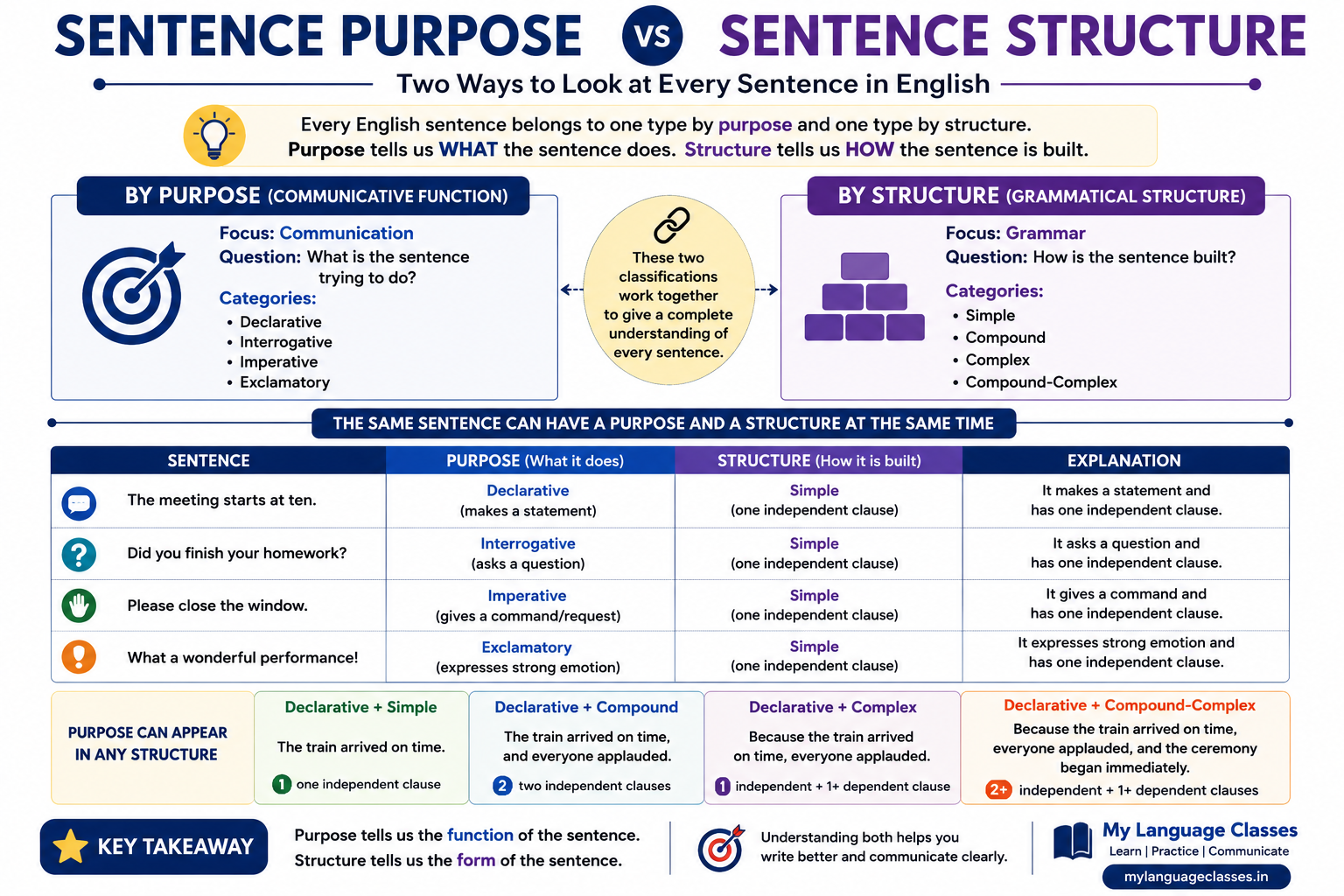
One of the most common sources of confusion for English learners is the difference between sentence types by purpose and sentence types by structure. Although both systems classify sentences, they do so from completely different perspectives. Understanding this distinction makes it much easier to analyze English grammar accurately.
Sentence types by purpose explain what a sentence is intended to communicate. They describe the speaker’s or writer’s communicative goal. A sentence may make a statement, ask a question, give a command, or express strong emotion.
Sentence types by structure, on the other hand, explain how a sentence is grammatically constructed. They focus on the number and types of clauses within the sentence rather than its communicative function.
The following table highlights the difference.
| Classification | Focus | Question It Answers | Categories |
|---|---|---|---|
| By Purpose | Communication | What is the sentence trying to do? | Declarative, Interrogative, Imperative, Exclamatory |
| By Structure | Grammar | How is the sentence built? | Simple, Compound, Complex, Compound-Complex |
Since these two systems measure different aspects of a sentence, every sentence belongs to one category from each classification at the same time.
Consider the following examples.
| Sentence | Purpose | Structure |
|---|---|---|
| The meeting starts at ten. | Declarative | Simple |
| Did you finish your homework? | Interrogative | Simple |
| Please close the window. | Imperative | Simple |
| What a wonderful performance! | Exclamatory | Simple |
| Although it was raining, we continued the match. | Declarative | Complex |
| Did you call your parents after you arrived home? | Interrogative | Complex |
| Finish your assignment before the deadline. | Imperative | Complex |
| What an amazing presentation everyone gave after months of preparation! | Exclamatory | Complex |
Notice that the purpose changes independently of the structure. For example, a declarative sentence does not always have to be simple. It can also be compound, complex, or compound-complex.
Examples:
→ The train arrived on time. (Declarative + Simple)
→ The train arrived on time, and everyone applauded. (Declarative + Compound)
→ Because the train arrived on time, everyone applauded. (Declarative + Complex)
→ Because the train arrived on time, everyone applauded, and the ceremony began immediately. (Declarative + Compound-Complex)
The same principle applies to interrogative sentences.
Examples:
→ Are you ready? (Interrogative + Simple)
→ Did you finish your work, or do you need more time? (Interrogative + Compound)
→ Why did you leave before the meeting ended? (Interrogative + Complex)
Likewise, imperative and exclamatory sentences can also appear in different structural forms, although simple structures are the most common in everyday communication.
The key idea is that purpose and structure are complementary, not competing, classifications. One tells you what the sentence is meant to accomplish, while the other tells you how it is assembled grammatically. When you analyze both together, you gain a much deeper understanding of English sentence formation and can identify sentence patterns with greater confidence.
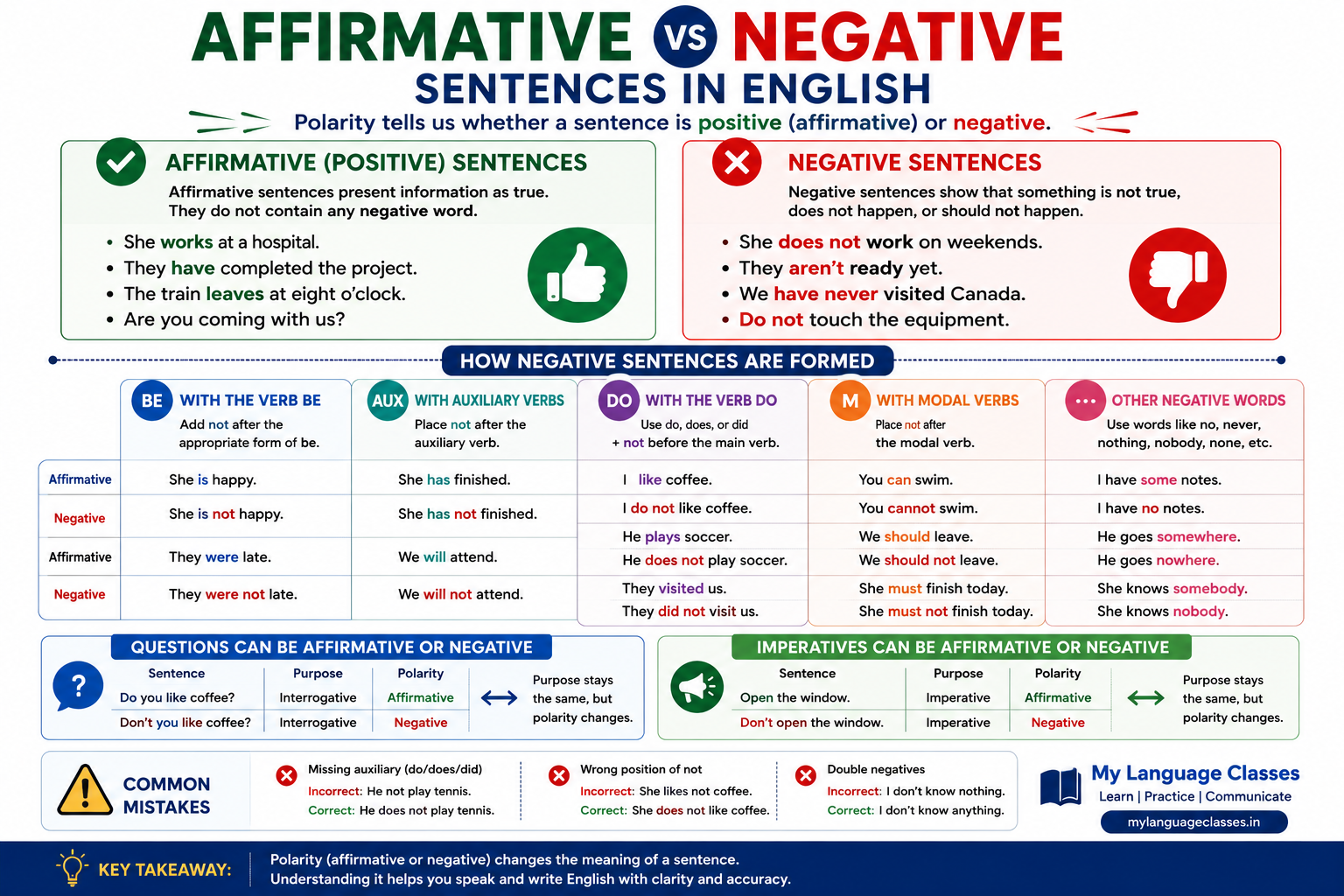
What Are Affirmative and Negative Sentences?
Besides classifying sentences by purpose and structure, English also classifies sentences by polarity. Polarity tells us whether a sentence presents information as positive or negative. This classification is especially important because it affects meaning without changing the sentence’s basic purpose or structure.
There are two main types of polarity in English:
→ Affirmative (Positive)
→ Negative
A sentence may be declarative, interrogative, imperative, or exclamatory while also being either affirmative or negative. Similarly, it may be simple, compound, complex, or compound-complex regardless of its polarity.
What Is an Affirmative Sentence?
An affirmative sentence presents information without negation. It states that something is true, happens, exists, or will happen. Unless a sentence contains a negative marker, it is considered affirmative.
Examples:
→ She works at a hospital.
→ They have completed the project.
→ The train leaves at eight o’clock.
→ Are you coming with us?
Notice that the last example is an interrogative sentence by purpose, but it is still affirmative because it does not contain a negative word.
What Is a Negative Sentence?
A negative sentence indicates that something is not true, does not happen, does not exist, or should not happen. In English, negative sentences are usually formed by adding not after an auxiliary verb or by using the contracted negative form.
Examples:
→ She does not work on weekends.
→ They aren’t ready yet.
→ We have never visited Canada.
→ Do not touch the equipment.
Negative sentences are common in everyday communication because they allow speakers to deny facts, refuse requests, express disagreement, or describe the absence of something.
How Are Negative Sentences Formed?
The way a negative sentence is formed depends on the verb used in the sentence.
With the Verb Be
Add not after the appropriate form of be.
| Affirmative | Negative |
|---|---|
| She is happy. | She is not happy. |
| They were late. | They were not late. |
With Auxiliary Verbs
Place not after the auxiliary verb.
| Affirmative | Negative |
|---|---|
| She has finished. | She has not finished. |
| We will attend. | We will not attend. |
With the Verb Do
When the main verb has no auxiliary, English uses do, does, or did to form the negative.
| Affirmative | Negative |
|---|---|
| I like coffee. | I do not like coffee. |
| He plays soccer. | He does not play soccer. |
| They visited us. | They did not visit us. |
With Modal Verbs
The negative is formed by placing not after the modal verb.
| Affirmative | Negative |
|---|---|
| You can swim. | You cannot swim. |
| We should leave. | We should not leave. |
| She must finish today. | She must not finish today. |
Can Questions Be Affirmative or Negative?
Yes. An interrogative sentence can have either affirmative or negative polarity.
Compare these examples.
| Sentence | Purpose | Polarity |
|---|---|---|
| Do you like coffee? | Interrogative | Affirmative |
| Don’t you like coffee? | Interrogative | Negative |
Likewise, imperative sentences can also have affirmative or negative polarity.
| Sentence | Purpose | Polarity |
|---|---|---|
| Open the window. | Imperative | Affirmative |
| Don’t open the window. | Imperative | Negative |
This shows that purpose and polarity are independent classifications. The communicative function remains the same, while the polarity changes.
What Are Common Mistakes with Negative Sentences?
Many English learners make similar mistakes when forming negative sentences. Paying attention to these patterns will help you avoid common grammar errors.
→ Adding not directly after the main verb instead of using an auxiliary.
Incorrect:
She likes not coffee.
Correct:
She does not like coffee.
→ Forgetting to use do, does, or did when required.
Incorrect:
He not play tennis.
Correct:
He does not play tennis.
→ Using double negatives unintentionally.
Incorrect:
I don’t know nothing.
Standard English:
I don’t know anything.
Although double negatives exist in some dialects, they are generally avoided in standard written English.
Understanding polarity makes it easier to recognize how English expresses agreement, disagreement, denial, prohibition, and absence. Once you can identify whether a sentence is affirmative or negative, you’ll also find it easier to study questions, passive voice, reported speech, and verb forms in greater depth.
How Can You Identify the Type of an English Sentence?
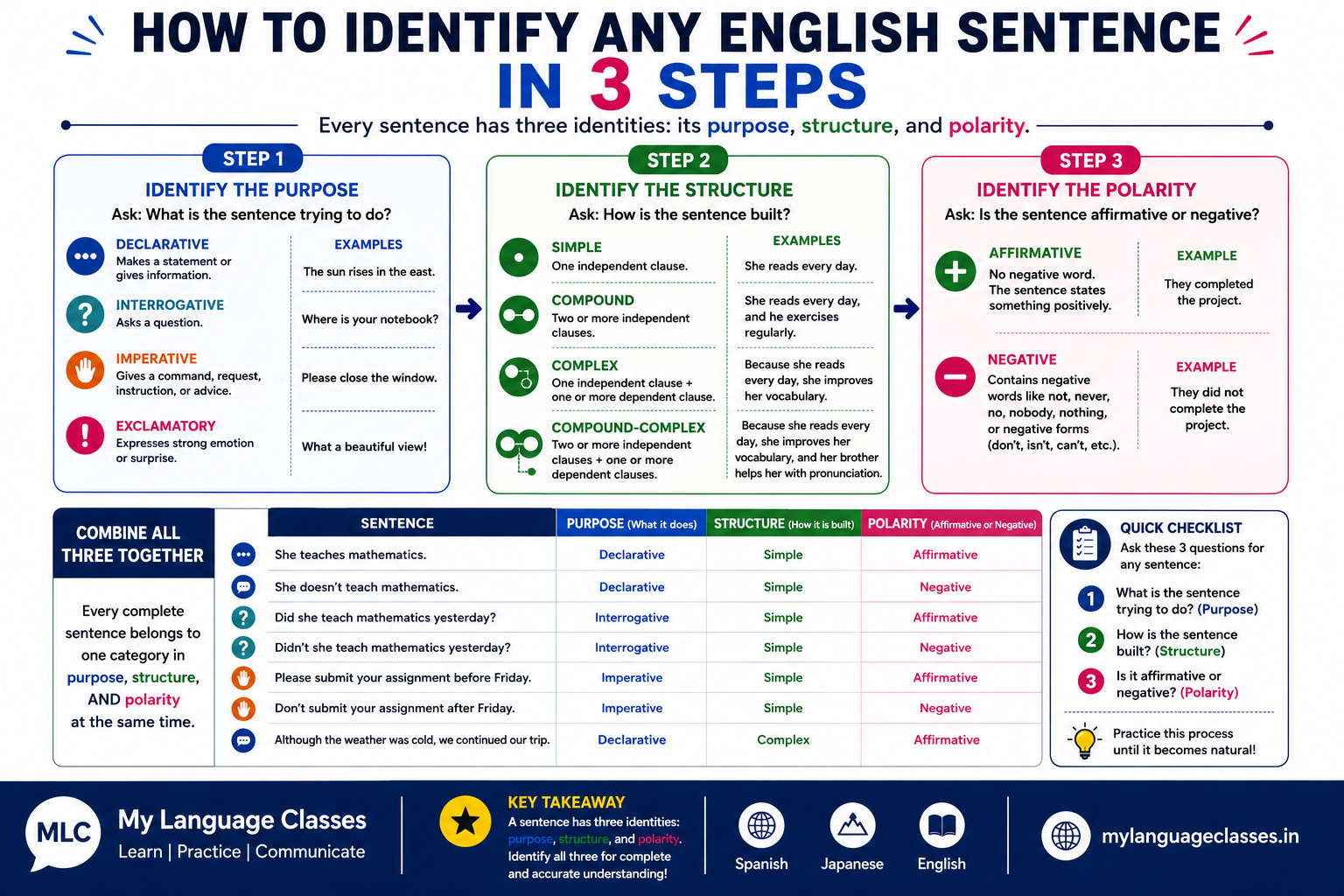
Once you understand the three classification systems, identifying the type of an English sentence becomes much easier. Instead of guessing, you can follow a simple step-by-step process. This approach helps you analyze any sentence by its purpose, structure, and polarity.
Step 1: Identify the Sentence’s Purpose
Start by asking yourself what the sentence is trying to communicate.
If it makes a statement, it is declarative.
If it asks a question, it is interrogative.
If it gives a command, request, instruction, or advice, it is imperative.
If it expresses strong emotion, it is exclamatory.
Examples:
→ The library closes at six. (Declarative)
→ Where is the nearest library? (Interrogative)
→ Please return the book tomorrow. (Imperative)
→ What an interesting novel that is! (Exclamatory)
Step 2: Identify the Sentence’s Structure
Next, examine how the sentence is built. Count the number of independent and dependent clauses.
Ask yourself these questions.
→ Does it contain only one independent clause?
→ Are there two or more independent clauses?
→ Is there a dependent clause?
→ Does it combine multiple independent and dependent clauses?
This will help you determine whether the sentence is simple, compound, complex, or compound-complex.
Examples:
→ She studies every evening. (Simple)
→ She studies every evening, and her brother practices the piano. (Compound)
→ Because she studies every evening, she performs well in school. (Complex)
→ Because she studies every evening, she performs well in school, and her teachers praise her progress. (Compound-Complex)
Step 3: Identify the Sentence’s Polarity
Now determine whether the sentence is affirmative or negative.
Look for negative markers such as not, never, no, nobody, nothing, nowhere, or contracted forms like don’t, isn’t, can’t, and won’t.
Examples:
→ They finished the assignment. (Affirmative)
→ They did not finish the assignment. (Negative)
→ Are you joining us? (Affirmative Interrogative)
→ Aren’t you joining us? (Negative Interrogative)
Step 4: Combine All Three Classifications
The final step is to identify all three classifications together. Every complete sentence can be described by its purpose, structure, and polarity.
Consider the following examples.
| Sentence | Purpose | Structure | Polarity |
|---|---|---|---|
| She teaches mathematics. | Declarative | Simple | Affirmative |
| She doesn’t teach mathematics. | Declarative | Simple | Negative |
| Did she teach mathematics yesterday? | Interrogative | Simple | Affirmative |
| Didn’t she teach mathematics yesterday? | Interrogative | Simple | Negative |
| Please submit your assignment before Friday. | Imperative | Simple | Affirmative |
| Don’t submit your assignment after Friday. | Imperative | Simple | Negative |
| Although the weather was cold, we continued our trip. | Declarative | Complex | Affirmative |
By analyzing a sentence in this order, you avoid one of the most common learner mistakes: confusing one classification system with another. A sentence does not have just one “type.” Instead, it has three separate identities, each describing a different grammatical feature.
A simple checklist can help you remember the process.
→ What is the sentence trying to do? (Purpose)
→ How is the sentence built? (Structure)
→ Is it affirmative or negative? (Polarity)
If you answer these three questions every time you analyze a sentence, identifying sentence types quickly becomes a natural part of your grammar skills rather than something you have to memorize.
What Are the Most Common Mistakes When Identifying Sentence Types?
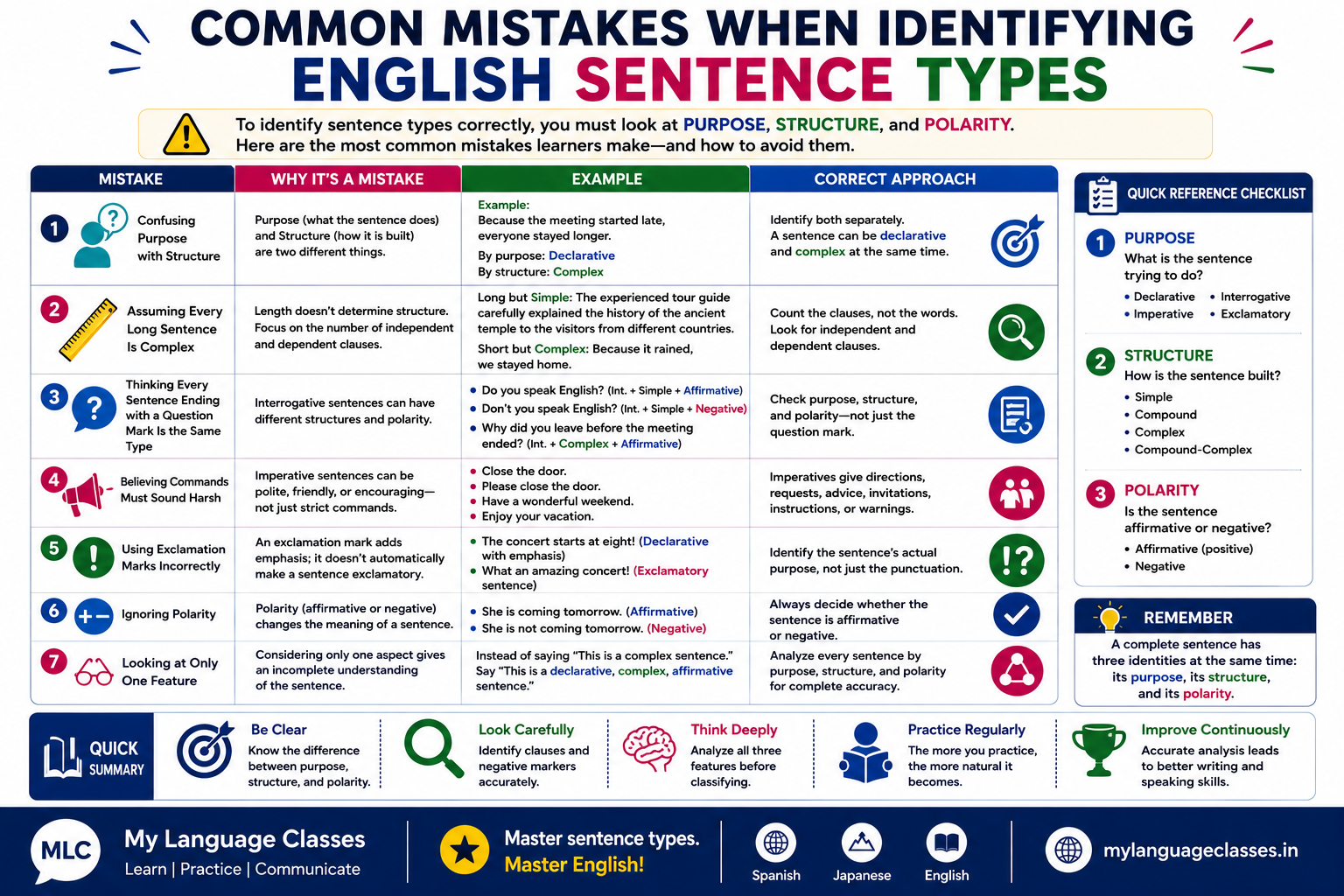
Learning the different ways to classify English sentences is only the first step. The next challenge is identifying them correctly in real situations. Many learners make mistakes because they focus on only one aspect of a sentence or apply the wrong classification system. Understanding these common errors will help you analyze sentences more accurately and avoid confusion.
Mistake 1: Confusing Purpose with Structure
The most common mistake is assuming that the four sentence types by purpose are the same as the four sentence types by structure. These are two completely different classification systems.
Consider the following sentence:
Because the meeting started late, everyone stayed longer.
By purpose:
→ Declarative
By structure:
→ Complex
The sentence is not simply “complex.” It is both declarative and complex because each classification describes a different feature.
Mistake 2: Assuming Every Long Sentence Is Complex
Sentence length does not determine sentence structure. A sentence may be long but still be a simple sentence if it contains only one independent clause.
Example:
The experienced tour guide carefully explained the history of the ancient temple to the visitors from different countries.
Although this sentence is long, it contains only one independent clause.
On the other hand, a much shorter sentence can be complex.
Example:
Because it rained, we stayed home.
Always count the clauses instead of counting the words.
Mistake 3: Thinking Every Sentence Ending with a Question Mark Is the Same Type
Many learners believe all questions have the same grammatical pattern. However, interrogative sentences can have different structures and different polarity.
Compare these examples.
→ Do you speak English? (Interrogative + Simple + Affirmative)
→ Don’t you speak English? (Interrogative + Simple + Negative)
→ Why did you leave before the meeting ended? (Interrogative + Complex + Affirmative)
The purpose remains interrogative, but the structure and polarity may change.
Mistake 4: Believing Commands Must Sound Harsh
Imperative sentences are often associated with strict commands, but they are much more flexible. They can express requests, invitations, instructions, advice, warnings, or encouragement.
Compare these examples.
→ Close the door.
→ Please close the door.
→ Have a wonderful weekend.
→ Enjoy your vacation.
Each sentence is imperative because it directs the listener to do something, even though the tone is polite or friendly.
Mistake 5: Using Exclamation Marks Incorrectly
An exclamation mark does not automatically make a sentence exclamatory. It simply adds emphasis. The meaning of the sentence determines whether it is truly exclamatory.
Compare these examples.
→ The concert starts at eight! (Declarative with emphasis.)
→ What an amazing concert! (Exclamatory sentence.)
Writers should avoid using unnecessary exclamation marks, especially in academic, professional, and business writing.
Mistake 6: Ignoring Polarity
Some learners correctly identify the purpose and structure of a sentence but forget to analyze its polarity.
Compare these examples.
| Sentence | Purpose | Structure | Polarity |
|---|---|---|---|
| She is coming tomorrow. | Declarative | Simple | Affirmative |
| She is not coming tomorrow. | Declarative | Simple | Negative |
The only difference is polarity, but it completely changes the meaning of the sentence.
Mistake 7: Looking at Only One Feature
The best way to analyze a sentence is to examine all three classification systems together.
Instead of saying:
“This is a complex sentence.”
Train yourself to say:
“This is a declarative, complex, affirmative sentence.”
Or:
“This is an interrogative, simple, negative sentence.”
This approach gives you a complete grammatical description instead of focusing on only one characteristic.
Quick Summary
The following table summarizes the most common learner mistakes.
| Common Mistake | Correct Approach |
|---|---|
| Confusing purpose with structure | Analyze each classification separately. |
| Judging structure by sentence length | Count the independent and dependent clauses. |
| Assuming all questions are the same | Check both structure and polarity. |
| Thinking imperatives are always commands | Remember they can also express requests, advice, and instructions. |
| Treating every exclamation mark as an exclamatory sentence | Identify the sentence’s actual communicative purpose. |
| Ignoring polarity | Decide whether the sentence is affirmative or negative. |
| Identifying only one sentence type | Classify every sentence by purpose, structure, and polarity. |
The more sentences you analyze using these three classifications together, the more natural the process becomes. After some practice, you’ll be able to recognize sentence patterns almost automatically, making both your writing and your grammar analysis more accurate.
How Can You Use Different Sentence Types to Improve Your English?
Knowing the different types of sentences is more than a grammar exercise. It helps you communicate your ideas more clearly, write more naturally, and understand how English is used in different situations. Instead of relying on the same sentence pattern repeatedly, you can choose the sentence type that best matches your purpose and organize your ideas more effectively.
Whether you are writing an email, participating in a conversation, preparing for an exam, or creating professional documents, using a variety of sentence types makes your communication more engaging and easier to understand.
Use Declarative Sentences to Share Information Clearly
Declarative sentences are the foundation of most communication. They help you present facts, explain ideas, describe situations, and express opinions in a clear and direct way.
Examples:
→ The conference begins at 9:00 a.m.
→ Learning English requires regular practice.
→ Our team completed the project ahead of schedule.
Since declarative sentences are the most common sentence type, learning to write them accurately is the first step toward effective communication.
Use Interrogative Sentences to Gather Information
Interrogative sentences allow you to ask questions, request clarification, and keep conversations moving naturally. Asking good questions is just as important as giving good answers.
Examples:
→ What inspired you to learn English?
→ How long have you been studying?
→ Could you explain that again?
In conversations, interviews, classrooms, and workplaces, well-formed questions encourage meaningful communication and help avoid misunderstandings.
Use Imperative Sentences to Give Clear Instructions
Imperative sentences are useful whenever you need someone to perform an action. They appear frequently in instructions, recipes, manuals, classroom activities, workplace procedures, and everyday conversations.
Examples:
→ Save your work before closing the application.
→ Please wait outside the meeting room.
→ Follow the instructions carefully.
Adding words such as please can make imperative sentences sound more polite and appropriate in formal situations.
Use Exclamatory Sentences to Express Emotion Naturally
Exclamatory sentences add emotion and emphasis to your communication. They are commonly used to express excitement, surprise, admiration, disappointment, or joy.
Examples:
→ What an incredible opportunity!
→ How beautiful this place is!
→ That’s fantastic!
While exclamatory sentences can make your writing more expressive, they should be used thoughtfully. In academic and professional writing, excessive use of exclamation marks can make your message appear less formal.
Vary Your Sentence Structure to Improve Your Writing
Using different structural sentence types makes your writing more interesting and easier to read. A paragraph made up entirely of simple sentences may sound repetitive, while a paragraph filled only with long compound-complex sentences may become difficult to follow.
Consider this example.
Less Varied
The workshop started on time. The instructor welcomed everyone. The students introduced themselves. The lesson began.
More Varied
The workshop started on time, and the instructor welcomed everyone. After the students introduced themselves, the lesson began.
The second version flows more naturally because it combines different sentence structures while maintaining clarity.
Match the Sentence Type to the Situation
Different situations often call for different sentence types.
| Situation | Sentence Type Commonly Used |
|---|---|
| Sharing facts | Declarative |
| Asking for information | Interrogative |
| Giving instructions | Imperative |
| Expressing emotion | Exclamatory |
| Academic writing | Simple, Compound, Complex |
| Storytelling | All structural sentence types |
| Professional emails | Mostly Declarative and Interrogative |
| Instruction manuals | Mostly Imperative |
Choosing the appropriate sentence type helps readers and listeners understand your message more quickly and accurately.
Build Better Communication Through Sentence Variety
Strong communicators rarely depend on just one sentence pattern. They naturally combine different purposes, structures, and polarity to make their communication more engaging.
For example:
The presentation begins at ten o’clock. Please arrive a few minutes early. If you have any questions, let me know before the session starts. What an exciting opportunity this will be!
This short paragraph combines:
→ Declarative sentences to provide information.
→ An imperative sentence to give an instruction.
→ A complex sentence to express a condition.
→ An exclamatory sentence to express enthusiasm.
Using sentence variety makes your writing sound more natural and helps you communicate with confidence in both spoken and written English.
Key Takeaways
The three ways of classifying English sentences work together to provide a complete understanding of English grammar. When you analyze a sentence, consider its purpose, structure, and polarity instead of focusing on only one characteristic.
→ English sentences can be classified by purpose, structure, and polarity.
→ The four sentence types by purpose are declarative, interrogative, imperative, and exclamatory.
→ The four sentence types by structure are simple, compound, complex, and compound-complex.
→ The two types of polarity are affirmative and negative.
→ Purpose tells you what the sentence is intended to communicate.
→ Structure tells you how the sentence is grammatically built.
→ Polarity tells you whether the sentence expresses a positive or negative meaning.
→ Every English sentence belongs to one category from each classification system at the same time.
→ Declarative, interrogative, imperative, and exclamatory sentences can each be simple, compound, complex, or compound-complex.
→ Questions and commands can be either affirmative or negative, depending on whether they contain a negative marker.
→ Counting independent and dependent clauses is the most reliable way to identify a sentence’s structure.
→ Punctuation provides useful clues, but it should never be the only factor used to identify a sentence type.
→ Long sentences are not necessarily complex, and short sentences are not always simple.
→ Using a variety of sentence types makes your writing clearer, more engaging, and more natural.
→ To identify any English sentence accurately, analyze it in this order:
→ Determine its purpose.
→ Identify its structure.
→ Identify its polarity.
Mastering these grammar concepts will help you understand English more deeply and improve the clarity, accuracy, and effectiveness of both your spoken and written communication.
Conclusion
Understanding the different types of sentences in English is one of the most important steps toward building strong grammar skills. Rather than viewing sentences as isolated grammar rules, it is more helpful to recognize that every sentence can be analyzed from three different perspectives: purpose, structure, and polarity. Together, these classifications provide a complete picture of how English sentences communicate meaning.
By purpose, sentences tell us whether the speaker is making a statement, asking a question, giving a command, or expressing emotion. By structure, they show how ideas are organized through independent and dependent clauses. By polarity, they indicate whether the message is affirmative or negative. Looking at all three classifications together allows you to analyze sentences more accurately and understand how grammar works in real communication.
As you continue learning English, make it a habit to identify these three characteristics whenever you read a sentence. Ask yourself what the sentence is trying to do, how it is built, and whether it is affirmative or negative. With regular practice, this process becomes automatic and helps you write with greater accuracy, variety, and confidence.
If you want to build a stronger foundation in English grammar beyond sentence types, Mastering English Grammar for A1 Level and Communicative English Foundation, both available on My Language Classes website and on Amazon, provide structured lessons, practical examples, and step-by-step explanations to help you develop lasting grammar skills and communicate more effectively.
The concepts introduced in this guide also prepare you for more advanced grammar topics, including clauses, sentence transformations, active and passive voice, direct and indirect speech, punctuation, and sentence combining techniques. Mastering sentence types today will make these topics much easier to understand as you continue improving your English.

Vikas Kumar is the founder of My Language Classes, a language learning platform dedicated to helping learners develop practical communication skills in Spanish, Japanese, and English through comprehensive grammar guides, structured learning resources, books, and evidence-informed educational content.
At My Language Classes, we believe that successful language learning is built on clarity, consistency, meaningful practice, and a deep understanding of how languages work. Every article is carefully researched and created to simplify complex concepts, provide practical guidance, and help learners develop confidence through real-world communication.
Inspired by the principles behind How Language Learning Really Works, our mission is to make high-quality language learning accessible to learners around the world by providing accurate, trustworthy, and comprehensive resources that support lasting progress, lifelong learning, and meaningful communication.
Leave a Reply