

Exploring Spanish Adverbs
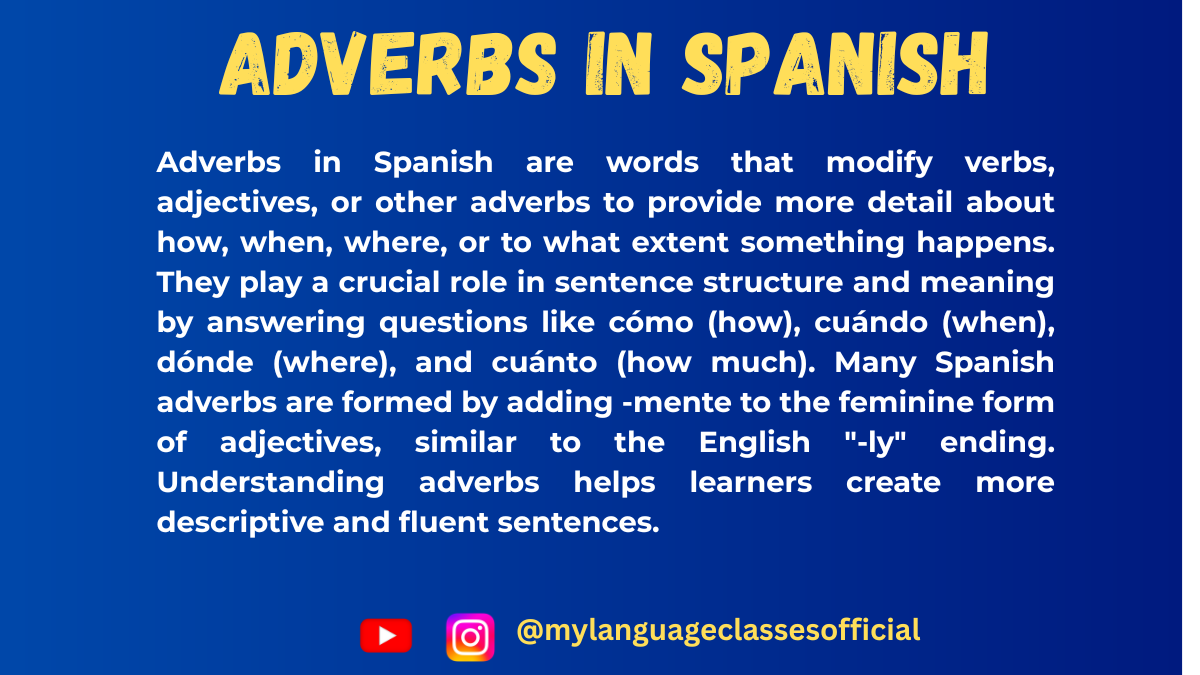
Adverbs are essential in Spanish, providing important details about actions—when, where, and how often they happen. Mastering adverbs will help you express yourself more clearly and accurately in everyday conversations. In this blog post, we’ll break down three important types of adverbs: adverbs of frequency, adverbs of time, and adverbs of place. Each type has its own role in enriching your sentences.
1. Adverbs of Frequency: How Often?
Adverbs of frequency tell us how often an action takes place. They are essential for describing habits, routines, and general tendencies in our daily lives. Common adverbs of frequency in Spanish include words like siempre (always) and nunca (never), which are often used to express regularity or lack thereof.
For example:
- Siempre (Always): Yo siempre tomo café por la mañana.
(I always drink coffee in the morning.) - Nunca (Never): Nunca llego tarde al trabajo.
(I never arrive late to work.)
Here’s a table summarizing common adverbs of frequency, their English meanings, and example sentences:
Adverbs of Frequency
| Adverb (Spanish) | English Meaning | Example Sentence (Spanish) | Translation (English) |
|---|---|---|---|
| Siempre | Always | Yo siempre tomo café por la mañana. | I always drink coffee in the morning. |
| A menudo | Often | Ellos visitan a sus abuelos a menudo. | They often visit their grandparents. |
| Frecuentemente | Frequently | Los niños frecuentemente juegan en el parque. | The children frequently play in the park. |
| A veces | Sometimes | A veces leo libros en la biblioteca. | Sometimes I read books in the library. |
| Rara vez | Rarely | Ella rara vez come comida rápida. | She rarely eats fast food. |
| Nunca | Never | Nunca llego tarde al trabajo. | I never arrive late to work. |
Tip: In Spanish, adverbs of frequency like siempre and nunca typically come before the verb, while others like a veces and frecuentemente can vary in position for emphasis.
2. Adverbs of Time: When?
Adverbs of time tell us when an action happens. They help us frame the timeline of a conversation, allowing us to specify moments in time—whether something happens right now, in the past, or in the future.
For example:
- Ahora (Now): Estoy estudiando ahora. (I am studying now.)
- Mañana (Tomorrow): Mañana tengo una reunión importante. (Tomorrow I have an important meeting.)
Here’s a table with some common adverbs of time and examples:
Adverbs of Time
| Adverb (Spanish) | English Meaning | Example Sentence (Spanish) | Translation (English) |
|---|---|---|---|
| Ahora | Now | Estoy estudiando ahora. | I am studying now. |
| Hoy | Today | Hoy vamos al cine. | Today we are going to the cinema. |
| Mañana | Tomorrow | Mañana tengo una reunión importante. | Tomorrow I have an important meeting. |
| Ayer | Yesterday | Ayer cociné una paella deliciosa. | Yesterday I cooked a delicious paella. |
| Tarde | Late | Llego tarde a la clase de español. | I am late for the Spanish class. |
| Temprano | Early | Siempre llegamos temprano al aeropuerto. | We always arrive early at the airport. |
Tip: When using adverbs of time, be sure to place them where they make the most sense contextually—before or after the verb depending on what you want to emphasize.
3. Adverbs of Place: Where?
Adverbs of place answer the question “Where?” These adverbs describe the location of an action. They are especially helpful in giving directions or providing specific details about where something happens. Common adverbs of place include aquí (here), allí (there), cerca (close), and lejos (far).
For example:
- Aquí (Here): Ven aquí, por favor. (Come here, please.)
- Lejos (Far): Su oficina está lejos de la estación de tren. (Their office is far from the train station.)
Here’s a table summarizing common adverbs of place:
Adverbs of Place
| Adverb (Spanish) | English Meaning | Example Sentence (Spanish) | Translation (English) |
|---|---|---|---|
| Aquí | Here | Ven aquí, por favor. | Come here, please. |
| Allí | There | Dejé mis llaves allí. | I left my keys there. |
| Cerca | Close/Nearby | Hay un supermercado cerca de mi casa. | There’s a supermarket near my house. |
| Lejos | Far | Su oficina está lejos de la estación de tren. | Their office is far from the train station. |
| Dentro | Inside | El gato está dentro de la caja. | The cat is inside the box. |
| Fuera | Outside | Los niños juegan fuera. | The children play outside. |
Tip: Adverbs of place often go after the verb, but they can sometimes appear at the beginning of the sentence for emphasis.
Final Thoughts
Adverbs are powerful tools in Spanish that help add context to your sentences. By using adverbs of frequency, adverbs of time, and adverbs of place, you can make your speech or writing much more expressive. Practice using them in different contexts, and soon they will become a natural part of your Spanish communication.
¡Buena suerte en tu aprendizaje! (Good luck with your learning!)

Vikas Kumar is the founder of My Language Classes, a language learning platform dedicated to helping learners develop practical communication skills in Spanish, Japanese, and English through comprehensive grammar guides, structured learning resources, books, and evidence-informed educational content.
At My Language Classes, we believe that successful language learning is built on clarity, consistency, meaningful practice, and a deep understanding of how languages work. Every article is carefully researched and created to simplify complex concepts, provide practical guidance, and help learners develop confidence through real-world communication.
Inspired by the principles behind How Language Learning Really Works, our mission is to make high-quality language learning accessible to learners around the world by providing accurate, trustworthy, and comprehensive resources that support lasting progress, lifelong learning, and meaningful communication.
Leave a Reply