
Mastering Polite Suggestions and Requests in Japanese
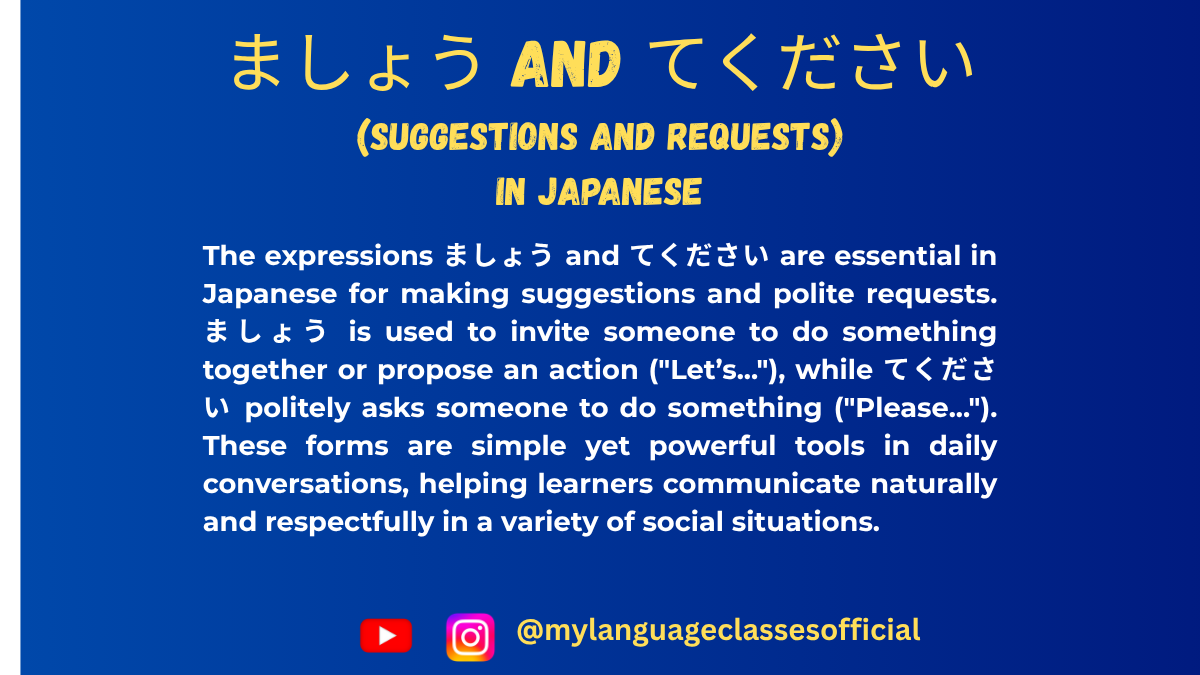
If you’re learning Japanese, understanding how to make polite suggestions and requests is a key part of effective communication. Whether you’re planning activities with friends or politely asking for help, two common expressions—Verb stem + ましょう and Verb stem + てください—are your go-to tools. Let’s dive into their usage, including how to form them step by step.
1. Making Suggestions with ましょう (mashou): “Let’s [verb]”
The expression ましょう is a polite and versatile way to suggest an activity or propose an idea. It carries a collaborative tone, meaning “Let’s do [verb].”
How to Form the ましょう Form
Japanese verbs are divided into three groups, and the method for creating the ましょう form depends on the group.
Group 1: U-Verbs (Godan Verbs)
- Start with the stem of the verb (remove the u-ending).
- Replace the u sound with the i sound.
- Add ましょう.
| Verb | Stem | Change to i Form | Add ましょう | Example Translation |
|---|---|---|---|---|
| 行く | 行 | 行き | 行きましょう | Let’s go. |
| 書く | 書 | 書き | 書きましょう | Let’s write. |
| 話す | 話 | 話し | 話しましょう | Let’s talk. |
Group 2: Ru-Verbs (Ichidan Verbs)
- Remove the final る.
- Add ましょう.
| Verb | Stem | Add ましょう | Example Translation |
|---|---|---|---|
| 食べる | 食べ | 食べましょう | Let’s eat. |
| 見る | 見 | 見ましょう | Let’s look. |
Group 3: Irregular Verbs
There are two irregular verbs, and their ましょう forms are as follows:
| Verb | Change to Stem | Add ましょう | Example Translation |
|---|---|---|---|
| する | し | しましょう | Let’s do it. |
| 来る (kuru) | 来 (ki) | 来ましょう | Let’s come. |
When to Use ましょう
- Planning with others:
Example: 公園へ行きましょう!(Kōen e ikimashou!) = Let’s go to the park! - Encouraging teamwork:
Example: 一緒に勉強しましょう。(Issho ni benkyou shimashou.) = Let’s study together.
The tone is polite, making it suitable for formal and casual settings, as long as it’s a group-oriented activity.
2. Making Requests with てください (tekudasai): “Please [verb]”
Before diving into てください, we need to understand how to form the te-form of verbs. The te-form is one of the most fundamental conjugations in Japanese grammar and is used in various contexts beyond requests, such as making commands, linking actions, and creating the polite request structure てください.
How to Make the Te-Form
Japanese verbs are categorized into three groups, and the rules for forming the te-form differ depending on the group.
Group 1: U-Verbs (Godan Verbs)
For verbs ending in う, つ, る, む, ぶ, ぬ, く, ぐ, す, follow these rules:
- Replace the final u-sound with its corresponding te-form sound:
| Ending | Te-Form Rule | Example |
|---|---|---|
| う | Replace with って | 買う (kau) → 買って (katte) = Buy |
| つ | Replace with って | 立つ (tatsu) → 立って (tatte) = Stand |
| る | Replace with って | 取る (toru) → 取って (totte) = Take |
| む | Replace with んで | 読む (yomu) → 読んで (yonde) = Read |
| ぶ | Replace with んで | 遊ぶ (asobu) → 遊んで (asonde) = Play |
| ぬ | Replace with んで | 死ぬ (shinu) → 死んで (shinde) = Die |
| く | Replace with いて | 書く (kaku) → 書いて (kaite) = Write |
| ぐ | Replace with いで | 泳ぐ (oyogu) → 泳いで (oyoide) = Swim |
| す | Replace with して | 話す (hanasu) → 話して (hanashite) = Speak |
Group 2: Ru-Verbs (Ichidan Verbs)
For verbs ending in る, simply drop る and add て:
- 食べる (taberu) → 食べて (tabete) = Eat.
- 見る (miru) → 見て (mite) = Look.
Group 3: Irregular Verbs
There are only two irregular verbs in Japanese:
- する → して = Do.
Example: 勉強する (benkyou suru) → 勉強して (benkyou shite) = Study. - 来る (kuru) → 来て (kite) = Come.
Forming てください
Once you have the te-form of a verb, simply add ください to make a polite request:
- 見る (miru) → 見て (mite) + ください = 見てください (mite kudasai) = Please look.
- 書く (kaku) → 書いて (kaite) + ください = 書いてください (kaite kudasai) = Please write.
- 手伝う (tetsudau) → 手伝って (tetsudatte) + ください = 手伝ってください (tetsudatte kudasai) = Please help.
When to Use It
- Asking politely:
Example: ちょっと待ってください。(Chotto matte kudasai.) = Please wait a moment. - Giving instructions:
Example: ドアを閉めてください。(Doa o shimete kudasai.) = Please close the door.
This phrase is polite and commonly used in both formal and informal situations.
Key Differences Between ましょう and てください
| Expression | Purpose | Tone |
|---|---|---|
| Verb stem + ましょう | Suggestion: “Let’s do [verb]” | Collaborative and inclusive |
| Verb stem + てください | Request: “Please do [verb]” | Respectful and polite |
Quick Practice: Try It Out!
Let’s put these into practice. Can you guess the correct form for each scenario?
- You’re suggesting to a friend: “Let’s watch a movie.”
Hint: The verb is 見る (miru).
Answer: 映画を見ましょう!(Eiga o mimashou!) - You’re asking someone politely: “Please listen to me.”
Hint: The verb is 聞く (kiku).
Answer: 私の話を聞いてください。(Watashi no hanashi o kiite kudasai.)
Conclusion
Mastering ましょう and てください opens up a world of polite and smooth communication in Japanese. By understanding these structures—and learning how to form the te-form and ましょう—you can make suggestions, request actions, and navigate various social situations with confidence. Practice them in your daily conversations, and soon they’ll become second nature!
What are your favorite phrases using ましょう or てください? Share them in the comments below! Or, if you have any questions about Japanese grammar, feel free to ask. Let’s keep learning together—日本語を楽しみましょう!(Nihongo o tanoshimimashou!) 😊

Vikas Kumar is the founder of My Language Classes, a language learning platform dedicated to helping learners develop practical communication skills in Spanish, Japanese, and English through comprehensive grammar guides, structured learning resources, books, and evidence-informed educational content.
At My Language Classes, we believe that successful language learning is built on clarity, consistency, meaningful practice, and a deep understanding of how languages work. Every article is carefully researched and created to simplify complex concepts, provide practical guidance, and help learners develop confidence through real-world communication.
Inspired by the principles behind How Language Learning Really Works, our mission is to make high-quality language learning accessible to learners around the world by providing accurate, trustworthy, and comprehensive resources that support lasting progress, lifelong learning, and meaningful communication.
Leave a Reply