

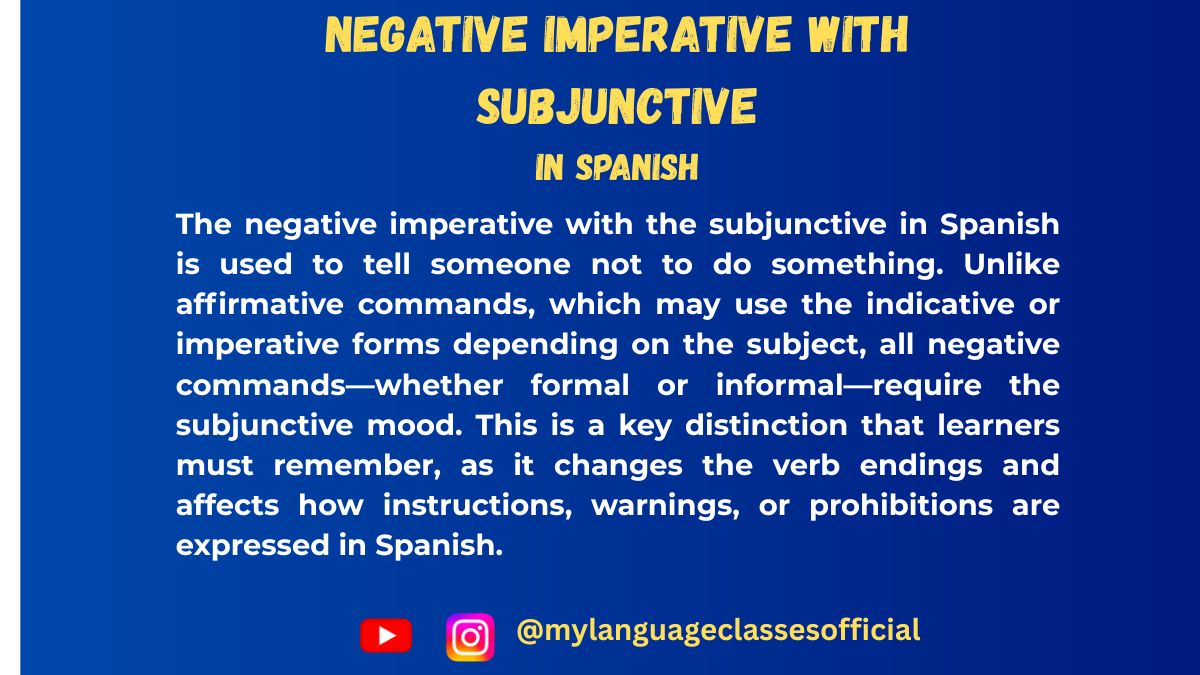
The Negative Imperative with subjunctive is a fascinating and essential aspect of Spanish grammar. It is used to give negative commands or instructions, telling someone not to do something. Unlike the affirmative imperative, which directly tells someone to do something, the negative imperative is formed using the present subjunctive. This structure is unique because it combines the negation “no” with the subjunctive mood, making it a bit tricky for learners. However, once mastered, it becomes an invaluable tool for effective communication in Spanish.
In this blog post, we will explore everything you need to know about the Negative Imperative with subjunctive, including common expressions, conjugation rules, irregular verbs, and practical examples. By the end of this guide, you’ll be able to confidently use this grammatical structure in your daily conversations.
Common Expressions Using Negative Imperative with Subjunctive
Here’s a list of common expressions that use the Negative Imperative with subjunctive. These are frequently used in day-to-day Spanish conversations:
- No hables – Don’t speak.
- No comas eso – Don’t eat that.
- No vayas allí – Don’t go there.
- No lo toques – Don’t touch it.
- No llegues tarde – Don’t be late.
- No te preocupes – Don’t worry.
- No lo hagas – Don’t do it.
- No digas mentiras – Don’t tell lies.
- No olvides – Don’t forget.
- No fumes aquí – Don’t smoke here.
These expressions are straightforward and can be used in various contexts, from giving advice to issuing warnings.
Things to Keep in Mind
When using the Negative Imperative with subjunctive, there are several key points to remember:
- Negation: Always start with “no” before the verb in the subjunctive form.
- Example: No hables (Don’t speak).
- Pronoun Placement: Object pronouns (like lo, la, me, te) are placed before the verb.
- Example: No lo hagas (Don’t do it).
- Gender and Number: The subjunctive form must agree with the subject in gender and number.
- Example: No habléis (Don’t speak – plural, informal).
- Formal vs. Informal: Use usted or ustedes for formal commands and tú or vosotros for informal ones.
- Example: No hable (Don’t speak – formal), No habléis (Don’t speak – informal, plural).
- Reflexive Verbs: For reflexive verbs, the pronoun precedes the verb.
- Example: No te preocupes (Don’t worry).
When to Use Negative Imperative with Subjunctive
The Negative Imperative with subjunctive is used in the following situations:
- Giving Negative Commands: Telling someone not to do something.
- Example: No corras en la casa (Don’t run in the house).
- Offering Advice: Suggesting that someone avoid a particular action.
- Example: No bebas demasiado café (Don’t drink too much coffee).
- Issuing Warnings: Alerting someone to avoid danger or mistakes.
- Example: No toques el fuego (Don’t touch the fire).
- Expressing Prohibitions: Forbidding an action in formal or informal settings.
- Example: No fumen aquí (Don’t smoke here).
Conjugation
Regular Verbs
To form the Negative Imperative with subjunctive, you need to know the present subjunctive conjugation of regular verbs. Here’s how it works for the three categories of regular verbs:
1. -AR Verbs (e.g., hablar – to speak)
- No hables (Don’t speak)
- No hable (Don’t speak – formal)
- No habléis (Don’t speak – plural, informal)
- No hablen (Don’t speak – plural, formal)
2. -ER Verbs (e.g., comer – to eat)
- No comas (Don’t eat)
- No coma (Don’t eat – formal)
- No comáis (Don’t eat – plural, informal)
- No coman (Don’t eat – plural, formal)
3. -IR Verbs (e.g., vivir – to live)
- No vivas (Don’t live)
- No viva (Don’t live – formal)
- No viváis (Don’t live – plural, informal)
- No vivan (Don’t live – plural, formal)
Irregular Verbs
Irregular verbs have unique conjugations in the subjunctive mood. Here are some common irregular verbs and their forms:
1. Ser (to be)
- No seas (Don’t be)
- No sea (Don’t be – formal)
- No seáis (Don’t be – plural, informal)
- No sean (Don’t be – plural, formal)
2. Ir (to go)
- No vayas (Don’t go)
- No vaya (Don’t go – formal)
- No vayáis (Don’t go – plural, informal)
- No vayan (Don’t go – plural, formal)
3. Tener (to have)
- No tengas (Don’t have)
- No tenga (Don’t have – formal)
- No tengáis (Don’t have – plural, informal)
- No tengan (Don’t have – plural, formal)
Example Sentences:
- No seas grosero (Don’t be rude).
- No vayas al parque solo (Don’t go to the park alone).
- No tengas miedo (Don’t be afraid).
List of Verbs in Negative Imperative with Subjunctive
| Verb | Imperativo Negativo | Example Sentence 1 | Example Sentence 2 |
|---|---|---|---|
| Hablar (to speak) | No hables | No hables tan rápido. (Don’t speak so fast.) | No hables con extraños. (Don’t talk to strangers.) |
| Comer (to eat) | No comas | No comas eso. (Don’t eat that.) | No comas demasiado. (Don’t eat too much.) |
| Vivir (to live) | No vivas | No vivas con miedo. (Don’t live in fear.) | No vivas allí. (Don’t live there.) |
| Ser (to be) | No seas | No seas tonto. (Don’t be silly.) | No seas malo. (Don’t be mean.) |
| Ir (to go) | No vayas | No vayas allí. (Don’t go there.) | No vayas sin mí. (Don’t go without me.) |
| Tener (to have) | No tengas | No tengas miedo. (Don’t be afraid.) | No tengas prisa. (Don’t be in a hurry.) |
| Hacer (to do) | No hagas | No hagas eso. (Don’t do that.) | No hagas ruido. (Don’t make noise.) |
| Decir (to say) | No digas | No digas mentiras. (Don’t tell lies.) | No digas nada. (Don’t say anything.) |
| Salir (to leave) | No salgas | No salgas tarde. (Don’t leave late.) | No salgas sin abrigo. (Don’t go out without a coat.) |
| Poner (to put) | No pongas | No pongas eso aquí. (Don’t put that here.) | No pongas excusas. (Don’t make excuses.) |
More Example Sentences
- No olvides llamarme. (Don’t forget to call me.)
- No fumes en el restaurante. (Don’t smoke in the restaurant.)
- No corras en el pasillo. (Don’t run in the hallway.)
- No bebas agua del grifo. (Don’t drink tap water.)
- No abras la ventana. (Don’t open the window.)
- No compres eso. (Don’t buy that.)
- No mires directamente al sol. (Don’t look directly at the sun.)
- No escribas en el libro. (Don’t write in the book.)
- No llegues tarde a la reunión. (Don’t be late for the meeting.)
- No te vayas sin despedirte. (Don’t leave without saying goodbye.)
Fill in the Blanks Exercise
- No _______ (hablar) durante la película.
- No _______ (comer) toda la pizza.
- No _______ (ir) al parque solo.
- No _______ (ser) grosero con ella.
- No _______ (tener) miedo de intentarlo.
- No _______ (hacer) ruido en la biblioteca.
- No _______ (decir) mentiras a tus padres.
- No _______ (salir) sin tu chaqueta.
- No _______ (poner) los pies sobre la mesa.
- No _______ (olvidar) tu tarea.
Answers:
- hables
- comas
- vayas
- seas
- tengas
- hagas
- digas
- salgas
- pongas
- olvides
Conclusion
Mastering the Negative Imperative with subjunctive is a significant step toward fluency in Spanish. It allows you to give negative commands, offer advice, and issue warnings effectively. By understanding the conjugation rules, common expressions, and usage scenarios, you can confidently incorporate this structure into your conversations. Practice regularly with the examples and exercises provided, and soon, using the negative imperative will feel like second nature. ¡No te rindas! (Don’t give up!)
Happy learning! 😊

Vikas Kumar is the founder of My Language Classes, a language learning platform dedicated to helping learners develop practical communication skills in Spanish, Japanese, and English through comprehensive grammar guides, structured learning resources, books, and evidence-informed educational content.
At My Language Classes, we believe that successful language learning is built on clarity, consistency, meaningful practice, and a deep understanding of how languages work. Every article is carefully researched and created to simplify complex concepts, provide practical guidance, and help learners develop confidence through real-world communication.
Inspired by the principles behind How Language Learning Really Works, our mission is to make high-quality language learning accessible to learners around the world by providing accurate, trustworthy, and comprehensive resources that support lasting progress, lifelong learning, and meaningful communication.
Leave a Reply