
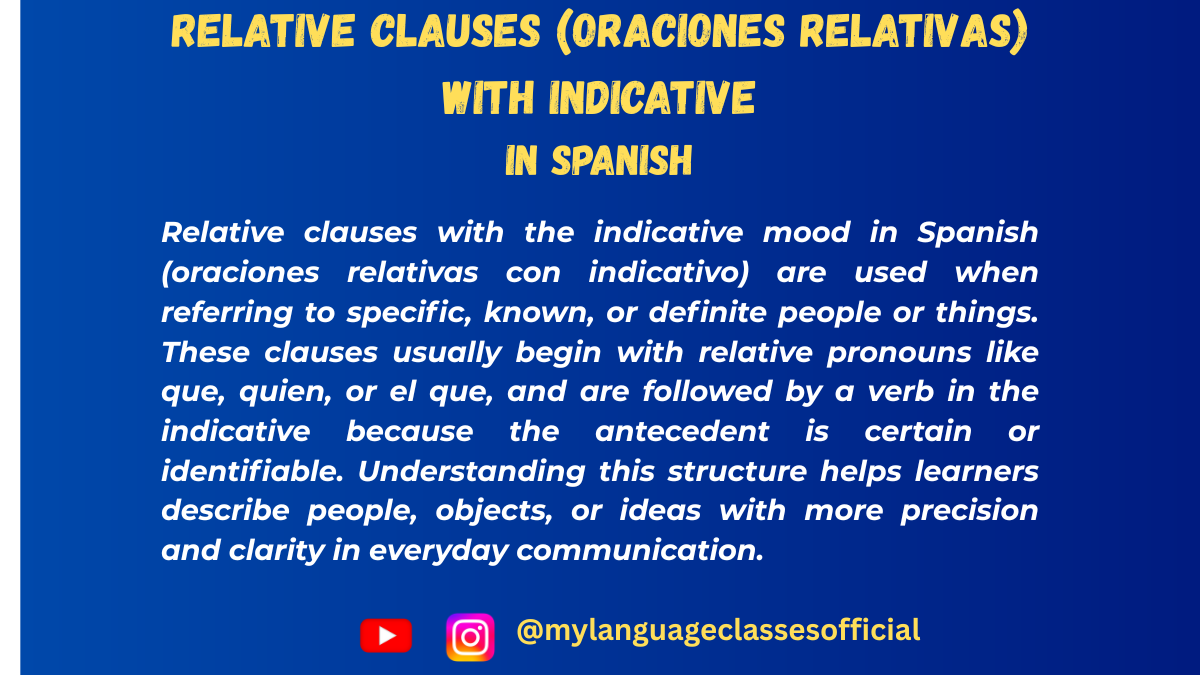
Relative clauses, or oraciones relativos, are an essential part of Spanish grammar. They allow us to provide additional information about a noun without starting a new sentence. When combined with the indicative mood, relative clauses are used to express factual or certain information. Understanding how to use them correctly can significantly improve your fluency and comprehension in Spanish.
In this blog post, we’ll explore everything you need to know about relative clauses with the indicative mood, including common expressions, conjugation rules, and practical examples.
Common Expressions Using Relative Clauses with Indicative
Here’s a list of common expressions that use relative clauses with the indicative mood in everyday Spanish:
- El libro que leí – The book that I read.
- La persona que me ayudó – The person who helped me.
- El lugar donde vivimos – The place where we live.
- El momento en que llegó – The moment when he/she arrived.
- La razón por la que vine – The reason why I came.
- Las cosas que me gustan – The things that I like.
- El chico que sabe mucho – The boy who knows a lot.
- La casa que compramos – The house that we bought.
- El día que nos conocimos – The day we met.
- La comida que preparé – The food that I prepared.
These expressions are widely used in daily conversations and are a great starting point for mastering relative clauses with the indicative.
Things to Keep in Mind
When using relative clauses with the indicative mood, keep the following points in mind:
- Articles and Agreement: The relative pronoun (que, quien, donde, etc.) must agree in number and gender with the noun it refers to. For example:
- El hombre que habla (The man who speaks).
- Las mujeres que cantan (The women who sing).
- Indicative Mood: The indicative is used when the information in the relative clause is factual or certain. For example:
- El niño que estudia mucho (The boy who studies a lot).
- Relative Pronouns:
- Que is the most common relative pronoun and can refer to people, things, or ideas.
- Quien/quienes is used for people, especially after prepositions.
- Donde refers to places.
- El cual/la cual/los cuales/las cuales are more formal and used to avoid ambiguity.
- Prepositions: When a preposition is needed, it is placed before the relative pronoun. For example:
- La chica con la que hablé (The girl I spoke with).
When to Use Relative Clauses with Indicative
Relative clauses with the indicative mood are used in the following situations:
- To Provide Specific Information:
- El coche que compré es rojo (The car I bought is red).
- To Describe People or Things:
- La profesora que enseña español es muy amable (The teacher who teaches Spanish is very kind).
- To Indicate Time or Place:
- El día que llegaste fue especial (The day you arrived was special).
- To Explain Reasons:
- La razón por la que no vine es el tráfico (The reason I didn’t come is the traffic).
Conjugation of Regular Verbs
To form relative clauses with the indicative, conjugate the verb in the indicative mood according to the subject. Here’s how to conjugate regular verbs:
1. -AR Verbs (e.g., hablar – to speak):
- Yo hablo
- Tú hablas
- Él/Ella/Usted habla
- Nosotros/Nosotras hablamos
- Vosotros/Vosotras habláis
- Ellos/Ellas/Ustedes hablan
2. -ER Verbs (e.g., comer – to eat):
- Yo como
- Tú comes
- Él/Ella/Usted come
- Nosotros/Nosotras comemos
- Vosotros/Vosotras coméis
- Ellos/Ellas/Ustedes comen
3. -IR Verbs (e.g., vivir – to live):
- Yo vivo
- Tú vives
- Él/Ella/Usted vive
- Nosotros/Nosotras vivimos
- Vosotros/Vosotras vivís
- Ellos/Ellas/Ustedes viven
Irregular Verbs and Their Conjugation
Here are some common irregular verbs and their conjugation in the indicative mood:
- Ser (to be):
- Yo soy
- Tú eres
- Él/Ella/Usted es
- Nosotros/Nosotras somos
- Vosotros/Vosotras sois
- Ellos/Ellas/Ustedes son
- Ir (to go):
- Yo voy
- Tú vas
- Él/Ella/Usted va
- Nosotros/Nosotras vamos
- Vosotros/Vosotras vais
- Ellos/Ellas/Ustedes van
- Tener (to have):
- Yo tengo
- Tú tienes
- Él/Ella/Usted tiene
- Nosotros/Nosotras tenemos
- Vosotros/Vosotras tenéis
- Ellos/Ellas/Ustedes tienen
10 Regular Verbs in Relative Clauses with Indicative
| Verb | Example Sentence 1 | Example Sentence 2 |
|---|---|---|
| Hablar | El hombre que habla es mi profesor. | La mujer que habla español es mi amiga. |
| Comer | El niño que come fruta está sano. | La comida que comimos fue deliciosa. |
| Vivir | La ciudad donde vivo es muy bonita. | Las personas que viven aquí son amables. |
| Escuchar | La música que escucho es relajante. | El chico que escucha música es mi hermano. |
| Escribir | El libro que escribió es famoso. | Las cartas que escribimos son importantes. |
| Leer | El artículo que leí es interesante. | Los libros que leemos son educativos. |
| Correr | El atleta que corre rápido ganó la carrera. | El perro que corre en el parque es mío. |
| Bailar | La chica que baila es mi hermana. | La música que bailamos es salsa. |
| Cantar | El cantante que canta bien es famoso. | Las canciones que cantamos son divertidas. |
| Trabajar | El hombre que trabaja aquí es ingeniero. | La empresa donde trabajamos es grande. |
More Example Sentences
- El coche que conduzco es nuevo. (The car I drive is new.)
- La casa que construyeron es enorme. (The house they built is huge.)
- El libro que leíste es interesante. (The book you read is interesting.)
- El lugar donde nos conocimos es especial. (The place where we met is special.)
- La persona que me llamó es mi jefe. (The person who called me is my boss.)
- El día que llegaste fue inolvidable. (The day you arrived was unforgettable.)
- La razón por la que estudias es importante. (The reason why you study is important.)
- Las flores que compraste son hermosas. (The flowers you bought are beautiful.)
- El niño que juega en el parque es mi hijo. (The boy who plays in the park is my son.)
- La comida que preparaste está deliciosa. (The food you prepared is delicious.)
Fill in the Blanks
- El libro ___ leí es muy interesante.
- La persona ___ me ayudó es mi amiga.
- El lugar ___ vivimos es tranquilo.
- El día ___ nos conocimos fue especial.
- La razón ___ vine es importante.
- Las cosas ___ me gustan son simples.
- El chico ___ sabe mucho es mi hermano.
- La casa ___ compramos es grande.
- El momento ___ llegó fue inesperado.
- La comida ___ preparé es saludable.
Answers: 1. que, 2. que, 3. donde, 4. que, 5. por la que, 6. que, 7. que, 8. que, 9. en que, 10. que
Conclusion
Mastering relative clauses with the indicative mood in Spanish is a key step toward fluency. By understanding the rules, practicing conjugation, and using common expressions, you’ll be able to communicate more effectively and naturally. Keep practicing with the examples and exercises provided, and soon you’ll find yourself using relative clauses with confidence in your conversations.
¡Buena suerte! (Good luck!)

Vikas Kumar is the founder of My Language Classes, a language learning platform dedicated to helping learners develop practical communication skills in Spanish, Japanese, and English through comprehensive grammar guides, structured learning resources, books, and evidence-informed educational content.
At My Language Classes, we believe that successful language learning is built on clarity, consistency, meaningful practice, and a deep understanding of how languages work. Every article is carefully researched and created to simplify complex concepts, provide practical guidance, and help learners develop confidence through real-world communication.
Inspired by the principles behind How Language Learning Really Works, our mission is to make high-quality language learning accessible to learners around the world by providing accurate, trustworthy, and comprehensive resources that support lasting progress, lifelong learning, and meaningful communication.
Leave a Reply