

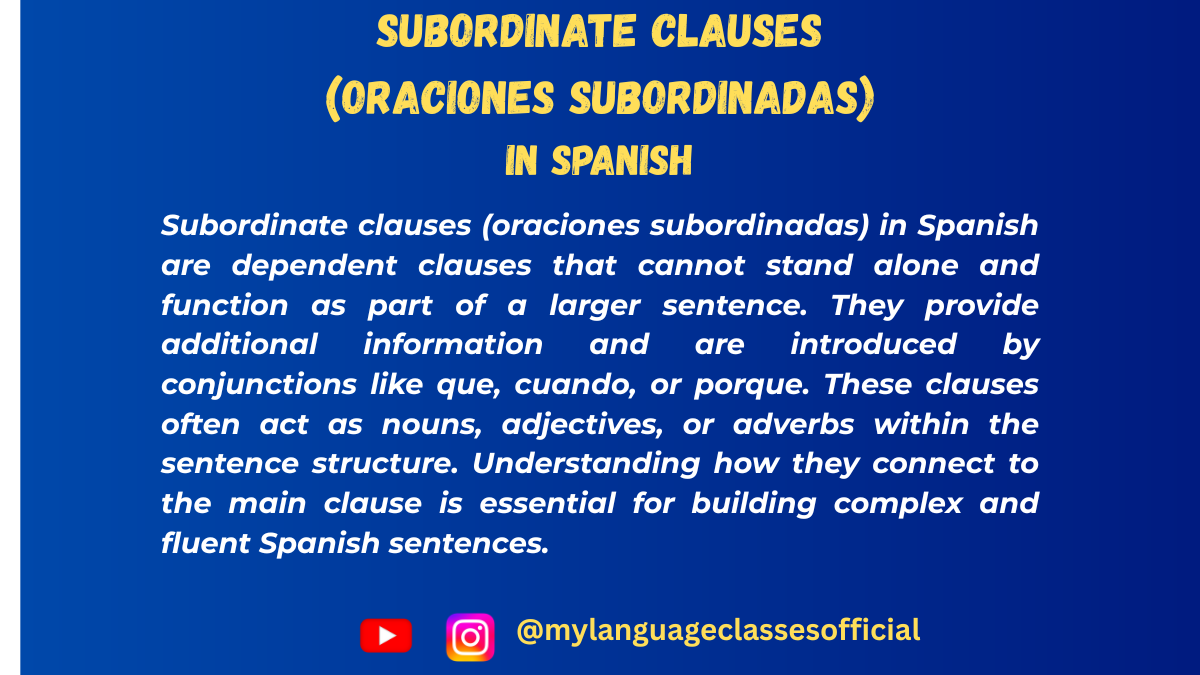
Subordinate clauses, or oraciones subordinadas in Spanish, are an essential part of mastering the language. They allow you to express complex ideas by connecting a main clause with a dependent clause. In simpler terms, a subordinate clause cannot stand alone as a complete sentence; it relies on the main clause to give it meaning. Whether you’re describing a condition, providing a reason, or expressing time, subordinate clauses are your go-to tool for adding depth and nuance to your Spanish conversations and writing.
In this blog post, we’ll explore everything you need to know about subordinate clauses in Spanish, including common expressions, conjugation rules, irregular verbs, and practical examples. By the end, you’ll be able to use subordinate clauses confidently in your daily Spanish communication.
Common Expressions Using Subordinate Clauses
Subordinate clauses are often introduced by specific conjunctions or expressions. Here’s a list of common ones used in everyday Spanish:
- Porque (because)
- Example: Estudio porque quiero aprender. (I study because I want to learn.)
- Aunque (although, even though)
- Example: Voy al parque aunque llueva. (I’m going to the park even if it rains.)
- Si (if)
- Example: Si tengo tiempo, te llamaré. (If I have time, I’ll call you.)
- Cuando (when)
- Example: Cuando llegues, avísame. (When you arrive, let me know.)
- Mientras (while)
- Example: Mientras cocino, escucho música. (While I cook, I listen to music.)
- Como (since, as)
- Example: Como no estudiaste, reprobaste. (Since you didn’t study, you failed.)
- Para que (so that)
- Example: Estudio mucho para que pueda aprobar. (I study a lot so that I can pass.)
- A menos que (unless)
- Example: No iré a menos que tú vayas. (I won’t go unless you go.)
- Después de que (after)
- Example: Después de que termines, llámame. (After you finish, call me.)
- Antes de que (before)
- Example: Llegaré antes de que empiece la película. (I’ll arrive before the movie starts.)
Things to Keep in Mind
When using subordinate clauses in Spanish, there are a few key points to remember:
- Verb Conjugation: The verb in the subordinate clause must agree with the subject and tense of the main clause.
- Example: Si tengo dinero, viajaré. (If I have money, I will travel.)
- Subjunctive Mood: Some subordinate clauses require the subjunctive mood, especially when expressing doubt, uncertainty, or hypothetical situations.
- Example: Espero que vengas. (I hope you come.)
- Articles and Gender: Ensure that articles and adjectives agree in gender and number with the nouns they modify.
- Example: El libro que compré es interesante. (The book that I bought is interesting.)
- Plural Forms: Pay attention to plural forms when using subordinate clauses.
- Example: Los niños que juegan son felices. (The children who play are happy.)
- Punctuation: In Spanish, subordinate clauses are often separated by commas when they precede the main clause.
- Example: Cuando llegues, avísame. (When you arrive, let me know.)
When to Use Subordinate Clauses
Subordinate clauses are used in various situations, including:
- Expressing Cause or Reason:
- No fui a la fiesta porque estaba cansado. (I didn’t go to the party because I was tired.)
- Describing Conditions:
- Si estudias, aprobarás. (If you study, you’ll pass.)
- Indicating Time:
- Cuando termine, te llamaré. (When I finish, I’ll call you.)
- Expressing Purpose:
- Estudio para que pueda conseguir un buen trabajo. (I study so that I can get a good job.)
- Showing Contrast:
- Aunque hace frío, voy a salir. (Even though it’s cold, I’m going out.)
Conjugation
Regular Verbs
Subordinate clauses can be formed with regular verbs in Spanish. Here’s how to conjugate them in the present tense:
- -AR Verbs (e.g., hablar)
- Yo hablo
- Tú hablas
- Él/Ella/Usted habla
- Nosotros hablamos
- Vosotros habláis
- Ellos/Ellas/Ustedes hablan
- -ER Verbs (e.g., comer)
- Yo como
- Tú comes
- Él/Ella/Usted come
- Nosotros comemos
- Vosotros coméis
- Ellos/Ellas/Ustedes comen
- -IR Verbs (e.g., vivir)
- Yo vivo
- Tú vives
- Él/Ella/Usted vive
- Nosotros vivimos
- Vosotros vivís
- Ellos/Ellas/Ustedes viven
Irregular Verbs
Irregular verbs in subordinate clauses follow unique conjugation patterns. Here are some common irregular verbs and their conjugations:
- Ser (to be)
- Yo soy
- Tú eres
- Él/Ella/Usted es
- Nosotros somos
- Vosotros sois
- Ellos/Ellas/Ustedes son
- Ir (to go)
- Yo voy
- Tú vas
- Él/Ella/Usted va
- Nosotros vamos
- Vosotros vais
- Ellos/Ellas/Ustedes van
- Tener (to have)
- Yo tengo
- Tú tienes
- Él/Ella/Usted tiene
- Nosotros tenemos
- Vosotros tenéis
- Ellos/Ellas/Ustedes tienen
Regular Verbs in Subordinate Clauses: Examples
| Verb | Example Sentence 1 | Meaning | Example Sentence 2 | Meaning |
|---|---|---|---|---|
| Hablar | Espero que hables con él. | I hope you talk to him. | Cuando hables, sé claro. | When you speak, be clear. |
| Comer | Quiero que comas sano. | I want you to eat healthy. | Si comes mucho, te sentirás mal. | If you eat too much, you’ll feel sick. |
| Vivir | Espero que vivas feliz. | I hope you live happily. | Cuando vivas aquí, lo entenderás. | When you live here, you’ll understand. |
| Estudiar | A menos que estudies, no aprobarás. | Unless you study, you won’t pass. | Estudio para que pueda aprender. | I study so that I can learn. |
| Trabajar | Cuando trabajes, sé responsable. | When you work, be responsible. | Trabajo para que mi familia tenga todo. | I work so that my family has everything. |
| Escribir | Espero que escribas una carta. | I hope you write a letter. | Si escribes bien, te publicarán. | If you write well, they’ll publish you. |
| Leer | Quiero que leas este libro. | I want you to read this book. | Cuando leas, comprenderás. | When you read, you’ll understand. |
| Correr | A menos que corras, no llegarás. | Unless you run, you won’t arrive. | Corro para que pueda mantenerme en forma. | I run so that I can stay in shape. |
| Bailar | Espero que bailes conmigo. | I hope you dance with me. | Si bailas bien, te felicitarán. | If you dance well, they’ll congratulate you. |
| Cantar | Quiero que cantes en la fiesta. | I want you to sing at the party. | Cuando cantes, todos te escucharán. | When you sing, everyone will listen to you. |
More Example Sentences
- Espero que vengas a la reunión. (I hope you come to the meeting.)
- Si llueve, no iremos al parque. (If it rains, we won’t go to the park.)
- Aunque esté cansado, terminaré el trabajo. (Even though I’m tired, I’ll finish the work.)
- Cuando llegues, avísame. (When you arrive, let me know.)
- Estudio mucho para que pueda aprobar. (I study a lot so that I can pass.)
- No iré a menos que tú vayas. (I won’t go unless you go.)
- Después de que termines, llámame. (After you finish, call me.)
- Llegaré antes de que empiece la película. (I’ll arrive before the movie starts.)
- Como no estudiaste, reprobaste. (Since you didn’t study, you failed.)
- Mientras cocino, escucho música. (While I cook, I listen to music.)
Fill in the Blanks
- Espero que _______ (venir) a la fiesta.
- Si _______ (tener) tiempo, te ayudaré.
- Aunque _______ (estar) cansado, iré.
- Cuando _______ (llegar), avísame.
- Estudio para que _______ (poder) aprobar.
- No iré a menos que tú _______ (ir).
- Después de que _______ (terminar), llámame.
- Llegaré antes de que _______ (empezar) la película.
- Como no _______ (estudiar), reprobaste.
- Mientras _______ (cocinar), escucho música.
Answers:
- vengas
- tienes
- esté
- llegues
- pueda
- vayas
- termines
- empiece
- estudiaste
- cocino
Conclusion
Mastering subordinate clauses in Spanish opens up a world of possibilities for expressing complex ideas and emotions. By understanding the rules of conjugation, recognizing common expressions, and practicing regularly, you’ll soon find yourself using oraciones subordinadas with ease. Whether you’re writing, speaking, or simply trying to understand native speakers, this guide will help you navigate the intricacies of Spanish grammar.
¡Buena suerte! (Good luck!)

Vikas Kumar is the founder of My Language Classes, a language learning platform dedicated to helping learners develop practical communication skills in Spanish, Japanese, and English through comprehensive grammar guides, structured learning resources, books, and evidence-informed educational content.
At My Language Classes, we believe that successful language learning is built on clarity, consistency, meaningful practice, and a deep understanding of how languages work. Every article is carefully researched and created to simplify complex concepts, provide practical guidance, and help learners develop confidence through real-world communication.
Inspired by the principles behind How Language Learning Really Works, our mission is to make high-quality language learning accessible to learners around the world by providing accurate, trustworthy, and comprehensive resources that support lasting progress, lifelong learning, and meaningful communication.
Leave a Reply