

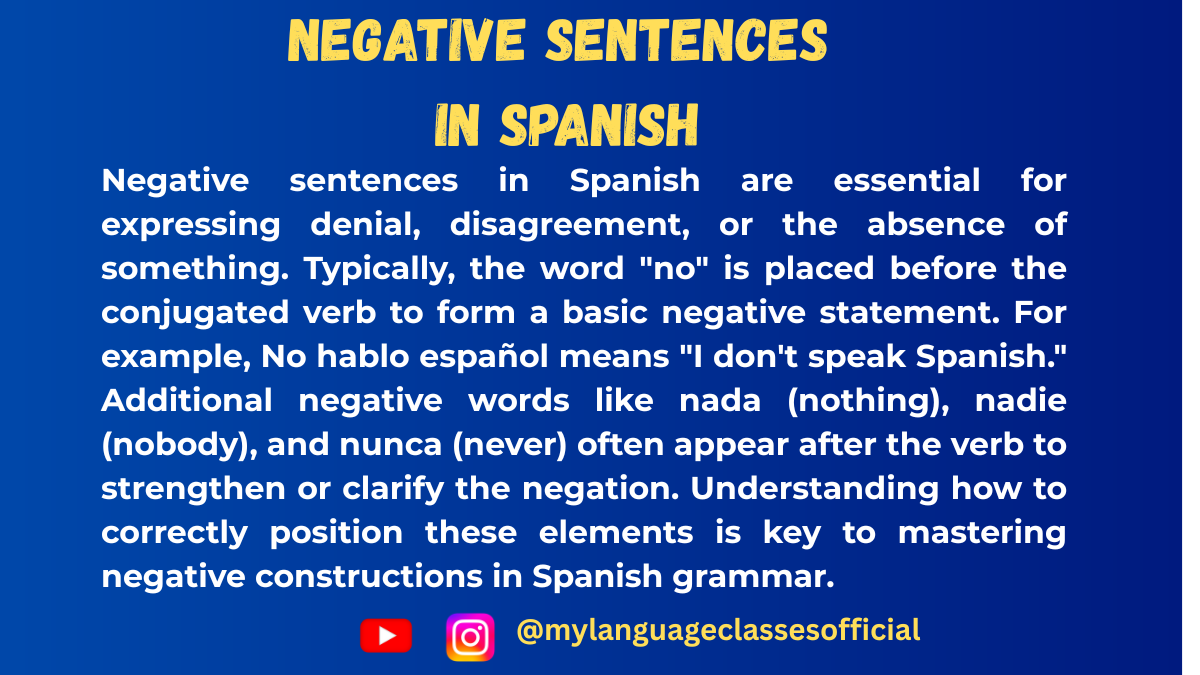
Negative Sentences in Spanish
When learning Spanish, mastering negative sentences is essential for effective communication. Negative sentences allow you to deny, contradict, or express the absence of something. This blog post will guide you through the rules, structures, and common considerations when constructing negative sentences in Spanish, including gender, articles, and plurals.
Basic Structure of Negative Sentences
In Spanish, the word “no” is the key to forming negative sentences. It is placed before the verb.
Examples:
- Affirmative: María canta bien. (María sings well.)
- Negative: María no canta bien. (María does not sing well.)
The structure is straightforward:
Subject + “no” + verb + complement.
Using Negative Words
In Spanish, additional negative words reinforce or replace “no.” These include:
- nada (nothing)
- nadie (nobody)
- ningún/ninguno/ninguna (none, no one)
- nunca (never)
- tampoco (neither)
Double Negatives
Unlike English, double negatives are not only acceptable but required in Spanish. For instance:
- No veo nada. (I don’t see anything.)
- No conozco a nadie. (I don’t know anyone.)
- No estudio nunca. (I never study.)
Here, “no” works in harmony with other negative words.
Gender and Plural Considerations
1. Gender Agreement
Negative words like ninguno and ninguna must agree with the gender of the noun they modify.
- Masculine singular:
No tengo ningún problema. (I don’t have any problem.) - Feminine singular:
No tengo ninguna idea. (I don’t have any idea.)
2. Plural Agreement
In most cases, ninguno is not pluralized, except in specific cases like inherently plural nouns:
- No tengo ningunas vacaciones este año. (I don’t have any vacations this year.)
Position of Negative Words
1. Before the Verb
Negative words like “no” are typically placed before the verb:
- No quiero comer. (I don’t want to eat.)
2. After the Verb
Other negative words may follow the verb for emphasis:
- No quiero nada. (I don’t want anything.)
If a subject pronoun is omitted (common in Spanish), pay attention to word order:
- Nadie sabe la respuesta. (Nobody knows the answer.)
Common Mistakes to Avoid
- Forgetting Double Negatives
Avoid translating English structures directly. Saying No sé algo instead of No sé nada is incorrect. - Ignoring Gender and Number Agreement
Ensure that words like ninguno/ninguna match the noun’s gender and number. - Mixing Articles Incorrectly
When using negative words, omit definite articles unless emphasizing specificity:
- Incorrect: No tengo la idea.
- Correct: No tengo idea.
Practical Tips
- Practice with Examples
Write affirmative and negative versions of sentences:
- Ella siempre llega a tiempo. (She always arrives on time.)
- Ella nunca llega a tiempo. (She never arrives on time.)
- Use Context to Choose Negative Words
- Use nada for “nothing” or “anything.”
- Use nadie when referring to “nobody” or “anybody.”
- Practice Conversations
Create scenarios to apply double negatives naturally:
- No tengo nada que decir. (I have nothing to say.)
Mastering negative sentences in Spanish opens up new possibilities for nuanced communication. Practice regularly, pay attention to gender and number agreement, and soon, negatives will become second nature.
¡Buena suerte! (Good luck!)

Vikas Kumar is the founder of My Language Classes, a language learning platform dedicated to helping learners develop practical communication skills in Spanish, Japanese, and English through comprehensive grammar guides, structured learning resources, books, and evidence-informed educational content.
At My Language Classes, we believe that successful language learning is built on clarity, consistency, meaningful practice, and a deep understanding of how languages work. Every article is carefully researched and created to simplify complex concepts, provide practical guidance, and help learners develop confidence through real-world communication.
Inspired by the principles behind How Language Learning Really Works, our mission is to make high-quality language learning accessible to learners around the world by providing accurate, trustworthy, and comprehensive resources that support lasting progress, lifelong learning, and meaningful communication.
Leave a Reply