

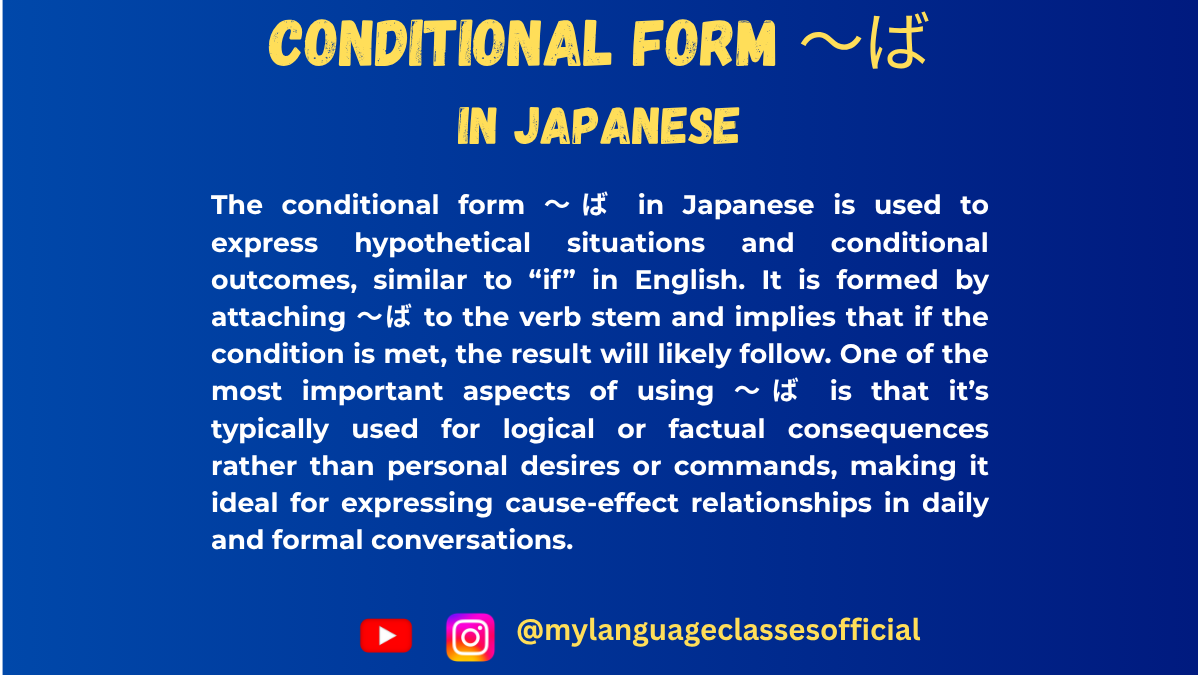
Understanding 〜ば: The Conditional Form in Japanese
The Japanese conditional form 〜ば is an essential grammatical structure used to express conditions, similar to “if” or “when” in English. It provides a flexible way to convey cause-and-effect relationships, hypothetical situations, and natural consequences. Let’s dive deep into its usage, exploring its nuances, and highlight situations where it can be used effectively.
What is 〜ば?
The particle 〜ば attaches to the stem of verbs or adjectives to create a conditional clause. It is equivalent to saying, “If [X], then [Y].”
How to Form 〜ば?
- For Verbs:
- Take the dictionary form of a verb.
- Convert the verb to its 仮定形 (hypothetical form) by changing the ending:
- Group 1 (五段動詞): Change the last character to its え-sound + ば.
- Example: 行く → 行けば
- Group 2 (一段動詞): Replace る with れば.
- Example: 食べる → 食べれば
- Irregular verbs:
- する → すれば
- くる → くれば
- Group 1 (五段動詞): Change the last character to its え-sound + ば.
- Result:
- Verb stem + ば = Conditional form.
- For Adjectives:
- い-adjectives:
- Drop the final い and add ければ.
- Example: 高い → 高ければ
- Drop the final い and add ければ.
- な-adjectives:
- Add ならば after the adjective stem.
- Example: 静か → 静かならば
- Add ならば after the adjective stem.
- い-adjectives:
- For Nouns:
- Add ならば after the noun.
- Example: 学生 → 学生ならば
- Add ならば after the noun.
Usage of 〜ば
- To Express Hypothetical Conditions
When you want to describe a situation that may or may not happen, 〜ば is perfect for creating “if” clauses.- Example:
明日雨が降れば、試合は中止です。
If it rains tomorrow, the match will be canceled.
- Example:
- To Indicate Natural or Logical Consequences
〜ば is often used to explain cause-and-effect relationships that feel natural.- Example:
努力すれば、成功します。
If you make an effort, you will succeed.
- Example:
- To Offer Suggestions or Advice
In conversational Japanese, 〜ば can give a softer tone when offering suggestions.- Example:
もっと早く寝れば、疲れが取れますよ。
If you sleep earlier, you’ll feel less tired.
- Example:
- To Express Regret or Reflection (Negative 〜ば)
When used in hindsight or regret, negative forms with 〜ば are common.- Example:
あの時、行かなければよかった。
I should not have gone at that time.
- Example:
- To Indicate Conditions for General Truths
Use 〜ば for statements that hold universally true under specific conditions.- Example:
火をつければ、水は蒸発する。
If you apply heat, water evaporates.
- Example:
- In Hypothetical Questions
〜ば is sometimes used to ask “what if” questions.- Example:
もし宝くじが当たれば、何をしますか?
If you win the lottery, what would you do?
- Example:
- Paired with Expressions of Hope or Desire
Combine 〜ば with verbs like いい or よい to express a wish or hope.- Example:
雨が止めばいいですね。
I hope the rain stops.
- Example:
- To Express Dependency
Describing situations where one thing depends on another.- Example:
彼が来れば、私たちは始めます。
If he comes, we will start.
- Example:
Key Points and Usage Notes
- Difference Between 〜ば and Other Conditionals (〜たら, 〜と, なら):
- 〜ば: Focuses on logical relationships and is often used for cause and effect.
- 〜たら: More versatile, used for real or imagined situations, often for past and specific contexts.
- 〜と: Used for natural consequences or habitual actions.
- 〜なら: Highlights conditions and is often used to suggest or clarify.
- 雨が降れば、試合は中止です。 (Logical relationship)
- 雨が降ったら、試合は中止です。 (Specific context, imagining the situation)
- 雨が降ると、試合は中止です。 (Natural consequence, habitual)
- 雨なら、試合は中止です。 (Condition clarified, suggesting understanding)
- Avoid Overusing 〜ば in Casual Speech:
While grammatically correct, 〜ば can sound formal or academic. For casual conversations, 〜たら or 〜と may be more natural. - Negating 〜ば:
To negate, use 〜なければ.- Example:
時間がなければ、参加しなくてもいいです。
If you don’t have time, you don’t need to participate.
- Example:
- Hypothetical Past with Regret:
Combine with expressions like よかった to express past hypotheticals.- Example:
もっと頑張ればよかった。
I should have tried harder.
- Example:
Situations Where 〜ば is Used
Here’s a summary of situations where you can use 〜ば effectively:
- Expressing hypothetical conditions.
- Explaining logical or natural consequences.
- Offering advice or suggestions.
- Reflecting on regrets or hindsight.
- Describing general truths or universal principles.
- Posing hypothetical or “what if” questions.
- Expressing hope or desire.
- Indicating dependencies between actions or events.
Practice Exercises
- Convert the following sentences into the 〜ば form:
- 明日、時間があるなら、一緒に映画を見ます。
- 成績が悪いと、両親に怒られます。
- Translate these English sentences into Japanese using 〜ば:
- If you study every day, you will pass the test.
- If it’s cold, let’s drink hot tea.
Mastering 〜ば will open up a range of expressive possibilities in your Japanese communication. With practice, you’ll find it natural to use this conditional form in both formal and everyday contexts. Keep practicing and experiment with its flexibility to become more fluent!
Happy learning! 😊

Vikas Kumar is the founder of My Language Classes, a language learning platform dedicated to helping learners develop practical communication skills in Spanish, Japanese, and English through comprehensive grammar guides, structured learning resources, books, and evidence-informed educational content.
At My Language Classes, we believe that successful language learning is built on clarity, consistency, meaningful practice, and a deep understanding of how languages work. Every article is carefully researched and created to simplify complex concepts, provide practical guidance, and help learners develop confidence through real-world communication.
Inspired by the principles behind How Language Learning Really Works, our mission is to make high-quality language learning accessible to learners around the world by providing accurate, trustworthy, and comprehensive resources that support lasting progress, lifelong learning, and meaningful communication.
Leave a Reply