

Understanding the Present Subjunctive (Presente de Subjuntivo) in Spanish
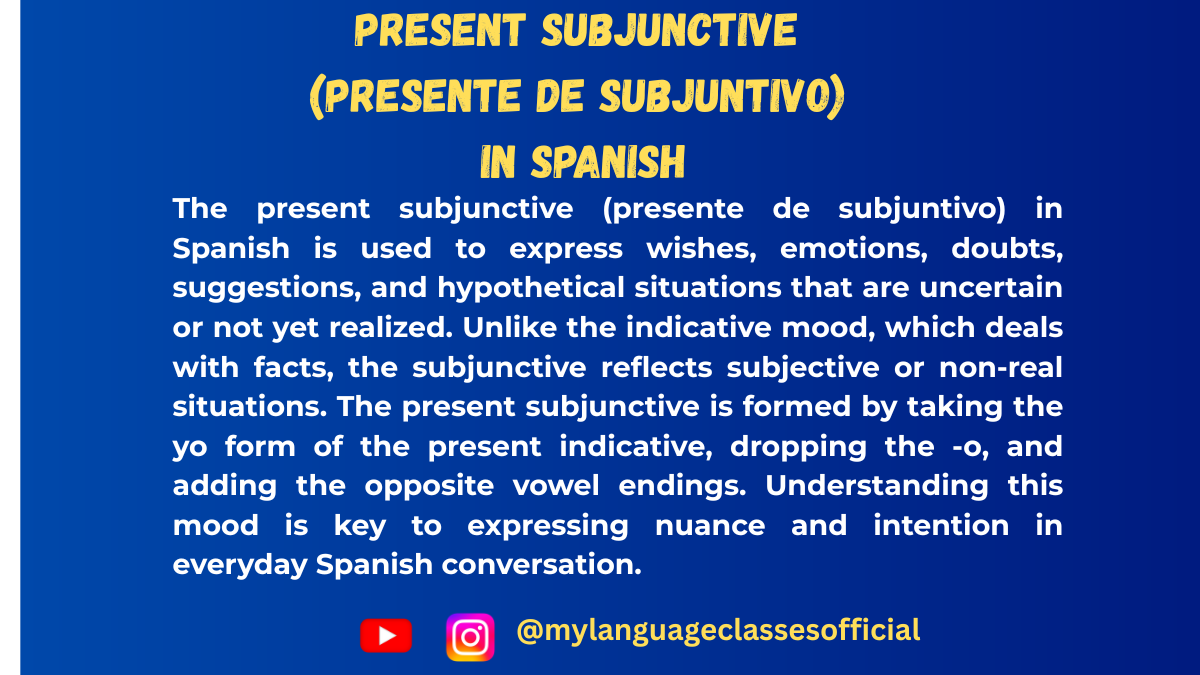
The Present Subjunctive (Presente de Subjuntivo) is a crucial concept in Spanish that expresses doubt, wishes, emotions, and subjective perceptions. Unlike the indicative, which is used for facts and certainty, the subjunctive emphasizes what is hypothetical, uncertain, or emotionally influenced.
Situations Where the Presente de Subjuntivo Is Used
- Expressions of Desire or Influence
Used when one person wants another person to do something.- Trigger Phrases: “Quiero que,” “Deseo que,” “Prefiero que.”
- Example:
- Indicative: Quiero aprender español. (I want to learn Spanish.)
- Subjunctive: Quiero que tú aprendas español. (I want you to learn Spanish.)
- Expressions of Doubt or Denial
Used with uncertainty or disbelief.- Trigger Phrases: “Dudo que,” “No creo que,” “Es posible que.”
- Example:
- Dudo que ella venga a la fiesta. (I doubt that she will come to the party.)
- Emotions and Reactions
Used to express feelings about actions or situations.- Trigger Phrases: “Me alegra que,” “Siento que,” “Temo que.”
- Example:
- Me alegra que tú estés aquí. (I’m glad you’re here.)
- Impersonal Expressions of Uncertainty or Emotion
When impersonal phrases signal subjectivity or uncertainty.- Trigger Phrases: “Es importante que,” “Es necesario que,” “Es increíble que.”
- Example:
- Es importante que estudiemos para el examen. (It’s important that we study for the exam.)
- Conjunctions That Express Future Uncertainty
Subjunctive is used after certain conjunctions if the action is uncertain or hasn’t occurred yet.- Trigger Conjunctions: “Para que,” “A menos que,” “Antes de que.”
- Example:
- Te lo explico para que lo entiendas. (I’ll explain it so you understand.)
- Negative Commands
For giving instructions to not do something.- Example:
- No hables con él. (Don’t talk to him.)
- Example:
Conjugating Verbs in the Presente de Subjuntivo
To conjugate regular verbs in the Present Subjunctive, follow these steps:
- Start with the first-person singular (yo) form of the verb in the present indicative.
- Remove the “-o” ending.
- Add the appropriate subjunctive ending based on the verb’s group (-AR, -ER, -IR).
Endings for Regular Verbs
| Verb Group | Yo | Tú | Él/Ella/Usted | Nosotros/Nosotras | Vosotros/Vosotras | Ellos/Ellas/Ustedes |
|---|---|---|---|---|---|---|
| -AR | -e | -es | -e | -emos | -éis | -en |
| -ER | -a | -as | -a | -amos | -áis | -an |
| -IR | -a | -as | -a | -amos | -áis | -an |
Examples of Regular Verbs
- Hablar (to speak)
- yo hable, tú hables, él/ella/usted hable, nosotros/nosotras hablemos, vosotros/vosotras habléis, ellos/ellas/ustedes hablen.
- Comer (to eat)
- yo coma, tú comas, él/ella/usted coma, nosotros/nosotras comamos, vosotros/vosotras comáis, ellos/ellas/ustedes coman.
- Vivir (to live)
- yo viva, tú vivas, él/ella/usted viva, nosotros/nosotras vivamos, vosotros/vosotras viváis, ellos/ellas/ustedes vivan.
Irregular Verbs in the Presente de Subjuntivo
Certain verbs are irregular in the Present Subjunctive and do not follow the standard rules. Below is a table of commonly used irregular verbs with their conjugations.
| Verb | Yo | Tú | Él/Ella/Usted | Nosotros/Nosotras | Vosotros/Vosotras | Ellos/Ellas/Ustedes |
| Ser | sea | seas | sea | seamos | seáis | sean |
| Ir | vaya | vayas | vaya | vayamos | vayáis | vayan |
| Estar | esté | estés | esté | estemos | estéis | estén |
| Saber | sepa | sepas | sepa | sepamos | sepáis | sepan |
| Haber | haya | hayas | haya | hayamos | hayáis | hayan |
| Dar | dé | des | dé | demos | deis | den |
| Ver | vea | veas | vea | veamos | veáis | vean |
Important Tips for Using the Presente de Subjuntivo
- Check for Triggers: The subjunctive is rarely used alone. Look for expressions that require it.
- Mind the Gender and Plurality: Match adjectives and nouns appropriately in gender (masculine/feminine) and number (singular/plural).
- Example: Es importante que las estudiantes estén preparadas.
- Distinguish Context: Ensure you use the subjunctive only when necessary to avoid confusion with the indicative.
- Practice Common Phrases: Memorize phrases where the subjunctive is frequently used to internalize its application.
By mastering the Presente de Subjuntivo, you open the door to expressing more nuanced thoughts and emotions in Spanish. Practice regularly, and don’t hesitate to use examples as guides in your learning journey. ¡Buena suerte!

Vikas Kumar is the founder of My Language Classes, a language learning platform dedicated to helping learners develop practical communication skills in Spanish, Japanese, and English through comprehensive grammar guides, structured learning resources, books, and evidence-informed educational content.
At My Language Classes, we believe that successful language learning is built on clarity, consistency, meaningful practice, and a deep understanding of how languages work. Every article is carefully researched and created to simplify complex concepts, provide practical guidance, and help learners develop confidence through real-world communication.
Inspired by the principles behind How Language Learning Really Works, our mission is to make high-quality language learning accessible to learners around the world by providing accurate, trustworthy, and comprehensive resources that support lasting progress, lifelong learning, and meaningful communication.
Leave a Reply