
Understanding 〜より〜のほうが
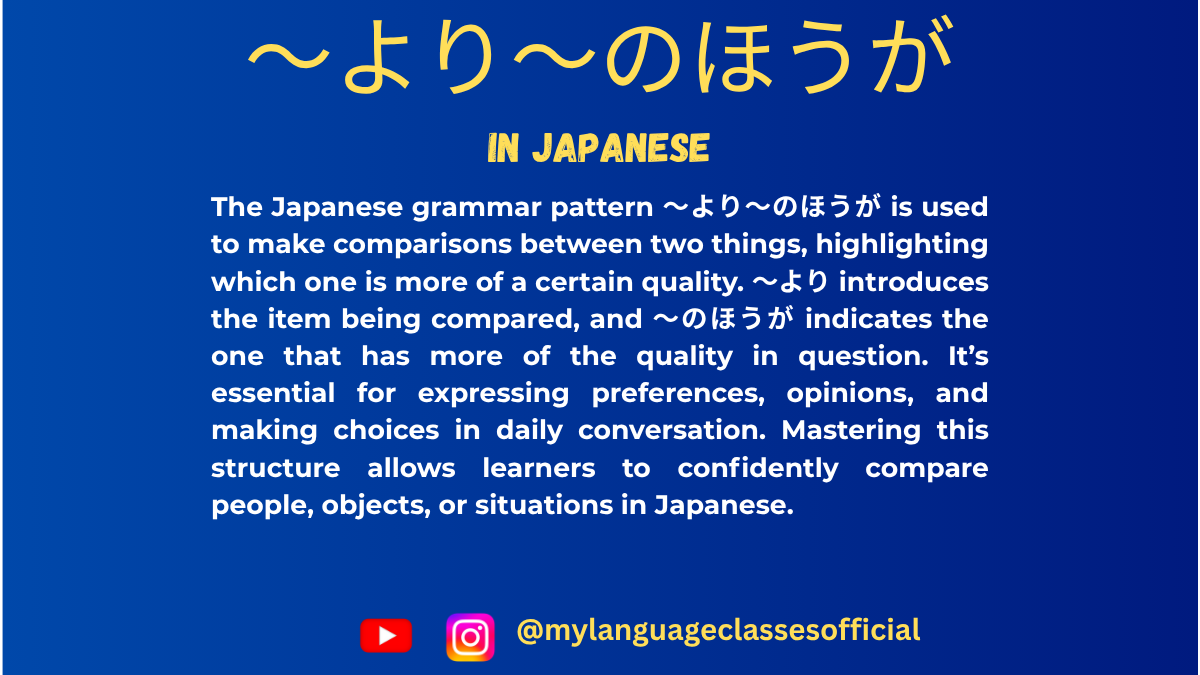
The construction 〜より〜のほうが is an essential tool in Japanese for making comparisons. It translates to “X is more than Y” or “X is better/more suitable than Y” and is widely used in everyday conversations, formal contexts, and written communication. This blog post dives into its meaning, usage, and various scenarios.
Structure of 〜より〜のほうが
The pattern is straightforward:
- Yより Xのほうが adjective/descriptive phrase.
- Yより: Indicates the thing being compared (Y).
- Xのほうが: Highlights the preferred or superior item (X).
Example:
- 犬より猫のほうが好きです。
(I like cats more than dogs.)
Core Uses of 〜より〜のほうが
- Preference
When expressing a preference between two items, activities, or options:- 旅行より勉強のほうが楽しいです。
(Studying is more fun than traveling.)
- 旅行より勉強のほうが楽しいです。
- Quantitative Comparisons
Highlighting differences in measurable qualities like size, speed, or price:- バスより電車のほうが早いです。
(Trains are faster than buses.) - このレストランよりあのレストランのほうが安いです。
(That restaurant is cheaper than this one.)
- バスより電車のほうが早いです。
- Capabilities
Used to compare abilities or skills:- 英語より日本語のほうが得意です。
(I’m better at Japanese than English.)
- 英語より日本語のほうが得意です。
- Frequency or Intensity
Comparing how often or how strongly something occurs:- 冬より夏のほうが好きです。
(I like summer more than winter.)
- 冬より夏のほうが好きです。
- Hypotheticals
For discussing hypothetical preferences or outcomes:- 映画館より家で映画を見たほうがいいです。
(Watching a movie at home is better than going to the cinema.)
- 映画館より家で映画を見たほうがいいです。
- Suitability
Indicating one option is more suitable for a specific purpose:- この仕事には男性より女性のほうが適しています。
(For this job, women are more suitable than men.)
- この仕事には男性より女性のほうが適しています。
Situations Where 〜より〜のほうが is Used
- Daily Conversations
- Comparing food, hobbies, weather, or locations:
- 寿司よりラーメンのほうがおいしいと思います。
(I think ramen is tastier than sushi.)
- 寿司よりラーメンのほうがおいしいと思います。
- Comparing food, hobbies, weather, or locations:
- Business and Professional Settings
- Discussing product qualities or work efficiency:
- この方法よりその方法のほうが効率的です。
(That method is more efficient than this one.)
- この方法よりその方法のほうが効率的です。
- Discussing product qualities or work efficiency:
- Travel and Leisure
- Comparing destinations, travel modes, or activities:
- 海外旅行より国内旅行のほうが安心です。
(Domestic travel is safer than international travel.)
- 海外旅行より国内旅行のほうが安心です。
- Comparing destinations, travel modes, or activities:
- Education and Learning
- Comparing subjects or teaching methods:
- 自習より先生に教えてもらうほうがいいです。
(Being taught by a teacher is better than self-study.)
- 自習より先生に教えてもらうほうがいいです。
- Comparing subjects or teaching methods:
- Relationships and Social Scenarios
- Evaluating people or interpersonal qualities:
- 彼より彼女のほうが優しいです。
(She is kinder than him.)
- 彼より彼女のほうが優しいです。
- Evaluating people or interpersonal qualities:
Key Notes
- Implied Context:
In conversational Japanese, the context often allows for the omission of repetitive elements:- 映画よりドラマのほうが好きです。(I like dramas more than movies.)
Can be shortened to:- ドラマのほうが好きです。 (I like dramas more.)
- 映画よりドラマのほうが好きです。(I like dramas more than movies.)
- Neutrality:
The phrase is neutral and doesn’t carry judgmental connotations, making it versatile for all scenarios. - Politeness Levels:
Depending on the situation, you can adjust politeness levels:- Casual: 〜より〜のほうがいい。
- Polite: 〜より〜のほうがいいです。
- Formal: 〜より〜のほうが適切です。
Practice Examples
- 自転車より車のほうが速いです。
(Cars are faster than bicycles.) - テレビを見るより本を読むほうがいいです。
(Reading books is better than watching TV.) - 東京より大阪のほうが住みやすいと思います。
(I think Osaka is easier to live in than Tokyo.)
By mastering 〜より〜のほうが, you can convey nuanced preferences and comparisons effectively. Practice using it in different contexts to build fluency!
What comparisons will you try making today? Let me know in the comments!
Happy learning! 😊

Vikas Kumar is the founder of My Language Classes, a language learning platform dedicated to helping learners develop practical communication skills in Spanish, Japanese, and English through comprehensive grammar guides, structured learning resources, books, and evidence-informed educational content.
At My Language Classes, we believe that successful language learning is built on clarity, consistency, meaningful practice, and a deep understanding of how languages work. Every article is carefully researched and created to simplify complex concepts, provide practical guidance, and help learners develop confidence through real-world communication.
Inspired by the principles behind How Language Learning Really Works, our mission is to make high-quality language learning accessible to learners around the world by providing accurate, trustworthy, and comprehensive resources that support lasting progress, lifelong learning, and meaningful communication.
Leave a Reply