

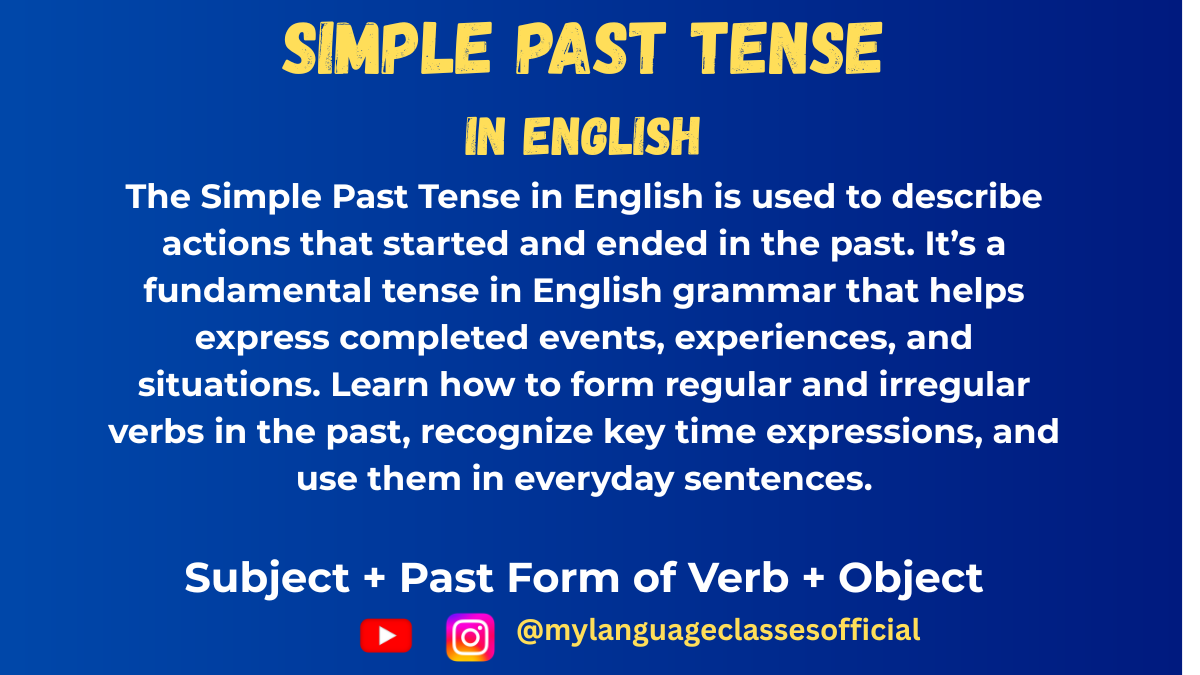
Simple Past Tense in English is used to talk about actions, events, situations, and states that belong to the past. It is one of the most frequently used English tenses because everyday communication often involves describing what happened earlier, what someone did yesterday, or how a situation changed over time.
Consider these sentences:
I visited my friend yesterday.
She finished her homework last night.
They moved to Chicago in 2022.
He worked at the company for five years.
We watched a movie after dinner.
In each sentence, the speaker places the situation in the past. The event does not need to be happening now, and the sentence does not necessarily connect the event with the present. The main focus is that the situation occurred at an earlier time.
The Simple Past is also useful when several past events happened one after another:
I woke up, took a shower, ate breakfast, and left for work.
The tense allows the listener to understand these events as completed parts of a past sequence.
Forming the Simple Past depends on the verb. Regular verbs usually take an “-ed” ending, while irregular verbs have different past forms:
work → worked
visit → visited
play → played
go → went
see → saw
take → took
The structure also changes when we form negative sentences and questions. With most ordinary verbs, “did” becomes the auxiliary verb in these structures:
I did not visit her.
Did you visit her?
After “did” or “did not,” the main verb returns to its base form.
The Simple Past therefore involves more than adding “-ed” to a verb. To use it accurately, learners need to understand past time, verb forms, auxiliary verbs, and the difference between completed past situations and situations expressed through other English tenses.
A clear understanding of these relationships provides a stronger foundation for studying English tense patterns, including the broader system presented in Complete English Tenses Mastery Guide.
What Is the Simple Past Tense in English?
The Simple Past Tense in English describes an action, event, situation, or state that happened or existed in the past. The speaker presents it as belonging to an earlier time rather than as an activity that is continuing in the present.
For example:
I visited New York last year.
She finished the report yesterday.
They moved to Texas in 2021.
He worked at the school for five years.
In each sentence, the situation belongs to the past. The time may be stated directly, as in “last year” or “yesterday,” or it may be clear from the surrounding conversation.
The Simple Past can describe a single completed event:
I called my brother last night.
It can also describe several completed events:
I woke up early, made coffee, and went to work.
Here, each action occurred in the past, and the events are presented as a sequence.
The tense can also describe repeated actions or habits that belonged to an earlier period:
When I was a child, I walked to school every day.
She visited her grandparents every summer.
These actions happened repeatedly, but the speaker presents them as part of a past period.
The Simple Past is not limited to physical actions. It can describe past states as well:
I lived in Boston for three years.
She knew the answer.
They owned a small restaurant.
He felt nervous before the interview.
The important idea is that the situation is viewed from the past. The speaker is not using the Simple Past simply because an action happened before the present. The choice also depends on how the speaker relates that situation to the present and to other events.
This becomes especially important when comparing the Simple Past with the Present Perfect. Compare:
I visited Japan in 2022.
I have visited Japan.
The first sentence places the visit at a specific finished time. The second presents the visit as a past experience without specifying a finished past time.
The Simple Past therefore gives English speakers a straightforward way to locate completed events, past states, repeated actions, and sequences within an earlier period. Understanding that basic relationship with past time makes the different forms and uses of the tense much easier to organize, especially within the wider system explained in Complete English Tenses Mastery Guide.
What Is the Simple Past Tense Formula?
The Simple Past Tense uses different structures depending on whether the sentence is affirmative, negative, or interrogative. The main verb also behaves differently in affirmative sentences and in sentences that use the auxiliary verb “did.”
For most ordinary verbs, the basic affirmative structure is:
Subject + past form of the verb + rest of the sentence
For example:
I visited my friend yesterday.
She finished the report last night.
They watched a movie after dinner.
He worked at the company for five years.
With regular verbs, the past form usually ends in “-ed.” With irregular verbs, the past form changes in a different way:
I walked to school.
She went to school.
They played tennis.
He took the train.
For negative sentences, use “did not” followed by the base form of the main verb:
Subject + did not + base form of the verb + rest of the sentence
For example:
I did not visit my friend.
She did not finish the report.
They did not watch the movie.
He did not take the train.
The main verb does not remain in its past form after “did not.” This is an important structural rule.
Incorrect: She did not finished the report.
Correct: She did not finish the report.
Questions with ordinary verbs follow a similar pattern:
Did + subject + base form of the verb?
For example:
Did you visit your friend?
Did she finish the report?
Did they watch the movie?
Did he take the train?
Again, the main verb returns to its base form because “did” carries the past tense.
The verb “be” follows a different pattern. Its Simple Past forms are “was” and “were”:
I was tired.
She was at home.
They were busy.
We were late.
Negative and question structures with “was” and “were” do not normally use “did”:
She was not tired.
Were they at home?
This distinction between ordinary verbs and “be” is important because the Simple Past is not formed through one single pattern in every sentence. The verb itself determines part of the structure.
Once the roles of the past form, “did,” “was,” and “were” are clear, the Simple Past becomes much easier to form accurately. These structures also fit into the larger pattern of English tense formation explained in Complete English Tenses Mastery Guide.
How Do You Form Affirmative Simple Past Sentences?
Affirmative Simple Past sentences are formed by using the subject followed by the past form of the main verb. The structure is straightforward, but the form of the verb depends on whether the verb is regular or irregular.
The basic structure is:
Subject + past form of the verb + rest of the sentence
For example:
I visited my friend yesterday.
She watched a movie last night.
They finished the project on Monday.
He called his brother after work.
With regular verbs, the past form is generally created by adding “-ed” to the base verb:
work → worked
play → played
visit → visited
clean → cleaned
For example:
I worked from home yesterday.
She played tennis on Saturday.
They visited their grandparents last weekend.
He cleaned the kitchen in the morning.
However, regular verbs can require spelling changes when the “-ed” ending is added. For example:
study → studied
live → lived
stop → stopped
The pronunciation of the “-ed” ending can also vary, but the spelling still represents the Simple Past form.
Irregular verbs do not follow one single pattern. Their past forms must be learned according to the individual verb:
go → went
take → took
see → saw
buy → bought
write → wrote
For example:
She went to the store yesterday.
He took the train to work.
We saw a movie last night.
They bought a new computer.
I wrote an email to my manager.
Unlike negative sentences and questions, affirmative sentences with ordinary verbs do not normally use “did” as an auxiliary. The past form itself carries the past meaning:
She visited her parents.
Not:
She did visited her parents.
When “did” is used for emphasis, however, the main verb returns to its base form:
I did visit her yesterday.
Here, “did” carries the past tense and adds emphasis, while “visit” remains in its base form.
The subject does not change the past form of an ordinary verb:
I worked.
You worked.
He worked.
She worked.
We worked.
They worked.
This is different from the Simple Present, where third-person singular subjects usually require a different verb form. In the Simple Past, regular and irregular verbs generally have one past form for all subjects.
Understanding the difference between regular and irregular past forms is essential for forming affirmative sentences naturally. These verb patterns are an important part of the wider English tense system presented in Complete English Tenses Mastery Guide.
How Do You Form Negative Simple Past Sentences?
Negative Simple Past sentences are formed with “did not” followed by the base form of the main verb. The important point is that “did” carries the past tense, so the main verb does not take its past form.
The basic structure is:
Subject + did not + base form of the verb + rest of the sentence
For example:
I did not visit my friend yesterday.
She did not finish the report.
They did not watch the movie.
He did not take the train.
The form “did not” can be shortened to “didn’t” in everyday English:
I didn’t visit my friend yesterday.
She didn’t finish the report.
They didn’t watch the movie.
He didn’t take the train.
Both the full form and the contraction are grammatically correct. The full form can be useful when the speaker wants to give greater emphasis to the negative statement or when a more formal style is appropriate.
One of the most important rules is that the main verb must remain in its base form after “did not” or “didn’t.”
Incorrect: She did not finished the report.
Correct: She did not finish the report.
Incorrect: They didn’t went to the restaurant.
Correct: They didn’t go to the restaurant.
Incorrect: He did not studied yesterday.
Correct: He did not study yesterday.
This rule applies to both regular and irregular verbs:
I did not work.
I did not go.
She did not study.
She did not take the bus.
The reason is that “did” already expresses the past. Adding another past form to the main verb creates an incorrect structure.
Negative sentences with “was” and “were” work differently because “was” and “were” are already the past forms of “be.” They do not normally use “did”:
I was not tired.
She was not at home.
They were not ready.
We were not late.
The contractions “wasn’t” and “weren’t” are also common:
I wasn’t tired.
She wasn’t at home.
They weren’t ready.
We weren’t late.
Understanding this difference between ordinary verbs and “be” prevents one of the most common Simple Past errors. With ordinary verbs, use “did not + base verb.” With “be,” use “was not” or “were not” directly.
Once this structure is clear, negative Simple Past sentences become predictable across regular and irregular verbs. The same relationship between auxiliary verbs and main verbs appears throughout the English tense system explained in Complete English Tenses Mastery Guide.
How Do You Form Simple Past Questions?
Simple Past questions with ordinary verbs are formed by placing “did” before the subject and using the base form of the main verb. The auxiliary “did” carries the past tense, so the main verb does not take its past form.
The basic structure is:
Did + subject + base form of the verb?
For example:
Did you visit your friend?
Did she finish the report?
Did they watch the movie?
Did he take the train?
The same structure applies to regular and irregular verbs:
Did you work yesterday?
Did she study last night?
Did they go to the restaurant?
Did he see the doctor?
Notice that the main verb remains in its base form even when it is irregular:
Did she go?
Not:
Did she went?
Similarly:
Did he take the train?
Not:
Did he took the train?
This happens because “did” already expresses the past tense.
Simple Past questions can also include time expressions:
Did you visit her yesterday?
Did they move here last year?
Did she call you this morning?
Did he finish the project on Monday?
The question can ask about a completed event without necessarily stating the exact time:
Did you see that movie?
Did she speak to the manager?
Did they finish the work?
Questions with “was” and “were” follow a different structure because “be” does not use “did” in this form:
Was he tired?
Was she at home?
Were they ready?
Were you busy yesterday?
The same distinction applies to negative questions:
Did you not finish the report?
Was she not at home?
In everyday English, contractions are also common:
Didn’t you finish the report?
Wasn’t she at home?
However, the basic grammatical structure remains the same.
One important point is that “did” is not normally used with “was” or “were” to form these questions. Avoid forms such as:
Incorrect: Did she was tired?
Correct: Was she tired?
Incorrect: Did they were late?
Correct: Were they late?
The structure of Simple Past questions becomes much easier once the role of “did” is understood. With ordinary verbs, “did” marks the past and the main verb stays in its base form. With “be,” “was” or “were” moves before the subject. These patterns are part of the larger system of English tense formation explained in Complete English Tenses Mastery Guide.
How Do You Form WH Questions in the Simple Past?
WH questions in the Simple Past are used when the speaker wants specific information about a past action, event, person, place, reason, or time. Common question words include “what,” “where,” “when,” “why,” “who,” and “how.”
For most WH questions with ordinary verbs, the basic structure is:
WH word + did + subject + base form of the verb?
For example:
What did you buy?
Where did she go?
When did they arrive?
Why did he leave?
How did you solve the problem?
The main verb stays in its base form because “did” already carries the past tense:
What did you see?
Where did he work?
Why did she leave?
Not:
What did you saw?
Where did he worked?
Why did she left?
The question word can ask about different parts of the past situation.
“What” can ask about an object, activity, or information:
What did you eat for dinner?
What did she write?
What did they discuss?
“Where” asks about a place:
Where did you stay?
Where did he work?
Where did they go?
“When” asks about a time:
When did she arrive?
When did you start the job?
When did they move here?
“Why” asks about a reason:
Why did he leave early?
Why did she cancel the meeting?
Why did they change their plans?
“How” can ask about the manner or method:
How did you learn English?
How did they solve the problem?
How did she get there?
“How long” can ask about the duration of a completed past situation:
How long did you stay there?
How long did he work at the company?
“How many” can ask about a number:
How many books did you buy?
How many people did she invite?
Questions with “who” require some care because “who” can function as either the subject or the object of the sentence.
When “who” is the object, “did” is used:
Who did you meet yesterday?
Who did she call?
When “who” is the subject, “did” is generally not used:
Who called you yesterday?
Who visited the office?
Here, “who” itself represents the person performing the action.
The verb “be” follows a different pattern:
Where was she yesterday?
Why was he late?
Where were they last night?
Who was at the meeting?
The auxiliary “did” is not used with “was” or “were” in these questions.
Understanding whether the question word represents the subject, object, place, time, reason, or another part of the sentence helps learners form WH questions accurately. These patterns are part of the larger structure of English tense formation explained in Complete English Tenses Mastery Guide.
What Are Regular Verbs in the Simple Past?
Regular verbs form their Simple Past tense according to predictable spelling patterns. In most cases, the past form is created by adding “-ed” to the base form of the verb.
For example:
work → worked
play → played
visit → visited
clean → cleaned
watch → watched
These forms can be used with every subject:
I worked yesterday.
She worked yesterday.
They worked yesterday.
The verb form does not change according to the subject in affirmative Simple Past sentences. This makes regular past forms different from some present-tense forms, where the verb can change with third-person singular subjects.
The “-ed” ending applies to many common verbs:
I opened the door.
She answered the question.
We finished the meeting.
They watched a movie.
He called his friend.
However, adding “-ed” is not always as simple as attaching the three letters to the base verb. Some regular verbs require spelling changes before the ending is added. For example:
study → studied
try → tried
stop → stopped
plan → planned
live → lived
These changes follow recognizable spelling patterns and help maintain the pronunciation and spelling of the word.
It is also important to separate spelling from pronunciation. The “-ed” ending can have different pronunciations in the Simple Past:
worked
played
wanted
Although the ending sounds different in these words, all three are regular past forms.
Regular verbs are also used after “did” in negative sentences and questions, but the verb returns to its base form:
She worked yesterday.
She did not work yesterday.
Did she work yesterday?
The past form “worked” appears in the affirmative sentence. After “did” or “did not,” the base form “work” is used.
This pattern is important because learners sometimes carry the “-ed” form into questions and negative sentences:
Incorrect: Did she worked yesterday?
Correct: Did she work yesterday?
Once the role of “-ed” and “did” is clear, regular verbs become much easier to use accurately in the Simple Past. Their spelling patterns also provide a useful foundation for understanding how English forms past-tense verbs, as explained in Complete English Tenses Mastery Guide.
How Do You Add -ed to Regular Verbs in the Simple Past?
Regular verbs usually form the Simple Past by adding “-ed,” but the spelling of the verb can change depending on how the base form ends. Understanding these patterns makes it easier to form past-tense verbs accurately instead of treating every verb as a simple addition of three letters.
For most regular verbs, add “-ed” directly to the base form:
work → worked
clean → cleaned
watch → watched
open → opened
visit → visited
For example:
I worked late yesterday.
She cleaned the kitchen.
They watched a movie last night.
He visited his parents on Sunday.
When a verb already ends in “e,” add only “-d”:
live → lived
love → loved
move → moved
arrive → arrived
For example:
We lived there for three years.
She loved the movie.
They moved to Boston in 2022.
The final “e” remains, so adding another “e” is unnecessary.
Verbs ending in a consonant followed by “y” usually change “y” to “i” before adding “-ed”:
study → studied
try → tried
carry → carried
worry → worried
For example:
She studied English last night.
He tried to call me.
They carried the boxes upstairs.
However, when a verb ends in a vowel followed by “y,” the “y” normally remains:
play → played
enjoy → enjoyed
stay → stayed
For example:
We played tennis yesterday.
She enjoyed the concert.
They stayed at the hotel.
Some short verbs ending in a single stressed vowel followed by a single consonant double the final consonant before adding “-ed”:
stop → stopped
plan → planned
prefer → preferred
For example:
The bus stopped outside the school.
She planned the trip carefully.
He preferred the earlier flight.
The doubling rule depends on the spelling and stress pattern of the verb, so it should not be applied to every verb ending in a consonant. For example:
visit → visited
open → opened
offer → offered
These verbs do not normally double the final consonant.
There is also an important distinction between spelling and pronunciation. The “-ed” ending can be pronounced differently depending on the final sound of the base verb:
worked
played
wanted
The spelling remains related to the same past-tense ending, even though the pronunciation changes.
These spelling patterns apply to affirmative Simple Past forms. When “did” is used in questions or negative sentences, the verb returns to its base form:
She studied yesterday.
She did not study yesterday.
Did she study yesterday?
The spelling rules for regular past forms become much easier when they are understood as patterns rather than isolated words. They provide a consistent foundation for forming the Simple Past and recognizing regular verb forms in written English. These patterns are also part of the broader tense system covered in Complete English Tenses Mastery Guide.
What Are Irregular Verbs in the Simple Past?
Irregular verbs are verbs that do not form their Simple Past by following the regular “-ed” pattern. Instead, their past forms change in different ways. Some change completely, some change only slightly, and some have the same form in the present and past.
Common examples include:
go → went
see → saw
take → took
write → wrote
buy → bought
come → came
For example:
I went to the store yesterday.
She saw her friend at the station.
They took the train home.
He wrote an email last night.
We bought a new table.
Unlike regular verbs, irregular verbs do not follow one single spelling rule. Learners therefore need to become familiar with the individual past forms.
Some irregular verbs change their vowel:
sing → sang
drink → drank
begin → began
Some change more substantially:
go → went
be → was/were
have → had
do → did
Others have the same form in the Simple Past as in the base form:
cut → cut
put → put
hit → hit
For example:
She cut the paper yesterday.
He put the book on the table.
They hit the ball over the fence.
Although the affirmative past form can be irregular, the verb returns to its base form after “did”:
She went to work.
She did not go to work.
Did she go to work?
The same principle applies to other irregular verbs:
He took the bus.
He did not take the bus.
Did he take the bus?
They saw the movie.
They did not see the movie.
Did they see the movie?
This is an important distinction. The irregular past form is used directly in affirmative sentences, but “did” carries the past tense in negative sentences and questions.
Irregular verbs are especially common in everyday English, so learning their past forms is an important part of developing accurate communication. Rather than treating them as one large group with a single rule, it is more useful to notice their different patterns and become familiar with the forms through meaningful examples. These verb patterns fit into the larger structure of English tense formation explained in Complete English Tenses Mastery Guide.
When Do You Use the Simple Past for Completed Actions?
The Simple Past is commonly used for actions and events that were completed in the past. The speaker presents the situation as finished and places it within an earlier period.
For example:
I finished my homework last night.
She called me yesterday.
They visited the museum on Saturday.
He bought a new laptop last month.
In each sentence, the action is presented as completed. The speaker is describing what happened rather than focusing on an activity that is still continuing.
The past time can be stated directly:
We moved to Chicago in 2020.
She graduated from college in 2018.
They opened the restaurant last year.
The time can also be understood from the context:
I saw John at the station.
She called earlier.
We watched a movie after dinner.
Even when the exact time is not mentioned, the speaker can use the Simple Past when the situation is understood as belonging to a completed past period.
The Simple Past is also useful when a completed action forms part of a sequence:
I got up, took a shower, ate breakfast, and left for work.
She opened the door, walked inside, and sat down.
The events are presented one after another, and each completed action moves the story forward.
A finished past action can also have a consequence in the present without requiring the Present Perfect. The choice depends on how the speaker frames the event:
I lost my keys yesterday.
The sentence simply reports a past event and identifies when it happened. If the speaker instead wants to emphasize the present consequence without a finished-time reference, the Present Perfect may be more appropriate:
I have lost my keys.
The difference is not simply whether the action happened before now. It depends on how the speaker relates the event to time and to the present.
The Simple Past can also describe an activity that continued for a period but has completely ended:
I lived in Boston for five years.
She worked at the company for ten years.
They stayed in Japan for three months.
The duration does not make the tense continuous. The important point is that the situation belongs to a completed past period.
The Simple Past is therefore the natural choice when the speaker presents an action or situation as finished and located in the past. Understanding this relationship between completion, time reference, and present relevance helps learners choose the tense more accurately, as explained in Complete English Tenses Mastery Guide.
How Do You Use the Simple Past for a Series of Past Events?
The Simple Past is often used to describe several events that happened one after another in the past. Each event is presented as completed, and the order of the verbs helps the reader or listener understand how the situation developed.
For example:
I woke up, made breakfast, and left for work.
She opened the door, walked inside, and sat down.
They arrived at the station, bought their tickets, and boarded the train.
In these examples, each action happened after the previous one. The Simple Past allows the speaker to present the events as a clear sequence.
This use is particularly common when telling stories or describing what happened during a particular day:
I got home at six, changed my clothes, cooked dinner, and watched television.
The sequence does not always need a time expression for every individual action. Once the speaker establishes the past context, the Simple Past can carry the sequence naturally.
Words such as “then,” “after that,” “later,” and “finally” can make the order even clearer:
She finished her work, then she called her sister.
We had dinner, and after that, we went for a walk.
He checked the documents, spoke to the manager, and finally signed the agreement.
The Simple Past can also describe a series of events in a story where one action leads to another:
The company opened a new office, hired more employees, and expanded its services.
The events are presented as completed developments in the past.
When describing a sequence, the Simple Past does not necessarily mean that every action happened immediately after the previous one. The surrounding context can establish the time between events:
She graduated from college, worked in New York for two years, and moved to California.
The actions happened in a particular order, even though the first and second events were separated by a substantial period.
The tense can also be combined with time expressions:
I arrived at the airport at 8 a.m., checked in, and went through security.
They moved to Seattle in 2020, bought a house, and started a new business.
The important feature is that the speaker views each event as part of a completed sequence in the past.
The Simple Past is therefore especially useful for narratives, personal experiences, historical accounts, and descriptions of what happened during a finished period. The sequence of past-tense verbs gives the listener a clear sense of how the events unfolded, a pattern that fits into the wider tense system explained in Complete English Tenses Mastery Guide.
When Do You Use the Simple Past for Past Habits?
The Simple Past can describe repeated actions and habits that belonged to an earlier period of a person’s life. The important point is that the speaker presents the repeated behavior as part of the past rather than as a current habit.
For example:
When I was a child, I walked to school every day.
She visited her grandparents every summer.
He played soccer after school.
They went to the beach every weekend.
These sentences describe actions that happened repeatedly during a past period. Expressions such as “every day,” “every summer,” and “every weekend” make the repeated nature of the activity clear.
The Simple Past can also describe a habit without an expression such as “every day” when the context already establishes repetition:
When we lived in the countryside, we walked everywhere.
When she worked in New York, she took the subway to work.
When they were students, they studied together.
The surrounding phrase establishes the past period in which the repeated action occurred.
The Simple Past can describe both frequent and occasional repeated actions:
I called my grandmother every Sunday.
We visited that restaurant from time to time.
He often stayed late at the office.
The frequency can be expressed with words such as “often,” “usually,” “sometimes,” and “every.”
Past habits can also involve states or preferences:
I loved reading when I was younger.
She preferred tea when she lived in England.
They believed the town was safer in those days.
These sentences describe conditions or attitudes that belonged to an earlier period.
It is useful to distinguish the Simple Past from “used to.” Both can describe past habits:
I walked to school every day.
I used to walk to school every day.
The Simple Past presents the repeated action as a past fact. “Used to” places stronger emphasis on the fact that the habit existed in the past and is no longer the speaker’s current situation.
The Simple Past can also describe repeated actions that occurred for a limited period:
During college, I worked at a bookstore on weekends.
For several years, she visited her parents every month.
The repetition belongs to a defined past period, which makes the Simple Past appropriate.
The Simple Past is therefore useful for describing habits and repeated actions that are viewed as part of a completed past period. The surrounding context, time expressions, and meaning help show that the repetition belongs to the past rather than continuing as a current habit. This distinction is part of the wider understanding of English tense usage developed in Complete English Tenses Mastery Guide.
When Do You Use the Simple Past for Past States?
The Simple Past can describe states, conditions, feelings, beliefs, relationships, possession, and other situations that existed during an earlier period. The tense is not limited to physical actions. What matters is that the state is presented as belonging to the past.
For example:
I lived in Boston for five years.
She knew the answer.
They owned a small restaurant.
He felt nervous before the interview.
We believed the plan would work.
These sentences describe situations rather than individual physical actions. The Simple Past shows that the situations existed during a past period.
The past state can be connected to a specific time:
I was tired yesterday.
She was sick last week.
They were happy during their vacation.
He felt nervous before the meeting.
It can also be connected to a longer period:
I lived in Japan for three years.
She worked at the university for ten years.
They owned that house until 2018.
The situation may have continued for a substantial amount of time, but the Simple Past is still appropriate when the entire period is viewed as finished.
Some common verbs used to describe past states include “be,” “know,” “believe,” “like,” “love,” “want,” “need,” “own,” “live,” and “understand”:
I knew him when we were children.
She liked the city when she lived there.
They owned the business for twenty years.
He understood the problem after the explanation.
The Simple Past can also describe a change from one past state to another:
I lived in Chicago until 2019, then I moved to Denver.
She worked in a bank before she became a teacher.
They owned a small house before they bought a larger one.
Here, the Simple Past presents each state as part of a completed past sequence.
The distinction between a past state and a current state can also affect tense choice:
I lived in New York for five years.
I live in New York.
The first sentence places the living situation in a completed past period. The second presents it as a current situation.
The Simple Past is therefore useful whenever a state or condition is understood as belonging to a finished or earlier period. Recognizing that tense describes states as well as actions gives learners a more complete understanding of how the Simple Past works within the English tense system covered in Complete English Tenses Mastery Guide.
How Do You Use the Simple Past with Specific Past Time?
The Simple Past is commonly used when an action, event, or situation is connected to a specific finished time in the past. The time expression helps the listener understand when the event happened and makes the past reference clear.
Common Simple Past time expressions include:
→ yesterday
→ last night
→ last week
→ last month
→ last year
→ two days ago
→ three years ago
→ in 2019
→ when I was a child
→ on Monday
→ during the summer
For example:
I visited Chicago last year.
She called me yesterday.
They moved to California in 2020.
He started the job on Monday.
We met during the summer.
These expressions refer to periods that are finished from the speaker’s point of view. The Simple Past presents the action as belonging to that completed past period.
The exact time does not always need to be a date or clock time. A broader finished period can also establish the past reference:
I traveled a lot last summer.
She worked there during college.
They lived in Japan when they were younger.
The Simple Past can also be used when the time is understood from the conversation:
“Did you enjoy the movie?”
“Yes, I loved it.”
The first speaker has already established the relevant past event, so the second speaker does not need to repeat a time expression.
A specific finished time is particularly important when comparing the Simple Past with the Present Perfect:
I visited Japan in 2022.
I have visited Japan.
The phrase “in 2022” identifies a finished past time, so the Simple Past is appropriate. The Present Perfect does not normally combine with a specific finished past-time expression such as “in 2022,” “yesterday,” or “last year” when the expression refers to a completed period.
For example:
Incorrect: I have visited Japan last year.
Correct: I visited Japan last year.
Similarly:
Incorrect: She has finished the project yesterday.
Correct: She finished the project yesterday.
The Simple Past can also be used with “when” to identify a particular past situation:
I met her when I was in college.
He started learning Spanish when he moved to Miami.
They bought the house when prices were lower.
The central idea is that the time reference places the situation in a completed period before the present. Understanding this relationship helps learners choose the Simple Past naturally and distinguish it from tenses that connect past events more directly with the present, as explained in Complete English Tenses Mastery Guide.
How Do You Use “Ago” with the Simple Past?
The word “ago” is used to describe how far back an event happened from the present. It refers to a completed period before now, so it commonly appears with the Simple Past.
The basic pattern is:
Subject + Simple Past verb + period of time + ago
For example:
I visited her three days ago.
She called me an hour ago.
They moved here five years ago.
He finished the project two weeks ago.
The expression before “ago” tells us how much time has passed since the event occurred. It can refer to different periods:
ten minutes ago
two hours ago
three days ago
six months ago
ten years ago
The Simple Past is used because the event is presented as something that happened at a completed point before the present:
I saw him yesterday.
I saw him two days ago.
I saw him last week.
All three sentences place the event in the past, even though they use different time expressions.
“Ago” can also appear in questions:
When did you move here?
How long ago did you meet her?
How many years ago did they start the business?
The verb after “did” remains in its base form:
How long ago did she leave?
Not:
How long ago did she left?
The same rule applies to irregular verbs:
How long ago did he go there?
How long ago did they buy the house?
How long ago did she write the book?
The Simple Past form is used in affirmative statements:
She left two hours ago.
They bought the house five years ago.
He wrote the book ten years ago.
It is important not to use the Present Perfect with “ago” when “ago” refers to a completed period before the present:
Incorrect: I have seen him two days ago.
Correct: I saw him two days ago.
Incorrect: She has moved here three years ago.
Correct: She moved here three years ago.
The reason is that “ago” identifies a completed past time measured backward from now, while the Present Perfect normally avoids specific finished past-time references.
“Ago” therefore provides a clear link between the present and a completed point in the past. Once this relationship is understood, choosing the Simple Past with “ago” becomes straightforward and fits naturally into the wider English tense system explained in Complete English Tenses Mastery Guide.
How Do You Use “When,” “Before,” and “After” with the Simple Past?
“When,” “before,” and “after” are commonly used with the Simple Past to show the relationship between two events in the past. These words help establish when one event happened in relation to another.
For example:
I called her when I arrived home.
She left after she finished work.
They ate dinner before they watched the movie.
In these sentences, the Simple Past presents both situations as completed past events. The connecting words show how the events are related.
“When” can identify the time at which one past event happened:
I met him when I lived in Boston.
She called me when she arrived at the airport.
They started the project when they joined the company.
The two events do not necessarily happen at exactly the same moment. “When” simply connects one situation with another past time or event.
“Before” shows that one event happened earlier than another:
I finished my homework before I went to bed.
She called her parents before she left.
They bought tickets before they traveled.
The event after “before” provides a later reference point within the past sequence.
“After” shows that one event happened later than another:
I went to bed after I finished my homework.
She called me after she arrived home.
They went out after they finished dinner.
The order can sometimes be understood without these words when the events are simply listed:
I finished my homework and went to bed.
However, “before” and “after” make the relationship between the events more explicit.
These words can also appear at the beginning of a sentence:
When I arrived home, I called her.
Before she left, she locked the door.
After they finished dinner, they went for a walk.
A comma is commonly used when the introductory time clause comes first.
The Simple Past can also be used when one event happened before another even though the first event is mentioned second:
I went to bed after I finished my work.
Here, “finished” happened first, while “went” happened later. The word “after” makes the chronological relationship clear.
It is also important to understand that “before” and “after” do not automatically require a different past tense. When the sequence is clear and both events belong to the same completed past context, the Simple Past can describe both:
She left after she spoke to her manager.
They started dinner after everyone arrived.
The choice of tense depends on the time relationship being expressed. “When,” “before,” and “after” help organize completed events so that the listener can understand how one past situation relates to another. These relationships form an important part of accurate English tense usage and are covered more broadly in Complete English Tenses Mastery Guide.
How Do You Use Was and Were in the Simple Past?
“Was” and “were” are the Simple Past forms of the verb “be.” They are used to describe past states, conditions, locations, identities, and situations.
Unlike ordinary verbs, “be” does not use “did” to form its basic Simple Past structures. Instead, the form changes according to the subject.
Use “was” with:
→ I
→ he
→ she
→ it
→ singular nouns
Use “were” with:
→ you
→ we
→ they
→ plural nouns
For example:
I was tired yesterday.
She was at home last night.
He was a student in 2018.
It was cold in the morning.
You were late.
We were busy yesterday.
They were at the airport.
The students were ready for the exam.
The choice between “was” and “were” depends on the subject, not on whether the sentence is describing an action or a state. The verb “be” can describe many different types of past situations:
I was nervous before the interview.
She was in New York last week.
They were happy with the results.
He was a teacher for ten years.
The meeting was difficult.
The rooms were clean.
Negative sentences are formed by placing “not” after “was” or “were”:
I was not tired.
She was not at home.
They were not ready.
We were not late.
The common contractions are “wasn’t” and “weren’t”:
I wasn’t tired.
She wasn’t at home.
They weren’t ready.
We weren’t late.
Questions are formed by moving “was” or “were” before the subject:
Was he tired?
Was she at home?
Were they ready?
Were you busy yesterday?
Were the students prepared?
Do not use “did” with “was” or “were” in these structures:
Incorrect: Did she was tired?
Correct: Was she tired?
Incorrect: Did they were late?
Correct: Were they late?
“Was” and “were” can also appear in descriptions of past circumstances:
The weather was beautiful.
The streets were crowded.
The restaurant was busy.
The shops were closed.
These forms are important because the Simple Past of “be” follows its own structure. Understanding when to use “was” and “were” gives learners a clearer foundation for describing past states and situations accurately, as part of the broader tense system explained in Complete English Tenses Mastery Guide.
How Do You Form Affirmative Simple Past Sentences with Was and Were?
Affirmative sentences with “was” and “were” are formed by placing the subject before the appropriate Simple Past form of “be.” Unlike ordinary verbs, “be” does not use one single past form for every subject.
Use “was” with “I,” “he,” “she,” “it,” and singular nouns:
I was tired yesterday.
She was at home last night.
He was a student in 2018.
The restaurant was busy.
Use “were” with “you,” “we,” “they,” and plural nouns:
You were late yesterday.
We were at the airport.
They were happy with the results.
The students were ready.
The basic structures are:
Subject + was + rest of sentence
Subject + were + rest of sentence
“Was” and “were” can describe a person’s condition:
I was nervous before the interview.
She was tired after work.
They were excited about the trip.
They can describe a location:
He was at the office.
We were in Chicago last week.
The children were at school.
They can also describe identity, occupation, or another past situation:
She was a teacher.
He was the manager.
They were good friends.
The meeting was a success.
The form of “be” changes according to the subject:
I was
You were
He was
She was
It was
We were
They were
This is different from ordinary Simple Past verbs, which normally have the same past form with every subject:
I worked.
She worked.
They worked.
With “be,” however, subject agreement remains visible in the past:
I was tired.
They were tired.
The Simple Past form can also describe a situation that continued for a period and later ended:
She was a teacher for ten years.
We were neighbors for several years.
He was the company director until 2020.
The important point is that “was” and “were” are complete past forms of “be.” They do not need “did” in affirmative sentences:
Correct: She was tired.
Incorrect: She did was tired.
Once the relationship between the subject and “was” or “were” is clear, affirmative sentences with the Simple Past of “be” become straightforward. These forms provide an essential part of the wider English tense system covered in Complete English Tenses Mastery Guide.
How Do You Form Negative Simple Past Sentences with Was and Were?
Negative sentences with “was” and “were” are formed by placing “not” directly after the Simple Past form of “be.” Unlike ordinary verbs, these sentences do not use “did not.”
The basic structures are:
Subject + was not + rest of sentence
Subject + were not + rest of sentence
Use “was not” with “I,” “he,” “she,” “it,” and singular nouns:
I was not tired.
She was not at home.
He was not ready.
The restaurant was not busy.
Use “were not” with “you,” “we,” “they,” and plural nouns:
You were not late.
We were not prepared.
They were not at the office.
The students were not ready.
In everyday English, “was not” is commonly shortened to “wasn’t,” while “were not” becomes “weren’t”:
I wasn’t tired.
She wasn’t at home.
They weren’t ready.
We weren’t late.
Both the full and contracted forms are grammatically correct. The full forms may be preferred in more formal writing, while contractions are very common in ordinary conversation.
The negative form can describe a past condition:
I was not feeling well yesterday.
She was not happy with the decision.
They were not satisfied with the service.
It can describe a past location:
He was not at work.
We were not in Chicago.
The children were not at school.
It can also describe identity, occupation, or another past situation:
She was not the manager.
He was not a student at that time.
They were not close friends.
A common mistake is to use “did not” with “was” or “were”:
Incorrect: She did not was tired.
Correct: She was not tired.
Incorrect: They did not were at home.
Correct: They were not at home.
“Was” and “were” already carry the past tense, so “did” is not needed.
Another common mistake is choosing the wrong form according to the subject:
Incorrect: They was not ready.
Correct: They were not ready.
Incorrect: He were not at home.
Correct: He was not at home.
The correct choice remains:
I was not
You were not
He was not
She was not
It was not
We were not
They were not
Understanding this structure makes negative sentences with “be” much easier to distinguish from negative sentences with ordinary verbs. The difference between these verb patterns is an important part of the larger English tense system explained in Complete English Tenses Mastery Guide.
How Do You Form Simple Past Questions with Was and Were?
Questions with “was” and “were” are formed by placing the appropriate form of “be” before the subject. Unlike questions with ordinary verbs, these questions do not use “did.”
The basic structures are:
Was + subject + rest of sentence?
Were + subject + rest of sentence?
Use “was” with “I,” “he,” “she,” “it,” and singular nouns:
Was I too late?
Was he tired?
Was she at home?
Was the restaurant busy?
Was the meeting difficult?
Use “were” with “you,” “we,” “they,” and plural nouns:
Were you tired?
Were we late?
Were they at home?
Were the students ready?
Were the shops open?
The questions can ask about a person’s condition:
Was she nervous before the interview?
Were they happy with the results?
They can ask about location:
Was he at the office?
Were you in New York last week?
They can ask about identity or another past situation:
Was she the manager?
Was he a teacher?
Were they close friends?
The same structure applies when a time expression is included:
Was she at home yesterday?
Were they busy last night?
Was the store open on Sunday?
Were you in college in 2015?
WH questions follow the same basic pattern:
WH word + was/were + subject + rest of sentence?
For example:
Where was she yesterday?
Why was he late?
When were they at the office?
How was your trip?
Who was at the meeting?
With “who,” the structure can vary depending on whether “who” represents the subject or another part of the sentence, but “was” or “were” still functions directly as the verb:
Who was at the door?
Who were the people at the meeting?
A common mistake is using “did” with “was” or “were”:
Incorrect: Did she was tired?
Correct: Was she tired?
Incorrect: Did they were at home?
Correct: Were they at home?
Another common mistake is choosing “was” or “were” incorrectly:
Incorrect: Was they ready?
Correct: Were they ready?
Incorrect: Were he at work?
Correct: Was he at work?
The correct form depends on the subject, so checking the subject before choosing “was” or “were” is important.
Questions with “was” and “were” become much easier once learners recognize that “be” forms its own Simple Past structure. Understanding this distinction helps prevent errors and strengthens the larger understanding of English tense formation developed in Complete English Tenses Mastery Guide.
How Do You Use the Simple Past with Time Expressions?
Time expressions help place an action, event, or state within a particular period in the past. They are especially useful with the Simple Past because they make the past reference clear and help the listener understand when the situation happened.
Common expressions include:
→ yesterday
→ last night
→ last week
→ last month
→ last year
→ two days ago
→ three months ago
→ five years ago
→ in 2019
→ on Monday
→ when I was a child
For example:
I visited my parents yesterday.
She started her new job last week.
They moved to California in 2020.
He called me two hours ago.
We met on Monday.
These expressions can refer to a specific past point or a completed period:
I saw her yesterday.
She worked there last year.
They lived in Boston from 2015 to 2019.
The Simple Past is appropriate because each situation is presented within a past period that is finished.
Some time expressions refer to a broader period rather than a specific date:
When I was a child, I played outside every afternoon.
During college, she worked at a bookstore.
In those days, they lived in a small apartment.
The context establishes the period as past, so an exact date is not necessary.
Time expressions can also appear at different positions in the sentence:
Yesterday, I visited my parents.
I visited my parents yesterday.
Last year, they moved to California.
They moved to California last year.
The meaning remains essentially the same, although placing the expression at the beginning can give it greater emphasis.
It is important to distinguish finished past expressions from expressions that include the present period. Compare:
I worked there last year.
I have worked there this year.
“Last year” refers to a completed period, so the Simple Past is natural. “This year” refers to a period that may still be continuing, so the Present Perfect may be appropriate when the speaker is connecting the experience with the present.
Similarly:
I visited Japan in 2022.
I have visited Japan.
The first sentence identifies a specific finished past time. The second presents the visit as a past experience without giving a finished-time reference.
Time expressions therefore provide important clues, but they should not be treated as automatic signals that determine the tense in every situation. The speaker’s intended time relationship remains important. Understanding that relationship makes it easier to choose the Simple Past accurately and use time expressions naturally, as explained in Complete English Tenses Mastery Guide.
How Do You Use the Simple Past to Describe Past Time Periods?
The Simple Past can describe situations that continued for a period of time in the past and later ended. The important point is that the entire period is viewed as part of the past.
For example:
I lived in Boston for five years.
She worked at the university for ten years.
They stayed in Japan for three months.
He studied engineering from 2018 to 2022.
These sentences describe situations that lasted for a period, but the situations are presented as completed. The fact that an activity lasted for several months or years does not automatically require a continuous tense.
The Simple Past can also describe a period that is defined by another past event:
I lived in Chicago until I moved to Denver.
She worked there until she started her own business.
They stayed at the hotel until the apartment was ready.
The words “until” and similar expressions can help establish where the past period ended.
A specific range of dates can also be used:
We lived there from 2015 to 2019.
She worked for the company from June 2018 to December 2022.
They studied Japanese between 2020 and 2023.
Because these periods are completed, the Simple Past naturally presents the situations as finished.
The same principle applies to past states:
I was a student for four years.
She was sick for several days.
They were married for twenty years.
The Simple Past can describe the entire period as a completed past situation.
Compare this with a situation that continues into the present:
I lived in Boston for five years.
I have lived in Boston for five years.
The first sentence normally suggests that the five-year period is finished. The second can mean that the speaker has lived there for five years and still lives there, depending on context.
The difference is therefore not simply about duration. Both sentences can describe long periods. The important question is whether the period is viewed as finished or connected with the present.
The Simple Past is a useful way to describe completed periods of activity, residence, employment, study, relationships, and other past situations. Understanding whether the time period has ended helps learners distinguish the Simple Past from the Present Perfect and other related tenses, as explained in Complete English Tenses Mastery Guide.
How Does the Simple Past Describe Completed Past Periods?
The Simple Past can describe an activity or situation that continued for some time but is now viewed as a completed part of the past. This use is common when the speaker wants to describe a former period of work, study, residence, travel, or another situation.
For example:
I lived in New York for five years.
She worked at the university for ten years.
They studied Spanish for three years.
He stayed in Japan for six months.
In each sentence, the activity or situation lasted for a period, but the speaker presents that period as finished.
The Simple Past can also describe a period between two specific points:
I worked there from 2018 to 2022.
She lived in London between 2015 and 2019.
They studied at the university from September 2017 to June 2021.
These sentences make the completed nature of the period especially clear because both the beginning and ending points are identified.
Expressions such as “until,” “before,” and “when” can also establish the end of a past period:
I lived there until 2020.
She worked at the company until she retired.
They studied Japanese before they moved to Tokyo.
The Simple Past is appropriate because the situations are viewed as belonging to completed periods.
This use is important when comparing the Simple Past with the Present Perfect. Consider:
I lived in Chicago for five years.
I have lived in Chicago for five years.
The first sentence normally presents the five-year period as finished. The second can indicate that the speaker has lived there for five years and still lives there.
Similarly:
She worked here for ten years.
She has worked here for ten years.
The first sentence generally suggests that the period of employment has ended. The second can connect the period with the present and may indicate that she still works here.
The difference is therefore not simply the length of the activity. Both tenses can describe long periods. The important question is whether the speaker presents the period as completed or connected with the present.
The Simple Past gives the listener a clear view of a finished period in the past, whether that period lasted for a few minutes or several decades. This distinction between completed past periods and present-connected situations is an important part of the tense relationships explained in Complete English Tenses Mastery Guide.
Simple Past vs Present Perfect: What Is the Difference?
The Simple Past and Present Perfect can both describe events that happened before now, but they present those events from different perspectives. The Simple Past normally places an event within a finished past time, while the Present Perfect connects a past event or experience with the present.
Compare these sentences:
I visited Japan in 2022.
I have visited Japan.
The first sentence identifies a specific finished time, “in 2022.” The visit is presented as a completed past event. The second sentence focuses on the experience of visiting Japan without identifying a finished past time.
A specific finished past-time expression normally goes with the Simple Past:
I saw her yesterday.
She moved here last year.
They finished the project on Monday.
He called me two hours ago.
The Present Perfect is generally not used with these finished-time expressions:
Incorrect: I have seen her yesterday.
Correct: I saw her yesterday.
Incorrect: She has moved here last year.
Correct: She moved here last year.
The Present Perfect is often used when the exact past time is not important or when the past situation has a clear connection with the present:
I have lost my keys.
She has finished her homework.
They have visited several countries.
In these examples, the speaker is interested in the current relevance, completed result, or experience rather than identifying a particular finished time.
The difference can also appear with life experiences:
I went to France in 2019.
I have been to France.
The first sentence tells us when the trip happened. The second simply tells us that the experience has occurred at some point before now.
The Simple Past can also describe a completed period:
I lived in Boston for five years.
The Present Perfect can describe a period that continues into the present:
I have lived in Boston for five years.
The first sentence normally suggests that the five-year period has ended. The second can mean that the speaker still lives there.
However, context matters. The choice is not based on a single word or formula. The speaker needs to consider whether the past period is finished and whether the situation is being connected with the present.
A useful distinction is:
→ Simple Past: presents an event, action, or state as belonging to a completed past time.
→ Present Perfect: connects a past event, experience, or situation with the present without normally specifying a finished past time.
Understanding this difference is essential because choosing between the two tenses can change the time perspective of the sentence. The broader relationship between past events and present relevance is explored in Complete English Tenses Mastery Guide.
Simple Past vs Past Continuous: What Is the Difference?
The Simple Past and Past Continuous both describe situations in the past, but they present those situations differently. The Simple Past usually presents a completed action or event, while the Past Continuous emphasizes an action that was in progress at a particular time in the past.
Compare these sentences:
I watched TV last night.
I was watching TV at 8 p.m. last night.
The first sentence presents watching TV as a completed past activity. The second focuses on the activity that was in progress at a particular past moment.
The Simple Past is often used when the speaker views an event as a complete occurrence:
She opened the door.
He called me yesterday.
They arrived at the station at six.
We finished the meeting before lunch.
The Past Continuous is used when an action was happening around a particular point in the past:
She was opening the door when the phone rang.
He was calling his manager when I arrived.
They were waiting at the station at six.
We were discussing the problem during lunch.
The two tenses are often used together when one action interrupts another. The longer action is commonly expressed with the Past Continuous, while the shorter event is expressed with the Simple Past:
I was sleeping when the alarm rang.
She was cooking when her friend arrived.
They were playing football when it started to rain.
In these examples, the Past Continuous establishes an activity that was already in progress. The Simple Past identifies the event that occurred during that activity.
The Simple Past can also describe a sequence of completed events:
I opened the door, walked inside, and sat down.
The Past Continuous does not normally present these actions as a simple sequence. Instead, it shows an activity as ongoing at a particular point:
I was walking home when I saw my neighbor.
Time expressions can also help establish the difference. Expressions such as “at 7 p.m.,” “at that moment,” and “when I arrived” often provide a past reference point for the Past Continuous. Expressions such as “yesterday,” “last night,” “two days ago,” and “in 2023” commonly identify completed past events with the Simple Past.
However, the choice depends on meaning rather than on the time expression alone. The same past activity can be described with either tense when the speaker wants to emphasize a different aspect:
I studied English last night.
I was studying English at 9 p.m. last night.
The first sentence presents the activity as a completed event. The second places the listener inside the activity at a particular moment.
A useful distinction is:
→ Simple Past: presents a past action or event as a completed occurrence.
→ Past Continuous: presents a past action as being in progress around a particular time or event.
This distinction is important when choosing the right English tense for past events. For a broader reference on how the Simple Past fits into the complete English tense system, see Complete English Tenses Mastery Guide.
Simple Past vs Present Perfect Continuous: What Is the Difference?
The Simple Past and Present Perfect Continuous can both describe activities that lasted for some time, but they connect those activities to the present in different ways. The Simple Past presents the activity as a completed past situation. The Present Perfect Continuous connects an activity to the present and often emphasizes its duration, continuity, or recent activity.
Compare these sentences:
I studied English for three hours yesterday.
I have been studying English for three hours.
The first sentence describes a completed activity in the past. The second sentence suggests that the activity started earlier and continues to the present, or that its recent duration is important now.
The Simple Past commonly refers to a finished period:
She worked at the company for five years.
They lived in Canada for ten years.
He studied Japanese for two years.
These sentences present the periods as completed. The speaker is looking back at a finished part of the person’s life.
The Present Perfect Continuous can describe an activity that began in the past and continues now:
She has been working at the company for five years.
They have been living in Canada for ten years.
He has been studying Japanese for two years.
The context suggests that these situations are still continuing.
The Present Perfect Continuous can also focus on an activity that has recently stopped but has a clear connection with the present:
I have been cleaning the house.
She has been running.
They have been working all morning.
The speaker may be explaining why the house is clean, why someone is tired, or why a person has been busy.
The Simple Past does not create this same connection:
I cleaned the house yesterday.
She ran this morning.
They worked all morning.
Here, the activities are presented as completed past events.
Duration expressions such as “for three hours,” “since Monday,” “all morning,” and “lately” frequently appear with the Present Perfect Continuous when the speaker wants to emphasize an ongoing or recently active situation.
The distinction is also useful when comparing activity with completed result:
I studied three chapters yesterday.
I have been studying for three hours.
The first sentence focuses on what was completed. The second focuses on the activity and its duration.
A useful distinction is:
→ Simple Past: focuses on a completed activity or situation located in the past.
→ Present Perfect Continuous: focuses on an activity that began before now and continues to now, or on recent activity whose duration or present relevance matters.
Choosing between these tenses depends on whether the speaker is placing the activity entirely in the past or connecting it with the present. For a broader explanation of English tense relationships, see Complete English Tenses Mastery Guide.
How Does the Simple Past Compare with the Present Perfect Continuous for Past Duration?
The Simple Past and Present Perfect Continuous can both describe activities that continued for a period of time. The main difference is whether that period is presented as finished in the past or connected to the present.
The Simple Past presents the activity as completed:
I worked there for five years.
She studied Spanish for three years.
They lived in London for a decade.
These sentences describe completed periods. The speaker is looking back at situations that belong to the past.
The Present Perfect Continuous usually connects the activity with the present:
I have been working here for five years.
She has been studying Spanish for three years.
They have been living in London for a decade.
These sentences normally suggest that the situations are still continuing.
The difference becomes especially clear when a past activity has ended:
I worked there for five years before I moved to another company.
The sentence places the entire five-year period in the past. There is a clear ending.
With the Present Perfect Continuous, the activity can extend to the present:
I have been working here for five years, and I still enjoy the job.
The speaker identifies a starting point in the past but presents the situation as continuing now.
The two tenses can also differ when the activity has recently stopped. The Present Perfect Continuous can emphasize the activity and its present evidence:
She has been running.
The sentence may explain why she is tired or why she is out of breath. The activity may have stopped only moments ago.
The Simple Past simply reports the completed event:
She ran this morning.
The focus is on the past event rather than its continuing connection with the present.
Time expressions can provide useful clues, but they do not determine the tense by themselves. Expressions such as “for five years,” “since 2020,” and “all morning” can occur with different tenses depending on the intended meaning.
Compare:
I lived there for five years.
I have been living there for five years.
The first normally describes a finished period. The second normally describes a period that began in the past and continues into the present.
A useful distinction is:
→ Simple Past: the activity and its duration belong to a completed past period.
→ Present Perfect Continuous: the activity began in the past and is connected to the present, with emphasis on duration or ongoing activity.
This distinction helps learners choose between a past event and an activity that extends toward the present. For a wider reference on how English tenses express time and relationships between events, see Complete English Tenses Mastery Guide.
Simple Past vs Past Perfect: What Is the Difference?
The Simple Past and Past Perfect both describe events that happened in the past, but they show the relationship between those events differently. The Simple Past usually describes a completed past event. The Past Perfect shows that one past event happened before another past event.
Compare:
I arrived at the station. The train left.
The order is not always clear from these two Simple Past sentences alone.
Now compare:
I arrived at the station, but the train had already left.
The Past Perfect makes the sequence clear. The train left before I arrived.
The basic pattern is:
→ Simple Past: Subject + past form of the verb
→ Past Perfect: Subject + had + past participle
Examples:
She finished her work before she went home.
She had finished her work before she went home.
Both sentences can communicate the sequence because “before” already establishes the relationship. However, the Past Perfect makes the earlier event especially clear.
The Past Perfect is particularly useful when two past events need to be distinguished:
When I got to the restaurant, my friends had already eaten.
He had left before I called.
They had finished the meeting when I arrived.
In each example, the Past Perfect identifies the event that happened first. The Simple Past identifies the later past event.
The Simple Past can describe both events when their order is obvious from context:
She opened the door and walked inside.
He finished dinner and went to bed.
They arrived, checked in, and went to their room.
Because the sequence is straightforward, there may be no need for the Past Perfect.
The difference becomes important when changing the order of information:
Before I arrived, the train had left.
The train had left before I arrived.
In both sentences, “had left” identifies the earlier event, while “arrived” identifies the later event.
The Past Perfect is not simply another way to describe any past action. It is normally used when the speaker needs to establish a relationship between two past reference points or make the earlier event clear.
Compare:
I lost my wallet yesterday.
This only reports one completed past event.
I realized that I had lost my wallet.
Here, “realized” happened in the past, while “had lost” refers to an earlier event.
A useful distinction is:
→ Simple Past: describes a completed event or situation in the past.
→ Past Perfect: shows that an event or situation happened before another past event or reference point.
This relationship between past events is an important part of the English tense system. For a broader reference on how the major English tenses work together, see Complete English Tenses Mastery Guide.
How Does the Simple Past Describe Repeated Past Actions?
The Simple Past can describe actions that happened repeatedly during a finished period in the past. The action may have happened every day, several times a week, every summer, or at irregular intervals.
For example:
I walked to school every day.
She visited her grandparents every summer.
We played tennis on weekends.
They often traveled together when they were younger.
The repeated action is understood as belonging to a past period. The Simple Past presents those repeated events as past facts rather than as activities continuing into the present.
Time expressions often make the repeated meaning clear:
He called his mother every Sunday.
I watched that show every week.
She went to the library twice a month.
We ate at that restaurant whenever we visited the city.
The Simple Past can also describe repeated actions without a frequency expression when the surrounding context makes the repetition clear:
When I was a child, I walked to school.
My grandfather told us stories whenever we visited him.
During college, I worked at a local bookstore.
The phrase “when I was a child” establishes the past period, while the context shows that walking to school happened repeatedly.
The Simple Past can describe both regular and occasional repetition:
I visited my uncle every month.
I sometimes met my friends after class.
She occasionally called me on weekends.
The frequency does not determine the tense. What matters is that the repeated activity is being viewed as part of a past period.
The Simple Past can also be compared with “used to”:
I walked to school every day.
I used to walk to school every day.
Both sentences describe a repeated past habit. “Used to” places stronger emphasis on the fact that the habit belonged to the past and is no longer true. The Simple Past can describe the same habit when the past context is already clear.
The Simple Past can therefore describe repeated actions without requiring a special habit structure. The regular past verb, together with context or frequency expressions, is enough to communicate repeated past activity.
A useful distinction is:
→ Use the Simple Past when repeated actions are presented as completed events within a past period.
→ Use frequency expressions such as “every day,” “often,” “sometimes,” or “every summer” when you need to make the repetition clear.
→ Use “used to” when you want to emphasize a former habit or situation that is no longer true.
This use of the Simple Past is especially useful for describing routines, experiences, and habits from earlier periods of life. For a broader reference on English tense forms and their uses, see Complete English Tenses Mastery Guide.
What Are the Most Common Simple Past Mistakes?
Learners often make Simple Past mistakes when they apply the past form to every verb in a sentence or use an auxiliary incorrectly. Most errors involve regular and irregular verbs, the use of “did,” or confusion between the Simple Past and other past-related tenses.
One common mistake is using the past form after “did”:
Incorrect: Did you went to work?
Correct: Did you go to work?
After “did,” the main verb returns to its base form because “did” already carries the past tense.
The same rule applies to negative sentences:
Incorrect: I did not went there.
Correct: I did not go there.
Another common mistake is using the past form after “did not”:
Incorrect: She did not finished the report.
Correct: She did not finish the report.
Learners also sometimes use “did” with “was” or “were”:
Incorrect: Did you were tired?
Correct: Were you tired?
The verbs “was” and “were” form their own Simple Past questions and negatives. They do not normally require “did.”
Another frequent problem is using an incorrect irregular verb form:
Incorrect: He goed to school.
Correct: He went to school.
Incorrect: She buyed a new phone.
Correct: She bought a new phone.
Irregular verbs need to be learned according to their actual past forms. They do not follow the regular “-ed” pattern.
A different problem occurs when learners use the Simple Past with a time expression that requires a different perspective:
Incorrect: I have visited Japan last year.
Correct: I visited Japan last year.
“Last year” refers to a completed past period, so the Simple Past is normally appropriate.
Another mistake is using the Simple Past when the speaker wants to connect a past event with the present:
I lost my keys yesterday.
I have lost my keys.
The first sentence places the loss at a specific finished time. The second focuses on the present situation resulting from the loss.
Learners can also forget that “-ed” spelling and pronunciation are different issues. For example, “worked,” “played,” and “wanted” all end in “-ed,” but the ending is pronounced differently.
The most reliable approach is to consider both the verb structure and the meaning of the sentence:
→ After “did” or “did not,” use the base form of the main verb.
→ Use the correct irregular past form when the verb does not follow the regular “-ed” pattern.
→ Use “was” and “were” without “did.”
→ Use the Simple Past for completed past events and finished past periods.
→ Check whether another tense is more appropriate when the sentence connects a past situation with the present.
Accurate Simple Past usage depends on understanding how the tense is formed and how speakers use it to locate events in time. A structured reference such as Complete English Tenses Mastery Guide can help you compare these patterns across the English tense system.
How Can You Use the Simple Past Correctly?
Using the Simple Past correctly requires more than changing a verb into its past form. You need to consider the time of the event, whether the situation is complete, the type of verb being used, and the structure of the sentence.
For ordinary verbs, use the past form in affirmative sentences:
I visited my friend yesterday.
She worked at the library last year.
They went to the museum on Saturday.
For negative sentences and most questions, use “did” with the base form of the main verb:
I did not visit my friend yesterday.
Did she work at the library last year?
They did not go to the museum.
Remember that “did” already expresses the past, so the main verb does not take its past form again.
For “be,” use “was” or “were” directly:
I was tired after work.
They were at home yesterday.
She was not available.
Were you busy this morning?
Time expressions can help establish the past reference:
I called him yesterday.
We moved here in 2020.
She finished the course last month.
They left two hours ago.
However, do not choose the Simple Past only because a sentence contains a past-looking time expression. Consider what the sentence means and whether the time period is finished.
Use the Simple Past when an action, event, state, or repeated activity belongs to a completed past period:
I lived in Delhi for five years.
He played football every weekend when he was younger.
She knew the answer.
We visited our grandparents every summer.
When describing several completed events, use the Simple Past to show the sequence:
I woke up, made breakfast, checked my email, and left for work.
When two past events need to be placed in a specific order, another past tense may sometimes be more appropriate. For example, the Past Perfect can show that one event happened before another:
When I arrived, the meeting had already started.
The Simple Past remains the basic tense for completed events, while other tenses add different relationships or perspectives.
Before choosing the tense, ask yourself what time relationship you want to communicate. Is the event finished in the past? Is the past period clearly completed? Are you describing a sequence of past events? Are you talking about a past habit or state? These questions can help you select the appropriate structure.
A reliable approach is to build accuracy in stages:
→ Identify the past time or past context.
→ Decide whether the situation is completed or connected to another time.
→ Choose the correct past form for affirmative sentences.
→ Use “did” with the base verb in ordinary negative sentences and questions.
→ Use “was” and “were” correctly with the subject.
→ Check whether another tense expresses the intended relationship more accurately.
The Simple Past becomes much easier to use when its structure and meaning are learned together. For a complete reference covering English tense forms, uses, comparisons, and common patterns, see Complete English Tenses Mastery Guide.
Key Takeaway
The Simple Past is used to describe actions, events, situations, and states that belong to a completed or clearly established past period. It is one of the most important English tenses for describing what happened before now.
The main patterns to remember are:
→ Use the past form of the verb in affirmative sentences: “She visited her friend.”
→ Use “did not” with the base form for negative sentences: “She did not visit her friend.”
→ Use “did” with the base form for most questions: “Did she visit her friend?”
→ Use “was” with I, he, she, it, and singular nouns, and “were” with you, we, they, and plural nouns.
→ Use regular past forms such as “worked,” “played,” and “visited” according to their spelling rules.
→ Learn irregular past forms such as “went,” “saw,” “took,” and “bought” individually because they do not follow the regular “-ed” pattern.
→ Use the Simple Past for completed actions, sequences of past events, past habits, past states, and finished past periods.
→ Use expressions such as “yesterday,” “last week,” “two years ago,” and “in 2020” when you need to identify a finished past time.
→ Use the Simple Past carefully when comparing it with the Present Perfect, Past Continuous, Present Perfect Continuous, and Past Perfect.
The most important principle is to connect the form of the verb with the meaning of the sentence. Learning isolated rules is less useful than understanding why a particular tense fits a particular time relationship.
For a more complete study of English tense structures, uses, and comparisons, see Complete English Tenses Mastery Guide.
Conclusion
The Simple Past is the basic tense for describing completed events, actions, states, and repeated activities in the past. Its meaning becomes clear when the speaker places the situation within a finished past period or presents it as a completed past event.
The structure is straightforward, but accurate use depends on choosing the correct verb form and understanding how the Simple Past relates to other tenses. Regular verbs generally take an -ed ending, while irregular verbs have their own past forms. In negative sentences and most questions, “did” is followed by the base form of the main verb. With “be,” use “was” and “were” directly.
The Simple Past can describe a single completed event, a sequence of events, a past habit, a past state, or an activity that continued for a period but has now ended. Time expressions such as “yesterday,” “last year,” “two weeks ago,” and “in 2020” often help establish the past reference.
It is also important to distinguish the Simple Past from related tenses. The Present Perfect connects a past event with the present, the Past Continuous emphasizes an activity in progress at a past time, the Present Perfect Continuous connects an activity or its duration with the present, and the Past Perfect places one past event before another.
The goal is not simply to memorize a list of rules. A strong understanding of the Simple Past comes from recognizing the relationship between the verb form, the time reference, and the meaning the speaker wants to communicate.
For a broader guide to English tense structures, rules, uses, and comparisons, see Complete English Tenses Mastery Guide.

Vikas Kumar is the founder of My Language Classes, a language learning platform dedicated to helping learners develop practical communication skills in Spanish, Japanese, and English through comprehensive grammar guides, structured learning resources, books, and evidence-informed educational content.
At My Language Classes, we believe that successful language learning is built on clarity, consistency, meaningful practice, and a deep understanding of how languages work. Every article is carefully researched and created to simplify complex concepts, provide practical guidance, and help learners develop confidence through real-world communication.
Inspired by the principles behind How Language Learning Really Works, our mission is to make high-quality language learning accessible to learners around the world by providing accurate, trustworthy, and comprehensive resources that support lasting progress, lifelong learning, and meaningful communication.
Leave a Reply