
Deber, Poder, Querer: Expressing Obligation, Possibility, and Desire in Spanish
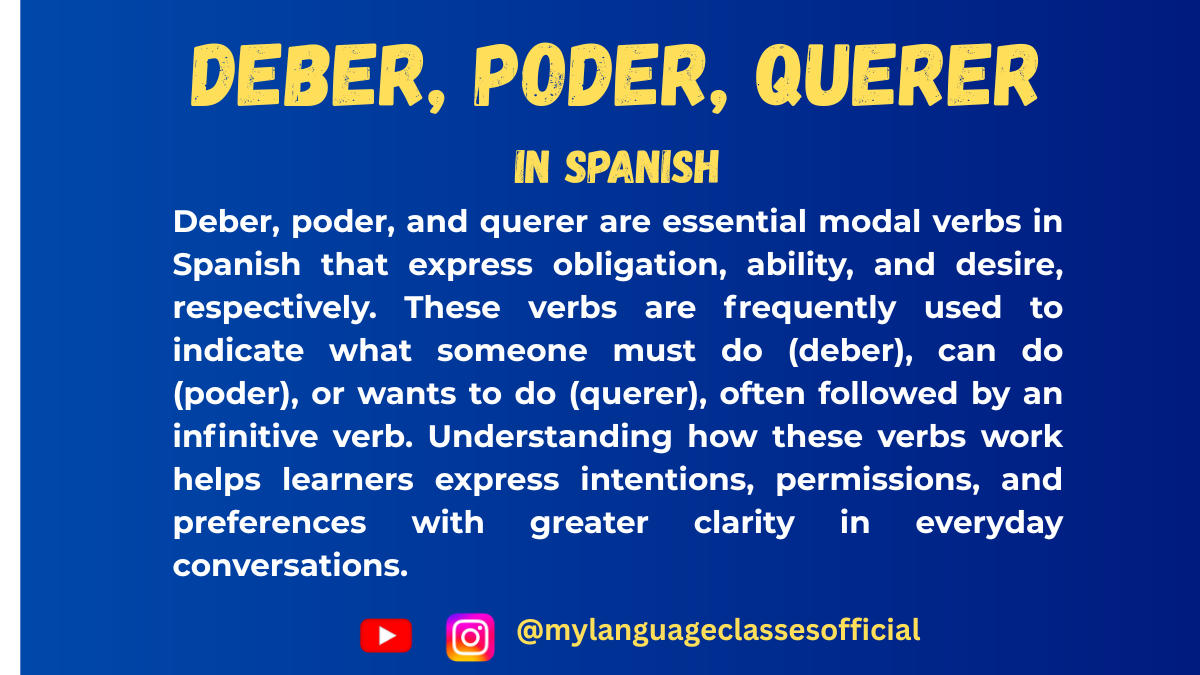
In Spanish, the verbs deber, poder, and querer are commonly used to express obligation, possibility, and desire, respectively. Understanding how to use these verbs correctly is essential for fluent communication. In this blog post, we will explore their meanings, conjugations, and common expressions used in daily life.
1. Deber – Expressing Obligation
The verb deber translates to “must” or “should” in English and is used to indicate duty, necessity, or moral obligation.
Common Expressions with Deber
- Deber + infinitivo → “Must/should do something.”
- Debo estudiar para el examen. (I must study for the exam.)
- Debes comer más verduras. (You should eat more vegetables.)
- Deber de + infinitivo → Expresses probability or supposition.
- Debe de estar en casa. (He/She must be at home.)
Conjugation of Deber
| Tense | Conjugation |
|---|---|
| Present Indicative | debo, debes, debe, debemos, debéis, deben |
| Preterite | debí, debiste, debió, debimos, debisteis, debieron |
| Imperfect | debía, debías, debía, debíamos, debíais, debían |
| Present Subjunctive | deba, debas, deba, debamos, debáis, deban |
| Imperative | (no direct affirmative imperative; use subjunctive) |
2. Poder – Expressing Possibility and Ability
The verb poder means “can” or “to be able to.” It is used to express ability, permission, or possibility.
Common Expressions with Poder
- Poder + infinitivo → “To be able to do something.”
- Puedo nadar bien. (I can swim well.)
- No puedes entrar sin permiso. (You can’t enter without permission.)
- ¿Se puede…? → Asking for permission.
- ¿Se puede fumar aquí? (Can one smoke here?)
- No poder más → “To be unable to handle something anymore.”
- No puedo más con este calor. (I can’t take this heat anymore.)
Conjugation of Poder (Irregular Verb)
| Tense | Conjugation |
| Present Indicative | puedo, puedes, puede, podemos, podéis, pueden |
| Preterite | pude, pudiste, pudo, pudimos, pudisteis, pudieron |
| Imperfect | podía, podías, podía, podíamos, podíais, podían |
| Present Subjunctive | pueda, puedas, pueda, podamos, podáis, puedan |
| Imperative | (no direct affirmative imperative; use subjunctive) |
3. Querer – Expressing Desire and Intentions
The verb querer means “to want” or “to love.” It is used to express desires, wishes, and sometimes affection.
Common Expressions with Querer
- Querer + infinitivo → “To want to do something.”
- Quiero viajar a España. (I want to travel to Spain.)
- ¿Quieres salir esta noche? (Do you want to go out tonight?)
- Querer a alguien → “To love someone.”
- Te quiero mucho. (I love you a lot.)
- Querer decir → “To mean.”
- ¿Qué quiere decir esta palabra? (What does this word mean?)
Conjugation of Querer (Irregular Verb)
| Tense | Conjugation |
| Present Indicative | quiero, quieres, quiere, queremos, queréis, quieren |
| Preterite | quise, quisiste, quiso, quisimos, quisisteis, quisieron |
| Imperfect | quería, querías, quería, queríamos, queríais, querían |
| Present Subjunctive | quiera, quieras, quiera, queramos, queráis, quieran |
| Imperative | (no direct affirmative imperative; use subjunctive) |
Key Considerations When Using Deber, Poder, Querer
- Articles and Gender:
- Use el, la, los, las with nouns when necessary.
- Example: Debes respetar las reglas. (You must respect the rules.)
- Plural vs. Singular:
- Conjugate the verb based on the subject.
- Example: Ellos pueden hablar inglés. (They can speak English.)
- Using the Subjunctive:
- Often follows expressions of doubt, wishes, or hypothetical scenarios.
- Example: Quiero que vengas conmigo. (I want you to come with me.)
- Negation:
- Use “no” before the verb to make it negative.
- Example: No debes mentir. (You must not lie.)
Conclusion
Mastering deber, poder, and querer is essential for effective communication in Spanish. These verbs allow you to express obligation, possibility, and desire in various situations. By understanding their conjugations, common expressions, and proper grammatical usage, you will significantly enhance your Spanish fluency. Keep practicing, and soon, you’ll be able to use them naturally in conversations!

Vikas Kumar is the founder of My Language Classes, a language learning platform dedicated to helping learners develop practical communication skills in Spanish, Japanese, and English through comprehensive grammar guides, structured learning resources, books, and evidence-informed educational content.
At My Language Classes, we believe that successful language learning is built on clarity, consistency, meaningful practice, and a deep understanding of how languages work. Every article is carefully researched and created to simplify complex concepts, provide practical guidance, and help learners develop confidence through real-world communication.
Inspired by the principles behind How Language Learning Really Works, our mission is to make high-quality language learning accessible to learners around the world by providing accurate, trustworthy, and comprehensive resources that support lasting progress, lifelong learning, and meaningful communication.
Leave a Reply