

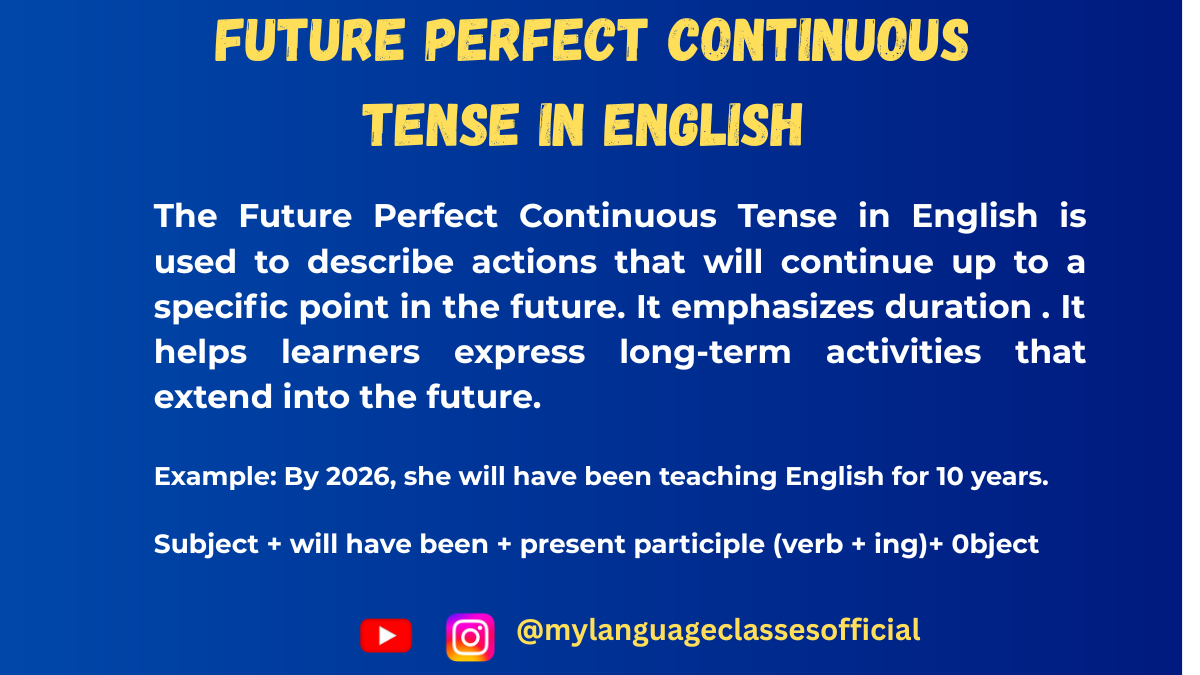
Future Perfect Continuous Tense in English helps you describe how long an activity will have continued by a particular point in the future. It connects an ongoing activity with a future time reference and emphasizes the duration leading up to that point.
Consider this example:
By 6 p.m., I will have been working for eight hours.
This sentence tells us that the speaker expects to reach eight hours of working time by 6 p.m. The focus is on how long the activity will have continued, rather than simply stating that the speaker will be working at that time.
You can use this tense when discussing work, education, travel, living arrangements, and other activities that continue over time. For example, you might explain how long you will have been teaching by the end of the year or how long your family will have been living in a particular city by next summer.
The Future Perfect Continuous can seem complicated because it combines several verb forms. However, its structure follows a clear pattern. Once you understand how the auxiliary verbs work together, you can form sentences, ask questions, and describe future duration more accurately.
This guide explains the tense step by step, including its formula, affirmative and negative forms, questions, common time expressions, practical uses, and differences from other English tenses. You will also learn how to avoid common mistakes and choose the right tense for the meaning you want to express.
If you want a broader understanding of how English verb forms work together, Complete English Tenses Mastery Guide by My Language Classes provides a structured reference to English tense rules, sentence patterns, and their uses.
What Is the Future Perfect Continuous Tense in English?
The Future Perfect Continuous Tense in English describes an activity that will have continued for a period of time by a specific point in the future. It emphasizes the duration of the activity, rather than only its completion or its presence at a future moment.
Consider this example:
By next June, she will have been teaching English for five years.
This sentence explains that she started teaching English five years before the future reference point of next June. The speaker focuses on the length of time she will have spent teaching by then.
The sentence follows this structure:
→ Subject: She
→ Helping verbs: Will have been
→ Main verb in the -ing form: Teaching
→ Duration: For five years
→ Future reference point: Next June
The tense connects three important elements: an activity, the time spent on that activity, and a point in the future. Understanding this relationship makes the tense easier to recognize and use correctly.
How Does the Future Perfect Continuous Tense Work?
The tense places an activity before a future reference point and emphasizes how long that activity will have continued by then.
For example:
By 8 p.m., I will have been studying for three hours.
Here, 8 p.m. is the future reference point. Three hours is the duration of the studying activity. The sentence tells us how long the person will have been studying when that future time arrives.
Now consider another example:
By the end of this year, they will have been living in Chicago for a decade.
The sentence focuses on the duration of their stay in Chicago. When the year ends, their time living there will have reached ten years.
Notice that the tense does not automatically tell us whether an activity will stop at the future reference point. The people in these examples might continue teaching, studying, or living in the same place afterward. The context determines whether the activity continues or ends.
What Makes This Tense Different From Other Future Tenses?
English has several ways to describe future events, but each tense places a different focus on the action.
Consider these three sentences:
→ Future Continuous: At 8 p.m., I will be studying.
This sentence focuses on the activity in progress at 8 p.m. It does not specify how long the studying will have continued before that time.
→ Future Perfect: By 8 p.m., I will have completed my assignment.
This sentence emphasizes the completion of the assignment before or by the stated future time.
→ Future Perfect Continuous: By 8 p.m., I will have been studying for three hours.
This sentence emphasizes the duration of the studying activity leading up to 8 p.m.
The main distinction is the information each tense communicates. The Future Continuous describes an activity in progress at a future moment. The Future Perfect emphasizes completion by a future point. The Future Perfect Continuous highlights the duration of an activity up to that point.
These differences become especially useful when you want to explain work schedules, study routines, personal experiences, or activities that have continued over time.
For a broader understanding of English tense patterns and their uses, Complete English Tenses Mastery Guide by My Language Classes provides a structured reference to English grammar rules and sentence formation.
What Is the Formula for the Future Perfect Continuous Tense?
The Future Perfect Continuous Tense follows a fixed sentence structure. Once you understand the formula, you can form affirmative sentences, negative sentences, and questions more confidently.
The basic formula is:
Subject + will + have + been + verb-ing + rest of the sentence
For example:
→ She will have been working for six hours by noon.
→ They will have been studying English for two years by next March.
→ I will have been waiting for an hour by the time the bus arrives.
In each sentence, the structure remains the same. The subject comes first, followed by will have been and the main verb in its -ing form. Additional information explains the duration, activity, or future reference point.
What Are the Main Parts of the Formula?
Each part of the formula has a specific role in forming the Future Perfect Continuous Tense.
1. Subject
The subject identifies the person, people, or thing performing the activity.
Examples include:
→ I
→ She
→ We
→ The students
→ My brother
The subject determines who performs the action, but it does not change the structure of the tense. Unlike some present-tense forms, the Future Perfect Continuous uses the same helping verb sequence with every subject.
For example:
→ He will have been reading for two hours.
→ They will have been reading for two hours.
Both sentences follow the same formula.
2. Will
The helping verb will places the statement in a future context.
For example:
By Friday, we will have been working on this project for two weeks.
The word will helps establish that the sentence describes a situation viewed from a future reference point.
3. Have
The word have follows will and forms part of the perfect construction.
For example:
By next month, she will have been learning Spanish for a year.
In this sentence, have is necessary to form the Future Perfect Continuous structure. It does not change to has, even when the subject is she, he, or it.
4. Been
The word been is the past participle of be. It follows have and connects the perfect construction to the continuous form.
For example:
By 10 a.m., he will have been driving for four hours.
The sequence will have been is essential to the tense. Leaving out any of these helping verbs changes the grammatical structure.
5. Main Verb in the -ing Form
The main verb describes the activity. It appears in its present participle form, which usually ends in -ing.
Examples include:
→ Work becomes working.
→ Study becomes studying.
→ Read becomes reading.
→ Travel becomes traveling.
→ Write becomes writing.
Some verbs require spelling changes when you add -ing. For instance, make becomes making, while run becomes running. The correct form depends on the spelling rules for the individual verb.
Does the Formula Change With Different Subjects?
No. The Future Perfect Continuous uses the same helping verb sequence with singular and plural subjects.
| Subject | Correct sentence |
|---|---|
| I | I will have been studying for two hours. |
| He | He will have been studying for two hours. |
| She | She will have been studying for two hours. |
| We | We will have been studying for two hours. |
| They | They will have been studying for two hours. |
Notice that will have been remains unchanged in every sentence. You do not write she will has been studying or he will have being studying. These forms do not follow the required structure.
How Does the Formula Express Duration?
The formula establishes the tense, while time expressions often explain how long the activity will have continued or identify the future reference point.
Consider this example:
By December, I will have been teaching for ten years.
The formula is:
→ Subject: I
→ Helping verbs: Will have been
→ Main verb: Teaching
→ Duration: For ten years
→ Future reference point: December
The duration tells us the length of time associated with the activity. The future reference point tells us when that duration will be measured.
You can also place the duration and reference point in different parts of a sentence, depending on the wording.
For example:
→ By the time the school year ends, she will have been studying Japanese for three years.
→ They will have been building the house for six months by September.
Both sentences follow the same grammatical formula, even though the time expressions appear in different positions.
Understanding this structure gives you a reliable foundation for forming different sentence types. For a wider reference to English tense formulas, sentence patterns, and usage rules, Complete English Tenses Mastery Guide by My Language Classes brings the major English tenses together in one structured resource.
How Do You Form Affirmative Sentences in the Future Perfect Continuous?
Affirmative sentences in the Future Perfect Continuous Tense describe activities that will have continued for a certain period by a particular point in the future. To form them correctly, place the subject before the helping verbs will have been, then use the main verb in its -ing form.
The formula is:
Subject + will + have + been + verb-ing + rest of the sentence
For example:
→ By 5 p.m., I will have been working for eight hours.
→ By next January, she will have been studying English for two years.
→ By the end of this month, they will have been building the house for six months.
Each sentence describes an activity and the duration associated with it at a future reference point. The activity may continue beyond that point, depending on the situation.
How Do You Build an Affirmative Sentence Step by Step?
You can form an affirmative sentence by following three basic steps.
Step 1: Choose the subject.
Decide who or what performs the activity.
Example: They
Step 2: Add will have been.
Keep all three helping verbs in this exact order, regardless of the subject.
Example: They will have been
Step 3: Add the main verb in its -ing form.
Choose the verb that describes the activity and place it in the continuous form.
Example: They will have been practicing
You can then add a duration or a future reference point to make the meaning clearer.
Complete sentence: By next month, they will have been practicing for six months.
This sentence explains how long the practice will have continued by next month.
What Are Some Examples of Affirmative Sentences?
Affirmative sentences can describe work, education, daily activities, travel, and other situations involving duration.
Work and professional activities
→ By noon, the manager will have been reviewing applications for three hours.
→ By the end of this year, I will have been working at this company for five years.
→ By 6 p.m., the technicians will have been repairing the equipment for seven hours.
These examples emphasize the time spent on professional activities by a future point.
Education and language learning
→ By next June, she will have been learning Spanish for two years.
→ By the end of the semester, we will have been studying Japanese for six months.
→ By Friday, the students will have been preparing for their examinations for three weeks.
Each sentence connects an ongoing learning activity with a future reference point.
Daily activities and personal routines
→ By 9 a.m., he will have been exercising for an hour.
→ By lunchtime, I will have been cleaning the house for three hours.
→ By the time our guests arrive, we will have been cooking for two hours.
These sentences show how the tense can describe ordinary activities when their duration matters.
Travel and living situations
→ By next August, they will have been living in Delhi for four years.
→ By the time we reach the hotel, we will have been traveling for ten hours.
→ By the end of the journey, she will have been driving for five hours.
The duration is the main focus in each example. The sentences explain how much time will have passed while the activity has continued.
How Do Time Expressions Fit Into Affirmative Sentences?
Time expressions help establish the duration of an activity or identify the future point at which the duration is measured.
The word for commonly introduces a period of time.
→ She will have been teaching for ten years by 2030.
→ We will have been waiting for thirty minutes by then.
The word since identifies the starting point of an activity.
→ By next April, he will have been working here since April 2022.
→ By December, I will have been studying Japanese since the beginning of the year.
The phrase by the time introduces a future reference point.
→ By the time the train arrives, we will have been waiting for an hour.
Notice the structure of the final example. The main clause uses the Future Perfect Continuous, while the time clause uses the Simple Present. In standard future time clauses, English normally uses the Simple Present rather than will.
What Common Errors Should You Avoid?
Affirmative sentences become easier to form when you pay attention to the order of the helping verbs and the form of the main verb.
Incorrect: She will has been studying for three hours.
Correct: She will have been studying for three hours.
The correct structure uses will have been with every subject.
Incorrect: They will have been study for two hours.
Correct: They will have been studying for two hours.
The main verb must appear in its -ing form.
Incorrect: By next year, he will been working here for five years.
Correct: By next year, he will have been working here for five years.
The helping verb have is essential to the formula.
Incorrect: By the time the meeting will begin, we will have been waiting for an hour.
Correct: By the time the meeting begins, we will have been waiting for an hour.
The time clause uses the Simple Present to refer to the future event.
When you consistently apply the formula, affirmative sentences become easier to construct. You can change the subject, activity, duration, and future reference point without changing the basic grammatical structure.
For a structured reference to English tense formulas and sentence formation, Complete English Tenses Mastery Guide by My Language Classes covers the patterns that help you build accurate sentences across the major English tenses.
How Do You Form Negative Sentences in the Future Perfect Continuous?
Negative sentences in the Future Perfect Continuous Tense describe activities that will not have continued for a particular duration by a specified point in the future. You form them by adding not after will and before have been.
The formula is:
Subject + will + not + have + been + verb-ing + rest of the sentence
For example:
→ By next June, she will not have been working here for five years.
→ By 8 p.m., I will not have been studying for three hours.
→ By the end of the month, they will not have been living in this apartment for a full year.
These sentences focus on the duration that will not have accumulated by the stated future point. They do not necessarily mean that the activity itself will not happen. The exact meaning depends on the context.
How Do You Add Not to the Future Perfect Continuous?
The word not comes immediately after will. The remaining helping verbs stay in the same order, and the main verb remains in its -ing form.
Consider the affirmative and negative forms:
| Affirmative sentence | Negative sentence |
|---|---|
| She will have been teaching for five years by June. | She will not have been teaching for five years by June. |
| They will have been traveling for ten hours by noon. | They will not have been traveling for ten hours by noon. |
| He will have been working here for a year by December. | He will not have been working here for a year by December. |
| We will have been waiting for thirty minutes by then. | We will not have been waiting for thirty minutes by then. |
In each negative sentence, not changes the meaning while the rest of the grammatical structure remains intact.
How Do You Use the Contraction Won’t Have Been?
In everyday English, speakers often use will not in its contracted form, won’t. Both forms are grammatically correct.
The formula for the contracted form is:
Subject + won’t + have + been + verb-ing + rest of the sentence
For example:
→ By next March, I will not have been studying Japanese for two years.
→ By next March, I won’t have been studying Japanese for two years.
Both sentences communicate the same basic meaning. The second version is shorter and often sounds more natural in everyday conversation.
Here are more examples:
→ By 6 p.m., he won’t have been working for eight hours.
→ By the end of the year, they won’t have been living here for a decade.
→ By the time the meeting starts, we won’t have been waiting for an hour.
Remember that won’t replaces will not. You still need have been before the main verb.
What Do Negative Sentences Mean in Different Situations?
The meaning of a negative sentence becomes clearer when you consider the activity and the future reference point.
Work and professional activities
By the end of this year, Priya will not have been working at the company for five years.
This sentence means that, when the year ends, Priya’s time working at the company will be less than five years. It does not mean she will stop working there.
Education and language learning
By next January, I will not have been learning Spanish for a full year.
The sentence indicates that the duration of the Spanish learning activity will be less than one year by January.
Travel and waiting
By the time the bus arrives, we will not have been waiting for thirty minutes.
This sentence tells us that the waiting period will be shorter than thirty minutes when the bus arrives.
In each case, the negative form focuses on a duration that will not have been reached by the reference point. Context helps the reader understand why that duration matters.
What Mistakes Should You Avoid When Forming Negative Sentences?
A few common errors can make negative sentences grammatically incorrect.
Incorrect: She will have not been studying for two hours.
Correct: She will not have been studying for two hours.
For the standard negative form, place not directly after will.
Incorrect: He will not has been working here for a year.
Correct: He will not have been working here for a year.
The helping verb after will not must be have, not has.
Incorrect: They won’t have been study for three hours.
Correct: They won’t have been studying for three hours.
The main verb must use the -ing form.
Incorrect: I will not been waiting for an hour.
Correct: I will not have been waiting for an hour.
The word have is essential to the structure.
Negative sentences follow the same basic pattern as affirmative sentences, with not added after will. Once you understand this placement, you can express negative meanings without changing the rest of the formula.
For a wider understanding of English tense structures and sentence formation, Complete English Tenses Mastery Guide by My Language Classes provides a structured reference to the rules and patterns used across English grammar.
How Do You Form Yes/No Questions in the Future Perfect Continuous?
Yes/no questions in the Future Perfect Continuous Tense ask whether an activity will have continued for a particular period by a specific point in the future. These questions usually begin with will, followed by the subject, have been, and the main verb in its -ing form.
The formula is:
Will + subject + have + been + verb-ing + rest of the sentence?
For example:
→ Will you have been working for eight hours by 5 p.m.?
→ Will she have been studying English for two years by next June?
→ Will they have been living in this apartment for a full year by December?
Each question asks about the duration of an activity at a future reference point. The answer can be affirmative or negative, depending on the situation.
How Do You Change a Statement Into a Yes/No Question?
To form a yes/no question, move will to the beginning of the sentence. Keep the subject after will, followed by have been and the main verb in its -ing form.
Consider this affirmative sentence:
You will have been studying for three hours by noon.
To turn it into a question, move will before the subject:
Will you have been studying for three hours by noon?
The rest of the sentence stays in the same order. The question mark indicates that the sentence asks for information rather than making a statement.
Here are more examples:
| Affirmative sentence | Yes/no question |
|---|---|
| He will have been working for six hours by noon. | Will he have been working for six hours by noon? |
| They will have been traveling for ten hours by 8 p.m. | Will they have been traveling for ten hours by 8 p.m.? |
| She will have been teaching for five years by June. | Will she have been teaching for five years by June? |
| We will have been waiting for thirty minutes by then. | Will we have been waiting for thirty minutes by then? |
Notice that will moves to the beginning, but have been stays together after the subject. This pattern remains the same with singular and plural subjects.
How Do You Answer Yes/No Questions in This Tense?
You can answer yes/no questions with short answers or complete sentences. Short answers are common in everyday English because they avoid repeating the entire question.
Consider this question:
Will you have been studying for three hours by noon?
Affirmative short answer:
Yes, I will.
Negative short answer:
No, I will not.
You can also use the contraction won’t in a negative short answer.
No, I won’t.
Here are additional examples:
Question: Will she have been working here for five years by December?
→ Yes, she will.
→ No, she will not.
Question: Will they have been traveling for twelve hours by the time they arrive?
→ Yes, they will.
→ No, they will not.
Question: Will he have been learning Japanese for six months by July?
→ Yes, he will.
→ No, he will not.
In short answers, use will for affirmative responses and will not or won’t for negative responses. Match the subject in the answer to the person or people mentioned in the question.
What Is the Difference Between a Yes/No Question and a Negative Question?
A standard yes/no question asks whether something will have continued for a particular duration.
Will she have been studying for two hours by 6 p.m.?
A negative question includes not or the contraction won’t. It can express surprise, expectation, or a request for confirmation, depending on the context.
Will she not have been studying for two hours by 6 p.m.?
Won’t she have been studying for two hours by 6 p.m.?
These forms are grammatically possible, although the contracted version often sounds more natural in everyday conversation. The speaker may expect the answer to be yes or may be checking an assumption.
For example:
Won’t you have been working for ten hours by the time your shift ends?
The speaker may expect that the person will have completed ten hours of work and wants to confirm that expectation.
What Common Mistakes Should You Avoid?
When forming yes/no questions, pay attention to the position of will and the order of the remaining verbs.
Incorrect: You will have been studying for three hours by noon?
Correct: Will you have been studying for three hours by noon?
In a standard written yes/no question, place will before the subject.
Incorrect: Will have you been working for six hours?
Correct: Will you have been working for six hours?
The subject must come immediately after will.
Incorrect: Will she has been teaching for five years?
Correct: Will she have been teaching for five years?
Use have, not has, after will.
Incorrect: Will they have been travel for ten hours?
Correct: Will they have been traveling for ten hours?
The main verb must appear in its -ing form.
The most reliable approach is to remember the complete question pattern: will + subject + have been + verb-ing. This structure helps you form accurate yes/no questions across a wide range of future situations.
For a broader reference to English tense formulas and question formation, Complete English Tenses Mastery Guide by My Language Classes provides a structured overview of English grammar patterns and their uses.
How Do You Form WH Questions in the Future Perfect Continuous?
WH questions in the Future Perfect Continuous Tense ask for specific information about an activity, its duration, or the future point connected to it. They begin with a question word such as what, where, why, how long, or when, followed by the question structure.
The basic formula is:
WH word + will + subject + have + been + verb-ing + rest of the sentence?
For example:
→ How long will you have been working here by December?
→ What will she have been studying for three hours by noon?
→ Where will they have been living for five years by next June?
These questions seek information beyond a simple yes or no. The question word determines the type of information the speaker wants to know.
Which WH Words Can You Use With This Tense?
Different question words help you ask about different parts of a future situation. The most suitable word depends on the information you need.
1. How long
Use how long to ask about the duration of an activity by a future reference point.
Examples:
→ How long will you have been learning Spanish by next January?
→ How long will she have been teaching at this school by June?
→ How long will they have been waiting by the time the train arrives?
These questions focus directly on the amount of time an activity will have continued.
2. What
Use what to ask about the activity itself or the thing involved in the situation.
Examples:
→ What will you have been studying for the examination?
→ What will he have been working on for three weeks by Friday?
→ What will they have been discussing for two hours by the time the meeting ends?
The answer identifies the subject of the activity, the task, or the topic being discussed.
3. Where
Use where to ask about a place connected with an activity.
Examples:
→ Where will she have been working for five years by next April?
→ Where will they have been living by the end of this year?
→ Where will you have been studying Japanese for six months by July?
These questions focus on the location associated with the activity or situation.
4. Why
Use why to ask about a reason.
Examples:
→ Why will he have been working late every evening by the end of the week?
→ Why will they have been waiting outside for an hour by the time the doors open?
→ Why will she have been studying for so many hours by the examination date?
The answer explains the reason behind the activity. The Future Perfect Continuous describes its duration, while the surrounding context helps establish the cause.
5. When
Use when to ask about the time of an event or situation. However, when and how long do not ask for the same information.
For example:
→ When will you have been working here for five years?
→ How long will you have been working here by next June?
The first question asks when the five-year milestone will occur. The second asks about the duration by a particular future point.
In many situations, when is more naturally used with other future tenses. The Future Perfect Continuous is especially useful when the question concerns a duration that leads up to a future reference point.
How Do You Form WH Questions Step by Step?
You can build a WH question by following a consistent pattern.
Consider this statement:
She will have been learning Japanese for two years by December.
Step 1: Identify the information you want.
If you want to ask about the duration, use how long.
Step 2: Place the question word at the beginning.
Start the question with How long.
Step 3: Add will before the subject.
The subject is she, so the beginning becomes How long will she.
Step 4: Add have been and the -ing form.
Continue with have been learning.
Step 5: Complete the question with the duration and future reference point.
The complete question is:
How long will she have been learning Japanese by December?
The final question focuses on the duration of the learning activity at the future reference point.
How Do You Form WH Questions With Different Subjects?
The structure stays the same regardless of whether the subject is singular or plural.
| Subject | WH question |
|---|---|
| I | How long will I have been working by noon? |
| He | How long will he have been studying by Friday? |
| She | How long will she have been teaching by June? |
| We | How long will we have been traveling by midnight? |
| They | How long will they have been living there by next year? |
Notice that will have been does not change according to the subject. You do not replace have with has when the subject is he, she, or it.
What Mistakes Should You Avoid When Forming WH Questions?
Several common errors can make WH questions incorrect.
Incorrect: How long you will have been working here by December?
Correct: How long will you have been working here by December?
In a standard WH question, place will before the subject.
Incorrect: Where will she has been working for five years?
Correct: Where will she have been working for five years?
Use have after will, regardless of the subject.
Incorrect: What will they have been discuss for an hour?
Correct: What will they have been discussing for an hour?
The main verb must appear in its -ing form.
Incorrect: How long will have you been studying?
Correct: How long will you have been studying?
The subject comes immediately after will. Keep the remaining helping verbs in their correct order.
When you understand the role of the question word and the placement of the helping verbs, you can form WH questions that ask clearly about duration, activities, and future situations.
For a broader reference to English tense patterns, sentence structures, and question formation, Complete English Tenses Mastery Guide by My Language Classes provides a structured guide to the major English tenses and their uses.
What Is the Role of Will, Have, Been, and the -ing Form?
The Future Perfect Continuous Tense uses four essential elements: will, have, been, and the main verb in its -ing form. Each element contributes to the grammatical structure, allowing you to describe how long an activity will have continued by a particular point in the future.
Consider this example:
By next December, she will have been teaching English for five years.
The sentence follows this pattern:
→ Will establishes the future context.
→ Have forms part of the perfect construction.
→ Been connects the perfect construction to the continuous form.
→ Teaching describes the activity and uses the -ing form.
Together, these elements create a tense that emphasizes the duration of an activity leading up to a future reference point.
How Does Will Work in the Future Perfect Continuous?
The helping verb will places the sentence in a future context. It appears before the other helping verbs in affirmative statements and after the subject in negative statements.
For example:
→ She will have been studying for three hours by noon.
→ They will have been traveling for ten hours by midnight.
→ I will not have been working here for a full year by June.
In affirmative sentences, will comes directly after the subject. In negative sentences, not follows will.
When forming questions, place will before the subject.
→ Will she have been studying for three hours by noon?
The word will remains unchanged regardless of the subject. You use the same form with I, you, he, she, we, and they.
Why Do You Need Have After Will?
The word have is an essential part of the perfect construction. In this tense, it always follows will, even when the subject is singular.
For example:
→ He will have been working for six hours by noon.
→ She will have been learning Spanish for two years by next June.
→ They will have been living here for a decade by 2030.
Notice that you use have, not has, with every subject. This is because the modal verb will is followed by the base form of the next verb.
The following sentence is incorrect:
He will has been working for six hours.
The correct sentence is:
He will have been working for six hours.
Remembering this rule helps you avoid a common error when forming future tense structures.
What Is the Function of Been?
The word been is the past participle of be. It follows have and helps form the continuous construction.
Consider this example:
By the end of the month, I will have been writing this book for six months.
The sequence will have been forms the helping verb structure. The main verb writing identifies the activity, while for six months explains its duration.
You cannot remove been without changing the grammatical structure.
Incorrect: I will have writing this book for six months.
Correct: I will have been writing this book for six months.
The word been is necessary even though the sentence refers to the future. Its role comes from the grammatical construction, not from the time at which the activity occurs.
Why Must the Main Verb End in -ing?
The main verb appears in its present participle form, which usually ends in -ing. This form creates the continuous aspect of the tense.
For example:
→ Work becomes working.
→ Read becomes reading.
→ Study becomes studying.
→ Drive becomes driving.
→ Run becomes running.
The spelling changes depend on the verb. Some verbs simply take -ing, while others require a change to the final letter or letters.
Compare these examples:
→ By 5 p.m., she will have been reading for two hours.
→ By next March, they will have been studying English for a year.
→ By the time we arrive, he will have been driving for six hours.
The -ing form identifies the activity whose duration is being emphasized.
However, not every verb works naturally in a continuous tense. Verbs that describe states, such as know, believe, and own, generally do not take continuous forms when they retain their usual stative meanings. This distinction becomes important when deciding whether the Future Perfect Continuous is appropriate.
What Happens When You Combine All Four Elements?
The complete structure becomes easier to understand when you examine each part of a sentence.
Consider this example:
By next September, we will have been learning Japanese for two years.
Here is how the sentence works:
| Element | Example | Function |
|---|---|---|
| Future marker | Will | Establishes the future context |
| Perfect auxiliary | Have | Forms part of the perfect construction |
| Past participle of be | Been | Supports the continuous construction |
| Main verb | Learning | Describes the activity in progress over time |
| Duration | For two years | Specifies the length of the activity |
| Future reference point | Next September | Identifies when the duration is measured |
The helping verbs work together as a single grammatical unit. Each one has a specific position, so changing their order can produce an incorrect sentence.
The structure also remains consistent across affirmative statements, negative statements, and questions. You may move will or add not, but the sequence have been + verb-ing stays intact.
Understanding the role of each element makes the Future Perfect Continuous easier to use accurately. Instead of memorizing isolated sentences, you can apply the same pattern to different subjects, activities, and future situations.
For a broader understanding of how English tense structures work together, Complete English Tenses Mastery Guide by My Language Classes provides a structured reference to tense formulas, sentence patterns, and grammatical usage.
When Do You Use the Future Perfect Continuous Tense?
The Future Perfect Continuous Tense is useful when you want to emphasize how long an activity will have continued by a particular point in the future. It connects an activity with its duration and a future reference point, helping readers understand how much time will have passed while that activity has continued.
For example:
By next July, I will have been teaching English for ten years.
This sentence emphasizes the length of the teaching experience by next July. The speaker focuses on the duration of the activity rather than simply stating that teaching will happen in the future.
There are several common situations in which this tense is useful.
1. To Describe the Duration of an Activity
One of the main uses of the Future Perfect Continuous is to describe how long an activity will have continued by a future time.
For example:
→ By 6 p.m., she will have been working for eight hours.
→ By next January, they will have been learning Spanish for two years.
→ By the end of the week, we will have been preparing for the examination for a month.
Each sentence emphasizes the duration of an activity at a future reference point. The time expression tells the reader when that duration will be measured.
This use is especially helpful when discussing work schedules, study plans, personal routines, and long-term activities.
2. To Describe an Activity That Began Before a Future Point
The tense can describe an activity that starts before a particular future time and continues toward that time.
For example:
By the time the conference begins, the organizers will have been preparing for the event for six months.
The preparation begins before the conference. When the conference starts, the preparation period will have reached six months.
Here are more examples:
→ By the time the new school year begins, the teachers will have been planning their lessons for several weeks.
→ By next summer, we will have been renovating the house for a year.
→ By the time the guests arrive, I will have been cooking for three hours.
In each example, the activity extends over a period leading up to a future event. The tense highlights that period rather than simply identifying the activity.
3. To Emphasize Work Experience and Professional Activities
The Future Perfect Continuous can describe how long someone will have spent working in a particular role or carrying out a professional activity by a future date.
For example:
By December, she will have been working as a teacher for seven years.
The sentence emphasizes the duration of her teaching experience by December.
Other examples include:
→ By next April, he will have been managing the department for four years.
→ By the end of this project, our team will have been developing the software for eighteen months.
→ By the time the company celebrates its anniversary, I will have been working here for a decade.
This construction is useful when discussing professional experience, project timelines, and the length of time devoted to a particular responsibility.
However, the tense does not automatically mean that the person will stop working at the stated time. The activity may continue afterward.
4. To Describe Education and Language Learning
Learning often takes place over an extended period. The Future Perfect Continuous helps express how long someone will have spent studying or developing a skill by a future point.
For example:
By next September, I will have been learning Japanese for two years.
The sentence emphasizes the duration of the learning process by September.
Consider these additional examples:
→ By the end of this course, she will have been studying English grammar for six months.
→ By next June, they will have been learning Spanish for three years.
→ By the time he takes the examination, he will have been preparing for it for twelve weeks.
These sentences connect a learning activity with a future milestone. They are particularly useful when discussing study plans, course timelines, and long-term educational goals.
The tense does not guarantee a particular level of achievement. It describes the duration of the activity, not the results a learner will achieve.
5. To Describe Travel, Waiting, and Daily Activities
The Future Perfect Continuous also works with ordinary activities when the duration matters.
For example:
By the time we reach the hotel, we will have been traveling for ten hours.
The speaker emphasizes the length of the journey at the point of arrival.
More examples include:
→ By midnight, they will have been driving for six hours.
→ By the time the doctor arrives, we will have been waiting for forty minutes.
→ By lunchtime, he will have been exercising for an hour.
→ By the end of the afternoon, I will have been cleaning the house for three hours.
These sentences help explain how long an activity will have continued before a future event or time.
6. To Explain the Duration Behind a Future Situation
Sometimes, the duration of an activity provides useful background for a future situation. The Future Perfect Continuous can emphasize that duration when it helps explain the circumstances.
For example:
By the end of the day, the workers will have been repairing the road for twelve hours.
The sentence highlights the extended period of work. Depending on the context, this information may help explain fatigue, delays, or the amount of work involved.
Consider another example:
By the time the race begins, the athletes will have been training together for six months.
The sentence emphasizes the length of their preparation before the race. It does not directly state how well they will perform, but it provides information about the duration of their training.
Another example is:
By the time the shop closes, the staff will have been serving customers for nine hours.
Here, the duration provides background about the staff’s working day.
This use is helpful when the length of an activity matters to the situation being described.
7. To Describe Duration Up to a Future Event
The Future Perfect Continuous frequently appears with expressions such as by the time, which establish a future event as the reference point.
For example:
By the time the train arrives, we will have been waiting for an hour.
The waiting begins before the train arrives. The sentence measures the duration of the waiting period at the moment of arrival.
Other examples include:
→ By the time the meeting ends, they will have been discussing the proposal for two hours.
→ By the time the semester finishes, she will have been studying at the university for four years.
→ By the time the shop opens tomorrow, the staff will have been preparing the inventory for several hours.
Notice that the clauses beginning with by the time use the Simple Present to refer to future events. English normally uses the Simple Present in these future time clauses rather than placing will directly before the verb.
For example, write:
By the time the train arrives, we will have been waiting for an hour.
Avoid writing:
By the time the train will arrive, we will have been waiting for an hour.
When Should You Choose This Tense?
The Future Perfect Continuous is most appropriate when the duration of an activity leading up to a future point is important to your message.
Compare these sentences:
→ I will work at this company next year.
This sentence describes future employment without emphasizing duration.
→ By next December, I will have been working at this company for five years.
This sentence emphasizes the length of time spent working at the company by December.
The second sentence is more suitable when you want to communicate duration. The first is sufficient when you only want to describe future employment.
Choosing the correct tense depends on the information you want to emphasize. When duration is central to the meaning, the Future Perfect Continuous provides a clear and precise way to express it.
For a structured reference to English tense uses, sentence patterns, and grammatical distinctions, Complete English Tenses Mastery Guide by My Language Classes brings the major English tense forms together in one resource.
How Do You Use the Future Perfect Continuous to Express Duration?
The Future Perfect Continuous Tense is particularly useful when you want to explain how long an activity will have continued by a specific point in the future. The duration may be measured in minutes, hours, days, months, or years, depending on the activity and the situation.
For example:
By next December, I will have been working at this company for six years.
The sentence identifies a future reference point, next December, and a duration, six years. The speaker emphasizes the amount of time spent working at the company by that date.
To understand this use, you need to recognize three elements: the activity, the duration, and the future reference point.
How Do You Identify the Duration in a Sentence?
The duration tells you how much time an activity will have continued by the future reference point. It often appears with the preposition for, followed by a period of time.
Consider these examples:
→ By 4 p.m., she will have been studying for three hours.
→ By next June, they will have been living in Madrid for five years.
→ By the end of the week, we will have been preparing for the event for ten days.
→ By midnight, he will have been driving for eight hours.
In each sentence, the phrase beginning with for identifies the duration. The activity is viewed in relation to a future time, allowing the speaker to emphasize how long it will have continued by then.
The duration does not need to be long. It can refer to a short activity or a process that has continued for several years.
For example:
By 10 a.m., I will have been waiting for twenty minutes.
By 2030, she will have been teaching for fifteen years.
Both sentences use the same grammatical structure. Only the activity, duration, and reference point change.
How Does the Future Reference Point Affect the Meaning?
The future reference point tells the reader when the duration will be measured. It may be a specific time, a date, or an event.
Consider this sentence:
By 6 p.m., they will have been working for seven hours.
The reference point is 6 p.m. The duration is seven hours.
Now change the reference point:
By 8 p.m., they will have been working for nine hours.
The activity remains the same, but the later reference point allows for a longer duration.
This relationship becomes easier to understand when you compare several examples.
→ By noon, she will have been reading for two hours.
→ By 2 p.m., she will have been reading for four hours.
→ By 5 p.m., she will have been reading for seven hours.
These examples assume that she began reading at the same time and continued throughout the period. As the reference point moves forward, the duration increases.
In real situations, the duration depends on when the activity began and whether it continued during the period being described.
How Do You Use For to Express Duration?
The preposition for introduces the length of time associated with an activity. It answers the question how long?
Common expressions include:
→ For ten minutes
→ For three hours
→ For two days
→ For several weeks
→ For six months
→ For many years
You can use these expressions in sentences about work, study, travel, and everyday activities.
For example:
→ By the time the class ends, we will have been studying for ninety minutes.
→ By Friday, the team will have been working on the project for three weeks.
→ By next January, he will have been living in Japan for eighteen months.
→ By the end of the journey, they will have been traveling for two days.
The phrase with for identifies the duration, while the Future Perfect Continuous places that duration in relation to a future reference point.
Can You Express Duration Without Using For?
Yes. Although for is common, the Future Perfect Continuous does not always require an explicit duration phrase.
For example:
By the time you arrive, I will have been working.
This sentence uses the Future Perfect Continuous, but it does not specify exactly how long the person will have been working. The context may make the duration clear, or the speaker may want to emphasize the ongoing activity without stating a precise period.
Consider another example:
By next June, she will have been teaching at the university.
The sentence identifies a future reference point and an activity. However, it does not tell us when the teaching began or how long it will have continued.
Adding a duration provides more specific information:
By next June, she will have been teaching at the university for eight years.
The additional phrase makes the length of time explicit.
Therefore, for is useful when the duration matters, but it is not a compulsory part of the tense formula.
How Do You Express Duration Before a Future Event?
You can also measure duration by referring to an event that will happen in the future. Expressions such as by the time the meeting begins, by the time we arrive, and by the end of the course establish the reference point.
For example:
By the time the meeting begins, the manager will have been preparing the presentation for three hours.
The preparation occurs before the meeting begins. The sentence emphasizes the length of that preparation by the time the meeting starts.
Here are more examples:
→ By the time the train arrives, we will have been waiting for forty minutes.
→ By the time the examination begins, she will have been studying for six hours.
→ By the end of the course, the students will have been learning English grammar for twelve weeks.
In these examples, the event establishes the future reference point, while the duration explains how long the activity will have continued before that point.
Remember that a future time clause introduced by by the time normally uses the Simple Present, even when the main clause uses the Future Perfect Continuous.
For example:
By the time the examination begins, she will have been studying for six hours.
The verb begins is in the Simple Present because it appears in a future time clause.
What Is the Difference Between Duration and Completion?
The Future Perfect Continuous emphasizes duration, but it does not automatically tell you whether an activity will be complete or continue after the reference point.
Consider this example:
By next July, he will have been writing his novel for a year.
The sentence tells us how long the writing activity will have continued by July. It does not tell us whether he will finish the novel by then.
Compare it with:
By next July, he will have finished his novel.
This sentence emphasizes completion. It states that the novel will be finished by the specified time.
The distinction matters because duration and completion provide different kinds of information. The Future Perfect Continuous focuses on the time spent on an activity, while the Future Perfect commonly emphasizes a completed action or result by a future point.
When you want to explain how long an activity will have continued, use the Future Perfect Continuous. When the main point is whether something will be completed by a future deadline, the Future Perfect may be more appropriate.
For a structured reference to English tense patterns, meanings, and sentence formation, Complete English Tenses Mastery Guide by My Language Classes explains how the major English tenses express different relationships between actions and time.
How Do You Use the Future Perfect Continuous Before Another Future Event?
The Future Perfect Continuous Tense can describe how long an activity will have continued before another event happens in the future. The second event provides a reference point, while the main clause emphasizes the duration of the earlier activity.
For example:
By the time the train arrives, we will have been waiting for an hour.
The waiting begins before the train arrives. When the train arrives, the waiting period will have reached one hour, assuming the group continues waiting until then.
This structure is useful when describing schedules, deadlines, journeys, meetings, examinations, and other situations in which one future event provides a reference point for an ongoing activity.
How Does the Structure Work?
When you connect an ongoing activity with another future event, the sentence often contains two clauses.
The main clause uses the Future Perfect Continuous:
Subject + will + have + been + verb-ing
The time clause identifies the future event:
By the time + subject + Simple Present verb
Consider this example:
By the time the meeting begins, the manager will have been preparing the presentation for three hours.
The sentence contains two parts:
→ Time clause: By the time the meeting begins
→ Main clause: The manager will have been preparing the presentation for three hours
The time clause identifies when the meeting starts. The main clause explains how long the preparation will have continued by that point.
Notice that the verb begins uses the Simple Present, even though the meeting will happen in the future. English normally uses the Simple Present in future time clauses introduced by expressions such as by the time, when, before, and after.
How Do You Use By the Time With This Tense?
The expression by the time introduces an event that serves as a future reference point. It helps connect the duration of one activity with the occurrence of another event.
For example:
→ By the time the bus arrives, we will have been waiting for forty minutes.
→ By the time the examination begins, she will have been studying for six hours.
→ By the time the guests arrive, I will have been cooking for three hours.
→ By the time the office opens, the security team will have been working for two hours.
In each sentence, the activity begins before the event identified in the time clause. The Future Perfect Continuous emphasizes its duration at that point.
The expression by the time is especially useful when the exact clock time is less important than the relationship between the two events.
Can You Place the Time Clause at the Beginning or End?
Yes. You can place the time clause at the beginning or the end of a sentence, depending on the emphasis and flow of the sentence.
Consider these two sentences:
By the time the train arrives, we will have been traveling for five hours.
We will have been traveling for five hours by the time the train arrives.
Both sentences are grammatically correct and communicate essentially the same information. The first begins with the future event, while the second places the duration and activity before the time clause.
When the time clause comes first, use a comma to separate it from the main clause. When the time clause comes at the end, a comma is generally unnecessary.
Here are more examples:
→ By the time the school year ends, she will have been teaching for ten months.
→ She will have been teaching for ten months by the time the school year ends.
→ By the time the project deadline arrives, our team will have been working on the project for six months.
→ Our team will have been working on the project for six months by the time the project deadline arrives.
Moving the clauses changes the sentence structure, but it does not change the basic relationship between the activity and the future event.
How Do You Use This Structure With Before and After?
You can also use before and after to connect activities with future events. However, the meaning and time relationship depend on the conjunction and the context.
Using before
Before identifies an event that occurs later than the activity or situation described in the main clause.
For example:
→ She will have been studying for three hours before the tutor arrives.
→ The workers will have been repairing the road for several hours before the inspection begins.
→ I will have been driving for six hours before we reach the hotel.
These sentences emphasize the duration of an activity before another event occurs.
Using after
After identifies an event that follows another event. When you use it with the Future Perfect Continuous, make sure the context supports the intended duration and timing.
For example:
After the meeting ends, we will have been discussing the proposal for two hours.
This sentence is possible if the discussion continues until the meeting ends and the speaker is measuring its duration at that point. However, the wording may sound more natural as:
By the time the meeting ends, we will have been discussing the proposal for two hours.
The second version makes the future reference point and the duration more direct.
What Mistakes Should You Avoid?
When connecting the Future Perfect Continuous with another future event, pay attention to the verb tense in the time clause.
Incorrect: By the time the train will arrive, we will have been waiting for an hour.
Correct: By the time the train arrives, we will have been waiting for an hour.
The time clause normally uses the Simple Present, not will.
Incorrect: When she will finish work, she will have been working for eight hours.
Correct: When she finishes work, she will have been working for eight hours.
The same rule applies to future time clauses introduced by when.
Another common mistake is confusing the duration of an activity with the completion of an action.
By the time the guests arrive, I will have been cooking for three hours.
This sentence emphasizes the length of time spent cooking. It does not necessarily mean that every dish will be ready when the guests arrive.
If you want to emphasize completion, you could write:
By the time the guests arrive, I will have prepared dinner.
The Future Perfect Continuous focuses on duration, while the Future Perfect emphasizes the completed result.
When Is This Structure Most Useful?
Use the Future Perfect Continuous before another future event when the length of an activity matters to the meaning of the sentence.
For example:
By the time the course ends, the students will have been learning English grammar for six months.
This sentence emphasizes the duration of the learning process by the end of the course. It does not make a claim about the students’ final level of proficiency.
Similarly:
By the time the conference begins, the organizers will have been preparing for the event for several months.
The sentence highlights the extended preparation period before the conference.
The key is to establish a clear future reference point and explain how long the activity will have continued by then. This relationship allows you to describe future situations with greater precision.
For a broader understanding of English tense structures and the relationships they express, Complete English Tenses Mastery Guide by My Language Classes provides a structured reference to tense rules, sentence patterns, and practical usage.
How Do You Use the Future Perfect Continuous With Work and Study?
The Future Perfect Continuous Tense is useful for describing the duration of work, study, and other activities that continue over time. It helps explain how long someone will have spent on a task, professional responsibility, or learning activity by a particular point in the future.
For example:
By the end of this semester, I will have been studying English grammar for six months.
The sentence emphasizes the duration of the study period by the end of the semester. It does not state that the learning process will be complete at that point.
Similarly:
By next December, she will have been working as a teacher for eight years.
Here, the tense highlights the length of her professional experience by December. The teaching may continue after that date.
How Do You Use This Tense to Describe Professional Experience?
You can use the Future Perfect Continuous to describe how long someone will have been working in a role, managing a responsibility, or contributing to a project by a future date.
For example:
→ By next April, he will have been working as an accountant for seven years.
→ By the end of this year, she will have been managing the department for three years.
→ By the time the company celebrates its anniversary, I will have been working here for a decade.
→ By next September, our team will have been developing this product for eighteen months.
In these examples, the tense connects professional activities with a future reference point. The duration provides information about the time spent in a role or on a task.
This structure is especially useful when discussing work experience, project timelines, and long-term responsibilities. However, the duration alone does not establish how successful someone has been or what results they have achieved.
How Do You Describe Long-Term Projects?
Projects often involve activities that continue for weeks, months, or years. The Future Perfect Continuous allows you to describe how long a project or a particular part of it will have been in progress by a future milestone.
For example:
By the time we launch the website, we will have been developing it for eight months.
The sentence emphasizes the development period leading up to the launch. It does not necessarily mean that every part of the project will be finished, although the launch itself may require certain tasks to be completed.
Consider these additional examples:
→ By the end of June, the engineers will have been testing the equipment for four months.
→ By the next board meeting, the research team will have been investigating the problem for a year.
→ By the time the new office opens, the contractors will have been renovating the building for six months.
→ By next January, we will have been working on the proposal for twelve weeks.
The tense works well when the duration of the work matters more than the final result. If the main point is that a project will be complete by a deadline, the Future Perfect may communicate that meaning more directly.
How Do You Use This Tense to Describe Studying?
Studying is another common context for the Future Perfect Continuous because learning activities often extend over a defined period.
For example:
By the end of the semester, she will have been studying biology for nine months.
The sentence describes the length of the study period by the end of the semester.
Here are more examples:
→ By next Friday, I will have been preparing for my examination for three weeks.
→ By the end of the course, the students will have been studying English grammar for four months.
→ By next March, he will have been attending Japanese classes for a year.
→ By the time the final examination begins, we will have been revising the syllabus for six weeks.
Each sentence identifies a learning activity and measures its duration at a future point. This can help when describing study schedules, examination preparation, and academic plans.
Remember that the tense describes the time spent studying. It does not automatically indicate how much a student has learned or whether the student will pass an examination.
How Do You Use This Tense for Language Learning?
Language learning often involves regular study over several months or years. The Future Perfect Continuous can describe the duration of that learning process by a future milestone.
For example:
By next December, I will have been learning Spanish for eighteen months.
The sentence emphasizes how long the learning process will have continued by December.
Other examples include:
→ By the end of this year, she will have been studying English grammar for six months.
→ By next June, they will have been learning Japanese for two years.
→ By the time he takes the DELE A1 examination, he will have been studying Spanish for nine months.
→ By the end of the program, we will have been reviewing English tenses for twelve weeks.
These examples are useful when discussing a language-learning routine, a course schedule, or preparation for an examination. They connect the duration of study with a future date or event.
However, the amount of time spent learning does not guarantee a particular level of proficiency. Progress also depends on the quality of study, the material used, prior knowledge, and how consistently the learner applies what they learn.
How Do You Use This Tense With Negative Statements About Work and Study?
Negative sentences can explain that an activity will not have reached a particular duration by a future point.
For example:
By next June, I will not have been working at this company for five years.
This sentence means that the period of employment will be shorter than five years by June. It does not necessarily mean that the person will stop working at the company.
In an educational context, you could say:
By the end of the semester, she will not have been studying Japanese for a full year.
The sentence indicates that the duration of her study will be less than one year by the end of the semester.
More examples include:
→ By the deadline, the team will not have been working on the project for six months.
→ By next January, he will not have been learning Spanish for two full years.
→ By the time the examination begins, we will not have been preparing for three months.
The negative form is useful when the length of an activity matters to a deadline, milestone, or expectation.
How Do You Choose Between the Future Perfect Continuous and the Future Perfect?
When discussing work or study, choose the tense according to the meaning you want to emphasize.
Compare these sentences:
Future Perfect Continuous: By next June, I will have been writing this book for a year.
Future Perfect: By next June, I will have written the entire book.
The first sentence emphasizes the duration of the writing activity. It does not tell us whether the book will be finished.
The second sentence emphasizes the completed result. It states that the entire book will have been written by June.
You can apply the same distinction to studying:
Future Perfect Continuous: By the end of the course, she will have been studying English grammar for six months.
Future Perfect: By the end of the course, she will have completed all twelve grammar units.
The first sentence focuses on the length of the study period. The second focuses on completing a defined set of material.
When you want to describe how long work or study will have continued, the Future Perfect Continuous is often the better choice. When you want to emphasize a completed task or result, the Future Perfect may be more appropriate.
For a structured reference to English tense formulas, meanings, and usage, Complete English Tenses Mastery Guide by My Language Classes brings the major tense patterns together to help you choose forms that match your intended meaning.
How Do You Use the Future Perfect Continuous With Travel and Living Situations?
The Future Perfect Continuous Tense can describe how long someone will have been traveling, living in a place, or carrying out another activity by a specific point in the future. It is especially useful when the duration of an experience matters more than the activity itself.
For example:
By next August, they will have been living in Toronto for four years.
This sentence emphasizes the length of time they will have spent living in Toronto by August. It does not tell us whether they will move away afterward. Their living situation may continue beyond that date.
Similarly:
By the time we reach the hotel, we will have been traveling for ten hours.
The sentence focuses on the duration of the journey when the travelers reach the hotel.
How Do You Use This Tense to Describe Travel?
Travel often involves journeys that last several hours or days. The Future Perfect Continuous helps you explain how long a journey will have continued by the time you reach a destination or another future milestone.
For example:
→ By midnight, we will have been driving for six hours.
→ By the time the flight lands, the passengers will have been traveling for twelve hours.
→ By the end of the road trip, they will have been traveling together for three weeks.
→ By the time we reach the campsite, we will have been hiking for five hours.
Each sentence identifies a travel activity and measures its duration at a future point. The tense is useful when the time spent traveling is important to the situation.
Consider another example:
By the time the ship reaches the port, the crew will have been sailing for four days.
The sentence emphasizes the length of the sailing period before the ship reaches the port. It does not necessarily indicate whether the crew will stop working or whether the ship will remain at the port.
How Do You Describe Long Journeys?
The Future Perfect Continuous can describe journeys that continue over extended periods. It helps establish how much time will have passed by a future destination or event.
For example:
By the time we arrive in Madrid, we will have been traveling for eighteen hours.
The duration includes the travel period leading up to the arrival, according to the context. The sentence does not necessarily mean that the travelers will have spent all eighteen hours moving continuously. Stops and breaks may be part of the journey.
More examples include:
→ By the time the expedition reaches the base camp, the team will have been trekking for seven days.
→ By next Monday, they will have been traveling across Europe for three weeks.
→ By the end of the cruise, we will have been sailing for ten days.
→ By the time the bus reaches the final stop, the driver will have been driving for nine hours.
These examples show how the tense can describe travel duration without requiring the activity to be physically continuous every second. The context determines what period the speaker includes.
How Do You Use This Tense to Describe Living in a Place?
The Future Perfect Continuous can describe how long someone will have been living in a city, country, house, or apartment by a future date.
For example:
By next September, I will have been living in Delhi for five years.
The sentence emphasizes the duration of the living arrangement by September.
Here are more examples:
→ By the end of this year, she will have been living in Japan for three years.
→ By next June, we will have been living in this apartment for eighteen months.
→ By 2030, they will have been living in Canada for a decade.
→ By the time his lease expires, he will have been living in this house for two years.
These sentences are useful when discussing relocation, accommodation, residence, and long-term living arrangements.
However, English speakers often use the Present Perfect Continuous to describe a living situation that began in the past and continues into the present.
For example:
I have been living in Delhi for three years.
This sentence relates the duration to the present. If the reference point moves into the future, the Future Perfect Continuous can express the duration expected by that future point.
For example:
By next June, I will have been living in Delhi for four years.
The difference lies in the reference point: the present in the first sentence and a future date in the second.
How Do You Describe Staying Somewhere Temporarily?
You can use the Future Perfect Continuous when you want to emphasize the length of a temporary stay by a future point.
For example:
By the time the training program ends, she will have been staying in the university hostel for six months.
The sentence emphasizes the duration of her stay by the end of the program.
Other examples include:
→ By next Friday, we will have been staying at this hotel for ten days.
→ By the end of the conference, the visitors will have been staying in the city for a week.
→ By the time the renovation finishes, they will have been staying with their relatives for two months.
These sentences focus on the length of time spent in a particular place. They do not necessarily indicate that the stay will end at the stated point, although the context may suggest it.
How Do You Form Negative Sentences About Travel and Living?
Negative sentences can describe a duration that will not have been reached by a future reference point.
For example:
By next June, we will not have been living in this apartment for two full years.
The sentence means that the period of living in the apartment will be shorter than two years by June.
More examples include:
→ By the time we reach the hotel, we will not have been traveling for twelve hours.
→ By next January, she will not have been living in Japan for a full year.
→ By the end of the trip, they will not have been traveling together for three weeks.
The negative form focuses on the duration that will not have accumulated by the reference point. It does not automatically mean that the travel or living arrangement will stop.
When Is the Future Perfect Continuous the Best Choice?
Choose this tense when you want to emphasize how long a journey, stay, or living arrangement will have continued by a future time.
Compare these sentences:
Simple Future: We will live in Tokyo next year.
This sentence describes a future living arrangement without emphasizing its duration.
Future Perfect Continuous: By next December, we will have been living in Tokyo for three years.
This sentence emphasizes the length of time spent living in Tokyo by December.
Similarly:
Simple Future: They will travel across Japan next summer.
Future Perfect Continuous: By the end of next summer, they will have been traveling across Japan for six weeks.
The first sentence describes a future travel plan. The second emphasizes the duration of the journey by a future point.
The distinction is useful whenever you want to communicate more than the fact that an activity will happen. The Future Perfect Continuous helps you explain the time invested in that activity before a future milestone.
For a structured reference to English tense patterns and their practical uses, Complete English Tenses Mastery Guide by My Language Classes covers the grammatical structures that help you express future activities, duration, and time relationships accurately.
Which Time Expressions Are Commonly Used With the Future Perfect Continuous?
Time expressions help establish how long an activity will have continued by a particular point in the future. In the Future Perfect Continuous Tense, they often identify the duration of an activity or the future time at which that duration is measured.
For example:
By 8 p.m., I will have been studying for three hours.
In this sentence, by 8 p.m. identifies the future reference point, while for three hours expresses the duration of the studying activity.
Understanding common time expressions makes it easier to form accurate sentences and communicate the relationship between an activity and a future event.
1. How Do You Use By With the Future Perfect Continuous?
The preposition by identifies a deadline or reference point. It tells the reader when a particular duration will have been reached.
For example:
→ By noon, she will have been working for four hours.
→ By next June, they will have been living in London for five years.
→ By the end of the week, we will have been preparing for the examination for a month.
→ By 2030, he will have been teaching English for fifteen years.
In each sentence, by introduces a future reference point. The duration tells us how long the activity will have continued by that time.
You can use by with clock times, dates, days, months, years, and other future deadlines.
2. How Do You Use By the Time?
The expression by the time introduces an event that serves as the future reference point. It is particularly useful when you want to explain how long an activity will have continued before another event happens.
For example:
→ By the time the train arrives, we will have been waiting for an hour.
→ By the time the examination begins, she will have been studying for six hours.
→ By the time the conference starts, the organizers will have been preparing for the event for several months.
→ By the time we reach the hotel, we will have been traveling for ten hours.
Notice that the time clause uses the Simple Present: arrives, begins, starts, and reach. English normally uses the Simple Present in future time clauses introduced by by the time.
Therefore, write:
By the time the train arrives, we will have been waiting for an hour.
Avoid using will arrive in that time clause.
3. How Do You Use For to Express Duration?
The preposition for introduces the length of time an activity will have continued by a future reference point. It answers the question how long?
Common expressions with for include:
→ For ten minutes
→ For two hours
→ For three days
→ For several weeks
→ For six months
→ For many years
You can use these expressions in a wide range of sentences.
For example:
→ By 5 p.m., I will have been reading for two hours.
→ By Friday, they will have been working on the project for three weeks.
→ By next January, she will have been learning Spanish for eighteen months.
→ By the end of the year, we will have been living here for a decade.
The duration can be short or long. The essential point is that the sentence measures the activity in relation to a future reference point.
4. How Do You Use Since to Identify a Starting Point?
The preposition since identifies when an activity began. It introduces a starting point rather than the total length of time.
For example:
→ By next June, I will have been working here since June 2022.
→ By the end of this year, she will have been studying Japanese since January.
→ By next September, they will have been living in Canada since September 2023.
In these sentences, since identifies the starting point of the activity. The future reference point establishes how far the activity will have extended in time.
Compare for and since:
→ By next June, I will have been working here for four years.
→ By next June, I will have been working here since June 2022.
The first sentence expresses a duration. The second identifies the starting point.
Both expressions can provide useful time information, but they serve different grammatical purposes.
5. How Do You Use All Day and All Night?
Expressions such as all day and all night can emphasize that an activity will have continued throughout a period leading up to a future reference point.
For example:
→ By the time the guests arrive, we will have been cleaning all day.
→ By midnight, the security staff will have been working all night.
→ By the end of the afternoon, she will have been preparing the presentation all day.
These expressions emphasize an extended period of activity without stating an exact number of hours.
However, context matters. If you need to communicate a precise duration, a phrase such as for eight hours may be clearer than all day.
6. How Do You Use Recently Specified Future Times?
Specific times and dates can identify the point at which the duration will be measured. Common expressions include by noon, by midnight, by Friday, by next month, and by the end of the year.
For example:
→ By noon, he will have been driving for four hours.
→ By Friday, we will have been preparing the report for two weeks.
→ By next March, she will have been teaching at the university for six years.
→ By the end of the year, they will have been developing the product for eighteen months.
These expressions help make the future reference point clear. The duration then explains how long the activity will have continued by that time.
7. Can You Use Future Time Expressions Without For or Since?
Yes. A sentence can use the Future Perfect Continuous without explicitly stating the duration or starting point.
For example:
By the time you arrive, I will have been working.
The sentence identifies a future reference point and an activity. However, it does not tell the reader exactly how long the person will have been working.
Similarly:
By next December, she will have been teaching at the university.
The sentence does not specify when she started teaching or how long the activity will have continued.
You can add a time expression when the duration is important:
By next December, she will have been teaching at the university for eight years.
The additional information makes the duration explicit.
Therefore, for and since are useful time expressions, but neither is compulsory in every Future Perfect Continuous sentence.
8. How Do You Choose the Correct Time Expression?
The best time expression depends on the information you want to communicate.
Use for when you want to express the length of an activity.
By June, he will have been working here for five years.
Use since when you want to identify when the activity began.
By June, he will have been working here since June 2021.
Use by when you want to identify a future deadline or reference point.
By June, he will have been working here for five years.
Use by the time when you want to connect the activity with another future event.
By the time the conference begins, he will have been working on the presentation for three weeks.
These expressions help establish the relationship between an activity, its duration, and a future point. Choosing the right one makes your sentence more precise and easier to understand.
For a structured reference to English tense rules, sentence patterns, and time expressions, Complete English Tenses Mastery Guide by My Language Classes brings the major English tenses together in one resource.
How Do You Use For and Since With the Future Perfect Continuous?
The prepositions for and since help you explain the duration of an activity in the Future Perfect Continuous Tense. Although both relate to time, they provide different information.
Use for to express how long an activity will have continued by a future reference point. Use since to identify when the activity began.
For example:
→ By next June, I will have been teaching English for five years.
→ By next June, I will have been teaching English since June 2022.
The first sentence expresses a duration of five years. The second identifies the starting point of the teaching activity. Both sentences connect the activity with a future reference point, but they describe time differently.
When Should You Use For?
Use for before a period of time. The expression tells the reader how long an activity will have continued by a specified future point.
The formula is:
Subject + will + have + been + verb-ing + for + period of time
For example:
→ By 5 p.m., she will have been working for eight hours.
→ By next January, they will have been learning Spanish for two years.
→ By the end of the month, we will have been preparing for the examination for six weeks.
→ By 2030, he will have been living in Canada for a decade.
The phrase following for identifies the length of the period. It may refer to minutes, hours, days, weeks, months, or years.
Common duration expressions include:
→ For ten minutes
→ For three hours
→ For several days
→ For two weeks
→ For six months
→ For many years
You can use for with activities related to work, education, travel, residence, and everyday routines. The important point is that the sentence emphasizes the length of time associated with the activity.
When Should You Use Since?
Use since before a starting point in time. Unlike for, it does not directly state the length of the period. Instead, it identifies when the activity began.
The structure is:
Subject + will + have + been + verb-ing + since + starting point
For example:
→ By next December, she will have been working here since January 2020.
→ By the end of this year, I will have been studying Japanese since January.
→ By next September, they will have been living in Toronto since September 2022.
→ By the time the course ends, he will have been learning Spanish since the beginning of the year.
The expressions after since identify starting points. These may be specific dates, years, days, or events.
Common starting-point expressions include:
→ Since Monday
→ Since January
→ Since 2022
→ Since last summer
→ Since the beginning of the year
→ Since the course started
The starting point must make sense in relation to the future reference point. For example, if someone began studying in January 2024, a sentence referring to the duration by December 2026 must place the activity within that timeline.
What Is the Difference Between For and Since?
The main difference is the type of time information each preposition provides.
| For | Since |
|---|---|
| Expresses a duration | Identifies a starting point |
| Answers how long | Answers when the activity began |
| For three years | Since 2023 |
| For six months | Since January |
| For two weeks | Since Monday |
| For ten hours | Since 8 a.m. |
Compare these sentences:
By next July, she will have been teaching for eight years.
By next July, she will have been teaching since July 2018.
The first sentence tells us the duration. The second tells us the starting point.
Both can be useful, but the correct choice depends on what you want to communicate.
Can You Use For and Since in the Same Sentence?
Yes. You can use both expressions when you want to provide a starting point and a duration. However, the sentence must make the relationship between the two clear.
For example:
By next June, I will have been working here since June 2022, completing four years of service.
A more natural alternative in many contexts is:
By next June, I will have been working here for four years, having started in June 2022.
The first sentence uses since to identify the starting point. The second uses for to express the duration and adds the starting point separately.
In most everyday situations, using either for or since is enough. Choose the expression that communicates the information you want to emphasize.
How Do For and Since Work With By the Time?
You can use for and since in sentences where another future event provides the reference point.
For example:
→ By the time the conference begins, we will have been preparing for the event for three months.
→ By the time the school year ends, she will have been teaching at the school since September.
→ By the time the train arrives, they will have been waiting for an hour.
→ By the time the course finishes, I will have been studying Japanese since January.
In each sentence, the event introduced by by the time establishes the future reference point. The phrase with for or since explains the duration or starting point of the activity.
Remember that the verb in the future time clause normally uses the Simple Present. For example, write by the time the conference begins, not by the time the conference will begin.
What Common Mistakes Should You Avoid?
Some errors occur when learners confuse a period of time with a starting point.
Incorrect: By next June, I will have been working here since five years.
Correct: By next June, I will have been working here for five years.
Use for with a duration, not since.
Incorrect: By next June, she will have been studying for January.
Correct: By next June, she will have been studying since January.
Use since when identifying the starting point.
Incorrect: By next year, they will have been living here since three years.
Correct: By next year, they will have been living here for three years.
A period such as three years requires for.
Incorrect: By the time the examination will begin, I will have been studying for six months.
Correct: By the time the examination begins, I will have been studying for six months.
The time clause normally uses the Simple Present to refer to a future event.
How Can You Choose the Correct Preposition?
Before using for or since, decide whether you want to express a length of time or identify the beginning of an activity.
Use for when the duration is important:
By next March, he will have been working here for six years.
Use since when the starting point is important:
By next March, he will have been working here since March 2021.
The Future Perfect Continuous connects the activity with a future reference point. The preposition then clarifies how time relates to that activity.
For a structured reference to English tense patterns, time expressions, and grammatical rules, Complete English Tenses Mastery Guide by My Language Classes covers the major English tenses and explains how their structures communicate different meanings.
Can You Use By the Time With the Future Perfect Continuous?
Yes. You can use by the time with the Future Perfect Continuous Tense to describe how long an activity will have continued when another future event happens. The expression establishes the reference point, while the main clause explains the duration of the activity leading up to that point.
For example:
By the time the train arrives, we will have been waiting for an hour.
The sentence tells us that the waiting period will reach one hour when the train arrives, assuming the waiting continues until then.
The expression by the time is particularly useful when you want to connect an ongoing activity with a future event rather than a specific clock time.
How Does By the Time Work in This Tense?
A sentence using by the time often contains two clauses. The time clause identifies the future event, and the main clause uses the Future Perfect Continuous to express the duration of the activity.
The common structure is:
By the time + subject + Simple Present verb, subject + will + have + been + verb-ing + duration.
For example:
By the time the meeting begins, the manager will have been preparing the presentation for three hours.
The sentence has two parts:
→ Time clause: By the time the meeting begins
→ Main clause: The manager will have been preparing the presentation for three hours
The time clause identifies when the meeting starts. The main clause explains how long the preparation will have continued by that point.
Notice that begins uses the Simple Present, even though the meeting will take place in the future. English normally uses the Simple Present in future time clauses introduced by by the time.
What Are Some Examples With By the Time?
You can use this construction in situations involving work, study, travel, and everyday activities.
Work and professional activities
→ By the time the office closes, she will have been working for eight hours.
→ By the time the project deadline arrives, our team will have been developing the product for six months.
→ By the time the manager returns, I will have been reviewing the documents for two hours.
These sentences emphasize the duration of professional activities before a future event.
Education and language learning
→ By the time the examination begins, he will have been studying for five hours.
→ By the time the course ends, the students will have been learning English grammar for six months.
→ By the time she takes the DELE A1 examination, she will have been studying Spanish for nine months.
The duration helps explain how long the learning or preparation activity will have continued by the stated point.
Travel and daily activities
→ By the time we reach the hotel, we will have been traveling for ten hours.
→ By the time the bus arrives, they will have been waiting for forty minutes.
→ By the time the guests arrive, I will have been cooking for three hours.
In each example, the event provides a reference point for measuring the duration.
Can You Place By the Time at the Beginning or End?
Yes. You can place the time clause at the beginning or end of the sentence without changing the basic meaning.
For example:
By the time the train arrives, we will have been traveling for five hours.
We will have been traveling for five hours by the time the train arrives.
Both sentences are correct. The first begins with the future event, while the second begins with the main clause.
When the by the time clause comes first, place a comma after it. When it comes at the end, a comma is generally unnecessary.
Here are more examples:
→ By the time the conference begins, the organizers will have been preparing for several months.
→ The organizers will have been preparing for several months by the time the conference begins.
→ By the time the school year ends, she will have been teaching for ten months.
→ She will have been teaching for ten months by the time the school year ends.
Choose the arrangement that makes the sentence easiest to follow.
What Is the Difference Between By and By the Time?
Although the expressions are related, they introduce different kinds of reference points.
Use by before a time, date, or deadline.
By 6 p.m., she will have been working for eight hours.
Use by the time before a clause describing an event.
By the time her shift ends, she will have been working for eight hours.
The first sentence identifies a specific clock time. The second identifies an event that establishes the reference point.
Both expressions can work with the Future Perfect Continuous, but the grammatical structure following them differs.
Should You Use Will in the By the Time Clause?
In standard English, the time clause normally uses the Simple Present when referring to a future event. The main clause can use the Future Perfect Continuous.
For example:
Incorrect: By the time the train will arrive, we will have been waiting for an hour.
Correct: By the time the train arrives, we will have been waiting for an hour.
More examples:
→ By the time the meeting starts, they will have been discussing the proposal for two hours.
→ By the time the guests arrive, we will have been preparing dinner for three hours.
→ By the time the examination begins, she will have been studying for six hours.
The verbs starts, arrive, and begins use the Simple Present in their respective time clauses. The Future Perfect Continuous appears in the main clauses because those clauses emphasize the duration of the activities.
Does By the Time Mean the Activity Will Stop?
No. The expression identifies a reference point, but it does not automatically indicate that the activity will stop at that moment.
Consider this example:
By the time the conference begins, the organizers will have been preparing for six months.
The sentence emphasizes the preparation period before the conference begins. The organizers may continue working during the conference or afterward.
Similarly:
By the time we reach the hotel, we will have been traveling for ten hours.
The sentence measures the duration of the journey at the point of arrival. It does not specify what the travelers will do afterward.
If the activity ends at the reference point, the surrounding context can make that clear. However, the Future Perfect Continuous itself primarily emphasizes duration.
When Should You Use By the Time With This Tense?
Use by the time when you want to connect an activity with a future event and emphasize how long that activity will have continued before the event occurs.
For example:
By the time the course finishes, I will have been studying Japanese for two years.
The sentence identifies the end of the course as the future reference point and emphasizes the duration of the learning process.
Compare it with:
By the time the course finishes, I will have completed all the lessons.
This second sentence emphasizes completion rather than duration.
The choice depends on your intended meaning. Use the Future Perfect Continuous to focus on how long an activity will have continued, and consider the Future Perfect when the completed result is more important.
For a structured reference to English tense rules, sentence patterns, and time relationships, Complete English Tenses Mastery Guide by My Language Classes brings the major English tenses together in one comprehensive resource.
What Is the Difference Between the Future Perfect Continuous and the Future Continuous?
The Future Perfect Continuous and the Future Continuous both describe future situations, but they emphasize different aspects of an activity. The Future Continuous focuses on an activity that will be in progress at a particular future time. The Future Perfect Continuous emphasizes how long an activity will have continued by a future reference point.
Understanding this distinction helps you choose the tense that communicates your intended meaning.
What Is the Main Difference Between These Two Tenses?
The Future Continuous describes an activity in progress at a future moment. The Future Perfect Continuous focuses on the duration of an activity leading up to a future point.
Consider these examples:
Future Continuous: At 8 p.m., I will be studying English.
Future Perfect Continuous: By 8 p.m., I will have been studying English for three hours.
The first sentence tells us what the person will be doing at 8 p.m. The second emphasizes how long the person will have been studying by that time.
The difference lies in the focus of the sentence. The Future Continuous places attention on the activity at a future moment, while the Future Perfect Continuous highlights its duration.
What Are the Formulas for These Two Tenses?
The two tenses use different helping verb structures.
Future Continuous formula:
Subject + will + be + verb-ing
Example:
She will be working at 10 a.m.
Future Perfect Continuous formula:
Subject + will + have + been + verb-ing
Example:
By 10 a.m., she will have been working for four hours.
Notice that the Future Continuous uses will be, while the Future Perfect Continuous uses will have been. The additional words form the perfect construction, allowing the second tense to emphasize duration up to a future reference point.
How Does the Meaning Change When You Change the Tense?
Compare the following pairs of sentences to see how the focus changes.
Example 1: Studying
Future Continuous:
At noon, he will be studying Japanese.
Future Perfect Continuous:
By noon, he will have been studying Japanese for two hours.
The first sentence describes the activity expected at noon. The second explains how long the studying will have continued by noon.
Example 2: Working
Future Continuous:
At 6 p.m., they will be working on the project.
Future Perfect Continuous:
By 6 p.m., they will have been working on the project for seven hours.
The first sentence focuses on the activity in progress at 6 p.m. The second emphasizes the duration of the work by that time.
Example 3: Traveling
Future Continuous:
At midnight, we will be traveling to Mumbai.
Future Perfect Continuous:
By midnight, we will have been traveling for six hours.
The first sentence describes the journey at a particular future moment. The second highlights the length of the journey by midnight.
These examples show that the tenses can describe the same general activity while communicating different information.
When Should You Use the Future Continuous?
Use the Future Continuous when you want to describe an activity that will be in progress at a particular future time.
For example:
→ At 9 a.m. tomorrow, I will be attending a meeting.
→ This time next week, she will be traveling across Spain.
→ At 7 p.m., they will be preparing dinner.
→ Tomorrow afternoon, we will be discussing the new proposal.
These sentences focus on what will be happening at the stated time. They do not need to specify how long the activities will have continued before that point.
The Future Continuous is useful when the activity itself is more important than its duration.
When Should You Use the Future Perfect Continuous?
Use the Future Perfect Continuous when you want to emphasize how long an activity will have continued by a future reference point.
For example:
→ By 9 a.m., I will have been working for three hours.
→ By next week, she will have been traveling across Spain for a month.
→ By 7 p.m., they will have been preparing dinner for two hours.
→ By the time the meeting ends, we will have been discussing the proposal for ninety minutes.
These sentences connect an activity with the time spent on it. The duration may be stated directly, often with for, or understood from the context.
Can Both Tenses Describe the Same Activity?
Yes. You can use either tense to describe the same general activity, but the sentence must match the meaning you want to express.
Consider these sentences:
At 5 p.m., she will be teaching English.
By 5 p.m., she will have been teaching English for four hours.
Both sentences describe teaching at a future time. However, the first focuses on the activity in progress at 5 p.m., while the second emphasizes the duration of the teaching activity by that time.
The choice also depends on the time expression. Phrases such as at 5 p.m. commonly establish a future moment for the Future Continuous. Expressions such as by 5 p.m. often establish a reference point for the Future Perfect Continuous, particularly when the sentence includes a duration.
These are common patterns rather than absolute rules. The intended meaning determines which tense is most suitable.
What Common Mistakes Should You Avoid?
One common mistake is using the Future Continuous when the sentence specifically emphasizes duration.
Less suitable for emphasizing duration: By noon, she will be studying for three hours.
Clearer for emphasizing duration: By noon, she will have been studying for three hours.
The first sentence can be understood in context, but the second uses the standard tense structure to emphasize the duration leading up to noon.
Another mistake is leaving out the helping verb have in the Future Perfect Continuous.
Incorrect: By 6 p.m., they will be working for eight hours.
Correct for emphasizing duration: By 6 p.m., they will have been working for eight hours.
The first sentence may describe an activity in progress at 6 p.m., but it does not express the same grammatical focus as the second.
You should also avoid adding the Future Perfect Continuous structure when the duration is irrelevant.
For example:
At 8 p.m., I will be watching a movie.
This sentence is clear when you simply want to describe the planned activity at 8 p.m. There is no need to emphasize how long the person will have been watching.
How Can You Choose the Correct Tense?
Before selecting a tense, consider what information matters most.
Use the Future Continuous when you want to answer the question, What will be happening at that time?
At 10 a.m., she will be working.
Use the Future Perfect Continuous when you want to answer the question, How long will the activity have continued by that time?
By 10 a.m., she will have been working for four hours.
This distinction helps you communicate future activities more precisely. The Future Continuous focuses on an activity in progress, while the Future Perfect Continuous emphasizes its duration up to a future reference point.
For a structured reference to English tense formulas, meanings, and usage, Complete English Tenses Mastery Guide by My Language Classes explains how the major English tenses differ and how to choose the right structure for your intended meaning.
What Is the Difference Between the Future Perfect Continuous and the Future Perfect?
The Future Perfect Continuous and the Future Perfect both describe situations in relation to a future point. However, the Future Perfect Continuous emphasizes the duration of an activity, while the Future Perfect generally emphasizes the completion of an action or the result achieved by that time.
Consider these examples:
Future Perfect Continuous: By next June, she will have been writing her book for a year.
Future Perfect: By next June, she will have written her book.
The first sentence emphasizes how long she will have spent writing. It does not tell us whether the book will be finished by June. The second sentence emphasizes completion by that future point.
Understanding this difference helps you choose the tense that best expresses your intended meaning.
What Are the Formulas for These Two Tenses?
The two tenses use different helping verb structures.
Future Perfect Continuous formula:
Subject + will + have + been + verb-ing
Example:
By 6 p.m., he will have been working for eight hours.
Future Perfect formula:
Subject + will + have + past participle
Example:
By 6 p.m., he will have completed the report.
The Future Perfect Continuous uses been followed by a verb in the -ing form. The Future Perfect uses the past participle of the main verb.
The structures reflect their different purposes. The first emphasizes the duration of an activity, while the second commonly emphasizes an action completed by a future deadline.
How Does the Meaning Change When You Change the Tense?
Compare the following examples to see how the focus changes.
Example 1: Studying
Future Perfect Continuous:
By noon, she will have been studying for four hours.
Future Perfect:
By noon, she will have completed four chapters.
The first sentence emphasizes the duration of the studying activity. The second focuses on the result, which is the completion of four chapters.
Example 2: Working
Future Perfect Continuous:
By December, he will have been working at the company for seven years.
Future Perfect:
By December, he will have completed seven years at the company.
Both sentences communicate a similar time frame. The first emphasizes the duration of the employment, while the second presents seven years as a completed period by December.
Example 3: Writing
Future Perfect Continuous:
By Friday, I will have been writing this article for three days.
Future Perfect:
By Friday, I will have finished this article.
The first sentence emphasizes the time spent writing. The second emphasizes the expected completion of the article.
These examples show that the two tenses can describe related situations while directing attention to different information.
When Should You Use the Future Perfect Continuous?
Use the Future Perfect Continuous when the duration of an activity leading up to a future reference point is important.
For example:
→ By next September, she will have been teaching English for ten years.
→ By the time the meeting begins, we will have been preparing for three hours.
→ By midnight, they will have been traveling for twelve hours.
→ By the end of the semester, I will have been studying Japanese for six months.
Each sentence emphasizes the length of time associated with an activity. The activity may continue after the stated reference point, depending on the context.
The tense is particularly useful when discussing work experience, study routines, long-term projects, travel, and living arrangements.
When Should You Use the Future Perfect?
Use the Future Perfect when you want to emphasize that an action will be completed by a particular future point or that a result will have been achieved by then.
For example:
→ By next Friday, she will have submitted the report.
→ By the end of the semester, I will have completed all twelve units.
→ By midnight, they will have reached their destination.
→ By the time the guests arrive, we will have prepared dinner.
These sentences focus on expected results or completed actions rather than the duration of the activities leading up to them.
The Future Perfect is useful when discussing deadlines, targets, milestones, and tasks that are expected to be finished by a future time.
Can Both Tenses Describe the Same Activity?
Yes. You can use both tenses to describe the same general activity, but the meaning changes according to what the sentence emphasizes.
Consider these examples:
Future Perfect Continuous: By next June, I will have been learning Spanish for two years.
Future Perfect: By next June, I will have completed two years of Spanish study.
Both sentences describe a two-year period of study by June. The first focuses on the duration of the learning activity, while the second presents the two-year period as completed by that date.
However, neither sentence guarantees a particular level of proficiency. They describe the duration or completion of a period of study, not the learner’s exact ability.
Here is another comparison:
Future Perfect Continuous: By the end of the project, the team will have been developing the product for eighteen months.
Future Perfect: By the end of the project, the team will have developed the product.
The first emphasizes the duration of the development process. The second emphasizes the development outcome. Depending on the project, the second sentence may suggest that the product will be ready, although the precise meaning depends on the context.
Does the Future Perfect Continuous Mean an Activity Is Unfinished?
Not necessarily. The Future Perfect Continuous emphasizes duration, but it does not automatically establish whether an activity will continue or end at the future reference point.
For example:
By the time the conference begins, the organizers will have been preparing for six months.
The preparation may continue during the conference. The sentence does not specify when the organizers will finish their work.
Now consider this example:
By the time the conference begins, the organizers will have completed all the preparations.
This sentence emphasizes that the preparations will be complete by the time the conference begins.
The distinction is important because an activity can have a measurable duration without its completion being the main point of the sentence.
What Common Mistakes Should You Avoid?
One common mistake is using the Future Perfect when you want to emphasize the duration of an activity.
Less suitable for emphasizing duration: By 5 p.m., she will have finished working for eight hours.
Clearer for emphasizing duration: By 5 p.m., she will have been working for eight hours.
The first sentence can be grammatical in a context where finished working means that the person will stop working at that point. However, it emphasizes finishing work, not simply the duration of the working period.
Another mistake is assuming that the Future Perfect Continuous always means an activity will remain unfinished.
For example:
By next December, he will have been writing his book for a year.
This sentence does not tell us whether he will finish the book in December. It only emphasizes the duration of the writing activity by that point.
Finally, avoid choosing a tense based only on the presence of a future time expression. Both tenses can appear with expressions such as by Friday, by next year, and by the time the meeting begins. The intended meaning determines which tense is appropriate.
How Can You Choose the Correct Tense?
Ask yourself what information you want the sentence to communicate.
Use the Future Perfect Continuous when you want to emphasize how long an activity will have continued by a future point.
By next March, she will have been teaching for six years.
Use the Future Perfect when you want to emphasize a completed action or result by that point.
By next March, she will have completed six years of teaching.
The difference is subtle in some contexts, but the emphasis matters. The Future Perfect Continuous highlights duration, while the Future Perfect generally highlights completion or a result achieved by a future time.
For a structured reference to English tense formulas, meanings, and usage, Complete English Tenses Mastery Guide by My Language Classes explains how the major English tenses differ and how to choose the right structure for your intended meaning.
What Is the Difference Between the Future Perfect Continuous and the Present Perfect Continuous?
The Future Perfect Continuous and the Present Perfect Continuous both emphasize the duration of an activity. The main difference is the reference point: the Present Perfect Continuous connects an activity with the present, while the Future Perfect Continuous describes how long an activity will have continued by a particular point in the future.
Consider these examples:
Present Perfect Continuous: I have been studying English for three years.
Future Perfect Continuous: By next June, I will have been studying English for four years.
The first sentence describes an activity that began in the past and continues into the present, or has recently stopped with a present connection. The second looks ahead to a future point and emphasizes the duration the activity will have reached by then.
Understanding this difference helps you describe activities accurately across different time frames.
What Are the Formulas for These Two Tenses?
Both tenses use have been followed by the main verb in its -ing form. However, the Future Perfect Continuous includes will to establish the future reference point.
Present Perfect Continuous formula:
Subject + have/has + been + verb-ing
Example:
She has been working here for five years.
Future Perfect Continuous formula:
Subject + will + have + been + verb-ing
Example:
By next June, she will have been working here for six years.
The Present Perfect Continuous uses have or has according to the subject. The Future Perfect Continuous uses will have been with every subject.
For example:
→ I have been learning Spanish for two years.
→ He has been learning Spanish for two years.
→ By next December, I will have been learning Spanish for three years.
→ By next December, he will have been learning Spanish for three years.
The helping verb structure changes, but both tenses emphasize the duration of an activity.
How Does the Reference Point Change the Meaning?
The most important difference is the point in time from which you measure the activity’s duration.
Consider this example:
I have been teaching English for five years.
The sentence connects the teaching activity with the present. It tells us that the person has spent five years teaching, assuming the activity continues up to now.
Now compare it with:
By next December, I will have been teaching English for six years.
This sentence measures the duration at a future point. By December, the teaching activity will have reached six years, assuming it continues throughout the period.
Here are more comparisons:
| Present Perfect Continuous | Future Perfect Continuous |
|---|---|
| I have been studying for two hours. | By noon, I will have been studying for four hours. |
| She has been working here for three years. | By next June, she will have been working here for four years. |
| They have been living in Madrid for five years. | By 2030, they will have been living in Madrid for eight years. |
| We have been preparing for the examination for two weeks. | By Friday, we will have been preparing for the examination for three weeks. |
The first column relates the activity to the present. The second measures its duration at a future reference point.
When Should You Use the Present Perfect Continuous?
Use the Present Perfect Continuous when you want to describe an activity that began in the past and continues into the present, or an activity that has recently stopped but remains relevant to the present situation.
For example:
→ I have been learning Japanese for six months.
→ She has been working on the report since Monday.
→ They have been living in Toronto for three years.
→ We have been preparing for the examination all week.
These sentences connect earlier activities with the present. They help explain how long something has continued up to now or why a present situation exists.
For example, if someone says, I have been working all morning, the statement emphasizes the activity and its duration up to the present. Depending on the context, the person may still be working or may have just stopped.
When Should You Use the Future Perfect Continuous?
Use the Future Perfect Continuous when you want to describe how long an activity will have continued by a particular point in the future.
For example:
→ By next January, I will have been learning Japanese for a year.
→ By the end of this month, she will have been working on the report for three weeks.
→ By next summer, they will have been living in Toronto for four years.
→ By the time the examination begins, we will have been preparing for six weeks.
Each sentence looks ahead to a future point. The duration describes the amount of time the activity will have continued by then.
The activity may continue beyond that reference point. The tense emphasizes duration rather than automatically indicating when the activity will end.
Can Both Tenses Use For and Since?
Yes. Both tenses commonly use for to express duration and since to identify a starting point.
With the Present Perfect Continuous:
→ I have been studying Spanish for two years.
→ I have been studying Spanish since January 2024.
With the Future Perfect Continuous:
→ By next January, I will have been studying Spanish for three years.
→ By next January, I will have been studying Spanish since January 2024.
The difference is the reference point. The Present Perfect Continuous connects the activity with the present, while the Future Perfect Continuous measures the duration at a future point.
Remember that for introduces a period of time, while since identifies when the activity began.
How Do You Change a Present-Focused Sentence Into a Future-Focused Sentence?
To change the reference point, consider when you want to measure the activity’s duration.
Present-focused sentence:
She has been teaching at this school for four years.
Future-focused sentence:
By next June, she will have been teaching at this school for five years.
The first sentence describes the duration in relation to the present. The second looks ahead to June and expresses the duration expected by then.
Another example:
Present-focused sentence:
We have been traveling for six hours.
Future-focused sentence:
By the time we reach the hotel, we will have been traveling for eight hours.
The first sentence relates the travel duration to the present. The second measures the duration at a future event.
This change requires more than adding a future time expression. You must use the appropriate helping verb structure for the reference point you intend to establish.
What Common Mistakes Should You Avoid?
A common error is using the Present Perfect Continuous when the sentence specifically refers to a future duration.
Less suitable for a future reference point: By next June, she has been working here for five years.
Correct: By next June, she will have been working here for five years.
The future reference point requires the Future Perfect Continuous when you want to emphasize the duration leading up to it.
Another mistake is using will in the Present Perfect Continuous.
Incorrect: I will have been studying English for two years now.
Correct for a present reference point: I have been studying English for two years now.
Correct for a future reference point: By next June, I will have been studying English for three years.
The appropriate form depends on whether you are measuring the duration up to the present or a future point.
You should also avoid assuming that either tense always means the activity remains unfinished. Both can describe activities that continue or have recently stopped, depending on the tense, time reference, and context.
How Can You Choose the Correct Tense?
Ask yourself whether you want to measure an activity’s duration up to the present or up to a future point.
Use the Present Perfect Continuous when the present is your reference point:
I have been working here for four years.
Use the Future Perfect Continuous when a future point is your reference point:
By next December, I will have been working here for five years.
The distinction allows you to describe ongoing activities with greater accuracy. Both tenses emphasize duration, but they place that duration in different time frames.
For a structured reference to English tense formulas, meanings, and usage, Complete English Tenses Mastery Guide by My Language Classes explains how the major English tenses work together and how their structures express different relationships between activities and time.
What Is the Difference Between the Future Perfect Continuous and the Simple Future?
The Future Perfect Continuous and the Simple Future both describe future situations, but they communicate different information. The Simple Future can describe an action or situation that will happen, while the Future Perfect Continuous emphasizes how long an activity will have continued by a particular point in the future.
Consider these examples:
Simple Future: I will work at this company next year.
Future Perfect Continuous: By next December, I will have been working at this company for five years.
The first sentence describes future employment. The second emphasizes the duration of the employment by a future date.
Understanding this difference helps you choose a tense that communicates whether you want to describe a future activity or focus on the time spent on that activity.
What Is the Difference Between the Formulas?
The Simple Future commonly uses will followed by the base form of the main verb. The Future Perfect Continuous uses will have been followed by the main verb in its -ing form.
Simple Future formula:
Subject + will + base form of the verb
Example:
She will study English tomorrow.
Future Perfect Continuous formula:
Subject + will + have + been + verb-ing
Example:
By next June, she will have been studying English for two years.
The Simple Future identifies an action expected to happen. The Future Perfect Continuous places an activity in relation to a future reference point and emphasizes its duration.
How Does the Meaning Change When You Change the Tense?
The same general activity can be described using either tense, but the focus changes.
Example 1: Studying
Simple Future:
I will study Japanese next year.
Future Perfect Continuous:
By the end of next year, I will have been studying Japanese for two years.
The first sentence describes a future study plan. The second emphasizes the duration of the study activity by the end of next year.
Example 2: Working
Simple Future:
She will work at the hospital next year.
Future Perfect Continuous:
By next December, she will have been working at the hospital for six years.
The first sentence describes future employment. The second focuses on how long she will have worked there by December.
Example 3: Traveling
Simple Future:
They will travel across Spain next summer.
Future Perfect Continuous:
By the end of next summer, they will have been traveling across Spain for six weeks.
The first sentence describes a future trip. The second emphasizes the duration of the journey by a future point.
These examples show that the Simple Future and the Future Perfect Continuous can describe related activities while answering different questions.
When Should You Use the Simple Future?
Use the Simple Future when you want to describe an action, event, decision, prediction, or situation related to the future.
For example:
→ I will attend the meeting tomorrow.
→ She will start her Spanish course next month.
→ They will move to Canada next year.
→ We will discuss the proposal on Friday.
These sentences describe future actions or events. They do not emphasize how long an activity will have continued by a particular future point.
The Simple Future is appropriate when the main information concerns what will happen rather than the duration leading up to a future reference point.
When Should You Use the Future Perfect Continuous?
Use the Future Perfect Continuous when the duration of an activity leading up to a future point matters to the meaning.
For example:
→ By tomorrow afternoon, I will have been working on the report for six hours.
→ By next September, she will have been studying Spanish for two years.
→ By the time we reach the hotel, they will have been traveling for ten hours.
→ By the end of the year, we will have been living in this apartment for three years.
Each sentence connects an activity with a future reference point and emphasizes the duration associated with it.
The tense is especially useful when describing work experience, study routines, travel, living arrangements, and long-term activities.
Can You Use the Simple Future to Talk About Duration?
Yes. You can use the Simple Future to describe the length of a future activity in some sentence structures. However, the Simple Future does not have the same grammatical focus as the Future Perfect Continuous.
For example:
I will work for eight hours tomorrow.
This sentence describes a future work period lasting eight hours.
Now compare it with:
By 5 p.m. tomorrow, I will have been working for eight hours.
This sentence emphasizes how long the work activity will have continued by 5 p.m.
The first sentence describes a future activity and its planned duration. The second measures the duration of an activity at a future reference point.
The distinction depends on how the sentence organizes the time information, not simply on whether it contains a duration phrase.
How Do Negative Sentences Differ?
Both tenses can form negative sentences, but their structures and meanings remain different.
Simple Future:
I will not study tomorrow.
This sentence states that the person will not study tomorrow.
Future Perfect Continuous:
By noon, I will not have been studying for three hours.
This sentence means that the studying period will be shorter than three hours by noon.
More examples include:
→ She will not attend the meeting tomorrow.
→ By the time the meeting begins, she will not have been preparing for a full week.
→ They will not travel next month.
→ By next month, they will not have been living here for a full year.
The Simple Future negates the future action or situation. The Future Perfect Continuous negates the stated duration by the future reference point, although the precise interpretation depends on context.
What Common Mistakes Should You Avoid?
A common mistake is using the Simple Future when you specifically want to emphasize how long an activity will have continued by a future time.
Less suitable for emphasizing duration: By noon, I will work for four hours.
Clearer for emphasizing duration: By noon, I will have been working for four hours.
The first sentence may be understood in context, but the second is the standard choice when you want to measure the duration of an activity leading up to noon.
Another mistake is leaving out part of the Future Perfect Continuous structure.
Incorrect: By next June, she will been studying here for two years.
Correct: By next June, she will have been studying here for two years.
The Future Perfect Continuous requires will have been followed by the -ing form of the main verb.
You should also avoid assuming that every sentence about the future needs the Future Perfect Continuous. If you only want to describe an action or plan, the Simple Future may be more natural.
For example:
I will visit my parents next weekend.
This sentence communicates the future plan clearly. Adding the Future Perfect Continuous would not be necessary unless you wanted to describe the duration of an activity leading up to a future reference point.
How Can You Choose the Correct Tense?
Ask yourself what information matters most.
Use the Simple Future when you want to describe what will happen:
I will work at the company next year.
Use the Future Perfect Continuous when you want to emphasize how long an activity will have continued by a future point:
By next December, I will have been working at the company for five years.
The distinction helps you communicate future activities more precisely. The Simple Future describes future actions or situations, while the Future Perfect Continuous emphasizes duration leading up to a future reference point.
For a structured reference to English tense formulas, meanings, and usage, Complete English Tenses Mastery Guide by My Language Classes explains how the major English tenses differ and how to choose the right structure for your intended meaning.
Can You Use Stative Verbs in the Future Perfect Continuous?
Stative verbs generally do not appear in the Future Perfect Continuous when they retain their usual stative meanings. These verbs describe states, feelings, possession, opinions, or knowledge rather than activities viewed as ongoing processes.
For example, verbs such as know, believe, own, and understand usually describe states. English speakers generally use other tense structures to express these meanings instead of the Future Perfect Continuous.
Consider these examples:
Incorrect: By next June, I will have been knowing her for five years.
Correct: By next June, I will have known her for five years.
The second sentence uses the Future Perfect because know normally describes a state rather than a continuous activity.
Understanding this distinction helps you avoid unnatural sentences and choose a tense that fits the meaning of the verb.
What Are Stative Verbs?
Stative verbs describe a condition or state rather than an activity that unfolds over time. They commonly relate to knowledge, emotions, possession, opinions, relationships, and perception.
Common examples include:
→ Knowledge: know, understand, recognize, remember
→ Beliefs and opinions: believe, agree, doubt, suppose
→ Possession: own, belong, possess
→ Emotions and preferences: love, hate, prefer, want
→ Relationships and states: resemble, contain, consist
Many of these verbs normally appear in simple or perfect forms rather than continuous forms when they retain their stative meanings.
For example:
→ I have known him for ten years.
→ She has owned this house since 2020.
→ They will have understood the instructions by tomorrow.
→ By next year, he will have believed this explanation for a decade.
The last example is grammatically possible, although its naturalness depends on the intended context. In ordinary communication, a different sentence structure may express the idea more clearly.
Why Are Stative Verbs Usually Not Used in the Future Perfect Continuous?
The Future Perfect Continuous emphasizes the duration of an activity or process leading up to a future reference point. Stative verbs, by contrast, typically describe conditions or states rather than ongoing activities.
For example:
Incorrect: By next December, she will have been owning this apartment for five years.
Correct: By next December, she will have owned this apartment for five years.
The verb own describes possession. The Future Perfect communicates how long the state of ownership will have lasted by the future reference point.
Consider another example:
Incorrect: By next June, I will have been knowing Spanish for ten years.
Correct: By next June, I will have known Spanish for ten years.
The second sentence describes the duration of the state of knowing Spanish without using a continuous form.
Here are more examples:
→ By next April, she will have understood the problem for several months.
→ By the end of the year, they will have owned the business for twenty years.
→ By next summer, I will have believed in this approach for a decade.
The Future Perfect is often suitable when a stative verb describes a condition that will have lasted up to a future point.
Which Stative Verbs Should You Avoid in This Tense?
Several common stative verbs generally do not take the -ing form when used with their usual meanings.
| Stative verb | Unnatural or incorrect form in the intended stative meaning | More suitable form |
|---|---|---|
| Know | I will have been knowing her for years. | I will have known her for years. |
| Own | He will have been owning the house for a decade. | He will have owned the house for a decade. |
| Believe | They will have been believing this for years. | They will have believed this for years. |
| Understand | She will have been understanding the rule for months. | She will have understood the rule for months. |
| Belong | The property will have been belonging to the family for generations. | The property will have belonged to the family for generations. |
These examples show why the meaning of the verb matters. The Future Perfect Continuous is not appropriate simply because you want to emphasize duration. The verb must also work naturally in a continuous construction.
Can Some Stative Verbs Appear in Continuous Forms?
Yes. Some verbs can function as either stative or dynamic verbs, depending on their meaning and context. When a verb describes an activity or a changing situation rather than a state, its continuous form may be natural.
For example, consider the verb think.
Stative meaning:
I think this plan is useful.
Here, think expresses an opinion.
Dynamic meaning:
I am thinking about the plan.
Here, thinking describes a mental activity.
The same distinction can affect the Future Perfect Continuous, although the construction must remain natural in context.
For example:
By next month, I will have been thinking about this decision for a year.
This sentence is natural because thinking about describes an ongoing mental activity.
Other verbs can also change meaning depending on how they are used.
Have
Stative meaning:
She has a car.
Dynamic meaning:
She is having lunch.
See
Stative meaning:
I see the problem.
Dynamic meaning:
I am seeing a doctor.
Be
Stative meaning:
He is difficult.
Dynamic meaning:
He is being difficult.
These examples illustrate why it is important to consider meaning rather than treating every verb as permanently stative or dynamic. A verb that usually describes a state may appear in a continuous form when it takes on an activity-based meaning.
Can You Use Feel, Live, and Work in the Future Perfect Continuous?
Some verbs can appear naturally in the Future Perfect Continuous because they describe activities or changing experiences.
For example:
→ By next June, she will have been living in Tokyo for four years.
→ By the end of the week, he will have been working on the project for six months.
→ By midnight, I will have been feeling tired for several hours.
The first two examples describe activities or living situations that can naturally be viewed as continuing over time. The third may be possible in context, although English speakers often choose a simpler structure depending on the intended meaning.
The verb feel can describe either a state or an experience. Its suitability in a continuous form depends on the meaning and the sentence.
For example:
I feel tired.
This describes a current state.
I have been feeling tired all day.
This emphasizes an experience continuing over a period.
The same principle applies when choosing a future tense. The meaning of the verb determines whether a continuous form is appropriate.
What Should You Use Instead of the Future Perfect Continuous?
When a verb describes a state that does not naturally take a continuous form, the Future Perfect is often a better choice.
Compare these examples:
Future Perfect Continuous: By next June, I will have been working here for five years.
Future Perfect: By next June, I will have known my manager for five years.
The verb work describes an activity, so the Future Perfect Continuous is natural. The verb know describes a state, so the Future Perfect is generally more appropriate.
More examples include:
→ By next year, she will have owned the house for ten years.
→ By December, they will have understood the system for several months.
→ By the time the course ends, he will have known the answer for weeks.
These sentences use the Future Perfect to describe states lasting up to a future point.
However, the Future Perfect is not the only alternative in every context. Depending on the meaning, you may be able to use a simple future form or another natural construction.
What Common Mistakes Should You Avoid?
One common mistake is assuming that every verb can take the -ing form.
Incorrect: By next year, I will have been owning this business for ten years.
Correct: By next year, I will have owned this business for ten years.
Another mistake is using the Future Perfect Continuous with a verb that describes a state of knowledge.
Incorrect: By June, she will have been knowing him for five years.
Correct: By June, she will have known him for five years.
You should also avoid treating every verb as permanently stative. Some verbs change meaning according to their context, and their continuous forms may be correct when they describe activities.
For example:
By next month, I will have been thinking about the proposal for six weeks.
This sentence is natural because thinking about describes an ongoing mental activity.
The best approach is to consider both the verb and its meaning before choosing the tense.
For a structured reference to English tense formulas, verb forms, and grammatical usage, Complete English Tenses Mastery Guide by My Language Classes provides a broader overview of how English tense structures work and when different forms are appropriate.
What Are the Most Common Future Perfect Continuous Tense Mistakes?
The Future Perfect Continuous Tense follows a specific grammatical structure. Common mistakes include using the wrong helping verb, forgetting the -ing form, choosing an unsuitable verb, and confusing duration with completion.
Understanding these errors helps you form accurate sentences and communicate how long an activity will have continued by a particular point in the future.
1. Using Has Instead of Have
One common mistake is using has after will. In the Future Perfect Continuous, the helping verb sequence remains will have been regardless of the subject.
Incorrect: She will has been studying for three hours.
Correct: She will have been studying for three hours.
More examples:
→ Incorrect: He will has been working here for five years.
→ Correct: He will have been working here for five years.
→ Incorrect: My brother will has been learning Japanese for six months.
→ Correct: My brother will have been learning Japanese for six months.
Remember that will is followed by the base form have, not has. This rule applies to singular and plural subjects.
2. Forgetting Been
The word been is an essential part of the Future Perfect Continuous structure. Without it, the sentence does not follow the correct formula.
Incorrect: By noon, I will have working for four hours.
Correct: By noon, I will have been working for four hours.
More examples:
→ Incorrect: By next June, she will have teaching here for five years.
→ Correct: By next June, she will have been teaching here for five years.
→ Incorrect: By midnight, they will have traveling for ten hours.
→ Correct: By midnight, they will have been traveling for ten hours.
The correct structure is will + have + been + verb-ing. Keep all three helping verbs in their required order.
3. Using the Base Form Instead of the -ing Form
The main verb must appear in its -ing form in the Future Perfect Continuous.
Incorrect: By Friday, they will have been work on the project for three weeks.
Correct: By Friday, they will have been working on the project for three weeks.
More examples:
→ Incorrect: By noon, she will have been study for three hours.
→ Correct: By noon, she will have been studying for three hours.
→ Incorrect: By next month, we will have been prepare for the examination for six weeks.
→ Correct: By next month, we will have been preparing for the examination for six weeks.
Pay attention to spelling changes when adding -ing. For example, write becomes writing, run becomes running, and study becomes studying.
4. Placing Not in the Wrong Position
To form a negative sentence, place not after will and before have been.
Incorrect: She will have not been studying for two hours.
Correct: She will not have been studying for two hours.
You can also use the contraction won’t.
She won’t have been studying for two hours.
More examples:
→ Incorrect: They will have been not working for long.
→ Correct: They will not have been working for long.
→ Incorrect: He will not has been waiting for an hour.
→ Correct: He will not have been waiting for an hour.
Keep the helping verbs in the correct order when forming negative sentences. The contraction won’t replaces will not, but have been and the -ing form remain unchanged.
5. Forming Questions With the Wrong Word Order
Yes/no questions begin with will, followed by the subject, have been, and the main verb in its -ing form.
Incorrect: You will have been working for six hours?
Correct: Will you have been working for six hours?
More examples:
→ Incorrect: Will have she been studying for three hours?
→ Correct: Will she have been studying for three hours?
→ Incorrect: How long you will have been living here?
→ Correct: How long will you have been living here?
In standard questions, place will before the subject. For WH questions, put the question word at the beginning, followed by the usual question structure.
6. Using Will in a Future Time Clause
English normally uses the Simple Present in future time clauses introduced by expressions such as when, before, after, and by the time.
Incorrect: By the time the train will arrive, we will have been waiting for an hour.
Correct: By the time the train arrives, we will have been waiting for an hour.
More examples:
→ Incorrect: When the meeting will begin, she will have been working for three hours.
→ Correct: When the meeting begins, she will have been working for three hours.
→ Incorrect: By the time the examination will start, I will have been studying for six hours.
→ Correct: By the time the examination starts, I will have been studying for six hours.
The main clause can use the Future Perfect Continuous, but the time clause normally uses the Simple Present to refer to the future event.
7. Confusing For and Since
The prepositions for and since provide different types of time information.
Use for to express a duration. Use since to identify the starting point.
Incorrect: By next June, I will have been working here since five years.
Correct: By next June, I will have been working here for five years.
Another example:
Incorrect: By next December, she will have been studying Japanese for January.
Correct: By next December, she will have been studying Japanese since January.
Compare these sentences:
→ By next June, he will have been teaching for ten years.
→ By next June, he will have been teaching since June 2017.
The first sentence gives the duration. The second identifies the starting point.
8. Confusing Duration With Completion
The Future Perfect Continuous emphasizes the duration of an activity. It does not automatically indicate that the activity will be completed by the future reference point.
Consider this sentence:
By next Friday, I will have been writing the report for three days.
This sentence emphasizes the time spent writing. It does not tell us whether the report will be finished by Friday.
Now compare it with:
By next Friday, I will have completed the report.
This sentence emphasizes completion by the deadline.
Both sentences describe future situations, but they communicate different information. Use the Future Perfect Continuous when duration matters. Use the Future Perfect when the completed result is the main focus.
9. Assuming the Activity Must Stop at the Future Reference Point
Another mistake is assuming that the Future Perfect Continuous always describes an activity that ends at the stated time.
For example:
By next June, she will have been teaching English for ten years.
This sentence tells us how long she will have been teaching by June. She may continue teaching afterward.
Similarly:
By the time we reach the hotel, we will have been traveling for eight hours.
The sentence measures the duration of the journey at arrival. It does not automatically mean that the travelers will stop traveling permanently or that the activity must end at that precise moment.
The context determines whether the activity continues or stops.
10. Using the Future Perfect Continuous With Stative Verbs
Stative verbs generally do not appear in continuous forms when they retain their usual meanings. These verbs describe states such as knowledge, possession, and belief.
Incorrect: By next June, I will have been knowing her for five years.
Correct: By next June, I will have known her for five years.
More examples:
→ Incorrect: By next year, he will have been owning this house for ten years.
→ Correct: By next year, he will have owned this house for ten years.
→ Incorrect: By December, they will have been believing this for a decade.
→ Correct: By December, they will have believed this for a decade.
Some verbs can appear in continuous forms when their meanings change. For example, thinking about a problem describes a mental activity, so a sentence such as By next month, I will have been thinking about this decision for a year is natural.
Always consider the meaning of the verb before choosing the tense.
11. Using the Future Perfect Continuous When Another Tense Is More Appropriate
The Future Perfect Continuous is useful when duration is the main focus, but it is not the best choice for every future sentence.
Consider these examples:
Simple Future: I will visit my parents tomorrow.
Future Continuous: I will be attending a meeting at 10 a.m.
Future Perfect: I will have completed the report by Friday.
Future Perfect Continuous: By Friday, I will have been working on the report for three days.
Each tense serves a different purpose. The Simple Future describes a future action, the Future Continuous focuses on an activity in progress at a future time, the Future Perfect emphasizes completion, and the Future Perfect Continuous emphasizes duration.
Choosing a tense based on meaning is more reliable than choosing one simply because the sentence refers to the future.
12. Forgetting to Establish a Clear Future Reference Point
The Future Perfect Continuous becomes easier to understand when the sentence clearly identifies the point at which the duration is measured.
For example:
Less specific: She will have been studying for three hours.
Clearer: By noon, she will have been studying for three hours.
The first sentence is grammatically correct, but the reference point may depend on the surrounding context. The second sentence explicitly identifies noon as the future reference point.
More examples:
→ By next September, I will have been teaching for six years.
→ By the time the meeting begins, they will have been preparing for two hours.
→ By midnight, we will have been traveling for ten hours.
A clear reference point helps readers understand how the duration relates to the future.
For a structured reference to English tense formulas, sentence formation, and common grammatical errors, Complete English Tenses Mastery Guide by My Language Classes covers the major English tenses and the rules that help you use them accurately.
How Can You Use the Future Perfect Continuous Tense Correctly?
You can use the Future Perfect Continuous Tense correctly by identifying the future reference point, choosing an activity that works naturally in the continuous form, and using the correct helping verbs. The tense is especially useful when you want to emphasize how long an activity will have continued by a particular future time.
For example:
By next December, I will have been learning Spanish for two years.
This sentence identifies the future reference point, December, and the duration, two years. The structure also follows the correct formula: will have been followed by the main verb in its -ing form.
Understanding a few practical principles can help you apply this tense accurately in everyday writing and communication.
1. Identify the Future Reference Point
Begin by deciding when you want to measure the duration of the activity. Your reference point may be a clock time, a date, a deadline, or another future event.
For example:
→ By 6 p.m., she will have been working for eight hours.
→ By next June, they will have been living in Canada for five years.
→ By the time the meeting begins, we will have been preparing for two hours.
Each sentence identifies a future point at which the duration will be measured.
A clear reference point makes the intended meaning easier to understand. Without one, the reader may need additional context to determine when the duration applies.
2. Decide Whether Duration Is the Main Focus
The Future Perfect Continuous is most useful when you want to emphasize the length of an activity leading up to a future point.
Compare these sentences:
Future Continuous: At noon, I will be studying English.
Future Perfect Continuous: By noon, I will have been studying English for three hours.
The first sentence describes an activity in progress at noon. The second emphasizes how long the studying activity will have continued by noon.
If the duration is the main information you want to communicate, the Future Perfect Continuous is often the better choice.
3. Follow the Correct Formula
Use this structure for affirmative sentences:
Subject + will + have + been + verb-ing
For example:
→ She will have been teaching for five years by June.
→ They will have been traveling for ten hours by midnight.
→ I will have been studying Japanese for six months by September.
The helping verbs remain in the same order regardless of the subject.
For negative sentences, place not after will:
She will not have been teaching for five years by June.
For yes/no questions, place will before the subject:
Will she have been teaching for five years by June?
For WH questions, place the question word at the beginning:
How long will she have been teaching by June?
Keeping the formula consistent helps you form different sentence types without changing the basic structure of the tense.
4. Use For and Since Correctly
The prepositions for and since provide different types of time information.
Use for to express a duration.
By next June, she will have been teaching for eight years.
Use since to identify the starting point.
By next June, she will have been teaching since June 2018.
The first sentence tells us how long the teaching activity will have continued. The second identifies when it began.
Both expressions can help clarify the time relationship, but the correct choice depends on whether you want to communicate a duration or a starting point.
5. Use the Simple Present in Future Time Clauses
When a sentence contains a future time clause introduced by when, before, after, or by the time, English normally uses the Simple Present in that clause.
For example:
→ By the time the train arrives, we will have been waiting for an hour.
→ When the meeting begins, she will have been working for three hours.
→ By the time the examination starts, I will have been studying for six hours.
Avoid placing will directly before the verb in these time clauses.
Incorrect: By the time the train will arrive, we will have been waiting for an hour.
Correct: By the time the train arrives, we will have been waiting for an hour.
The main clause uses the Future Perfect Continuous, while the time clause establishes the future event using the Simple Present.
6. Choose Verbs That Work Naturally in the Continuous Form
Not every verb is suitable for the Future Perfect Continuous. Stative verbs such as know, own, and believe generally do not appear in continuous forms when they retain their usual meanings.
For example:
Incorrect: By next June, I will have been knowing her for five years.
Correct: By next June, I will have known her for five years.
However, some verbs can describe either states or activities, depending on their meaning.
For example:
By next month, I will have been thinking about this decision for a year.
Here, thinking about describes an ongoing mental activity, so the continuous form is natural.
Consider the meaning of the verb before choosing the tense. A duration alone does not make the Future Perfect Continuous appropriate.
7. Distinguish Duration From Completion
The Future Perfect Continuous emphasizes how long an activity will have continued. The Future Perfect generally emphasizes a completed action or result by a future point.
Compare these sentences:
Future Perfect Continuous: By Friday, I will have been writing this report for three days.
Future Perfect: By Friday, I will have completed this report.
The first sentence focuses on the duration of the writing activity. The second emphasizes completion of the report.
The Future Perfect Continuous does not automatically mean that an activity will remain unfinished. Context determines whether the activity continues or ends at the reference point.
Choose the tense according to the information you want to emphasize, rather than simply because the sentence refers to the future.
8. Practice Recognizing the Time Relationship in Real Sentences
One effective way to improve your use of the tense is to examine how activities relate to future times in ordinary situations.
Consider this example:
By the time the course ends, I will have been studying English grammar for six months.
The sentence contains three important elements:
→ Activity: Studying English grammar.
→ Duration: Six months.
→ Future reference point: The end of the course.
Now consider another example:
By next September, she will have been working at the university for four years.
The activity is working at the university, the duration is four years, and the reference point is next September.
Identifying these elements helps you understand why the tense is appropriate. You can apply the same method to sentences about employment, education, travel, living arrangements, and long-term projects.
9. Keep Your Sentences Clear and Natural
A grammatically correct sentence should also communicate its meaning clearly. Include the duration and reference point when they help the reader understand the relationship between the activity and the future.
For example:
Less specific: They will have been working.
Clearer: By 5 p.m., they will have been working for eight hours.
The shorter sentence is grammatically correct, but its meaning depends more heavily on context. The second sentence provides a clear reference point and duration.
However, you do not need to include every possible time expression. If the context already establishes the reference point, adding more details may make the sentence unnecessarily complicated.
Aim for the amount of information needed to express your meaning accurately.
10. Review the Main Rules Before Using the Tense
Before using the Future Perfect Continuous, check a few essential points.
→ The structure is will + have + been + verb-ing.
→ The tense emphasizes duration leading up to a future reference point.
→ For introduces a duration, while since identifies a starting point.
→ Future time clauses introduced by when, before, after, and by the time normally use the Simple Present.
→ Stative verbs generally do not take continuous forms when they retain their usual meanings.
→ The Future Perfect Continuous emphasizes duration, while the Future Perfect commonly emphasizes completion or a result.
These principles provide a reliable foundation for using the tense in different situations. Once you understand the relationship between the activity, the duration, and the future reference point, the structure becomes easier to apply.
For a structured reference to English tense formulas, sentence patterns, and grammatical distinctions, Complete English Tenses Mastery Guide by My Language Classes brings the major English tenses together and explains how their forms communicate different meanings.
Key Takeaway
The Future Perfect Continuous Tense in English describes the duration of an activity leading up to a particular point in the future. It helps you explain how long an action will have continued by a future time or before another future event.
The most important rule is the sentence formula:
Subject + will + have + been + verb-ing
For example:
→ By 8 p.m., I will have been studying for three hours.
→ By next June, she will have been teaching at this school for ten years.
→ By the time the train arrives, we will have been waiting for forty minutes.
In each example, the sentence connects an activity with a future reference point. The emphasis falls on the duration of the activity rather than simply its completion.
To use this tense correctly, remember these essential rules:
→ Use will have been followed by the verb’s -ing form to create affirmative sentences.
→ Place not after will to form negative sentences. For example, They will not have been working for long.
→ Place will before the subject to form yes/no questions. For example, Will you have been studying for two hours by 6 p.m.?
→ Use for to express a duration, such as for three days or for five years.
→ Use since to identify the starting point of an activity, such as since Monday or since 2020.
→ Use expressions such as by Friday, by next year, and by the time the meeting starts to establish the future reference point.
→ In future time clauses beginning with when, before, after, or by the time, use the simple present when referring to the future. For example, By the time she arrives, I will have been waiting for an hour.
It is also important to distinguish this tense from other future and continuous forms. The Future Continuous focuses on an activity in progress at a future moment. The Future Perfect emphasizes completion by a future time. The Future Perfect Continuous highlights how long an activity will have continued up to that point.
Compare these sentences:
→ At 6 p.m., I will be working. This describes an activity in progress at a future moment.
→ By 6 p.m., I will have finished the report. This emphasizes completion before or at a future deadline.
→ By 6 p.m., I will have been working for eight hours. This emphasizes the duration of the activity up to the future reference point.
Remember that the Future Perfect Continuous does not always mean an activity will still be happening at the reference point. The activity may continue afterward, or it may stop around that time. The surrounding context determines the intended meaning.
You should also be careful with stative verbs. Verbs such as know, believe, and own generally do not appear in continuous forms when they express their usual stative meanings. In these cases, another tense may communicate the intended meaning more naturally.
A strong understanding of English tenses comes from recognizing how verb forms express time, duration, completion, and the relationship between events. For a structured reference to these patterns across all 12 English tenses, Complete English Tenses Mastery Guide by My Language Classes brings the rules, sentence structures, and uses together in one resource.
Conclusion
The Future Perfect Continuous Tense allows you to describe the duration of an activity up to a specific point in the future. Its structure, will have been + verb-ing, connects an ongoing or continuing activity with a future reference time.
Once you understand this relationship, the tense becomes easier to use in sentences about work, education, travel, personal plans, and everyday situations. Expressions such as for, since, by Friday, and by the time help clarify how long an activity will have continued and when that duration is being measured.
The key is to choose the tense according to the meaning you want to express. When duration matters more than completion, the Future Perfect Continuous is often the appropriate choice. When you understand why the tense works, you can form accurate sentences without relying only on memorized formulas.
To review this tense alongside the other English verb forms, Complete English Tenses Mastery Guide by My Language Classes offers a structured resource for understanding English tense rules, sentence patterns, and practical usage.

Vikas Kumar is the founder of My Language Classes, a language learning platform dedicated to helping learners develop practical communication skills in Spanish, Japanese, and English through comprehensive grammar guides, structured learning resources, books, and evidence-informed educational content.
At My Language Classes, we believe that successful language learning is built on clarity, consistency, meaningful practice, and a deep understanding of how languages work. Every article is carefully researched and created to simplify complex concepts, provide practical guidance, and help learners develop confidence through real-world communication.
Inspired by the principles behind How Language Learning Really Works, our mission is to make high-quality language learning accessible to learners around the world by providing accurate, trustworthy, and comprehensive resources that support lasting progress, lifelong learning, and meaningful communication.
Leave a Reply