

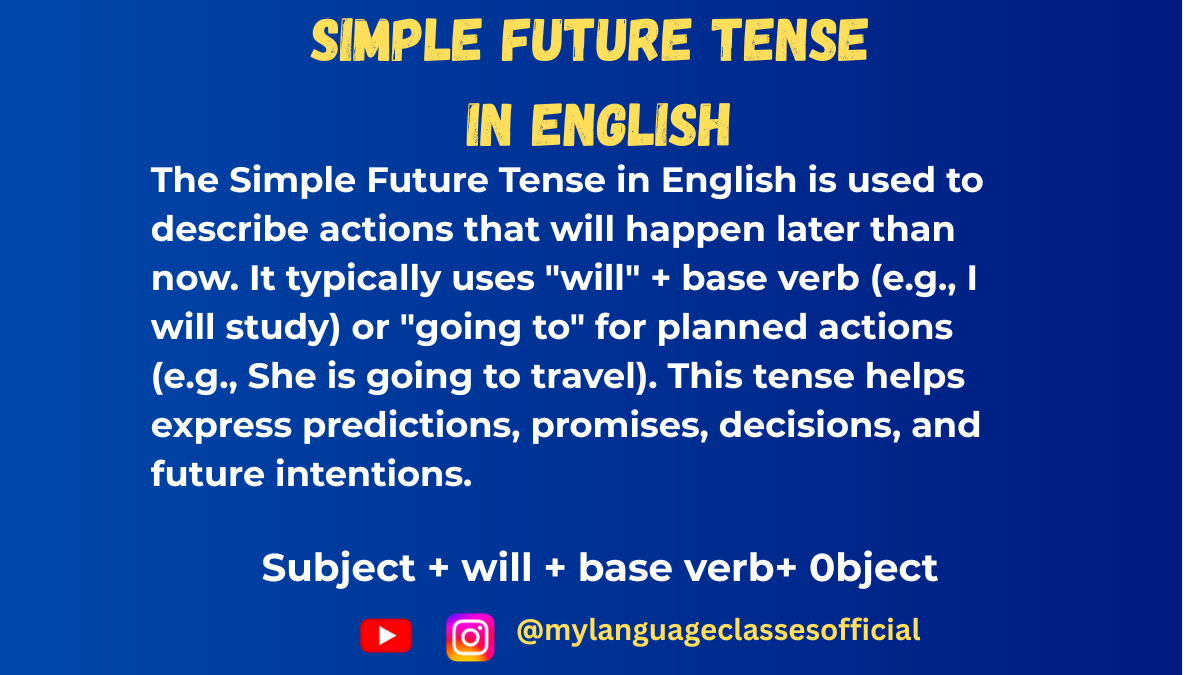
Simple Future Tense in English is used to talk about actions, events, decisions, and situations that will happen after the present moment. It helps us express predictions, make promises, offer help, and explain what we expect to happen in the future.
Consider these sentences:
I will call you tomorrow.
She will finish the report next week.
They will travel to New York next summer.
In each sentence, the speaker refers to a future action or event. The basic structure uses the auxiliary verb will followed by the base form of the main verb. Once you understand this pattern, you can form many different sentences about the future.
However, learning the Simple Future Tense involves more than memorizing a formula. You also need to understand when to use it, how to form negative sentences and questions, and how it differs from other ways of expressing future meaning in English.
This guide explains the Simple Future Tense step by step, with clear rules and practical examples. You will learn how to use it in everyday communication and how to avoid common mistakes that can make your sentences sound unnatural. If you want to understand how this construction fits into the wider English tense system, Complete English Tenses Mastery Guide provides a structured reference to English tense forms, uses, and differences.
What Is the Simple Future Tense in English?
The Simple Future Tense is a verb construction used to describe actions, events, and situations that will happen in the future. In traditional English grammar, it is commonly formed with the auxiliary verb will followed by the base form of the main verb.
For example:
I will visit my grandparents tomorrow.
She will start her new job next Monday.
We will discuss the results later.
These sentences refer to events that are expected to happen after the present moment. The construction remains the same regardless of whether the subject is I, you, he, she, it, we, or they.
Consider these examples:
→ I will learn English.
→ He will learn English.
→ They will learn English.
Notice that the main verb learn does not change. Unlike the Simple Present Tense, where we say he learns, the Simple Future construction uses will learn for every subject.
The Simple Future Tense can express several meanings, depending on the situation. Speakers commonly use it to make predictions, announce decisions, offer assistance, make promises, and describe future events they expect to happen.
For example:
It will rain tomorrow.
I will help you with your homework.
She will probably arrive before noon.
In the first sentence, the speaker makes a prediction. In the second, the speaker offers help or expresses willingness. In the third, the speaker describes an expected future event.
English also uses other structures to talk about the future, including be going to, the Present Continuous, and the Simple Present. Each construction serves particular purposes, so choosing the right one depends on what the speaker wants to communicate.
Understanding the Simple Future Tense begins with recognizing its basic structure and the meanings it can express. For a broader explanation of how English tense constructions relate to one another, Complete English Tenses Mastery Guide provides a structured reference to their forms, uses, and differences.
What Is the Formula for the Simple Future Tense?
The formula for the Simple Future Tense is subject + will + base form of the verb. This structure is used for all subjects, including I, you, he, she, it, we, and they.
Understanding this formula helps you form affirmative sentences, negative sentences, and questions without changing the main verb to match the subject.
1. Affirmative Sentence Formula
The formula for an affirmative sentence is:
Subject + will + base form of the verb + rest of the sentence
Examples:
→ I will call you tomorrow.
→ She will study English tonight.
→ He will finish the assignment soon.
→ We will visit our relatives next weekend.
→ They will arrive at the airport in two hours.
In each sentence, will comes before the main verb. The main verb remains in its base form, even when the subject is singular.
For example, we say She will work, not She will works.
2. Negative Sentence Formula
To make a negative sentence, place not after will.
The formula is:
Subject + will not + base form of the verb + rest of the sentence
Examples:
→ I will not attend the meeting tomorrow.
→ She will not travel next week.
→ He will not forget your advice.
→ We will not stay at the hotel tonight.
→ They will not finish the project today.
In everyday English, speakers often use the contraction won’t instead of will not.
For example:
I will not be late.
I won’t be late.
Both sentences are correct and have the same basic meaning.
3. Yes/No Question Formula
To form a Yes/No question, place will before the subject.
The formula is:
Will + subject + base form of the verb + rest of the sentence?
Examples:
→ Will you attend the meeting tomorrow?
→ Will she call us tonight?
→ Will he finish the work on time?
→ Will they visit you next month?
→ Will we need more time?
These questions ask whether an action or event will happen. In short answers, use will or will not, often contracted to won’t.
For example:
Will she come tomorrow?
Yes, she will.
No, she will not.
4. WH Question Formula
When you want to ask for specific information, begin with a question word such as what, where, when, why, or how.
The formula is:
WH question word + will + subject + base form of the verb?
Examples:
→ What will you do tomorrow?
→ Where will they stay?
→ When will she arrive?
→ Why will he leave early?
→ How will you solve this problem?
The question word identifies the information you want. The rest of the sentence follows the same basic structure as a Yes/No question.
5. Formula With the Verb Be
The Simple Future construction can also describe a future condition, identity, location, or state using the verb be.
The formula is:
Subject + will + be + complement
Examples:
→ I will be busy tomorrow.
→ She will be a doctor.
→ They will be at home tonight.
→ The weather will be pleasant next week.
Notice that the verb be follows will in its base form. Do not use am, is, or are immediately after will.
For example, She will be ready is correct, while She will is ready is incorrect.
The same principle applies throughout the Simple Future construction: will is followed by a base-form verb. Once you understand how this formula works, you can build sentences for different subjects and purposes. To explore how this pattern compares with other English tense structures, Complete English Tenses Mastery Guide provides a broader reference to tense formulas, uses, and sentence formation.
How Do You Form Affirmative Sentences in the Simple Future Tense?
To form an affirmative sentence in the Simple Future Tense, place will after the subject and use the base form of the main verb. This structure works with every subject, so you do not need to change the verb based on whether the subject is singular or plural.
The basic formula is:
Subject + will + base form of the verb + rest of the sentence
For example:
→ I will visit my parents tomorrow.
→ You will learn many new words.
→ He will complete the project next week.
→ She will call you in the evening.
→ It will rain tomorrow.
→ We will attend the conference.
→ They will arrive before noon.
Each sentence follows the same pattern. The subject identifies who or what the sentence is about, will introduces the future construction, and the main verb describes the action.
Does the Verb Change With the Subject?
No. The main verb remains in its base form after will, regardless of the subject.
Consider these examples:
→ I will work tomorrow.
→ She will work tomorrow.
→ They will work tomorrow.
In the Simple Present Tense, the verb changes with certain subjects. For example, we say I work but she works. In the Simple Future construction, however, we use will work for both subjects.
The following forms are incorrect:
→ She will works tomorrow.
→ He will goes to school.
→ They will visited us next week.
The correct sentences are:
→ She will work tomorrow.
→ He will go to school.
→ They will visit us next week.
Remember that will is followed by the base form of the main verb. Do not add -s, -ed, or to to that verb.
How Do You Use Will With Different Types of Verbs?
The same formula works with action verbs, verbs that describe states, and the verb be, although be follows its own base form.
With action verbs:
I will cook dinner tonight.
She will write the report tomorrow.
They will play soccer this weekend.
With verbs that describe states:
I will understand the lesson better after studying.
He will need more time to finish the work.
We will remember your advice.
With the verb be:
She will be happy to see you.
They will be ready by noon.
I will be at home tomorrow.
In these examples, will remains unchanged. The main verb follows it in its base form, whether that verb is cook, understand, need, or be.
Can You Use Contractions in Affirmative Sentences?
Yes. In everyday English, speakers often combine the subject and will into a contraction.
→ I will becomes I’ll.
→ You will becomes you’ll.
→ He will becomes he’ll.
→ She will becomes she’ll.
→ It will becomes it’ll.
→ We will becomes we’ll.
→ They will becomes they’ll.
For example:
I will call you later.
I’ll call you later.
Both sentences are correct. The full form may be useful when teaching the sentence structure or emphasizing a commitment, while the contracted form is common in conversation and informal writing.
Learning affirmative sentences gives you the foundation for using the Simple Future construction. Once you can identify the subject, place will correctly, and choose the base form of the verb, you can form sentences with a wide range of meanings. For a broader explanation of English tense structures and their patterns, Complete English Tenses Mastery Guide provides a structured reference to the forms and uses of English tenses.
How Do You Form Negative Sentences in the Simple Future Tense?
To form a negative sentence in the Simple Future Tense, place not after will and before the base form of the main verb. This structure shows that an action will not happen or that a future situation is not expected to occur.
The basic formula is:
Subject + will not + base form of the verb + rest of the sentence
For example:
→ I will not attend the meeting tomorrow.
→ She will not travel next week.
→ He will not forget your advice.
→ We will not stay at the hotel tonight.
→ They will not finish the project today.
In each sentence, will not makes the statement negative. The main verb remains in its base form, regardless of the subject.
How Do You Use Will Not With Different Subjects?
The structure remains the same for all subjects. You do not need to change will not or the main verb.
Consider these examples:
→ I will not work tomorrow.
→ You will not need additional documents.
→ He will not join us for dinner.
→ She will not accept the offer.
→ It will not take much time.
→ We will not cancel the appointment.
→ They will not arrive before noon.
Notice that the main verb does not change. For example, he will not join is correct, while he will not joins is incorrect.
This is because the auxiliary will carries the grammatical information required by the construction. The main verb stays in its base form.
What Is the Difference Between Will Not and Won’t?
Won’t is the standard contraction of will not. Both forms express the same basic negative meaning.
Examples:
I will not forget your birthday.
I won’t forget your birthday.
She will not come to the office tomorrow.
She won’t come to the office tomorrow.
Both versions are grammatically correct. The full form will not is common in formal writing and can place greater emphasis on the negative statement. The contraction won’t is widely used in everyday conversation and informal writing.
Remember that willn’t is incorrect. The standard contraction is won’t, even though its spelling does not follow the pattern found in contractions such as isn’t or don’t.
How Do You Form Negative Sentences With the Verb Be?
When the main verb is be, place not after will and before be.
The formula is:
Subject + will not + be + complement
Examples:
→ I will not be available tomorrow.
→ She will not be late for the interview.
→ He will not be at home tonight.
→ We will not be ready before noon.
→ They will not be responsible for the decision.
Do not use am, is, or are immediately after will. The verb must remain in its base form.
For example:
Incorrect: She will not is available tomorrow.
Correct: She will not be available tomorrow.
How Do You Make Negative Future Statements More Naturally?
Negative sentences often include time expressions that clarify when an action will not happen.
For example:
I will not travel this weekend.
She will not finish the report by Friday.
They will not attend the conference next month.
We will not need the extra room tomorrow.
These expressions help establish the time frame of the statement. However, a time expression is not required when the context already makes the future reference clear.
The main rule remains straightforward: use will not or won’t, followed by the base form of the main verb. For a wider understanding of how negative structures work across English tenses, Complete English Tenses Mastery Guide provides a structured reference to tense formation, sentence patterns, and common grammatical distinctions.
How Do You Form Yes/No Questions in the Simple Future Tense?
To form a Yes/No question in the Simple Future Tense, place will before the subject, followed by the base form of the main verb. These questions ask whether an action or event will happen in the future.
The basic formula is:
Will + subject + base form of the verb + rest of the sentence?
For example:
→ Will you attend the meeting tomorrow?
→ Will she call us tonight?
→ Will he finish the assignment on time?
→ Will they visit you next weekend?
→ Will we need more information?
Each question begins with will, followed by the subject and the main verb. Unlike affirmative sentences, where will comes after the subject, questions place will at the beginning.
How Do You Form Questions With Different Subjects?
The structure remains the same regardless of the subject. You do not need to change will or the main verb.
Consider these examples:
→ Will I need a ticket?
→ Will you join us for dinner?
→ Will he arrive before noon?
→ Will she remember the appointment?
→ Will it rain tomorrow?
→ Will we have enough time?
→ Will they accept the invitation?
Notice that the main verb stays in its base form. For example, Will she remember the appointment? is correct, while Will she remembers the appointment? is incorrect.
This rule applies to regular verbs, irregular verbs, and the verb be.
How Do You Answer Yes/No Questions in the Simple Future Tense?
You can answer these questions with short answers or complete sentences. Short answers usually sound natural in everyday conversation.
For affirmative answers, use:
Yes + subject + will.
Examples:
Will you come tomorrow?
Yes, I will.
Will she attend the conference?
Yes, she will.
Will they finish the project?
Yes, they will.
For negative answers, use:
No + subject + will not.
Examples:
Will he call later?
No, he will not.
Will you be available tomorrow?
No, I will not.
Will they join the meeting?
No, they will not.
In everyday English, you can also use won’t in negative answers.
Will she visit us next week?
No, she won’t.
The subject in the short answer should match the person or thing being discussed. For example, a question about he normally receives an answer using he, not I.
How Do You Form Questions With the Verb Be?
When the main verb is be, place will before the subject and use be after it.
The formula is:
Will + subject + be + complement?
Examples:
→ Will you be at home tonight?
→ Will she be ready by noon?
→ Will he be available tomorrow?
→ Will they be happy with the results?
→ Will we be late for the event?
Do not use is, am, or are immediately after will. The correct structure is Will she be ready?, not Will she is ready?
What Is the Difference Between Affirmative Sentences and Questions?
The main difference is the position of will.
Affirmative sentence:
You will finish the work tomorrow.
Yes/No question:
Will you finish the work tomorrow?
In the affirmative sentence, the subject comes first. In the question, will comes before the subject.
You do not need to add do or does to form a question with will. For example, Will you call me? is correct, while Do you will call me? is incorrect.
Once you understand this change in word order, forming Yes/No questions becomes straightforward. To see how question structures fit into the wider English tense system, Complete English Tenses Mastery Guide provides a structured reference to tense formation, sentence patterns, and common grammatical differences.
How Do You Form WH Questions in the Simple Future Tense?
To form a WH question in the Simple Future Tense, place a question word before will, followed by the subject and the base form of the main verb. These questions ask for specific information about future actions, events, people, places, reasons, or times.
The basic formula is:
Question word + will + subject + base form of the verb + rest of the sentence?
For example:
→ What will you do tomorrow?
→ Where will she stay during her trip?
→ When will they arrive?
→ Why will he leave early?
→ How will we solve this problem?
Each question begins with a word that identifies the information the speaker wants. The rest of the sentence follows the same word order used in Yes/No questions.
How Do You Use Different WH Words?
Different question words help you ask about different aspects of the future. Choosing the right one depends on the information you need.
What
Use what to ask about an action, activity, object, or situation.
What will you cook for dinner?
What will she study next semester?
What will they discuss at the meeting?
Where
Use where to ask about a future location or destination.
Where will you stay tonight?
Where will he work next year?
Where will they meet us?
When
Use when to ask about the time of a future action or event.
When will the train arrive?
When will you submit the report?
When will she return from her trip?
Why
Use why to ask about a reason.
Why will you leave early tomorrow?
Why will they postpone the meeting?
Why will he choose that university?
How
Use how to ask about a method, process, condition, or manner.
How will you travel to the airport?
How will she complete the project?
How will they manage the expenses?
You can also use combinations such as how long, how often, how much, and how many to ask more specific questions.
How long will you stay in London?
How much will the tickets cost?
How many people will attend the event?
How Do You Form WH Questions With the Verb Be?
When the main verb is be, the question word still comes first, followed by will, the subject, and be.
The formula is:
Question word + will + subject + be + complement?
Examples:
→ Where will you be tomorrow?
→ How will she be able to attend the meeting?
→ When will they be ready?
→ Why will he be absent next week?
Remember that be remains in its base form after will. Do not use is, am, or are immediately after the auxiliary.
For example, Where will she be? is correct, while Where will she is? is incorrect.
What Happens When Who Is the Subject?
When who asks about the subject performing the future action, the word order can be different. You do not normally place a separate subject after will because who itself identifies the subject.
For example:
Who will attend the meeting?
Who will call you tomorrow?
Who will help us with the project?
Compare these with questions in which who refers to the object of the action:
Who will you invite to the meeting?
Who will she call tomorrow?
In the first group, who is the subject. In the second group, the subject appears after will, and who identifies the person receiving the action.
Understanding this distinction helps you form natural questions without adding unnecessary words.
What Are Common Mistakes in WH Questions?
Learners sometimes use the wrong word order or add an unnecessary auxiliary when forming questions with will.
Incorrect: Where you will go tomorrow?
Correct: Where will you go tomorrow?
Incorrect: What will she studies next year?
Correct: What will she study next year?
Incorrect: Why do you will leave early?
Correct: Why will you leave early?
The main rules are consistent: place the question word first, use will before the subject when the subject is stated separately, and keep the main verb in its base form.
Once you understand these patterns, you can ask detailed questions about future events without changing the basic structure of the Simple Future construction. For a broader understanding of English sentence formation across different tenses, Complete English Tenses Mastery Guide provides a structured reference to verb forms, question patterns, and their uses.
What Is the Role of Will in the Simple Future Tense?
The auxiliary verb will is the main grammatical element used to form the Simple Future construction in English. It appears before the base form of the main verb and helps express future actions, predictions, decisions, promises, offers, and expectations.
For example:
I will call you tomorrow.
She will finish the assignment next week.
They will visit their grandparents during the holidays.
In each sentence, will comes before the main verb. The main verb describes the action, while the construction as a whole places that action in a future context.
Does Will Change With the Subject?
No. Unlike some present-tense verbs, will does not change according to the subject. You use the same form with singular and plural subjects.
Consider these examples:
→ I will study tonight.
→ You will study tonight.
→ He will study tonight.
→ She will study tonight.
→ We will study tonight.
→ They will study tonight.
The auxiliary remains will in every sentence. You do not add -s or another ending to it when the subject is he, she, or it.
For example, She will study tonight is correct, while She wills study tonight is incorrect in standard modern English when expressing the future.
Why Does Will Come Before the Main Verb?
In an affirmative sentence, will comes after the subject and before the main verb.
The structure is:
Subject + will + base form of the verb
Examples:
He will drive to work tomorrow.
We will discuss the proposal later.
She will understand the explanation.
The main verb remains in its base form because will is a modal auxiliary verb. In this construction, you do not use to before the main verb or add an ending to show the future.
For example:
Correct: He will drive tomorrow.
Incorrect: He will drives tomorrow.
Incorrect: He will to drive tomorrow.
This pattern also applies when the main verb is be.
Correct: She will be ready soon.
Incorrect: She will is ready soon.
How Does Will Work in Negative Sentences?
To make a negative sentence, place not immediately after will.
The structure is:
Subject + will + not + base form of the verb
Examples:
I will not forget your advice.
She will not attend the meeting.
They will not arrive before noon.
In everyday English, will not is often shortened to won’t.
For example:
We will not cancel the appointment.
We won’t cancel the appointment.
Both sentences express the same basic meaning. The full form can be useful in formal writing or when emphasizing a refusal or negative statement, while the contraction is common in conversation.
How Does Will Work in Questions?
In questions, will moves before the subject. The main verb still remains in its base form.
The structure is:
Will + subject + base form of the verb?
Examples:
Will you call me tomorrow?
Will she finish the report?
Will they join us for dinner?
For questions that request specific information, place the question word before will.
What will you study next year?
Where will they stay?
When will he return?
This movement of will is an important part of English question formation. You do not need to add do or does when forming questions with this auxiliary.
Does Will Always Express the Future?
Although will is commonly used to refer to future events, its meaning depends on the context. It can also express willingness, promises, offers, and other meanings.
For example:
I will help you with the boxes.
Here, the speaker expresses willingness to help.
I will never forget your kindness.
Here, the speaker makes a strong commitment about future behavior.
The door will not open.
Depending on the context, this sentence may describe a future prediction or indicate that the door refuses to open. The intended meaning comes from the situation in which the sentence is used.
It is also important to understand that English does not rely on will for every future reference. Constructions such as be going to, the Present Continuous, and the Simple Present can also refer to future events. The choice depends on the meaning and context.
Understanding the role of will gives you a foundation for forming future statements, negatives, and questions correctly. To see how this auxiliary fits into the wider system of English verb forms, Complete English Tenses Mastery Guide provides a structured reference to tense formation, sentence patterns, and grammatical differences.
Why Do You Use the Base Form of the Verb After Will?
In the Simple Future Tense, the main verb always appears in its base form after will. This rule applies to every subject, including I, you, he, she, it, we, and they. You do not add -s, -es, -ed, or to to the main verb after will.
The basic structure is:
Subject + will + base form of the verb
For example:
→ I will work tomorrow.
→ She will visit her friend next week.
→ He will study English tonight.
→ They will play soccer this weekend.
In each sentence, the main verb follows will in its base form. Understanding this pattern helps you avoid several common grammatical errors.
What Is the Base Form of a Verb?
The base form is the basic form of a verb before endings or other changes are added. It is the form you find in a dictionary entry, such as work, study, go, write, or eat.
English verbs can appear in different forms depending on the grammatical structure.
Consider the verb work:
→ Base form: work
→ Simple Present with he or she: works
→ Simple Past: worked
→ Present participle: working
→ Past participle: worked
When you use will, choose the base form rather than one of these other forms.
For example:
Correct: She will work tomorrow.
Incorrect: She will works tomorrow.
Incorrect: She will worked tomorrow.
Incorrect: She will working tomorrow.
The correct sentence uses work because will is followed by the base form of the main verb.
Why Does the Verb Not Change With He or She?
In the Simple Present Tense, the main verb usually takes an -s or -es ending when the subject is he, she, or it.
For example:
I study English every day.
She studies English every day.
However, this subject-based change does not occur after will.
I will study English tomorrow.
She will study English tomorrow.
The auxiliary will remains unchanged, and the main verb stays in its base form. This makes the Simple Future construction consistent across different subjects.
Do You Use To Before the Verb After Will?
No. In a standard affirmative future construction, you do not place to between will and the main verb.
Correct:
He will visit us tomorrow.
Incorrect:
He will to visit us tomorrow.
The same rule applies to other verbs:
→ She will learn Spanish.
→ They will finish the assignment.
→ We will discuss the plan later.
However, to can appear later in the sentence when it belongs to another grammatical structure.
For example:
She will want to learn Spanish.
In this sentence, will is followed by the base form want. The phrase to learn belongs to the verb want, not directly to will.
Does the Same Rule Apply to the Verb Be?
Yes. The verb be also appears in its base form after will.
Correct:
I will be ready soon.
She will be at home tonight.
They will be happy with the results.
Incorrect:
I will am ready soon.
She will is at home tonight.
They will are happy with the results.
Although am, is, and are are forms of be, they cannot replace the base form immediately after will.
What Happens in Negative Sentences and Questions?
The base-form rule remains the same when you form negative sentences or questions.
Negative sentences:
→ She will not attend the meeting.
→ He will not forget your advice.
→ They will not leave early.
Questions:
→ Will she attend the meeting?
→ Will he remember the appointment?
→ Will they leave early?
Adding not or moving will before the subject does not change the form of the main verb. It remains in its base form.
The key is to recognize that will is a modal auxiliary and that modal auxiliaries are followed by the base form of the main verb in these constructions. Once you understand this relationship, you can form future statements, negatives, and questions more accurately. For a broader explanation of how English verbs change across different tense constructions, Complete English Tenses Mastery Guide provides a structured reference to verb forms, sentence patterns, and their uses.
When Do You Use the Simple Future Tense?
The Simple Future Tense is commonly used to make predictions, express decisions, offer help, make promises, and describe events expected to happen in the future. The appropriate use depends on what the speaker wants to communicate and the situation in which the sentence appears.
Although the basic structure remains will + base form of the verb, the meaning can change according to the context.
1. To Make Predictions About the Future
Use will when you express a belief or prediction about something that may happen in the future.
Examples:
→ I think it will rain tomorrow.
→ She will probably pass the examination.
→ This new business will become successful.
→ The weather will be warmer next week.
→ People will continue to use technology in their daily lives.
These sentences express expectations about future events. The speaker believes that the events will happen, but the statements do not necessarily guarantee those outcomes.
Words such as think, probably, perhaps, and certainly can help communicate how confident the speaker feels about a prediction.
For example, She will probably arrive early expresses an expectation without claiming complete certainty.
2. To Express Decisions Made at the Moment of Speaking
Use will when you make a decision while speaking rather than describing an intention you had already formed.
Consider this conversation:
A: The phone is ringing.
B: I will answer it.
The speaker decides to answer the phone at that moment.
More examples:
→ The room is getting cold. I will close the window.
→ I am hungry. I will make a sandwich.
→ We have run out of milk. I will buy some.
→ You look tired. I will carry that bag for you.
In each example, the speaker responds to a situation by deciding what to do. This is a common use of will in everyday English.
However, decisions are not always expressed with will. When the speaker describes an intention formed before the conversation, be going to may be more appropriate.
3. To Make Promises
Use will to make a promise or express a commitment about future behavior.
Examples:
→ I will always support you.
→ I will finish the report by Friday.
→ She will return the money tomorrow.
→ We will keep your information confidential.
→ I will never forget your kindness.
These sentences communicate a commitment to do something in the future. Depending on the context, they may express reassurance, responsibility, or determination.
The negative form can also express a promise or firm commitment not to do something.
For example:
I will never repeat that mistake.
The speaker commits to avoiding the same mistake in the future.
4. To Offer Help or Assistance
Use will when offering to do something for another person. In these situations, the construction often expresses willingness.
Examples:
→ I will help you prepare for the interview.
→ We will carry your bags.
→ I will explain the instructions again.
→ She will show you how to use the machine.
→ I will call a taxi for you.
The exact meaning depends on the situation. For instance, I will help you can function as an offer when someone needs assistance or as a commitment when help has already been discussed.
5. To Express Willingness or Refusal
The Simple Future construction can express whether someone is willing to do something. Negative sentences can communicate refusal or an unwillingness to act.
Examples:
→ I will help you with the assignment.
→ He will gladly answer your questions.
→ She will not share the documents.
→ They will not accept the proposal.
In the first two sentences, will communicates willingness. In the negative examples, will not may express refusal, although the exact meaning depends on the context.
Compare these sentences:
I will not attend the meeting tomorrow.
The speaker may simply be stating a future decision.
I will not change my mind.
The speaker expresses a firm refusal or commitment.
This distinction shows why understanding context matters when interpreting will and will not.
6. To Describe Expected Future Events
Use will when stating what you expect to happen in the future.
Examples:
→ The results will be available next week.
→ The new library will open soon.
→ Our guests will arrive this evening.
→ The company will announce its decision tomorrow.
→ The meeting will begin in ten minutes.
These sentences describe anticipated future events. The speaker may have information supporting the expectation, but the sentence itself focuses on the event rather than the evidence behind it.
For fixed schedules and confirmed arrangements, English speakers may also use the Simple Present or Present Continuous. The choice depends on the type of event and how the speaker wants to present it.
7. To Make General Statements About Future Consequences
Use will to describe a result that the speaker expects to follow from a particular action or situation.
Examples:
→ If you study regularly, you will improve your English.
→ If we leave now, we will reach the station on time.
→ If she misses the bus, she will arrive late.
→ If you heat water to its boiling point under normal atmospheric pressure, it will boil.
The first three examples describe possible future situations and their expected consequences. The last example expresses a general relationship between a condition and a result.
Notice that the verb in the if clause usually uses the Simple Present when referring to a possible future condition.
For example, If you study regularly, you will improve your English is the standard pattern. In this type of conditional sentence, you do not normally use will in the if clause.
Choosing the Right Use of Will
Before using the Simple Future construction, consider the meaning you want to express. Are you making a prediction, responding to a situation, offering help, making a promise, or describing an expected event? Identifying the purpose helps you choose a suitable sentence.
The structure is consistent, but the meaning comes from the context. For a deeper understanding of how will works alongside other English tense constructions, Complete English Tenses Mastery Guide provides a structured reference to tense forms, their uses, and the differences between them.
How Do You Use the Simple Future Tense for Predictions?
The Simple Future Tense is commonly used to make predictions about events, situations, or outcomes that may happen in the future. Speakers often use will when they believe something is likely to happen, even when they cannot be completely certain.
For example:
I think it will rain tomorrow.
She will probably pass the examination.
The new restaurant will attract many customers.
In each sentence, the speaker expresses an expectation about the future. The prediction may come from personal judgment, experience, available information, or an understanding of the situation.
1. Making Predictions Based on Personal Beliefs
Use will when you express what you believe or expect to happen.
Examples:
→ I think our team will win the match.
→ She will become a successful writer.
→ This book will help you understand English grammar.
→ I believe they will accept the offer.
→ He will probably enjoy the movie.
These sentences express the speaker’s beliefs about future outcomes. The predictions may be reasonable, but they are not presented as guaranteed facts.
Words such as think, believe, and expect often appear with predictions.
For example:
I think she will enjoy the course.
The phrase I think makes it clear that the speaker is expressing an opinion rather than stating a certain outcome.
You can also place an adverb such as probably before the main verb.
She will probably arrive early.
They will probably finish the project tomorrow.
These sentences communicate an expectation without claiming absolute certainty.
2. Making Predictions About Weather
Weather predictions are a common use of will, particularly when the speaker expresses an expectation about future conditions.
Examples:
→ It will rain tomorrow.
→ The weather will be colder next week.
→ There will be strong winds tonight.
→ The temperature will rise in the afternoon.
→ It will probably snow during the weekend.
These statements refer to conditions expected in the future. In everyday conversation, speakers may use will to express their expectations, while formal forecasts may use different constructions depending on the available evidence and intended meaning.
For example, It will rain tomorrow expresses a prediction. The sentence does not explain whether the prediction comes from a weather forecast, personal observation, or another source.
3. Making Predictions About People and Their Actions
You can use will to predict what someone may do, how someone may respond, or what may happen to a person in the future.
Examples:
→ She will enjoy living in a new city.
→ He will understand the instructions after reading them carefully.
→ They will appreciate your help.
→ My parents will be happy to hear the news.
→ The students will find this explanation useful.
These predictions often come from what the speaker knows about the people involved. However, they remain predictions because the future outcome has not yet been confirmed.
Consider this sentence:
The students will find this lesson useful.
The speaker expects the lesson to be useful, but different students may respond differently. The construction communicates the speaker’s expectation rather than an established fact about every student.
4. Making Predictions About Work, Education, and Business
The Simple Future Tense is also useful when discussing expected developments in education, careers, technology, and business.
Examples:
→ The company will launch its new product next month.
→ Online education will continue to grow.
→ She will perform well in the interview.
→ The new policy will affect many employees.
→ This investment will create new opportunities.
These sentences describe expected developments. Depending on the context, a prediction may come from evidence, professional judgment, or an informed opinion.
However, will does not make a prediction certain. The construction expresses what the speaker expects to happen, not necessarily what will happen in reality.
5. Using Will and Going to for Predictions
Both will and be going to can express predictions, but speakers often choose between them based on the situation.
Use will when presenting a prediction as a belief, opinion, or expectation.
I think our team will win.
She will probably enjoy the trip.
Use be going to when the prediction is closely connected to present evidence.
Look at those dark clouds. It is going to rain.
The sky is becoming very dark, and it is going to storm soon.
This distinction is a useful tendency rather than an absolute rule. Both constructions can appear in different prediction contexts, and the speaker’s intended meaning influences the choice.
For example, I think it will rain presents a belief, while Look at those clouds. It is going to rain draws attention to visible evidence.
How Can You Make Predictions More Naturally?
When making predictions, consider how certain you want to sound and what supports your expectation. You can use expressions such as I think, I believe, probably, and I expect to communicate your level of confidence.
For example:
I think she will arrive before noon.
They will probably complete the project this week.
I expect the results will be available tomorrow.
These expressions help make your meaning clearer and more precise. The key is to understand that the Simple Future construction can express expectations without guaranteeing the outcome.
To understand how predictions fit into the wider English tense system, Complete English Tenses Mastery Guide provides a structured reference to tense forms, their uses, and the differences between related constructions.
How Do You Use the Simple Future Tense for Decisions Made at the Moment of Speaking?
The Simple Future Tense is commonly used with will when someone makes a decision while speaking. The decision often comes from a situation, request, or new piece of information that appears at that moment.
For example:
The phone is ringing. I will answer it.
In this situation, the speaker decides to answer the phone after hearing it ring. The decision was not necessarily planned before the conversation.
This use of will is common in everyday English because people often decide what to do as situations develop.
1. Making Decisions in Everyday Situations
People frequently use will when responding to immediate needs or unexpected situations.
Examples:
→ The room is getting cold. I will close the window.
→ We are out of milk. I will buy some.
→ You look tired. I will make you a cup of tea.
→ The doorbell is ringing. I will see who it is.
→ I cannot find my notebook. I will look for it upstairs.
In each example, the speaker responds to the situation and decides what to do. The Simple Future construction communicates that decision directly.
Notice that the sentence does not need a specific future time expression. The situation itself makes the future meaning clear.
2. Making Decisions During Conversations
You can also use will when deciding to do something after hearing information from another person.
Consider this conversation:
A: I do not understand this question.
B: I will explain it to you.
The second speaker decides to explain the question in response to the first speaker’s difficulty.
Here are more examples:
A: I have forgotten to email the manager.
B: I will send the email for you.
A: I cannot carry all these bags.
B: I will help you.
A: We need someone to take notes during the meeting.
B: I will do it.
In each conversation, the decision follows the information provided by the other person. The speaker uses will to express a willingness to take action.
3. Using Will to Respond to Problems
When a problem appears unexpectedly, will can express a decision about how to handle it.
Examples:
→ The printer is not working. I will check the connections.
→ We have missed the bus. I will book a taxi.
→ The computer has frozen. I will restart it.
→ We do not have enough chairs. I will bring some from the next room.
→ The report contains an error. I will correct it.
These sentences show how the Simple Future construction helps people explain their immediate responses to practical situations.
The decision may lead to an action moments later, but the construction itself focuses on the speaker’s decision or intention at the time of speaking.
4. Will for Immediate Decisions vs. Going to for Earlier Intentions
One important distinction is the difference between a decision made at the moment of speaking and an intention formed earlier.
Use will when you decide what to do as you speak.
The phone is ringing. I will answer it.
Use be going to when you describe an intention or plan that already existed before the moment of speaking.
I am going to visit my grandparents this weekend.
The first sentence presents a decision made in response to the ringing phone. The second describes an existing intention about a future visit.
Consider another comparison:
I will buy some groceries.
I am going to buy some groceries after work.
The first sentence can express a decision made at the moment of speaking. The second more naturally presents an intention that has already been formed.
However, this distinction is not an absolute rule. Speakers sometimes use will and be going to in overlapping ways, depending on the context and the meaning they want to emphasize.
5. Can Will Express a Decision About Something You Will Not Do?
Yes. The negative form can communicate a decision not to take an action.
Examples:
→ I will not buy that jacket. It is too expensive.
→ I will not drive in this weather.
→ We will not order food tonight. We will cook at home.
→ She will not accept the offer.
→ I will not spend money on something I do not need.
In these examples, the speaker expresses a decision or refusal. The context helps the listener understand whether the decision has just been made or reflects an existing position.
How Can You Recognize This Use of Will?
Look at the situation surrounding the sentence. If someone responds to new information, solves an immediate problem, or decides to take action while speaking, will is often an appropriate choice.
For example:
The lights have gone out. I will get a flashlight.
The speaker decides what to do after discovering the problem. The construction expresses that immediate response without requiring a detailed explanation of the decision-making process.
Understanding this use of will helps you speak more naturally when making choices, offering solutions, and responding to everyday situations. For a broader understanding of how English expresses future meaning through different verb constructions, Complete English Tenses Mastery Guide provides a structured reference to tense forms, their uses, and their differences.
How Do You Use the Simple Future Tense for Promises and Offers?
The Simple Future Tense is commonly used with will to make promises, offer assistance, and show a willingness to do something. These uses help speakers express commitment, reassure others, and respond to situations where someone needs help.
For example:
I will help you prepare for the interview.
This sentence communicates a willingness to help. Depending on the situation, it may also serve as a promise that the speaker will provide assistance.
Although promises and offers can both use will, they serve different purposes. A promise commits the speaker to an action, while an offer proposes help or assistance to another person.
1. How Do You Use Will to Make Promises?
A promise is a statement in which someone commits to doing something in the future. You can use will to express that commitment clearly.
Examples:
→ I will finish the report by Friday.
→ I will return your book tomorrow.
→ She will keep your information confidential.
→ We will deliver the documents before the deadline.
→ I will never forget what you did for me.
In these sentences, the speaker commits to a future action or behavior. The promise may involve completing a task, meeting a deadline, protecting information, or maintaining a personal commitment.
Promises often appear with time expressions such as tomorrow, by Friday, and before the deadline. These expressions clarify when the promised action is expected to happen.
For example:
I will send you the completed document by Monday.
The sentence communicates both the commitment and the expected deadline.
2. How Do You Use Will to Reassure Someone?
You can use will to reassure someone when they feel worried, uncertain, or concerned about a situation.
Examples:
→ Everything will be fine.
→ I will stay with you until the doctor arrives.
→ We will find a solution to this problem.
→ You will have enough time to prepare.
→ I will make sure the documents reach you safely.
These sentences express confidence, support, or a commitment to help. Their exact meaning depends on the context, but they often aim to make another person feel more secure.
For example, We will find a solution to this problem expresses confidence that a solution can be found. It does not guarantee that the problem will be resolved immediately.
This use of will is common in personal conversations, professional communication, and situations where someone needs reassurance.
3. How Do You Use Will to Offer Help?
An offer proposes that you do something for another person. You can use will to offer assistance when you notice a need or respond to a request.
Examples:
→ I will carry those bags for you.
→ I will help you complete the application.
→ We will arrange transportation for your guests.
→ I will explain the instructions again.
→ I will call the customer and clarify the issue.
In each example, the speaker expresses a willingness to take action. The offer may arise spontaneously or follow a request for assistance.
Consider this conversation:
A: I cannot understand how to complete this form.
B: I will help you fill it out.
The second speaker offers assistance in response to the problem. The construction communicates a decision to help.
4. How Do You Use Will to Make Offers in Professional Situations?
In professional communication, will can express a commitment to complete a task or provide assistance.
Examples:
→ I will send you the revised proposal this afternoon.
→ Our team will review the documents and contact you tomorrow.
→ I will arrange a meeting with the department manager.
→ We will provide the information you requested.
→ I will check the figures before submitting the report.
These statements are useful in emails, meetings, and workplace conversations because they communicate the action the speaker intends to take.
However, the context matters. A sentence such as I will send you the proposal this afternoon can function as a promise, a commitment, or a simple statement of intended action.
5. How Do You Use Will Not When Making Promises or Commitments?
The negative form can express a commitment to avoid a particular action or behavior.
Examples:
→ I will not share your personal information.
→ We will not disclose the details of the agreement.
→ I will not miss the deadline again.
→ She will not abandon the project halfway through.
→ I will not repeat the same mistake.
These sentences can communicate reassurance, determination, or a firm commitment. In some situations, will not expresses refusal rather than a promise, so the intended meaning depends on the circumstances.
For example, I will not share your personal information may reassure someone that their information will remain private. By contrast, I will not accept the offer expresses a refusal.
6. What Is the Difference Between a Promise and an Offer?
Promises and offers both use will, but the speaker’s purpose differs.
A promise commits the speaker to an action:
I will return your money tomorrow.
An offer proposes assistance:
I will carry your suitcase.
The first sentence commits the speaker to returning money. The second offers to help someone by carrying a suitcase.
In practice, the meanings can overlap. An offer may become a commitment once the other person accepts it, while a promise may also reassure someone who needs assistance.
Understanding this distinction helps you choose language that reflects your intention. Whether you are making a commitment, offering help, or reassuring someone, Complete English Tenses Mastery Guide provides a broader reference to the forms and uses of English tenses, including how will works in different sentence patterns.
How Do You Use the Simple Future Tense to Express Expectations?
The Simple Future Tense is commonly used with will to describe what someone expects to happen in the future. These expectations may relate to people, events, work, education, business, or everyday situations.
For example:
The results will be available next week.
This sentence expresses an expectation about when the results will become available. The speaker presents the event as something expected to happen in the future.
Although expectations and predictions are closely related, expectations often focus on what someone anticipates based on available information, experience, or circumstances.
1. Expressing Expectations About Future Events
Use will when you expect a particular event to happen.
Examples:
→ The meeting will begin at 10 a.m.
→ Our guests will arrive this evening.
→ The new store will open next month.
→ The examination results will arrive tomorrow.
→ The delivery will reach us by Friday.
These sentences describe events that the speaker expects to happen. The expectation may come from a schedule, an announcement, or information received earlier.
However, when an event follows a fixed timetable, English may use the Simple Present instead.
For example:
The train leaves at 8 a.m.
The train will leave at 8 a.m.
Both sentences can refer to a future departure, but the Simple Present commonly presents the departure as part of a schedule, while will can present it as an expected future event.
2. Expressing Expectations About People
You can use will to describe what you expect someone to do, understand, or experience.
Examples:
→ She will understand the instructions after reading them.
→ He will probably arrive before the interview begins.
→ They will appreciate your support.
→ My parents will be happy to hear the news.
→ The students will find the explanation helpful.
These sentences communicate the speaker’s expectations about future actions or reactions. The statements may reflect knowledge of the people involved, but the outcomes are not guaranteed.
Words such as probably, certainly, and likely can help express how confident the speaker feels.
For example:
She will probably finish the assignment tonight.
The word probably indicates that the speaker expects the assignment to be completed but does not claim complete certainty.
3. Expressing Expectations About Work and Education
The Simple Future Tense is useful when discussing expected outcomes in professional and educational settings.
Examples:
→ The team will complete the project before the deadline.
→ She will perform well in the examination.
→ The company will announce the results next week.
→ The new employee will receive training during the first month.
→ Our department will review the proposal tomorrow.
These sentences express expectations about tasks, results, and future developments. The speaker may have reasons for expecting these events, but the construction itself does not explain the evidence behind the expectation.
In professional communication, this distinction matters. Saying The team will complete the project by Friday expresses an expectation or commitment, depending on the context. It does not establish that the task has already been completed.
4. Expressing Expectations About Future Conditions
You can also use will to describe conditions that you expect to exist in the future.
Examples:
→ The weather will be warmer next week.
→ The roads will be crowded during the holiday.
→ The office will be quieter after the meeting.
→ The city will be busy during the festival.
→ The new building will be ready by December.
The verb be follows will in its base form. You do not use is, am, or are immediately after will.
For example:
Correct: The office will be quieter tomorrow.
Incorrect: The office will is quieter tomorrow.
These sentences describe expected future conditions rather than actions performed by a person.
5. Expressing Expectations With Think, Believe, and Expect
Certain verbs commonly introduce expectations about the future. These include think, believe, and expect.
Examples:
→ I think she will arrive on time.
→ We believe the project will succeed.
→ I expect they will respond by tomorrow.
→ He thinks the new course will help beginners.
→ They expect the weather will improve soon.
These structures allow speakers to communicate their views without presenting the expected outcome as an established fact.
You can also use hope to express a desired future outcome.
For example:
I hope the meeting will finish early.
This sentence expresses a wish about the future. It does not necessarily mean that the speaker expects the meeting to finish early.
6. Expressing Negative Expectations
Use will not or won’t when you expect something not to happen.
Examples:
→ The package will not arrive today.
→ She will probably not attend the meeting.
→ The weather will not improve before evening.
→ They will not finish the project by Friday.
→ He will not be available tomorrow.
These sentences express negative expectations about future events or conditions. The contraction won’t is common in everyday English.
For example:
The package won’t arrive today.
The full form will not may be preferable in formal writing or when the speaker wants to emphasize the negative statement.
How Can You Express Expectations Accurately?
When describing an expectation, consider whether you are stating a strong belief, a possibility, or a desired outcome. The construction with will often communicates what you believe is going to happen, while words such as probably, think, and expect help clarify your meaning.
It is also important to remember that English uses several constructions to discuss the future. The Simple Future is useful for expectations, but the Simple Present can describe scheduled events, and be going to can express intentions or predictions based on present evidence.
Understanding these differences helps you communicate expectations more precisely. For a broader explanation of English tense structures and their uses, Complete English Tenses Mastery Guide provides a structured reference to the forms and meanings of the major English tenses.
How Do You Use the Simple Future Tense With Time Expressions?
Time expressions help you show when an action or event is expected to happen in the future. In the Simple Future Tense, these expressions often appear with will + base form of the verb to make the time reference clear.
For example:
I will call you tomorrow.
She will start her new job next week.
They will visit their grandparents next summer.
In these sentences, the verbs describe future actions, while the time expressions tell the reader or listener when those actions are expected to happen.
1. Using Tomorrow
Use tomorrow to refer to the day after today. It commonly appears at the end of a sentence, although it can also appear at the beginning for emphasis.
Examples:
→ I will finish the report tomorrow.
→ She will visit her friend tomorrow.
→ We will discuss the proposal tomorrow.
→ Tomorrow, they will announce the results.
The word tomorrow identifies the time of the action without changing the verb structure.
2. Using Next Week, Next Month, and Next Year
Use expressions with next to refer to a future period.
Examples:
→ I will begin my English course next week.
→ She will move to another city next month.
→ They will launch the new product next year.
→ We will review the project next Friday.
These expressions are useful when the exact date or time is not necessary. The Simple Future construction remains the same regardless of the length of the period.
Remember that you do not normally add on before expressions such as next Monday or next week in standard American English.
For example:
Correct: We will meet next Monday.
Incorrect: We will meet on next Monday.
However, you can use on with a specific day when the sentence does not include next.
We will meet on Monday.
3. Using Soon and Later
Use soon when an action is expected to happen in the near future. Use later when an action will happen after the present moment or after another event.
Examples:
→ The meeting will begin soon.
→ She will call you later.
→ We will receive the documents soon.
→ I will explain the details later.
→ They will return soon.
These expressions do not specify an exact time. Their meaning depends on the context and the speaker’s expectations.
For example, I will call you later indicates that the call will happen after the present moment, but it does not identify a particular hour.
4. Using Tonight and This Weekend
Some time expressions refer to a specific part of the current day or week.
Examples:
→ I will prepare dinner tonight.
→ She will finish the assignment this evening.
→ We will watch a movie tonight.
→ They will visit us this weekend.
→ He will travel to Chicago this Saturday.
These expressions help you discuss future plans, expected events, and decisions. However, the use of will depends on the intended meaning. When describing an existing arrangement, the Present Continuous may be more natural.
For example:
I am meeting my manager tomorrow.
This sentence presents the meeting as an arrangement. By contrast, I will meet my manager tomorrow can express a future decision, expectation, or commitment, depending on the context.
5. Using In With Periods of Future Time
Use in followed by a period of time to indicate how far into the future an event is expected to happen.
Examples:
→ I will finish the book in two days.
→ She will return in an hour.
→ They will arrive in ten minutes.
→ We will complete the project in three weeks.
The expression in two days usually means that the event will happen two days from the present moment. It does not mean that the action will last for two days.
Compare these sentences:
I will finish the report in two hours.
I will work on the report for two hours.
The first sentence describes the expected time needed before completion. The second describes the duration of the work.
Understanding this distinction helps you choose between in and for when talking about future time.
6. Using By With a Future Deadline
Use by to identify a deadline or the latest expected time for an action to happen.
Examples:
→ I will submit the assignment by Friday.
→ She will return the documents by noon.
→ We will complete the repairs by next week.
→ They will announce the decision by the end of the month.
These sentences communicate that the action is expected to happen no later than the stated time. The action may happen earlier.
For example, I will submit the assignment by Friday means the assignment is expected to be submitted on Friday or before Friday, depending on the context.
7. Using Before and After
Use before and after to show the relationship between two events.
Examples:
→ I will finish my work before dinner.
→ She will call you after the meeting.
→ They will leave before the office closes.
→ We will discuss the results after everyone arrives.
These sentences establish the order of future events. One action is expected to happen earlier or later than another.
Notice that the verb in the time clause usually uses the Simple Present when referring to a future event.
For example:
Correct: I will call you after I finish work.
Incorrect: I will call you after I will finish work.
This rule also applies to many time clauses beginning with when, before, after, and as soon as.
8. Can You Use the Simple Future Without a Time Expression?
Yes. A time expression is not required when the context already makes the future meaning clear.
For example:
I will help you.
She will understand.
They will come.
These sentences can refer to future actions or events even though they do not contain words such as tomorrow or next week. The surrounding conversation helps establish the intended time.
For example, if someone asks who will help with a task, the response I will help you communicates a commitment without needing a specific time expression.
How Do You Choose the Right Time Expression?
Choose an expression that matches the time reference you want to communicate. Use tomorrow for the next day, next week for a future week, in two hours for a point two hours from now, and by Friday for a deadline.
Also remember that time expressions do not determine the tense by themselves. The intended meaning and sentence structure matter. English can use different constructions to discuss the same future time, depending on whether the speaker is making a prediction, describing an arrangement, or referring to a schedule.
For a broader understanding of how time expressions work across English tense constructions, Complete English Tenses Mastery Guide provides a structured reference to tense forms, their uses, and the relationships between them.
How Do You Use the Simple Future Tense With Questions About the Future?
The Simple Future Tense is used to ask questions about future actions, events, decisions, and expectations. By placing will before the subject, you can ask whether something will happen, what someone will do, or when an event is expected to occur.
For example:
Will you attend the meeting tomorrow?
When will she arrive?
What will they do next?
These questions help you gather information about the future. The structure depends on whether you want a Yes/No answer or a specific piece of information.
1. Asking Whether Something Will Happen
Use a Yes/No question when you want to know whether an action or event will occur.
The formula is:
Will + subject + base form of the verb?
Examples:
→ Will you visit us tomorrow?
→ Will she finish the assignment today?
→ Will they attend the conference?
→ Will he call you later?
→ Will we have enough time?
These questions focus on whether an event is expected to happen. They are useful in everyday conversations, workplace discussions, and situations involving future arrangements or expectations.
You can answer with a short affirmative or negative response.
Will you join us for dinner?
Yes, I will.
Will they arrive before noon?
No, they will not.
In everyday conversation, you can also use won’t in negative answers.
No, they won’t.
2. Asking About Future Actions
Use what to ask about an action, activity, decision, or event that will happen in the future.
Examples:
→ What will you do after work?
→ What will she study next semester?
→ What will they discuss during the meeting?
→ What will happen if we miss the deadline?
→ What will you buy for your parents?
These questions allow the speaker to ask for details rather than simply asking whether an action will happen.
For example, Will you study tomorrow? asks whether studying will happen. In contrast, What will you study tomorrow? asks about the subject or material.
3. Asking About Future Time and Location
Use when to ask about the time of an event and where to ask about its location.
Examples:
→ When will the train arrive?
→ When will you submit the report?
→ Where will she stay during her trip?
→ Where will they meet us?
→ When will the new course begin?
These questions are especially useful when discussing appointments, travel, deadlines, meetings, and other future events.
The question word appears first, followed by will, the subject, and the base form of the main verb.
For example:
When + will + subject + base form of the verb?
When will he return?
Where will they work?
4. Asking About Reasons and Methods
Use why to ask about a reason and how to ask about a method, process, or manner.
Examples:
→ Why will you leave early tomorrow?
→ Why will the company change its policy?
→ How will you solve this problem?
→ How will she travel to the airport?
→ How will they complete the project on time?
These questions focus on the reasons behind an expected action or the way an action will be carried out.
For example, Why will you leave early tomorrow? asks for a reason, while How will you reach the station? asks about the method of travel.
5. Asking About Future Duration and Quantity
You can combine how with other words to ask more specific questions about the future.
Examples:
→ How long will you stay in London?
→ How much will the tickets cost?
→ How many people will attend the event?
→ How often will the team meet?
→ How far will we need to travel?
Each question asks for a different kind of information. How long asks about duration, how much asks about an amount or price, how many asks about a countable quantity, and how often asks about frequency.
The same basic word order applies to all these questions.
6. Asking Questions With the Verb Be
When you ask about a future condition, identity, or location, use be after will.
Examples:
→ Will you be available tomorrow?
→ Will she be at home tonight?
→ Will they be ready by noon?
→ When will he be back?
→ Where will the meeting be?
The verb be remains in its base form after will. Do not use is, am, or are immediately after the auxiliary.
For example:
Correct: Will she be ready?
Incorrect: Will she is ready?
7. Asking Questions About Future Decisions
Questions with will can also help you ask about another person’s intentions, willingness, or expected actions.
Examples:
→ Will you help me with this assignment?
→ Will she accept the invitation?
→ Will they agree to the proposal?
→ Will he take responsibility for the mistake?
→ Will you come with us?
Depending on the situation, these questions can ask about expectations, request assistance, or seek a commitment. For example, Will you help me? can function as a request rather than a simple question about a future event.
Understanding the context helps you interpret the speaker’s purpose correctly.
How Can You Form Future Questions Correctly?
Start by deciding what information you need. If you want a Yes/No answer, begin with will. If you need a specific detail, begin with a question word such as what, when, where, why, or how.
Then place will before the subject and use the base form of the main verb. Avoid adding do or does because will already functions as the auxiliary in the construction.
For example:
Incorrect: When do you will arrive?
Correct: When will you arrive?
Once you understand these patterns, you can ask clear questions about future actions, plans, expectations, and decisions. For a broader explanation of how questions work across English tense constructions, Complete English Tenses Mastery Guide provides a structured reference to tense forms, sentence patterns, and their uses.
How Do You Use the Simple Future Tense With the Verb Be?
The Simple Future Tense uses will be to describe a future condition, identity, location, or state. In this structure, will is followed by be, the base form of the verb, rather than am, is, or are.
For example:
She will be busy tomorrow.
They will be at home tonight.
He will be a teacher in the future.
In each sentence, will be connects the subject with information about a future situation. The sentence can describe how someone will feel, where someone will be, or what someone will become.
1. Using Will Be to Describe Future Conditions
Use will be when describing a condition or state that you expect to exist in the future.
Examples:
→ I will be ready in ten minutes.
→ She will be happy with the results.
→ They will be tired after the journey.
→ The weather will be pleasant tomorrow.
→ We will be available next week.
These sentences describe expected conditions rather than actions. The adjective or other complement after be provides information about the subject.
For example, in She will be happy with the results, the phrase will be happy describes her expected emotional state.
2. Using Will Be to Describe Future Locations
Use will be when explaining where a person, place, or thing will be at a future time.
Examples:
→ I will be at home tonight.
→ She will be in the office tomorrow.
→ They will be at the airport by noon.
→ We will be in New York next week.
→ The documents will be on your desk tomorrow morning.
In these sentences, will be connects the subject with a location. The location may be a place, building, city, or specific position.
You can also use time expressions to clarify when the subject will be at that location.
For example, They will be at the airport by noon identifies the expected location and the deadline by which they should be there.
3. Using Will Be to Describe Future Identities and Roles
Use will be to describe a future identity, occupation, role, or position.
Examples:
→ She will be a doctor.
→ He will be the new department manager.
→ I will be your guide during the trip.
→ They will be responsible for the project.
→ My brother will be a university student next year.
These sentences describe what someone will be or the role someone is expected to have in the future.
When be is followed by a singular countable occupation or role, a suitable article is usually needed.
For example:
Correct: She will be a teacher.
Incorrect: She will be teacher.
However, not every complement requires an article. In They will be responsible for the project, the adjective responsible describes their role or condition.
4. Using Will Be With Adjectives
Adjectives describe qualities, conditions, or feelings. You can place an adjective after will be to explain how someone or something is expected to be in the future.
Examples:
→ The exam will be difficult.
→ The children will be excited about the trip.
→ The office will be quieter tomorrow.
→ The new course will be useful for beginners.
→ The roads will be crowded during the festival.
The adjective provides the main description, while will be places that description in a future context.
Compare these sentences:
The office is quiet today.
The office will be quiet tomorrow.
The first sentence describes the present. The second describes an expected future condition.
5. Using Will Be in Negative Sentences
To make a negative sentence with be, place not after will and before be.
The formula is:
Subject + will not + be + complement
Examples:
→ I will not be available tomorrow.
→ She will not be late for the meeting.
→ They will not be at home tonight.
→ The weather will not be warm next week.
→ We will not be responsible for the delay.
You can also use the contraction won’t.
For example:
She will not be available tomorrow.
She won’t be available tomorrow.
Both sentences are correct and express the same basic meaning.
Remember that not comes after will, not after be. The structure is will not be, rather than will be not, in standard negative sentences.
6. Using Will Be in Questions
To form a Yes/No question, place will before the subject and keep be after the subject.
The formula is:
Will + subject + be + complement?
Examples:
→ Will you be at home tonight?
→ Will she be ready by noon?
→ Will they be available next week?
→ Will he be the new manager?
→ Will the weather be pleasant tomorrow?
For WH questions, place the question word before will.
Examples:
→ Where will you be tomorrow?
→ When will she be ready?
→ Why will he be absent next week?
→ How long will they be away?
The verb be remains in its base form in both affirmative and negative sentences, as well as in questions.
7. Avoiding Common Mistakes With Will Be
Learners sometimes use am, is, or are after will because these are familiar forms of the verb be.
Incorrect: She will is happy tomorrow.
Correct: She will be happy tomorrow.
Incorrect: They will are at home tonight.
Correct: They will be at home tonight.
Incorrect: I will am ready soon.
Correct: I will be ready soon.
Another common mistake involves omitting be entirely.
Incorrect: He will busy tomorrow.
Correct: He will be busy tomorrow.
The word will needs a base-form verb after it. When the intended verb is be, you must include be in the sentence.
Understanding will be helps you describe future conditions, locations, identities, and roles with greater accuracy. To explore how this structure compares with other forms of the verb be across English tenses, Complete English Tenses Mastery Guide provides a structured reference to tense formation, sentence patterns, and their uses.
How Do You Use the Simple Future Tense With There Will Be?
Use there will be to express that something will exist, occur, or be available in the future. This construction is useful when discussing future events, situations, opportunities, problems, and changes without focusing on who or what causes them.
For example:
There will be a meeting tomorrow.
There will be more opportunities next year.
There will be several changes to the schedule.
In these sentences, there introduces the existence or occurrence of something, while will be places it in a future context.
1. Using There Will Be With Singular Nouns
Use there will be before a singular countable noun when referring to something expected to exist or happen in the future.
The structure is:
There + will + be + singular noun phrase
Examples:
→ There will be a meeting tomorrow.
→ There will be a new student in our class next week.
→ There will be an announcement this evening.
→ There will be a problem if we miss the deadline.
→ There will be an opportunity to discuss the proposal later.
The article a or an is generally necessary before a singular countable noun when the context requires it.
For example, There will be a meeting tomorrow is correct, while There will be meeting tomorrow is generally incorrect when referring to one meeting.
2. Using There Will Be With Plural Nouns
The construction there will be also works with plural nouns. Unlike some other forms of there be, the structure does not change to there will are when the noun is plural.
Examples:
→ There will be several meetings next week.
→ There will be many visitors during the festival.
→ There will be new opportunities for students.
→ There will be changes to the examination schedule.
→ There will be more books available next month.
Notice that will be remains the same in every sentence. The noun after it can be singular or plural.
Incorrect: There will are several meetings next week.
Correct: There will be several meetings next week.
3. Using There Will Be With Uncountable Nouns
You can also use there will be with uncountable nouns when describing something expected to exist or become available in the future.
Examples:
→ There will be enough food for everyone.
→ There will be more information on the website tomorrow.
→ There will be less traffic after the holiday.
→ There will be plenty of time to finish the assignment.
→ There will be additional support for new employees.
Uncountable nouns such as information, traffic, and support do not normally take a plural ending in these meanings.
For example, There will be more information tomorrow is correct, while There will be more informations tomorrow is incorrect in standard English.
4. Using There Will Be to Describe Future Events
Use there will be when you want to announce or predict that an event will take place.
Examples:
→ There will be a conference in New York next month.
→ There will be a school meeting on Friday.
→ There will be a celebration after the ceremony.
→ There will be an examination at the end of the semester.
→ There will be a public announcement tomorrow morning.
This construction is useful because it focuses on the event rather than the person organizing or conducting it.
For example, There will be a meeting tomorrow tells people that a meeting is expected to take place. It does not identify who will organize it.
5. Using There Will Be to Describe Future Changes
The construction can also describe changes in conditions, circumstances, or availability.
Examples:
→ There will be more jobs in this sector in the future.
→ There will be fewer buses during the holiday.
→ There will be improvements to the road next year.
→ There will be greater demand for qualified teachers.
→ There will be new rules starting next month.
These sentences describe situations expected to change or develop over time. Depending on the context, they may express predictions, announcements, or expectations.
6. How Do You Form Negative Sentences With There Will Be?
To make a negative sentence, place not after will.
The structure is:
There + will + not + be + noun phrase
Examples:
→ There will not be a meeting tomorrow.
→ There will not be enough time to complete the work.
→ There will not be any classes next Monday.
→ There will not be many opportunities to revise the schedule.
→ There will not be additional charges for the service.
In everyday English, won’t is commonly used instead of will not.
For example:
There will not be a meeting tomorrow.
There won’t be a meeting tomorrow.
Both sentences are correct. The second is more conversational.
7. How Do You Form Questions With There Will Be?
To form a Yes/No question, place will before there.
The structure is:
Will + there + be + noun phrase?
Examples:
→ Will there be a meeting tomorrow?
→ Will there be enough food for everyone?
→ Will there be any changes to the schedule?
→ Will there be a new course next semester?
→ Will there be more opportunities in the future?
These questions ask whether something will exist, occur, or be available.
You can also use WH question words to request specific information.
Examples:
→ When will there be another meeting?
→ How many students will there be in the class?
→ What changes will there be next year?
The structure depends on the question word, but there will be remains the central construction.
8. Avoiding Common Mistakes With There Will Be
One common mistake is changing be to is or are because the noun is singular or plural.
Incorrect: There will is a meeting tomorrow.
Correct: There will be a meeting tomorrow.
Incorrect: There will are many opportunities next year.
Correct: There will be many opportunities next year.
Another mistake is placing there after will in an ordinary affirmative statement.
Incorrect: Will be there a meeting tomorrow?
Correct: Will there be a meeting tomorrow?
Remember that there will be stays consistent in affirmative and negative statements. In questions, will moves before there, producing will there be.
Understanding this construction helps you discuss future events, availability, changes, and situations without needing to identify a specific person responsible for them. To see how there will be fits into the wider English tense system, Complete English Tenses Mastery Guide provides a structured reference to tense forms, sentence patterns, and their uses.
How Do You Use the Simple Future Tense With Future Events and Situations?
The Simple Future Tense is commonly used with will to describe events, developments, and situations expected to happen in the future. It allows you to communicate what you expect to happen, what you believe will occur, or what you intend to do in response to a situation.
For example:
The company will announce its decision tomorrow.
The weather will become colder next week.
We will discuss the proposal during the next meeting.
Each sentence refers to a future event or situation. The construction remains the same, but the meaning depends on the context.
1. Describing Events Expected to Happen
Use will when you expect an event to happen at a future time.
Examples:
→ The conference will begin at 9 a.m.
→ The examination results will arrive next week.
→ Our guests will reach the hotel this evening.
→ The new library will open next month.
→ The school will announce the examination dates tomorrow.
These sentences describe anticipated events. The speaker may have received information about them or may simply be expressing an expectation.
When an event follows a fixed timetable, however, the Simple Present is often more natural.
For example:
The conference begins at 9 a.m.
The conference will begin at 9 a.m.
Both sentences can refer to the future. The first presents the event as part of a schedule, while the second can emphasize the expected occurrence.
2. Describing Future Developments
The Simple Future Tense can describe developments that you expect to take place over time.
Examples:
→ The city will become more crowded over the next decade.
→ Technology will continue to influence education.
→ The company will expand its services next year.
→ More students will enroll in the program next semester.
→ The demand for qualified teachers will increase.
These statements express expectations about future changes. Depending on the context, they may be based on current trends, available information, or the speaker’s judgment.
However, using will does not make a statement certain. It presents the development as an expected future outcome.
3. Describing Future Situations
Use will to describe a condition or situation that you expect to exist in the future.
Examples:
→ The office will be quieter tomorrow.
→ The roads will be busy during the holiday.
→ The students will have more time to prepare next week.
→ The new building will be ready by December.
→ Our team will have enough resources for the project.
These sentences focus on future conditions rather than on a single action.
The verb be follows will in its base form. For example, The office will be quieter tomorrow is correct, while The office will is quieter tomorrow is incorrect.
4. Describing Future Events in Personal Life
You can use will when talking about expected events in your personal life, including visits, celebrations, appointments, and other future activities.
Examples:
→ I will visit my grandparents next weekend.
→ She will celebrate her birthday on Saturday.
→ We will meet our friends after work.
→ They will move to a new apartment next month.
→ My brother will graduate next year.
These sentences communicate future events in a straightforward way. However, when you describe an arrangement that has already been made, the Present Continuous may be more appropriate.
For example:
I am meeting my friends after work.
This sentence presents the meeting as an arrangement. In contrast, I will meet my friends after work can express a decision, expectation, or commitment, depending on the context.
5. Describing Future Events at Work or School
The Simple Future Tense is also useful when discussing professional responsibilities, educational activities, and upcoming tasks.
Examples:
→ The manager will review the report tomorrow.
→ The students will submit their assignments next Monday.
→ Our team will present the proposal next week.
→ The teacher will explain the new topic during class.
→ The company will release the updated policy soon.
These statements describe actions expected to happen in a professional or educational setting. They can communicate plans, commitments, announcements, or expectations.
The surrounding context helps clarify the intended meaning.
For example, The manager will review the report tomorrow may describe a confirmed commitment or an expectation about what the manager will do.
6. Describing Future Outcomes
You can use will to describe an outcome that you expect to follow from an action or situation.
Examples:
→ Regular practice will improve your grammar.
→ This change will make the process easier.
→ Better planning will reduce unnecessary delays.
→ The new policy will affect several departments.
→ Reading regularly will help you build your vocabulary.
These sentences describe expected consequences. Some express general relationships, while others refer to particular future circumstances.
For example, Regular practice will improve your grammar expresses an expected benefit. The actual result may depend on the quality of the practice, consistency, and other factors.
7. Choosing Between Will and Other Future Constructions
English uses several constructions to refer to future events. Although will is common, it is not always the most suitable choice.
Use will for predictions, spontaneous decisions, promises, offers, and many statements about expected future events.
For example:
I will help you with the assignment.
Use be going to when describing an existing intention or a prediction based on present evidence.
For example:
I am going to visit my grandparents this weekend.
Use the Present Continuous when referring to an arrangement.
For example:
I am meeting my manager tomorrow.
Use the Simple Present when describing a fixed schedule or timetable.
For example:
The train leaves at 8 a.m.
These constructions can overlap, so the choice depends on the speaker’s intended meaning and the context.
Understanding how the Simple Future Tense describes events and situations helps you communicate expectations clearly without assuming that every future reference requires will. For a broader explanation of how these constructions relate to other English tenses, Complete English Tenses Mastery Guide provides a structured reference to tense forms, their uses, and their differences.
What Is the Difference Between Will and Going to?
Both will and be going to can express future events in English, but speakers often choose between them based on the meaning they want to communicate. The Simple Future construction with will is commonly used for predictions, decisions made at the moment of speaking, promises, and offers. The construction be going to often expresses an intention formed earlier or a prediction based on present evidence.
Understanding the difference helps you choose the construction that fits the situation.
1. Will for Decisions Made at the Moment of Speaking
Use will when you decide to do something while speaking, often in response to a new situation.
Examples:
→ The phone is ringing. I will answer it.
→ I am hungry. I will make a sandwich.
→ We have run out of milk. I will buy some.
→ The room is cold. I will close the window.
In each example, the speaker decides what to do in response to the situation. The decision is presented as being made at that moment.
2. Going to for Intentions Formed Earlier
Use be going to when you describe an intention or plan that existed before the moment of speaking.
Examples:
→ I am going to study Spanish this evening.
→ She is going to visit her grandparents this weekend.
→ We are going to move to a new apartment next month.
→ They are going to start a new business.
These sentences describe intentions that the speakers have already formed. The plans may change, but the construction presents them as existing intentions.
Compare these examples:
I will call the manager.
I am going to call the manager this afternoon.
The first sentence may express a decision, promise, or intention, depending on the context. The second more clearly presents an existing intention to make the call.
3. Will for Predictions Based on Beliefs or Opinions
Use will when you express a prediction based on what you think or believe about the future.
Examples:
→ I think she will pass the examination.
→ This book will help you improve your grammar.
→ The new restaurant will attract many customers.
→ I believe they will win the competition.
These sentences communicate the speaker’s expectations. The prediction may come from experience, knowledge, or personal judgment.
You can also use words such as probably, certainly, and perhaps to express different levels of confidence.
For example:
She will probably arrive before noon.
The speaker expects an early arrival but does not present it as completely certain.
4. Going to for Predictions Based on Present Evidence
Use be going to when you make a prediction based on something you can observe or other evidence available now.
Examples:
→ Look at those dark clouds. It is going to rain.
→ Be careful! You are going to drop that glass.
→ The road is covered with ice. The car is going to skid.
→ He has not studied for the examination. He is going to struggle.
In these examples, the prediction is connected to evidence or circumstances that exist in the present.
Compare these sentences:
I think it will rain tomorrow.
Look at those clouds. It is going to rain.
The first sentence presents a belief or expectation. The second points to visible evidence that supports the prediction.
However, this distinction is a tendency, not an absolute rule. Speakers can use will and be going to in overlapping prediction contexts.
5. How Do You Form Sentences With Will and Going to?
The two constructions use different grammatical patterns.
For will, the formula is:
Subject + will + base form of the verb
Examples:
→ She will travel tomorrow.
→ They will finish the work.
→ I will help you.
For be going to, the formula is:
Subject + am/is/are + going to + base form of the verb
Examples:
→ I am going to travel tomorrow.
→ She is going to finish the work.
→ They are going to help us.
Notice that be going to changes according to the subject. Use am with I, is with he, she, and it, and are with you, we, and they.
The main verb after going to remains in its base form.
For example, She is going to study is correct, while She is going to studies is incorrect.
6. How Do You Form Negative Sentences?
The negative structures differ because the two constructions use different auxiliaries.
With will, place not after will.
Examples:
→ I will not attend the meeting.
→ She will not travel next week.
→ They will not accept the offer.
With be going to, place not after the appropriate form of be.
Examples:
→ I am not going to attend the meeting.
→ She is not going to travel next week.
→ They are not going to accept the offer.
Both constructions can express a negative future intention or expectation. The choice depends on the meaning and context.
7. How Do You Form Questions?
Questions with will begin with will, followed by the subject and the base form of the verb.
Examples:
→ Will you attend the meeting?
→ Will she travel tomorrow?
→ Will they accept the offer?
Questions with be going to begin with the appropriate form of be.
Examples:
→ Are you going to attend the meeting?
→ Is she going to travel tomorrow?
→ Are they going to accept the offer?
Both sets of questions are grammatically correct. Their meanings may overlap, although the context can make one construction more suitable than the other.
8. Can Will and Going to Mean the Same Thing?
Yes. In many situations, both constructions can refer to the same future event.
For example:
I will visit my grandparents tomorrow.
I am going to visit my grandparents tomorrow.
Both sentences describe a future visit. The second often suggests an existing intention, while the first can express a decision, commitment, or expectation. Without additional context, the difference may be small.
English speakers do not always follow a strict rule that assigns every future situation to only one construction. Meaning, context, and the speaker’s intended emphasis all influence the choice.
Which Construction Should You Choose?
Use will when you want to express a prediction based on a belief, make a spontaneous decision, offer help, or make a promise. Use be going to when you want to emphasize an intention formed earlier or a prediction supported by present evidence.
These are useful guidelines rather than rigid rules. As you read and write English, pay attention to why a speaker chooses one construction over the other instead of memorizing isolated examples.
For a broader understanding of how English expresses future time and how its verb constructions differ, Complete English Tenses Mastery Guide provides a structured reference to tense forms, their uses, and their relationships.
What Is the Difference Between the Simple Future and the Simple Present?
The Simple Future and the Simple Present can both refer to future events, but they are used in different situations. The Simple Future commonly expresses predictions, decisions, promises, and expectations. The Simple Present can describe schedules, timetables, and events that follow a fixed program.
Understanding this difference helps you choose the correct verb form when talking about future time.
1. When Do You Use the Simple Future?
Use the Simple Future with will to express predictions, decisions, promises, offers, and expectations about future events.
Examples:
→ I will call you tomorrow.
→ She will finish the report next week.
→ They will probably arrive in the evening.
→ We will help you with the project.
These sentences describe actions or situations expected to happen in the future. The construction focuses on the speaker’s statement about what will happen.
2. When Do You Use the Simple Present for Future Events?
Use the Simple Present to describe scheduled events, official timetables, and fixed programs. This use is especially common when the event is part of an established schedule.
Examples:
→ The train leaves at 7:30 tomorrow morning.
→ The examination begins next Monday.
→ Our English class starts at 10 a.m. tomorrow.
→ The conference ends on Friday.
Although the verbs leaves, begins, starts, and ends are in the Simple Present form, the time expressions show that the events belong to the future.
The Simple Present is particularly natural when the speaker refers to a timetable or an arrangement established by an organization.
3. How Do Will and the Simple Present Differ in Meaning?
Compare these sentences:
The train will leave at 7:30 tomorrow morning.
The train leaves at 7:30 tomorrow morning.
Both sentences refer to a future departure. However, the first presents the departure as a future event or expectation, while the second presents it as part of the train schedule.
Consider another comparison:
I will start my English course next Monday.
My English course starts next Monday.
The first sentence focuses on the future action or the speaker’s intention. The second presents the course start date as a scheduled event.
These differences are useful, but they are not absolute. Speakers can use will to describe scheduled events, and the Simple Present can communicate future information when the context supports that meaning.
4. How Do You Form the Simple Present for Scheduled Future Events?
The Simple Present follows its usual grammatical rules, even when it refers to the future.
With I, you, we, and they, use the base form of the verb.
Examples:
→ We travel tomorrow morning.
→ They arrive at noon.
With he, she, and it, add the appropriate third-person singular ending.
Examples:
→ The flight departs at 9 p.m.
→ The class begins at 8 a.m.
→ The shop closes early tomorrow.
When a future schedule requires a negative sentence or a question, use the usual Simple Present structures.
Examples:
→ The train does not stop at this station tomorrow.
→ Does the examination begin at 9 a.m.?
Remember that does takes the base form of the main verb. Therefore, Does the examination begins? is incorrect.
5. Can the Simple Present Describe Personal Plans?
The Simple Present can refer to future events in certain contexts, but it is not the usual choice for every personal plan.
For example:
→ My flight leaves tomorrow morning.
→ The meeting starts at 3 p.m.
→ Our holiday begins next week.
These examples describe events that are scheduled or fixed.
However, when you want to emphasize your personal intention, the Simple Future or the Present Continuous may be more suitable.
Compare these sentences:
I will study English tomorrow.
I am studying English tomorrow.
The first can express a decision, promise, or expectation. The second commonly presents the study session as a planned arrangement.
The Simple Present would be less natural for this personal plan unless the context presents it as part of a regular schedule.
6. How Do Time Expressions Help You Choose the Correct Tense?
Time expressions help establish whether a sentence refers to the present or the future, but they do not determine the tense by themselves.
Examples of future time expressions include tomorrow, next week, on Monday, at 6 p.m., and next month.
Compare these sentences:
→ She works at the language school every Monday.
→ She will work at the language school next Monday.
→ Her class starts at the language school next Monday.
The first sentence describes a regular activity. The second expresses a future action or expectation. The third describes a scheduled event.
The time expression and the intended meaning work together to determine which verb form is most appropriate.
How Can You Remember the Difference?
Use the Simple Future when you want to make a statement about a future action, prediction, decision, or commitment. Use the Simple Present when you refer to a timetable, schedule, or established program.
As you study English grammar, focus on the relationship between verb form and meaning. Complete English Tenses Mastery Guide offers a structured reference for understanding English tense forms, their uses, and the differences between them.
What Is the Difference Between the Simple Future and the Future Continuous?
The Simple Future and the Future Continuous both describe future events, but they emphasize different aspects of those events. The Simple Future commonly expresses predictions, decisions, promises, and future actions. The Future Continuous emphasizes an activity that will be in progress at a particular time in the future.
Understanding this difference helps you describe future actions more precisely.
1. How Do You Form the Simple Future and the Future Continuous?
The Simple Future commonly uses will followed by the base form of the verb.
Formula:
Subject + will + base form of the verb
Examples:
→ I will study English tomorrow.
→ She will travel next week.
→ They will work on the project.
The Future Continuous uses will be followed by the present participle, which is the verb form ending in -ing.
Formula:
Subject + will be + verb-ing
Examples:
→ I will be studying English at 8 p.m.
→ She will be traveling this time tomorrow.
→ They will be working on the project in the afternoon.
The Simple Future presents an action as a future event. The Future Continuous presents an activity as being in progress at a future time.
2. When Do You Use the Simple Future?
Use the Simple Future when you want to express a future action, prediction, decision, promise, or expectation without specifically emphasizing its progress at a particular future moment.
Examples:
→ I will finish the report tomorrow.
→ She will visit her grandparents next week.
→ They will complete the project soon.
→ We will discuss the proposal later.
These sentences focus on the future actions or events. They do not specifically present the actions as activities in progress at a particular time.
However, the Simple Future does not always guarantee that an action will be completed. The meaning depends on the verb and the context.
3. When Do You Use the Future Continuous?
Use the Future Continuous when you want to describe an activity that will be in progress at a particular time in the future.
Examples:
→ I will be studying English at 8 p.m. tonight.
→ She will be traveling to Madrid this time tomorrow.
→ They will be attending a conference next Monday morning.
→ We will be having dinner when you arrive.
In these examples, the focus is on the activity during a future period or at a future moment.
The sentences do not necessarily tell you when the activities will begin or end. They emphasize what will be happening at the specified time.
4. How Do the Two Tenses Differ When Describing the Same Action?
Compare these sentences:
I will read the book tonight.
I will be reading the book at 9 p.m. tonight.
The first sentence states that the speaker will read the book tonight. The second emphasizes the activity that will be in progress at 9 p.m.
Consider another comparison:
She will work tomorrow.
She will be working at 10 a.m. tomorrow.
The first sentence describes a future work activity. The second identifies a particular time when the activity will be in progress.
Similarly:
→ They will travel to Japan next month.
→ They will be traveling to Japan this time next month.
The first sentence presents the trip as a future event. The second emphasizes the activity in progress at a particular future time.
The difference lies in the intended focus rather than in a simple distinction between completed and incomplete actions.
5. How Do You Use the Two Tenses With Specific Future Times?
A specific future time can help you decide whether the Simple Future or the Future Continuous better expresses your meaning.
For example:
→ I will call you at 6 p.m.
→ I will be working at 6 p.m.
The first sentence expresses a future action scheduled or expected to occur at 6 p.m. The second describes an activity that will be in progress at that time.
Compare these examples:
→ The students will take the examination tomorrow.
→ The students will be taking the examination at 10 a.m. tomorrow.
The first presents the examination as a future event. The second emphasizes the activity during a particular period.
Remember that the Simple Future can also describe an action expected at a specific time. The Future Continuous is useful when you want to emphasize the activity in progress.
6. How Do You Form Negative Sentences?
To form a negative Simple Future sentence, place not after will.
Examples:
→ I will not attend the meeting tomorrow.
→ She will not travel next week.
→ They will not finish the work today.
To form a negative Future Continuous sentence, place not after will and before be.
Examples:
→ I will not be attending the meeting at 10 a.m.
→ She will not be traveling this time tomorrow.
→ They will not be working on the project tonight.
The first construction expresses a negative future action or expectation. The second emphasizes an activity that will not be in progress at a particular future time.
7. How Do You Form Questions?
In Simple Future questions, place will before the subject.
Examples:
→ Will you attend the meeting tomorrow?
→ Will she travel next week?
→ Will they finish the project?
In Future Continuous questions, place will before the subject, followed by be and the verb ending in -ing.
Examples:
→ Will you be attending the meeting at 10 a.m.?
→ Will she be traveling this time tomorrow?
→ Will they be working on the project tonight?
The Simple Future questions ask about future actions or events. The Future Continuous questions often ask whether an activity will be in progress at a particular future time.
8. What Are the Most Important Differences to Remember?
The main difference concerns how you present the future action.
→ Use the Simple Future to express predictions, decisions, promises, and future actions.
→ Use the Future Continuous to emphasize an activity that will be in progress at a particular future time.
→ Use will + base form for the Simple Future construction.
→ Use will be + verb-ing for the Future Continuous construction.
→ Consider the context before choosing a tense because both constructions can describe the same future event.
For example, I will study tonight describes a future activity, while I will be studying at 8 p.m. emphasizes what will be happening at that time.
Learning these distinctions makes your English more precise because you can communicate not only when something will happen, but also how you want the listener to understand the action.
For a more complete understanding of English tense forms and their relationships, Complete English Tenses Mastery Guide provides a structured reference to the rules, uses, and examples of English tenses.
What Are the Most Common Simple Future Tense Mistakes?
The Simple Future Tense in English becomes easier to use when you understand its structure and recognize common grammatical errors. Many learners make mistakes with the base form of verbs, negative sentences, questions, and the choice between will and other future constructions.
Learning these patterns helps you form accurate sentences and communicate future actions more clearly.
1. Using the Third-Person Singular Form After Will
One common mistake is adding -s or -es to the main verb after will. The verb after will must always remain in its base form.
Incorrect: She will goes to school tomorrow.
Correct: She will go to school tomorrow.
Incorrect: He will studies English tonight.
Correct: He will study English tonight.
Incorrect: The train will arrives at noon.
Correct: The train will arrive at noon.
Remember that will does not change according to the subject. The main verb also remains in its base form, regardless of whether the subject is I, she, they, or another noun.
2. Using Do or Does to Form Negative Sentences
The Simple Future uses will not to form negative sentences. You do not need do not or does not before the main verb.
Incorrect: I do not will attend the meeting.
Correct: I will not attend the meeting.
Incorrect: She does not will come tomorrow.
Correct: She will not come tomorrow.
Incorrect: They do not will finish the work.
Correct: They will not finish the work.
You can also use the contraction will not becomes will not in formal writing, while will not is commonly shortened to will not in speech and informal writing as will not? The standard contraction is will not → will not? Actually, the contraction is will not → will not?
For clear formal grammar practice, use will not consistently. The important rule is to place not directly after will.
3. Using the Past Form of the Verb After Will
Another mistake is using the past form of a verb after will. The Simple Future requires the base form, even when the sentence refers to an action that will happen later.
Incorrect: She will went to the office tomorrow.
Correct: She will go to the office tomorrow.
Incorrect: They will finished the project next week.
Correct: They will finish the project next week.
Incorrect: He will wrote the report tonight.
Correct: He will write the report tonight.
The time expression may refer to the future, but it does not change the verb form required after will.
4. Using Will in Both Parts of a Negative Sentence
A negative Simple Future sentence needs only one will. Adding another auxiliary creates an incorrect structure.
Incorrect: I will do not attend the class.
Correct: I will not attend the class.
Incorrect: She will does not complete the assignment.
Correct: She will not complete the assignment.
Incorrect: They will not will participate in the event.
Correct: They will not participate in the event.
The correct pattern is subject + will not + base form of the verb. Once you understand this structure, negative sentences become much easier to form.
5. Using the Wrong Word Order in Questions
In Simple Future questions, place will before the subject. Do not place the subject before will when forming a standard yes/no question.
Incorrect: You will attend the meeting?
Correct: Will you attend the meeting?
Incorrect: She will come tomorrow?
Correct: Will she come tomorrow?
Incorrect: They will finish the work?
Correct: Will they finish the work?
Questions such as You will attend the meeting? can occur in conversation as statements with rising intonation. However, the standard grammatical form for a yes/no question is Will you attend the meeting?
6. Using the Past Form After Will in Questions
The main verb remains in its base form when you ask a question with will.
Incorrect: Will she went to the market?
Correct: Will she go to the market?
Incorrect: Will they completed the assignment?
Correct: Will they complete the assignment?
Incorrect: Will he bought a new car?
Correct: Will he buy a new car?
The formula is will + subject + base form of the verb. Moving will to the beginning does not change the form of the main verb.
7. Confusing Will and Going to
Both will and be going to can describe future events, but they often communicate different intentions or perspectives.
For example:
→ I will answer the phone.
→ I am going to answer the phone.
The first sentence can express a decision made at the moment of speaking. The second can describe an intention that already exists.
Another comparison:
→ Look at those clouds. It is going to rain.
→ I think it will rain tomorrow.
The first sentence presents a prediction based on present evidence. The second expresses a belief or expectation.
These distinctions are tendencies rather than strict rules. The meaning depends on context, and the two constructions can overlap.
8. Using Will for Every Future Situation
Although will is useful for many future statements, it is not always the most natural choice. English uses several verb constructions to express future time.
For example:
→ The train leaves at 8 a.m. tomorrow.
→ I am meeting my teacher tomorrow.
→ I will call you tomorrow.
The first sentence describes a scheduled departure. The second presents a planned arrangement. The third expresses a future action or commitment.
All three sentences refer to future time, but their verb forms communicate different perspectives. Choosing the appropriate construction helps your sentences sound more natural.
9. Forgetting That Will Does Not Change With the Subject
Unlike some present-tense verbs, will remains the same for every subject.
Incorrect: He wills visit us tomorrow.
Correct: He will visit us tomorrow.
Incorrect: She will visits her grandmother.
Correct: She will visit her grandmother.
Incorrect: They wills complete the task.
Correct: They will complete the task.
The auxiliary will does not take an -s ending for third-person singular subjects. The main verb also remains in its base form.
10. Confusing Will Be With Will Being
The Simple Future uses will be when the main verb is be. It does not use will being in standard Simple Future sentences.
Incorrect: She will being happy with the results.
Correct: She will be happy with the results.
Incorrect: They will being at home tomorrow.
Correct: They will be at home tomorrow.
Incorrect: I will being ready by noon.
Correct: I will be ready by noon.
Use will be + adjective, will be + noun phrase, or will be + place phrase when you want to describe a future state or situation.
For example:
→ He will be ready soon.
→ She will be a teacher next year.
→ We will be at the office tomorrow.
11. Using the Simple Future When Another Construction Fits Better
Sometimes a sentence is grammatically possible with will, but another construction communicates the intended meaning more naturally.
For example:
The class will start at 9 a.m. tomorrow.
The class starts at 9 a.m. tomorrow.
Both sentences are possible. The Simple Present is particularly natural when describing a fixed timetable.
Similarly:
I will meet my manager tomorrow.
I am meeting my manager tomorrow.
Both can be correct, but the Present Continuous often emphasizes an arrangement that has already been made.
The goal is to understand the meaning behind each construction rather than treating every future sentence as interchangeable.
How Can You Avoid These Simple Future Tense Mistakes?
You can improve your accuracy by checking the structure of each sentence before using it.
→ After will, use the base form of the main verb.
→ Place not after will to form a negative sentence.
→ Put will before the subject in standard yes/no questions.
→ Keep will unchanged with every subject.
→ Choose between will, be going to, the Present Continuous, and the Simple Present according to the intended meaning and context.
→ Use examples to understand how sentence structure affects meaning instead of memorizing rules without context.
A clear understanding of these patterns provides a strong foundation for accurate future-tense sentences. Complete English Tenses Mastery Guide offers a structured reference for studying English tense forms, their grammatical rules, and their uses in different contexts.
How Can You Use the Simple Future Tense Correctly?
You can use the Simple Future Tense in English correctly by understanding its structure, choosing the right verb form, and matching the construction to your intended meaning. The most important skills are forming affirmative sentences, negatives, and questions accurately, recognizing common future uses, and distinguishing will from other constructions that express future time.
1. Follow the Correct Sentence Structure
The basic Simple Future construction uses will followed by the base form of the main verb.
→ Affirmative: Subject + will + base form of the verb
→ Negative: Subject + will not + base form of the verb
→ Yes/no question: Will + subject + base form of the verb?
→ WH question: WH word + will + subject + base form of the verb?
Examples:
→ She will visit her grandmother tomorrow.
→ They will not attend the meeting.
→ Will you finish the report today?
→ When will the train arrive?
Following these patterns helps you avoid mistakes with word order and verb forms.
2. Always Use the Base Form After Will
The main verb must remain in its base form after will, regardless of the subject or the time expression.
Correct examples:
→ He will study English tonight.
→ She will write the report tomorrow.
→ They will go to the library next week.
Avoid adding -s, using the past form, or adding -ed to the main verb after will.
Incorrect: She will writes the letter.
Correct: She will write the letter.
Incorrect: They will went home.
Correct: They will go home.
This rule applies to regular and irregular verbs.
3. Use Will for the Right Purpose
The Simple Future construction with will serves several purposes in everyday English. You can use it to make predictions, express decisions, offer help, make promises, and communicate expectations.
Examples:
→ I think the weather will improve tomorrow.
→ I will answer the phone.
→ I will help you with your assignment.
→ I will never forget your kindness.
→ The new course will begin next month.
The context determines the precise meaning. For example, I will answer the phone may express a spontaneous decision, while I will help you can function as an offer or promise.
4. Choose Between Will and Other Future Constructions
English uses several constructions to discuss future time. Therefore, using will in every future sentence may not communicate your intended meaning as naturally as another form.
Compare these examples:
→ I will call my teacher tomorrow.
→ I am going to call my teacher tomorrow.
→ I am calling my teacher tomorrow.
The first sentence can express a decision, promise, or expectation. The second often describes an existing intention. The third commonly presents a planned arrangement.
These distinctions are not absolute. Speakers can use different constructions for the same future event, depending on context and emphasis.
5. Use Time Expressions Clearly
Time expressions help readers and listeners understand when an event is expected to happen. Common examples include tomorrow, next week, soon, later, in two days, and next year.
Examples:
→ She will graduate next year.
→ We will discuss the proposal tomorrow.
→ They will arrive in two hours.
→ I will finish the book soon.
A time expression is not always necessary when the context already makes the future meaning clear. However, adding one can make your sentence more precise when the timing matters.
6. Check Negative Sentences and Questions
Negative sentences and questions follow specific patterns. Review the placement of not and the position of will before using these structures.
Negative examples:
→ I will not forget your advice.
→ He will not attend the meeting.
→ We will not change the schedule.
Question examples:
→ Will she join us tomorrow?
→ Will they complete the assignment?
→ Where will you stay?
→ Why will the company change its policy?
Avoid adding do or does to Simple Future negatives and questions. The auxiliary will already performs that grammatical role.
7. Understand the Meaning Before Choosing the Tense
Correct grammar involves more than following a formula. You also need to understand what you want to communicate.
Consider these examples:
→ The train leaves at 8 a.m. tomorrow.
→ I am meeting my friend tomorrow.
→ I will meet my friend tomorrow.
The first sentence describes a scheduled event. The second commonly describes a planned arrangement. The third can express a future action, decision, or commitment.
All three sentences can refer to future time, but they present the situations differently.
When choosing a verb form, consider whether you are describing a schedule, an existing plan, a prediction, a promise, or a decision made while speaking.
8. Build Accuracy Through Careful Reading and Writing
Regular exposure to well-written English helps you recognize how future constructions work in different contexts. Pay attention to sentence structure, auxiliary verbs, time expressions, and the relationship between the speaker’s intention and the chosen verb form.
When reviewing a sentence, check three things:
→ Is will followed by the base form of the verb?
→ Is the word order correct for the sentence type?
→ Does the construction express the intended meaning?
These checks help you identify grammatical errors while developing a clearer understanding of English tense patterns.
For a more structured reference to English tense forms, sentence patterns, and their uses, Complete English Tenses Mastery Guide brings the major English tenses together in one resource, helping you compare their structures and understand when to use them.
Key Takeaway
The Simple Future Tense in English is commonly taught through the construction will + base form of the verb. It helps you express predictions, spontaneous decisions, promises, offers, expectations, and other future events.
→ Use will + base form in affirmative sentences.
→ Use will not + base form in negative sentences.
→ Place will before the subject in standard yes/no questions.
→ Use the base form of the main verb after will, regardless of the subject.
→ Recognize the difference between will, be going to, the Present Continuous, and the Simple Present when expressing future time.
→ Choose the construction that best communicates your intended meaning and context.
Understanding these rules gives you a reliable foundation for forming accurate future statements, questions, and negative sentences.
To review these patterns alongside other English tense forms, Complete English Tenses Mastery Guide provides a structured resource for understanding the rules, uses, and relationships between the tenses.
Conclusion
The Simple Future Tense helps you talk about future actions, predictions, decisions, promises, and expectations. Once you understand its basic structure, you can form affirmative sentences, negative sentences, and questions with greater accuracy.
However, learning the Simple Future also means understanding how it differs from other ways of expressing future time. The Simple Present can describe schedules, the Present Continuous can describe planned arrangements, and be going to often expresses existing intentions or predictions based on present evidence.
By paying attention to these differences, you can communicate future events more clearly and choose verb constructions that suit the situation.
Complete English Tenses Mastery Guide by My Language Classes is a useful reference for studying English tense structures, understanding their uses, and comparing the major tense forms in one place.

Vikas Kumar is the founder of My Language Classes, a language learning platform dedicated to helping learners develop practical communication skills in Spanish, Japanese, and English through comprehensive grammar guides, structured learning resources, books, and evidence-informed educational content.
At My Language Classes, we believe that successful language learning is built on clarity, consistency, meaningful practice, and a deep understanding of how languages work. Every article is carefully researched and created to simplify complex concepts, provide practical guidance, and help learners develop confidence through real-world communication.
Inspired by the principles behind How Language Learning Really Works, our mission is to make high-quality language learning accessible to learners around the world by providing accurate, trustworthy, and comprehensive resources that support lasting progress, lifelong learning, and meaningful communication.
Leave a Reply