

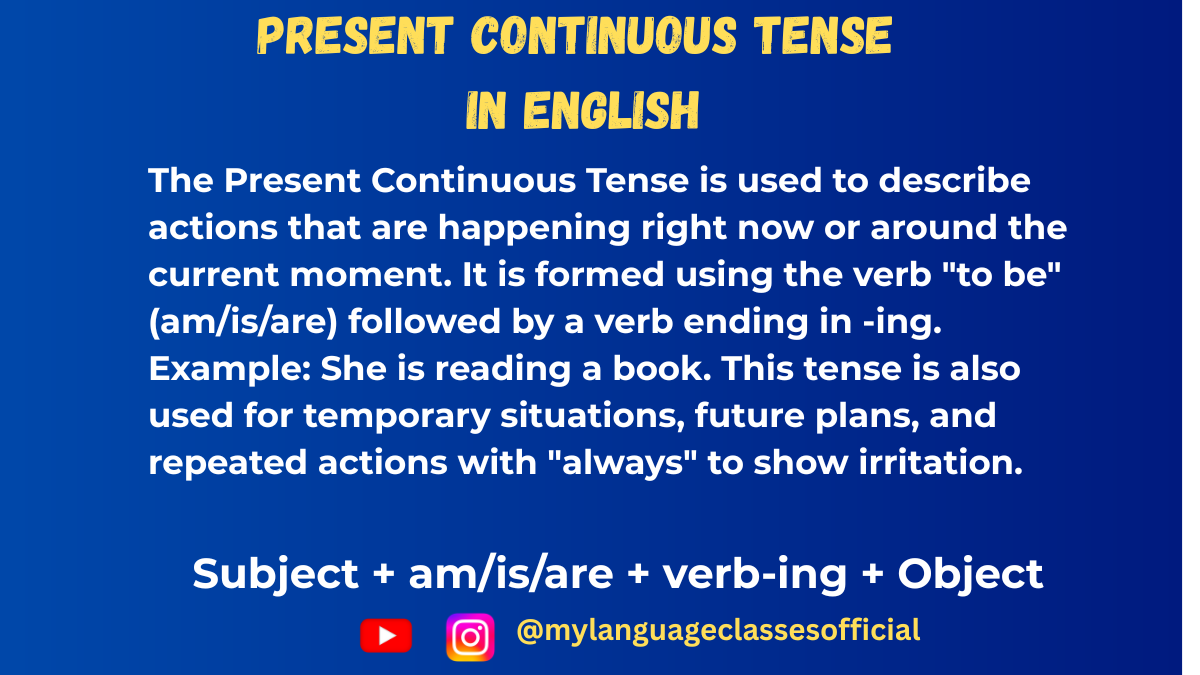
Present Continuous Tense in English is used to describe actions and situations that are happening around the present, are temporary, are developing, or have been arranged for the future. The tense is easy to recognize once its structure is clear, but using it well requires more than adding “-ing” to a verb.
Consider these sentences:
I am reading a book.
She is working from home this week.
They are waiting for the bus.
We are meeting our friends tonight.
All four sentences use the Present Continuous, but they do not express exactly the same idea. The first describes an activity happening around the present. The second describes a temporary situation. The third describes an action in progress, while the fourth refers to a future arrangement.
The basic structure is also straightforward. The Present Continuous combines a form of the verb “be” with the present participle of the main verb:
I am reading.
She is reading.
They are reading.
The form of “be” changes according to the subject, while the main verb takes its -ing form.
This distinction matters because the Present Continuous is not simply a tense for actions happening at the exact second when someone speaks. English speakers use it to present an activity or situation as ongoing around a particular period of time. Understanding that idea makes the different uses of the tense much easier to recognize.
The Present Continuous is one part of the larger English tense system, and seeing how it relates to the other tenses can make tense selection much more logical. A broader explanation of these relationships is provided in Complete English Tenses Mastery Guide.
What Is the Present Continuous Tense in English?
The Present Continuous Tense describes an action or situation that is in progress around the present time. It can refer to something happening at the exact moment of speaking, but its use is broader than that. The speaker may also be describing a temporary situation, a developing change, or an arrangement for the near future.
The basic structure is:
Subject + am/is/are + present participle
For example:
I am reading a book.
She is talking to her friend.
They are waiting outside.
We are studying English this month.
In each sentence, the form of “be” changes according to the subject. The main verb takes the present participle form, usually ending in “-ing.”
The tense can describe an action happening at the moment of speaking:
I am writing an email.
The person is writing the email while speaking or around that moment.
It can also describe an activity that is happening around the present but not necessarily at the exact second when the sentence is spoken:
I am reading a book about Japanese history.
The speaker may not be reading the book at this exact moment. The sentence can simply mean that reading the book is a current activity.
The Present Continuous can also describe temporary situations:
She is staying with her parents this month.
Here, the situation is connected with the present but is not presented as permanent.
It can even describe future arrangements:
We are meeting our teacher tomorrow.
The activity has not happened yet, but the meeting has been arranged.
These different uses share the same basic idea. The speaker presents an activity or situation as connected with a current period rather than as a general fact or completed event.
This is an important distinction when comparing the Present Continuous with other English tenses. The meaning depends not only on the verb itself but also on how the speaker views the situation in relation to time. Understanding this wider tense system is an important part of Complete English Tenses Mastery Guide.
What Is the Formula of the Present Continuous Tense?
The Present Continuous Tense has a simple basic structure, but the form of the auxiliary verb changes according to the subject. The main verb then appears in its present participle form.
The basic affirmative formula is:
Subject + am/is/are + present participle
For example:
I am reading a book.
She is studying English.
They are watching a movie.
We are learning Spanish.
The choice of “am,” “is,” or “are” depends on the subject. Use “am” with “I”:
I am working.
I am writing.
I am waiting.
Use “is” with he, she, it, and singular nouns:
He is working.
She is writing.
The student is waiting.
Use “are” with you, we, they, and plural nouns:
You are working.
We are writing.
They are waiting.
The negative formula adds “not” after the auxiliary verb:
Subject + am/is/are + not + present participle
For example:
I am not working.
She is not sleeping.
We are not waiting.
They are not studying.
Questions use a different word order:
Am/Is/Are + subject + present participle?
For example:
Am I speaking too quickly?
Is she working today?
Are you studying English?
Are they waiting outside?
The main verb remains in the present participle form in affirmative sentences, negative sentences, and questions. Only the auxiliary verb changes according to the subject.
Understanding this structure makes the Present Continuous much easier to build correctly. Once the relationship between the subject, auxiliary verb, and present participle is clear, learners can create many different sentences without memorizing individual patterns. The wider structure of this tense and its relationship with other English tenses is covered in Complete English Tenses Mastery Guide.
How Do You Form Affirmative Sentences in the Present Continuous?
Affirmative sentences in the Present Continuous are formed by combining the subject, the correct form of “be,” and the present participle of the main verb. The structure stays the same across subjects, but “am,” “is,” or “are” changes according to the subject.
The basic structure is:
Subject + am/is/are + present participle
Use “am” with “I”:
I am reading a book.
I am learning English.
I am working from home.
Use “is” with “he,” “she,” “it,” and singular nouns:
He is studying for his exam.
She is talking to her friend.
The child is sleeping.
The computer is working properly.
Use “are” with “you,” “we,” “they,” and plural nouns:
You are learning quickly.
We are preparing dinner.
They are playing outside.
The students are studying together.
The main verb takes its present participle form after “am,” “is,” or “are.” Some verbs require spelling changes when “-ing” is added:
Incorrect form: She is writeing.
Correct form: She is writing.
Incorrect form: They are runing.
Correct form: They are running.
These spelling patterns become particularly important with verbs ending in silent “e,” verbs ending in “-ie,” and certain short verbs that require a doubled final consonant. These patterns will be explained in detail later.
The auxiliary verb is also essential. The Present Continuous cannot normally be formed by adding “-ing” directly to the subject:
Incorrect form: I reading a book.
Correct form: I am reading a book.
Incorrect form: She working today.
Correct form: She is working today.
The same structure works whether the sentence describes an action happening now, a temporary situation, a developing change, or another use of the Present Continuous. The meaning changes with the context, but the grammatical structure remains consistent. The complete system of English tense formation is explained in Complete English Tenses Mastery Guide.
How Do You Form Negative Sentences in the Present Continuous?
Negative sentences in the Present Continuous are formed by placing “not” after the correct form of the verb “be.” The main verb remains in its present participle form.
The basic structure is:
Subject + am/is/are + not + present participle
Use “am not” with “I”:
I am not working today.
I am not watching television.
I am not studying at the moment.
Use “is not” with “he,” “she,” “it,” and singular nouns:
He is not sleeping.
She is not working today.
The child is not playing outside.
The computer is not working properly.
Use “are not” with “you,” “we,” “they,” and plural nouns:
You are not listening.
We are not watching a movie.
They are not studying today.
The students are not waiting outside.
The position of “not” is important. It comes between the auxiliary verb and the present participle:
She is not reading a book.
The main verb does not change to another form. The negative meaning is created by adding “not” to the auxiliary verb.
In everyday English, negative contractions are also common:
I am not working. → I’m not working.
She is not sleeping. → She isn’t sleeping.
They are not waiting. → They aren’t waiting.
There is no standard contraction such as “I amn’t.” Instead, English normally uses “I’m not.”
The Present Continuous negative can describe an action that is not happening at the moment:
I am not using my computer right now.
It can also describe a temporary situation that is not taking place:
She is not staying at the hotel this week.
The same structure can describe a future arrangement that has been canceled or is not happening:
We are not meeting the teacher tomorrow.
The important point is that the auxiliary verb must still agree with the subject. The main verb remains in the present participle form, while “not” changes the sentence from affirmative to negative. This relationship between auxiliary verbs and main verbs is an important part of the English tense system explained in Complete English Tenses Mastery Guide.
How Do You Form Questions in the Present Continuous?
Questions in the Present Continuous are formed by placing the correct form of the verb “be” before the subject. The main verb remains in its present participle form.
The basic structure is:
Am/Is/Are + subject + present participle?
Use “am” with “I”:
Am I speaking too quickly?
Am I doing this correctly?
Am I disturbing you?
Use “is” with “he,” “she,” “it,” and singular nouns:
Is he working today?
Is she studying English?
Is the child sleeping?
Is your brother coming with us?
Use “are” with “you,” “we,” “they,” and plural nouns:
Are you waiting for someone?
Are we going in the right direction?
Are they watching the movie?
Are the students preparing for the exam?
The main verb stays in the present participle form after the subject:
Is she reading a book?
Are they playing football?
Am I making a mistake?
The word order is different from an affirmative sentence. Compare the two structures:
Affirmative: She is working today.
Question: Is she working today?
The auxiliary verb moves before the subject to form the question.
Present Continuous questions can ask about actions happening at the moment:
Are you listening to me?
Is he talking on the phone?
They can also ask about temporary situations:
Are you staying with your parents this week?
Is she working from home this month?
Questions can also refer to future arrangements:
Are you meeting your teacher tomorrow?
Are they coming to the party tonight?
A common mistake is to use “do” or “does” with the Present Continuous:
Incorrect form: Do you working today?
Correct form: Are you working today?
Another common mistake is to leave out the auxiliary verb:
Incorrect form: You working today?
Correct form: Are you working today?
The Present Continuous question structure is therefore based on one central pattern: the form of “be” comes first, followed by the subject and the present participle. Once this structure is understood, learners can form questions for actions, temporary situations, and future arrangements with much greater confidence. The wider patterns of English question formation are covered in Complete English Tenses Mastery Guide.
How Do You Form WH Questions in the Present Continuous?
WH questions in the Present Continuous begin with a question word such as “what,” “where,” “why,” “who,” “when,” or “how.” The question word comes before the usual Present Continuous question structure.
The basic structure is:
WH word + am/is/are + subject + present participle?
For example:
What are you doing?
Where is she going?
Why are they waiting?
When are you leaving?
How is he feeling?
The form of the verb “be” still depends on the subject. Use “am” with “I”:
What am I doing wrong?
Why am I feeling tired?
Use “is” with “he,” “she,” “it,” and singular nouns:
What is she reading?
Where is he working?
Why is the child crying?
Use “are” with “you,” “we,” “they,” and plural nouns:
What are you studying?
Where are they staying?
Why are we waiting?
WH questions can ask about an action happening at the moment of speaking:
What are you doing right now?
They can also ask about a temporary situation:
Where are you staying this week?
A WH question can refer to a future arrangement:
When are you meeting your teacher?
Why are you traveling to Chicago next week?
The question word determines the information the speaker wants, while the Present Continuous structure shows that the situation is ongoing, temporary, or arranged.
One important point concerns questions beginning with “who.” When “who” is the subject of the sentence, the structure can be different:
Who is coming to the meeting?
Here, “who” is the subject. We do not normally add another subject after “is.”
When “who” asks about the object, the usual structure is used:
Who are you talking to?
In this sentence, “you” is the subject and “who” refers to the person receiving the action.
The most common mistake is to use “do” or “does” when forming a Present Continuous WH question:
Incorrect form: What do you doing?
Correct form: What are you doing?
The Present Continuous requires the appropriate form of “be,” followed by the subject and present participle. Keeping that structure clear makes WH questions much easier to form accurately. A broader explanation of English tense structures and their relationships is provided in Complete English Tenses Mastery Guide.
What Is the Present Participle in the Present Continuous?
The present participle is the form of the main verb that usually ends in “-ing.” In the Present Continuous, it comes after “am,” “is,” or “are” to show that an action or situation is in progress.
The basic structure is:
Subject + am/is/are + present participle
For example:
I am reading a book.
She is working from home.
They are studying English.
We are waiting for the bus.
In each sentence, “am,” “is,” or “are” functions as the auxiliary verb, while “reading,” “working,” “studying,” and “waiting” are present participles.
The present participle is formed from the base form of a verb by adding “-ing,” although some verbs require spelling changes:
work → working
read → reading
study → studying
write → writing
run → running
The spelling rules become important because the Present Continuous requires the correct present participle form. For example, “writeing” is incorrect because the final silent “e” is normally removed before “-ing” is added.
The term “-ing form” is also commonly used when teaching English grammar, but “-ing form” and “present participle” are not always exactly the same grammatical concept. An “-ing” form can perform different functions in English.
Compare:
She is reading a book.
Reading is an enjoyable activity.
In the first sentence, “reading” is the present participle used to form the Present Continuous. In the second sentence, “reading” functions as a noun-like gerund.
For the Present Continuous, the important point is that the present participle follows the appropriate form of “be”:
I am working.
He is working.
They are working.
The present participle itself does not change according to the subject. The auxiliary verb changes instead. This is why we say “I am working,” “she is working,” and “they are working,” rather than changing “working” for each subject.
Understanding the role of the present participle makes the structure of the Present Continuous much clearer and helps learners avoid treating the “-ing” ending as the entire tense. The complete relationship between verb forms and English tense structures is explained in Complete English Tenses Mastery Guide.
How Do You Add -ing to Verbs in the Present Continuous?
The Present Continuous requires the present participle of the main verb. For many verbs, this means adding “-ing” to the base form. However, some verbs require spelling changes before “-ing” is added.
Understanding these spelling patterns helps learners form the tense correctly.
Most verbs simply take “-ing”
For many verbs, add “-ing” directly to the base form:
work → working
read → reading
play → playing
watch → watching
study → studying
For example:
She is working today.
They are watching a movie.
I am studying English.
Verbs ending in silent “e”
When a verb ends in a silent “e,” the “e” is usually removed before “-ing” is added:
write → writing
make → making
take → taking
come → coming
dance → dancing
For example:
He is writing an email.
We are making dinner.
She is coming home.
However, verbs ending in “ee” usually keep the final letters:
see → seeing
agree → agreeing
For example:
I am seeing my doctor tomorrow.
They are agreeing with the proposal.
Short verbs ending in a consonant
Some short verbs require the final consonant to be doubled before “-ing” is added:
run → running
sit → sitting
swim → swimming
get → getting
stop → stopping
For example:
The children are running outside.
She is sitting near the window.
They are swimming in the pool.
This doubling commonly occurs when a short verb ends in a single vowel followed by a single consonant. The exact spelling pattern depends on the word and its pronunciation.
Verbs ending in “-ie”
Verbs ending in “-ie” usually change “-ie” to “y” before “-ing” is added:
lie → lying
die → dying
tie → tying
For example:
The dog is lying on the floor.
The plant is dying.
She is tying her shoes.
Writing “lieing,” “dieing,” or “tieing” is incorrect.
Verbs ending in “-y”
A verb ending in “y” normally keeps the “y” when “-ing” is added:
study → studying
play → playing
carry → carrying
For example:
He is studying for his exam.
They are playing outside.
The teacher is carrying some books.
The spelling rules for the present participle are important because adding “-ing” is not always a mechanical process. Learners need to recognize when the final “e” is removed, when a consonant is doubled, and when “-ie” changes to “y.” These patterns make the formation of the Present Continuous more predictable and are part of the wider verb-form system covered in Complete English Tenses Mastery Guide.
How Do You Use the Present Continuous for Actions Happening Now?
The Present Continuous is commonly used to describe an action that is happening at the moment of speaking. The action is in progress when the speaker describes it.
The basic structure is:
Subject + am/is/are + present participle
For example:
I am writing an email.
She is talking on the phone.
They are playing outside.
We are having dinner.
In each sentence, the action is presented as ongoing. The speaker focuses on what is happening rather than on the action as a general habit or completed event.
The Present Continuous can describe an action that is happening exactly when someone speaks:
The students are taking a test.
The teacher is explaining the question.
The children are playing in the garden.
It can also describe an activity happening around the current moment:
I am reading a book about Japanese history.
She is learning Spanish this year.
They are working on a new project.
The person may not be performing the action at the exact second when the sentence is spoken. The activity is still part of the current period.
This distinction is important when comparing the Present Continuous with the Simple Present. Consider these two sentences:
I read books about history.
I am reading a book about history.
The first sentence describes a general activity or habit. The second presents the reading as a current activity that is in progress around the present.
Time expressions can make the current meaning clearer:
I am working right now.
She is studying at the moment.
They are talking currently about the problem.
We are watching a movie now.
However, a time expression is not always necessary. The structure and context can already show that the action is connected with the present:
What are you doing?
I am cooking dinner.
The Present Continuous can therefore describe both an action happening at the exact moment of speaking and an activity taking place during the current period. The central idea is that the speaker presents the action as ongoing rather than as a general habit or a completed event. This distinction is an important part of understanding the English tense system in Complete English Tenses Mastery Guide.
How Do You Use the Present Continuous for Temporary Situations?
The Present Continuous can describe a situation that is true around the present time but is not expected to continue permanently. The focus is on the temporary nature of the situation rather than on the exact moment when the sentence is spoken.
For example:
I am staying with my parents this month.
She is working from home this week.
They are living in New York for a few months.
We are using a different classroom this week.
These sentences describe situations connected with the present, but the speaker presents them as temporary.
The Present Continuous is especially useful when a situation is different from a person’s usual circumstances:
She usually works in an office, but she is working from home this week.
He normally lives in Boston, but he is staying with his brother this month.
I usually drive to work, but I am taking the train this week.
The Simple Present can describe a regular or permanent situation, while the Present Continuous can emphasize a temporary situation:
I live in Chicago.
I am living in Chicago for the summer.
The first sentence can describe the speaker’s normal place of residence. The second presents the situation as temporary.
Temporary situations do not always have to last for only a few days. They can continue for weeks or even months if the speaker views them as limited situations:
She is studying in Canada this year.
We are working on this project for several months.
He is staying at a hotel while his apartment is being renovated.
The important factor is the speaker’s view of the situation. A situation can be physically long-lasting but still be presented as temporary in the context.
Time expressions such as “this week,” “this month,” “this year,” “for a few days,” and “for several months” can make the temporary meaning clearer:
I am taking an evening course this semester.
They are staying here for a few weeks.
She is working on a temporary project this year.
The Present Continuous therefore helps distinguish a current temporary situation from a general, habitual, or permanent situation. Understanding this difference is essential when choosing between the Present Continuous and the Simple Present, a distinction explored further in Complete English Tenses Mastery Guide.
How Do You Use the Present Continuous for Changing Situations?
The Present Continuous can describe a situation that is gradually developing or changing around the present time. The speaker uses the tense to show that the situation is in progress and that its current state may not remain the same.
For example:
The weather is getting colder.
The city is becoming more crowded.
Technology is changing rapidly.
Prices are increasing.
In these sentences, the Present Continuous describes a process of change rather than a single action happening at one particular moment.
The tense is especially useful with verbs such as “become,” “get,” “change,” “increase,” “decrease,” “improve,” “grow,” and “develop”:
The company is growing quickly.
Her English is improving.
The cost of living is increasing.
The situation is getting better.
The population of the city is growing.
The change does not have to be completed. In fact, the Present Continuous often emphasizes that the process is still underway:
Your pronunciation is improving.
The situation is changing.
The weather is getting warmer.
These sentences focus on the development itself rather than presenting the change as a completed fact.
The Present Continuous can also describe trends that are noticeable during a particular period:
More people are working from home.
Many businesses are moving online.
Students are using digital resources more frequently.
These examples describe developments taking place around the present period. They do not necessarily mean that every person or business is doing the action at the exact moment of speaking.
The Simple Present can describe a general fact, while the Present Continuous can emphasize a current development:
The city has many new businesses.
The city is attracting many new businesses.
The first sentence presents a fact. The second focuses on an ongoing development.
This use of the Present Continuous is particularly helpful when discussing changes in people’s behavior, technology, society, prices, weather, business, and other situations that develop over time. The speaker is presenting the situation as an ongoing process rather than as a fixed condition. Understanding how English tenses express these differences in perspective is part of the wider system explained in Complete English Tenses Mastery Guide.
How Do You Use the Present Continuous for Repeated Temporary Actions?
The Present Continuous can describe an action that happens repeatedly during a temporary period. The action may occur several times, but the speaker presents the repetition as a current or limited situation.
For example:
I am taking the bus to work this week.
She is visiting her grandmother every weekend this month.
They are meeting after work several times this week.
We are eating at home more often these days.
These sentences describe repeated activities, but the repetition is connected with a particular period around the present.
The Present Continuous is useful when the repeated activity is different from a person’s normal routine:
I usually drive to work, but I am taking the bus this week.
She normally works from home, but she is going to the office every day this month.
They usually eat out on weekends, but they are cooking at home more often these days.
The contrast with the Simple Present is important. The Simple Present commonly describes regular habits and routines:
I take the bus to work every day.
She visits her grandmother every weekend.
The Present Continuous can instead emphasize that the repeated activity is temporary or unusual:
I am taking the bus to work this week.
She is visiting her grandmother every weekend this month.
The Present Continuous can also express a repeated activity that the speaker considers noticeable or unusual:
He is calling me several times a day this week.
They are asking the same question again and again.
The repeated action does not need to happen continuously. The important point is that the activity is repeated within a current or temporary period.
Time expressions such as “this week,” “this month,” “these days,” “every day this week,” and “more often” can help establish this meaning:
We are meeting twice a week this month.
She is exercising more often these days.
I am working late every evening this week.
The Present Continuous therefore can describe more than one action happening at a single moment. It can also present repeated activities as part of a temporary pattern. Choosing between this tense and the Simple Present depends largely on whether the speaker is describing a current temporary pattern or a regular habit. The broader differences between English tense patterns are explained in Complete English Tenses Mastery Guide.
How Do You Use the Present Continuous for Future Arrangements?
The Present Continuous can describe a future arrangement that has already been planned or organized. Although the action has not happened yet, the speaker presents it as a definite arrangement connected with the future.
The basic structure remains:
Subject + am/is/are + present participle
For example:
I am meeting my teacher tomorrow.
She is traveling to Boston next week.
We are having dinner with our friends tonight.
They are flying to New York on Friday.
The Present Continuous is particularly common when the future event involves another person, a place, a time, or some other established arrangement:
I am meeting Sarah at 6 p.m.
We are having lunch with our manager tomorrow.
She is visiting her parents this weekend.
They are playing a match on Saturday.
The arrangement does not have to involve another person, but there is usually some sense that the event has been planned rather than simply imagined.
Compare:
I am meeting my doctor tomorrow.
I will meet my doctor tomorrow.
The first sentence presents the meeting as an arranged event. The second can simply state a future decision, prediction, or event without emphasizing the arrangement.
Future time expressions often make this use clear:
I am leaving tomorrow morning.
She is starting her new job next Monday.
We are traveling to California next month.
They are moving to a new apartment in June.
The Present Continuous can also be used when the arrangement is part of a schedule that the speaker personally has planned:
I am working from home tomorrow.
He is taking the train to Chicago next week.
We are staying at a hotel during our trip.
The important distinction is between a planned arrangement and a general intention. The Present Continuous usually suggests that the future activity has already been arranged.
Compare:
I am meeting my friend tonight.
I am going to meet my friend sometime this week.
The first sentence presents a more definite arrangement. The second focuses more on intention.
The Present Continuous can therefore refer to the future even though its basic structure contains a present form of “be.” The context and the future time expression make it clear that the activity has not happened yet. Understanding how the Present Continuous expresses future arrangements also helps learners distinguish it from other ways of talking about the future, as explained in Complete English Tenses Mastery Guide.
What Time Expressions Are Used with the Present Continuous?
Time expressions help show when an action or situation is connected with the present. With the Present Continuous, they often emphasize that an activity is happening now, continuing around the present, or taking place during a temporary period.
Common time expressions include:
→ now
→ right now
→ at the moment
→ currently
→ today
→ this week
→ this month
→ this year
→ these days
“Now” and “right now” are commonly used when an action is happening at or very close to the moment of speaking:
I am studying now.
She is talking on the phone right now.
They are having dinner at the moment.
“At the moment” has a similar meaning:
He is working at the moment.
We are waiting for the bus at the moment.
“Currently” can describe an activity or situation that is in progress around the present:
She is currently studying Japanese.
The company is currently developing a new product.
Time expressions referring to a broader period can show that an activity is temporary:
I am working from home this week.
She is taking an evening course this month.
They are living in Canada this year.
“These days” can describe a current activity, behavior, or developing situation:
People are spending more time online these days.
I am reading more English books these days.
The weather is becoming warmer these days.
A Present Continuous sentence does not always need a time expression. Context can make the meaning clear:
What are you doing?
I am cooking dinner.
The question and answer already establish that the activity is happening around the present.
A time expression can also help distinguish the Present Continuous from the Simple Present:
I work from home.
I am working from home this week.
The first sentence describes a regular situation. The second presents the situation as temporary and connected with the current period.
Time expressions therefore support the meaning of the Present Continuous, but they do not create the tense by themselves. The grammatical structure still requires the appropriate form of “be” followed by the present participle. Understanding how time expressions interact with tense helps make English tense choices more precise, as explained in Complete English Tenses Mastery Guide.
How Do You Use Always with the Present Continuous?
“Always” is usually associated with the Simple Present when we describe habits or repeated actions. However, it can also be used with the Present Continuous when the speaker wants to emphasize that a repeated behavior is happening frequently, especially when the behavior is unusual, excessive, or frustrating.
The basic structure remains:
Subject + am/is/are + always + present participle
For example:
He is always losing his keys.
She is always arriving late.
They are always arguing.
You are always asking the same question.
In these sentences, “always” describes repetition, while the Present Continuous gives the repeated behavior a particular tone or emphasis.
Compare the Present Continuous with the Simple Present:
He always loses his keys.
He is always losing his keys.
The first sentence can simply describe a regular habit. The second often suggests that the speaker finds the behavior noticeable, surprising, annoying, or excessive.
The same difference can be seen here:
She always interrupts people.
She is always interrupting people.
The Simple Present presents the behavior as a general habit. The Present Continuous can express the speaker’s reaction to the repeated behavior.
This use is not limited to negative or annoying behavior. The Present Continuous can also express repeated actions that the speaker views positively or with affection:
You are always helping me.
She is always thinking about other people.
He is always making us laugh.
The position of “always” is important. It normally comes after the form of “be” and before the present participle:
She is always talking.
They are always complaining.
I am always forgetting things.
A common mistake is to place “always” after the main verb:
Incorrect form: She is talking always.
Correct form: She is always talking.
The meaning of the sentence depends heavily on context and tone. “Always” with the Present Continuous does not simply mean that an action is happening continuously without interruption. It usually refers to repeated occasions during a period and adds emphasis to the speaker’s attitude toward that behavior.
This use shows how tense choice can communicate more than time alone. The Present Continuous can also shape the speaker’s perspective on a repeated action, a distinction that becomes clearer when the English tense system is studied as a connected whole in Complete English Tenses Mastery Guide.
Which Verbs Are Not Normally Used in the Present Continuous?
Some English verbs are not normally used in the Present Continuous because they describe states rather than actions or activities. These verbs are often called stative verbs.
Stative verbs commonly describe thoughts, feelings, possession, relationships, senses, preferences, or other conditions:
I know the answer.
She likes this book.
They own a house.
He believes you.
We need more time.
These sentences normally use the Simple Present even when the state exists at the time of speaking.
For example:
Correct: I know the answer.
Incorrect: I am knowing the answer.
Correct: She likes coffee.
Incorrect: She is liking coffee.
Correct: They understand the question.
Incorrect: They are understanding the question.
Common stative verbs include:
→ know
→ understand
→ believe
→ remember
→ forget
→ want
→ need
→ like
→ love
→ hate
→ prefer
→ own
→ belong
→ seem
→ mean
However, stative verbs do not all behave in exactly the same way. Some can be used in the Present Continuous when their meaning changes or when they describe an activity rather than a state.
For example, “think” can describe an opinion:
I think this is a good idea.
It can also describe the activity of considering something:
I am thinking about your suggestion.
Similarly, “have” can describe possession:
She has a car.
But it can describe an activity in expressions such as:
She is having lunch.
“See” can also have different meanings:
I see what you mean.
I am seeing my doctor tomorrow.
In the first sentence, “see” means understand. In the second, it refers to an arranged meeting.
This means learners should not assume that every verb traditionally described as stative can never appear in the Present Continuous. The meaning and context determine which form is appropriate.
A common mistake is to use the Present Continuous simply because the state exists now. English tense choice depends on how the speaker presents the situation, not only on whether it is happening at the present time.
Understanding stative verbs helps learners recognize why sentences such as “I am knowing” or “She is wanting” usually sound incorrect, while sentences such as “I am thinking” or “She is having lunch” can be completely natural. These distinctions are part of the larger relationship between verb meaning and tense choice explained in Complete English Tenses Mastery Guide.
What Is the Difference Between the Present Continuous and the Simple Present?
The Present Continuous and the Simple Present can both describe situations connected with the present, but they present those situations differently. The Simple Present commonly describes habits, routines, general facts, and stable situations. The Present Continuous presents an action or situation as ongoing, temporary, developing, or arranged for the future.
Compare:
I work from home.
I am working from home this week.
The first sentence can describe a regular or normal situation. The second presents working from home as temporary.
The difference is also clear with habits and actions happening around the present:
She reads every evening.
She is reading a book now.
The first sentence describes a regular activity. The second describes an activity that is in progress around the present.
The Simple Present is commonly used for general facts:
Water boils at 100°C.
The Present Continuous would not normally be used to describe this type of permanent scientific fact.
The Present Continuous can describe a developing situation:
The weather is getting colder.
The city is becoming more crowded.
The Simple Present can instead describe a general or stable condition:
The city has many large buildings.
The Present Continuous can also describe a temporary repeated activity:
I take the bus to work every day.
I am taking the bus to work this week.
The first sentence describes a normal routine. The second emphasizes that the activity is temporary.
Future meaning provides another important contrast:
I meet my manager every Monday.
I am meeting my manager tomorrow.
The Simple Present describes a regular event in the first sentence. The Present Continuous presents the second event as a specific future arrangement.
A useful way to compare the two tenses is to consider the speaker’s perspective:
→ Simple Present: habit, routine, general fact, or stable situation
→ Present Continuous: action in progress, temporary situation, developing change, repeated temporary activity, or future arrangement
The choice therefore depends on more than the time of the action. It depends on how the speaker views and presents the situation. A clear understanding of this distinction makes tense selection more natural and reduces the tendency to use the Present Continuous for every action happening around the present. The relationship between the Present Continuous and the other English tenses is explained in Complete English Tenses Mastery Guide.
What Is the Difference Between the Present Continuous and the Present Perfect Continuous?
The Present Continuous and the Present Perfect Continuous can both describe activities that are connected with the present, but they focus on different aspects of the activity.
The Present Continuous focuses on an action or situation that is in progress around the present:
I am studying English.
She is working from home.
They are waiting for the bus.
The Present Perfect Continuous focuses on an activity that started in the past and has continued up to the present, or has recently stopped but has a present result. It often emphasizes the duration or ongoing nature of the activity.
The basic structure is:
Subject + have/has + been + present participle
For example:
I have been studying English for two hours.
She has been working from home since Monday.
They have been waiting for the bus for thirty minutes.
Compare these sentences:
I am studying English.
I have been studying English for two hours.
The first sentence focuses on the activity as something currently in progress. The second emphasizes that the activity began earlier and has continued for a period of time.
The difference becomes clearer with a specific starting point:
She is working here today.
She has been working here since Monday.
The first sentence describes her current activity. The second shows that the activity started in the past and continues into the present.
Duration expressions such as “for” and “since” are particularly common with the Present Perfect Continuous:
I have been waiting for an hour.
He has been studying since 7 a.m.
They have been living here for six months.
The Present Continuous does not normally express this same connection between a starting point in the past and the present:
I am studying for two hours.
This sentence does not normally communicate the intended meaning of an activity that began two hours ago and continues now. A Present Perfect Continuous form is more appropriate:
I have been studying for two hours.
The two tenses can also describe the same general activity from different perspectives:
She is working in the garden.
She has been working in the garden all morning.
The first sentence focuses on what she is doing now. The second emphasizes the activity’s duration and its connection with an earlier point in time.
A useful comparison is:
→ Present Continuous: focuses on an activity in progress around the present.
→ Present Perfect Continuous: focuses on an activity that has continued from the past to the present or has recently stopped with a present result.
Understanding this difference helps learners avoid using the Present Continuous when they need to express duration from the past. The relationship between these two tenses is part of the wider English tense system explained in Complete English Tenses Mastery Guide.
What Is the Difference Between the Present Continuous and the Simple Future?
The Present Continuous and the Simple Future can both describe future events, but they usually communicate different ideas about how the speaker views the event.
The Present Continuous commonly describes a future arrangement that has already been planned:
I am meeting my teacher tomorrow.
She is traveling to New York next week.
We are having dinner with our friends tonight.
The Simple Future, formed with “will,” can describe a future decision, prediction, promise, offer, or event that is not necessarily presented as a prior arrangement:
I will call you tomorrow.
She will probably arrive late.
We will help you with the project.
The difference becomes clearer when the speaker makes a decision at the moment of speaking:
I am meeting John tomorrow.
This suggests that the meeting has already been arranged.
I will call John tomorrow.
This can describe a decision, promise, or intention about a future action without focusing on an established arrangement.
The Present Continuous is particularly natural when the future event has a specific time or arrangement:
We are leaving at 8 a.m. tomorrow.
They are meeting the client on Friday.
I am flying to Chicago next week.
The Simple Future can make a prediction:
I think it will rain tomorrow.
The Present Continuous would not normally be the natural choice for this meaning:
I think it is raining tomorrow.
If the speaker is referring to a planned arrangement, however, the Present Continuous becomes appropriate:
I am visiting Chicago next week.
The two forms can also appear in similar contexts but with a different focus:
I am helping Sarah tomorrow.
I will help Sarah tomorrow.
The first sentence presents the help as an arranged future activity. The second can sound more like a decision, promise, or willingness to help.
The main distinction can be summarized as follows:
→ Present Continuous: a planned or arranged future event.
→ Simple Future with “will”: a future decision, prediction, promise, offer, or statement about what will happen.
These meanings can overlap in some situations, so context remains important. The Present Continuous does not mean that every future action is formally scheduled. It is most useful when the speaker presents the event as an established arrangement. Understanding this distinction helps learners choose between different English future forms with greater accuracy, as explained in Complete English Tenses Mastery Guide.
What Is the Difference Between the Present Continuous and Be Going To?
The Present Continuous and “be going to” can both describe future plans, but they do not always communicate the same idea. The Present Continuous usually presents a specific arrangement that has already been made, while “be going to” commonly expresses an intention or a planned action.
Compare:
I am meeting my friend tomorrow.
I am going to meet my friend tomorrow.
The first sentence emphasizes the arrangement. The second emphasizes the speaker’s intention or plan.
The Present Continuous is especially natural when details such as a time, place, or other person are already involved:
I am meeting my doctor at 10 a.m. tomorrow.
We are having dinner with our friends tonight.
She is flying to London next Monday.
These sentences present the future events as arrangements.
“Be going to” can focus more directly on what someone intends to do:
I am going to study English tonight.
She is going to start a new course next month.
They are going to move to another city.
The plan may be clear to the speaker even when specific arrangements have not yet been made.
“Be going to” is also commonly used for predictions based on present evidence:
Look at those clouds. It is going to rain.
The Present Continuous does not normally express this type of prediction:
It is raining tomorrow.
This would not normally be used to predict tomorrow’s weather.
However, the Present Continuous can be appropriate when the future event has been arranged:
It is raining tomorrow.
This sentence would not normally communicate an ordinary weather prediction, but a sentence such as “We are meeting outside tomorrow” clearly presents a future arrangement.
The distinction can be summarized as follows:
→ Present Continuous: emphasizes an established future arrangement.
→ Be going to: commonly emphasizes a future intention, plan, or prediction based on present evidence.
The two forms can overlap because a plan can also be an arrangement. Context determines which form sounds more natural. Understanding the difference helps learners express future meaning more precisely instead of treating all planned future events as grammatically identical. The wider relationships between English tense and future forms are explained in Complete English Tenses Mastery Guide.
How Is the Present Continuous Used for Permanent Situations?
The Present Continuous is generally used for actions and situations that are temporary, ongoing, developing, or connected with a particular current period. Permanent or stable situations are usually expressed with the Simple Present instead.
Compare:
I live in Chicago.
I am living in Chicago for the summer.
The first sentence presents Chicago as the speaker’s normal or permanent place of residence. The second presents the situation as temporary.
The same distinction appears with work:
She works at a bank.
She is working at a bank this month.
The first sentence describes her regular employment. The second emphasizes a temporary situation.
The Present Continuous can sometimes be used with situations that last for a relatively long period if the speaker views them as temporary:
He is living in Canada this year.
We are working on this project for several months.
She is studying in Boston this semester.
The length of the situation does not automatically determine which tense to use. A situation can last for months and still be presented as temporary.
However, when the speaker describes a stable fact, permanent condition, or usual situation, the Simple Present is generally more appropriate:
I live in India.
She works at a university.
He speaks Japanese.
They own a house.
The Present Continuous would usually sound unnatural if used simply to describe these stable facts:
Incorrect in the intended permanent sense: I am living in India.
More natural for a stable situation: I live in India.
This does not mean that “I am living in India” is always grammatically wrong. It can be appropriate when the speaker wants to emphasize that living in India is a temporary current situation:
I am living in India while I complete my studies.
The context changes the meaning.
This distinction is particularly important because learners sometimes assume that an action occurring now must use the Present Continuous. In reality, English tense choice depends on how the speaker presents the situation. Stable facts and long-term conditions commonly use the Simple Present, while temporary circumstances can use the Present Continuous.
Understanding this difference helps learners avoid using the Present Continuous for situations that English normally presents as stable or permanent. The relationship between temporary and permanent situations is part of the broader tense system explained in Complete English Tenses Mastery Guide.
What Are the Most Common Mistakes with the Present Continuous?
Learners often make Present Continuous mistakes because the tense requires both the correct form of “be” and the correct form of the main verb. The meaning also matters because the Present Continuous is not appropriate for every action or situation connected with the present.
Leaving out the auxiliary verb
The Present Continuous requires “am,” “is,” or “are.”
Incorrect form: I reading a book.
Correct form: I am reading a book.
Incorrect form: She working today.
Correct form: She is working today.
The “-ing” form alone cannot normally create the Present Continuous.
Using “do” or “does” instead of “be”
The Present Continuous does not use “do” or “does” to form negatives or questions.
Incorrect form: She does not working today.
Correct form: She is not working today.
Incorrect form: Do you working now?
Correct form: Are you working now?
The auxiliary verb in the Present Continuous is a form of “be.”
Using the wrong form of “be”
The form of “be” must agree with the subject.
Incorrect form: I is studying English.
Correct form: I am studying English.
Incorrect form: She are working today.
Correct form: She is working today.
Incorrect form: They is waiting outside.
Correct form: They are waiting outside.
Using the base verb instead of the present participle
The main verb must normally appear in its present participle form.
Incorrect form: He is work today.
Correct form: He is working today.
Incorrect form: They are study English.
Correct form: They are studying English.
Making spelling mistakes with -ing
Some verbs require spelling changes when “-ing” is added.
Incorrect form: She is writeing an email.
Correct form: She is writing an email.
Incorrect form: They are runing outside.
Correct form: They are running outside.
Understanding the spelling patterns for silent “e,” doubled consonants, and “-ie” endings helps prevent these errors.
Using the Present Continuous for a general habit
The Present Continuous is not normally used simply to describe a regular habit.
Incorrect for a general habit: I am going to work every day.
More natural: I go to work every day.
However, the Present Continuous can describe a temporary repeated activity:
I am going to the office every day this week.
The context changes the meaning because the second sentence presents the routine as temporary.
Using the Present Continuous with a stative verb
Some verbs normally describe states rather than ongoing activities.
Incorrect in the usual meaning: I am knowing the answer.
Correct: I know the answer.
Incorrect in the usual meaning: She is wanting more time.
Correct: She wants more time.
Some stative verbs can take the Present Continuous when their meaning changes, so learners should consider the meaning rather than treating every verb as permanently restricted.
Using the Present Continuous for a permanent situation
Stable or permanent situations are commonly expressed with the Simple Present:
Less natural for a permanent situation: I am living in India.
More natural for a stable situation: I live in India.
The Present Continuous can still be appropriate when the situation is temporary:
I am living in India while I complete my studies.
The most reliable way to avoid these mistakes is to consider both structure and meaning. Check that the sentence contains the correct form of “be,” the correct present participle, and a use that fits the situation. A broader understanding of how English tenses work together can help learners make these choices more consistently in Complete English Tenses Mastery Guide.
How Can You Use the Present Continuous Correctly?
Using the Present Continuous correctly requires attention to both its grammatical structure and its meaning. The structure is straightforward, but choosing the tense depends on how the speaker views the action or situation.
Start with the basic structure:
Subject + am/is/are + present participle
For example:
I am reading a book.
She is working from home.
They are waiting outside.
Then check that the form of “be” agrees with the subject. Use “am” with “I,” “is” with singular third-person subjects, and “are” with “you,” “we,” “they,” and plural subjects.
Next, make sure the main verb has the correct present participle form. Some verbs simply take “-ing,” while others require spelling changes:
read → reading
write → writing
run → running
lie → lying
The next step is to consider the meaning. Use the Present Continuous when the situation is presented as an action in progress, a temporary situation, a developing change, a repeated temporary activity, or an established future arrangement.
For example:
I am studying right now.
She is staying with her parents this month.
The weather is getting colder.
They are meeting us tomorrow.
The tense should not be selected simply because the action is connected with the present. General habits, permanent situations, and many stative meanings normally require the Simple Present:
I work from home.
I live in Chicago.
I know the answer.
The context can change which tense is appropriate. Compare:
I work from home.
I am working from home this week.
The first sentence describes a regular situation. The second describes a temporary arrangement.
It is also important to consider whether the verb normally describes an action or a state. Some verbs are not normally used in the continuous form when they express states:
I understand the problem.
She wants more time.
They own a house.
However, some verbs can have both stative and dynamic meanings:
I think this is a good idea.
I am thinking about your suggestion.
The first sentence expresses an opinion. The second describes an ongoing mental activity.
A useful way to check a Present Continuous sentence is to consider three points:
→ Is the sentence formed with am, is, or are?
→ Is the main verb in the correct present participle form?
→ Does the meaning fit an ongoing, temporary, developing, repeated temporary, or arranged future situation?
When these three points are clear, the Present Continuous becomes much easier to use accurately. Rather than memorizing isolated rules, learners can understand the relationship between the structure, the meaning, and the speaker’s perspective. That broader approach to English tense learning is developed in Complete English Tenses Mastery Guide.
Key Takeaway
The Present Continuous Tense is formed with a form of “be” followed by the present participle of the main verb. Its central meaning is to present an action or situation as ongoing around the present.
→ Use “am,” “is,” or “are” according to the subject.
→ Use the present participle, usually formed with “-ing,” after the auxiliary verb.
→ Use the Present Continuous for actions happening at the moment or around the current period.
→ Use it for temporary situations that are limited to a particular period.
→ Use it for changing or developing situations.
→ Use it for repeated temporary activities, especially when the pattern is unusual or limited.
→ Use it for established future arrangements.
→ Use time expressions such as “now,” “right now,” “at the moment,” “this week,” and “these days” when they help clarify the time relationship.
→ Use “always” with the Present Continuous when emphasizing repeated behavior or the speaker’s attitude toward that behavior.
→ Remember that many stative verbs normally use the Simple Present rather than the Present Continuous.
→ Distinguish the Present Continuous from the Simple Present by considering whether the situation is ongoing or temporary rather than a general habit, fact, or stable condition.
→ Distinguish it from the Present Perfect Continuous when the activity began in the past and the duration or connection with the past is important.
→ Distinguish its future use from “will” and “be going to” by considering whether the future event is an established arrangement, a decision, intention, or prediction.
The most important principle is to understand why the speaker chooses the Present Continuous instead of memorizing a list of isolated rules. Once the relationship between structure, time, and meaning is clear, the tense becomes much easier to use accurately. A complete overview of English tense structures is available in Complete English Tenses Mastery Guide.
Conclusion
The Present Continuous Tense is built from a form of “be” and the present participle of the main verb, but using it correctly requires more than recognizing the “-ing” ending. The tense presents an action or situation from the perspective of something ongoing, temporary, developing, repeated within a current period, or arranged for the future.
A clear understanding of the tense begins with its structure:
Subject + am/is/are + present participle
From this structure, learners can form affirmative sentences, negative sentences, yes/no questions, and WH questions. Correct use also requires attention to present participle spelling, including changes involving silent “e,” doubled consonants, and “-ie” endings.
The meaning of the Present Continuous depends on context. It can describe an action happening now, an activity taking place around the present, a temporary situation, a developing change, a repeated temporary activity, or an established future arrangement. It can also express repeated behavior with “always” when the speaker wants to emphasize a particular attitude toward that behavior.
At the same time, the Present Continuous should not replace the Simple Present in every situation connected with the present. General habits, stable facts, permanent situations, and many stative meanings normally require the Simple Present. The Present Continuous also needs to be distinguished from the Present Perfect Continuous, the Simple Future, and “be going to” because each form presents time and meaning from a different perspective.
The most useful way to learn the Present Continuous is to understand the relationship between its structure and its meaning. When learners know why a speaker chooses this tense, they can apply the pattern to new sentences instead of relying only on memorized examples. That approach makes the English tense system more logical and supports more accurate communication. A broader guide to the relationships among English tenses is available in Complete English Tenses Mastery Guide.

Vikas Kumar is the founder of My Language Classes, a language learning platform dedicated to helping learners develop practical communication skills in Spanish, Japanese, and English through comprehensive grammar guides, structured learning resources, books, and evidence-informed educational content.
At My Language Classes, we believe that successful language learning is built on clarity, consistency, meaningful practice, and a deep understanding of how languages work. Every article is carefully researched and created to simplify complex concepts, provide practical guidance, and help learners develop confidence through real-world communication.
Inspired by the principles behind How Language Learning Really Works, our mission is to make high-quality language learning accessible to learners around the world by providing accurate, trustworthy, and comprehensive resources that support lasting progress, lifelong learning, and meaningful communication.
Leave a Reply