

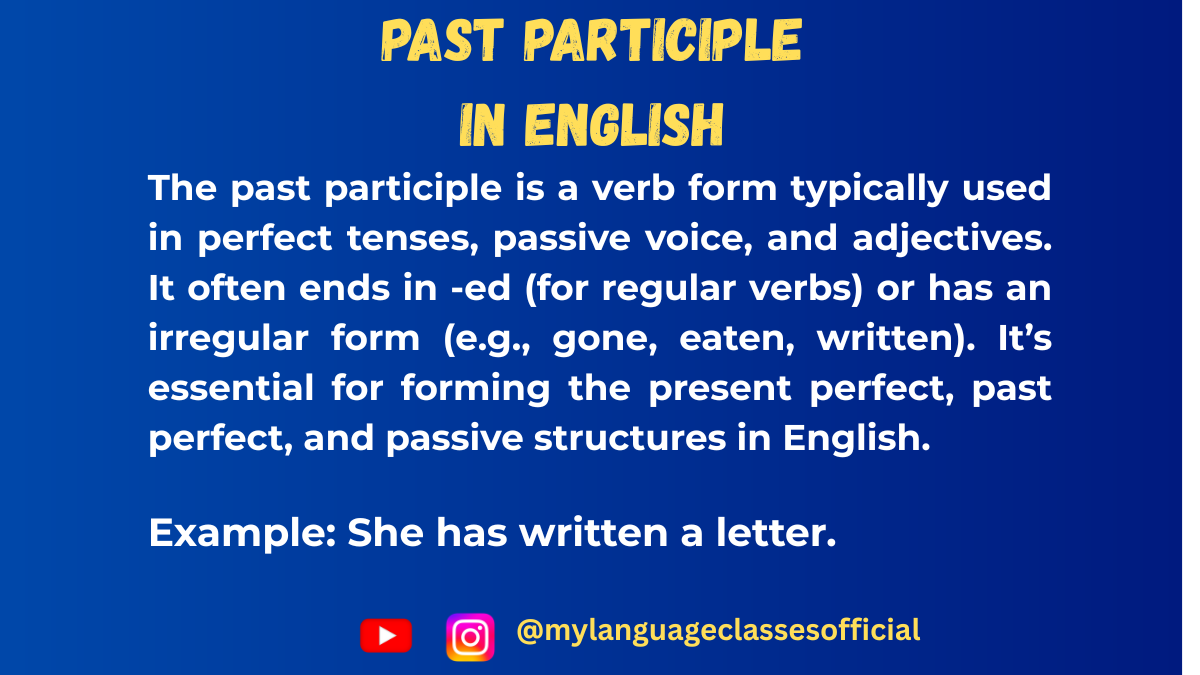
Past Participle in English is an important verb form used to build perfect tenses, form passive sentences, and describe people, objects, and situations. Although learners encounter past participles throughout English grammar, many confuse them with the simple past form of a verb. This confusion often leads to sentences such as She has went home instead of She has gone home.
Consider these two sentences: She wrote a letter yesterday. She has written a letter. Both sentences refer to a completed action, but they use different verb forms. The first uses the simple past, while the second uses the past participle with the helping verb has. Understanding this difference helps learners form accurate sentences and understand how English expresses time, completed actions, and states.
Learning past participles also becomes easier when you recognize how they fit into the wider verb system. The Complete English Tenses Mastery Guide by My Language Classes provides a structured reference for understanding English tense forms and how they work together.
What Is a Past Participle in English?
A past participle is a form of a verb that appears in several important English grammar structures. It is not a tense by itself. Instead, it works with helping verbs or functions as an adjective, depending on how it is used in a sentence.
One of its most common uses is in perfect tenses, where it follows a form of have. For example, in the sentence She has finished her work, the word finished is the past participle of finish. The helping verb has combines with the participle to form the present perfect tense.
Past participles also appear in passive sentences. Consider the sentence The window was broken during the storm. Here, broken is the past participle of break, and the construction tells us what happened to the window. The verb was helps form the passive structure.
A past participle can also describe a noun. In the sentence We found a broken window, the word broken describes the window rather than forming a perfect tense. Its exact role depends on the sentence.
Regular verbs usually form their past participles by adding -ed, as in worked, cleaned, and finished. Irregular verbs have different forms, such as written, gone, eaten, and seen. Some irregular verbs have the same form in the simple past and past participle, while others have different forms.
Understanding how past participles work becomes easier when you study them alongside the helping verbs and sentence patterns that use them. The Complete English Tenses Mastery Guide by My Language Classes offers a structured way to understand these forms within the wider system of English tenses.
How Do You Form the Past Participle in English?
The past participle form depends on whether a verb is regular or irregular. Regular verbs follow common spelling patterns, while irregular verbs have forms that learners need to recognize and learn. Understanding these patterns makes it easier to use past participles correctly in perfect tenses, passive sentences, and other grammatical structures.
1. How Do Regular Verbs Form the Past Participle?
Most regular verbs form their past participles by adding -ed to the base form. The spelling may change slightly depending on how the verb ends.
| Formation Rule | Base Form | Past Participle | Example |
|---|---|---|---|
| Add -ed to most verbs | work | worked | She has worked here for five years. |
| Add -d to verbs ending in -e | live | lived | They have lived in Chicago. |
| Change consonant + y to -ied | study | studied | He has studied English for two years. |
| Keep the y and add -ed after a vowel | play | played | We have played this game before. |
| Double the final consonant in certain short verbs | stop | stopped | The bus has stopped outside. |
| Double the final consonant in certain stressed final syllables | prefer | preferred | She has preferred this method for years. |
These rules cover many common regular verbs, but spelling depends on the word itself. For example, open becomes opened, not openned. Learners should pay attention to the final letters, syllables, and stress patterns when forming participles.
Regular verbs are generally easier to learn because their past simple and past participle forms are identical. For example, clean → cleaned → cleaned and watch → watched → watched. However, knowing the spelling rule is only part of the task. You must also recognize when the sentence requires a past participle.
2. How Do Irregular Verbs Form the Past Participle?
Irregular verbs do not follow one universal formation rule. Some change their vowels, some end in -en or -n, and others remain unchanged. A few have the same past simple and past participle forms, while others use three distinct forms.
The following examples show some common patterns.
| Pattern | Base Form | Past Simple | Past Participle |
|---|---|---|---|
| Three different forms | begin | began | begun |
| Three different forms | drink | drank | drunk |
| Three different forms | write | wrote | written |
| Past simple and participle are identical | buy | bought | bought |
| Past simple and participle are identical | teach | taught | taught |
| All three forms are identical | cut | cut | cut |
| All three forms are identical | put | put | put |
| Base form and past participle are identical | become | became | become |
| Base form and past participle are identical | come | came | come |
These patterns can help you recognize similarities between verbs, but they do not cover every irregular verb. For example, go → went → gone follows a different pattern from speak → spoke → spoken. Learning irregular verbs through examples and sentences helps you remember which form belongs in each grammatical structure.
3. A Reference Table of 100 Common Irregular Verbs
Because irregular verbs have no single formation rule, learners need a reliable reference for checking their forms. The following table lists 100 common irregular verbs alphabetically, along with their past simple forms, past participles, and meanings.
| No. | Base Form | Past Simple | Past Participle | Meaning |
|---|---|---|---|---|
| 1 | be | was/were | been | exist or have a particular state |
| 2 | become | became | become | start to be something |
| 3 | begin | began | begun | start |
| 4 | bend | bent | bent | curve or make something curve |
| 5 | bet | bet | bet | risk money on an outcome |
| 6 | bite | bit | bitten | cut with the teeth |
| 7 | bleed | bled | bled | lose blood |
| 8 | blow | blew | blown | move air or be moved by air |
| 9 | break | broke | broken | separate into pieces |
| 10 | bring | brought | brought | carry something to a place |
| 11 | build | built | built | construct |
| 12 | buy | bought | bought | purchase |
| 13 | catch | caught | caught | capture or seize |
| 14 | choose | chose | chosen | select |
| 15 | come | came | come | move toward a place |
| 16 | cost | cost | cost | have a particular price |
| 17 | cut | cut | cut | divide with a sharp tool |
| 18 | deal | dealt | dealt | handle or distribute |
| 19 | dig | dug | dug | break up or remove earth |
| 20 | do | did | done | perform an action |
| 21 | draw | drew | drawn | make a picture or pull |
| 22 | drink | drank | drunk | consume liquid |
| 23 | drive | drove | driven | operate a vehicle |
| 24 | eat | ate | eaten | consume food |
| 25 | fall | fell | fallen | move downward |
| 26 | feed | fed | fed | give food to someone or something |
| 27 | feel | felt | felt | experience a sensation or emotion |
| 28 | fight | fought | fought | engage in a struggle |
| 29 | find | found | found | discover or locate |
| 30 | fly | flew | flown | travel through the air |
| 31 | forget | forgot | forgotten | fail to remember |
| 32 | forgive | forgave | forgiven | stop feeling anger toward someone |
| 33 | freeze | froze | frozen | become or make something very cold |
| 34 | get | got | got/gotten | obtain or receive |
| 35 | give | gave | given | provide or present |
| 36 | go | went | gone | move to another place |
| 37 | grow | grew | grown | increase in size or develop |
| 38 | hang | hung | hung | suspend something |
| 39 | have | had | had | possess or experience |
| 40 | hear | heard | heard | perceive sound |
| 41 | hide | hid | hidden | keep out of sight |
| 42 | hit | hit | hit | strike |
| 43 | hold | held | held | grasp or keep |
| 44 | hurt | hurt | hurt | cause or experience pain |
| 45 | keep | kept | kept | retain or continue to have |
| 46 | know | knew | known | have knowledge of |
| 47 | lay | laid | laid | put something down |
| 48 | lead | led | led | guide or direct |
| 49 | leave | left | left | go away from a place |
| 50 | lend | lent | lent | allow someone to borrow something |
| 51 | let | let | let | allow or permit |
| 52 | lie | lay | lain | recline or rest horizontally |
| 53 | lose | lost | lost | fail to keep or find |
| 54 | make | made | made | create or produce |
| 55 | mean | meant | meant | signify or intend |
| 56 | meet | met | met | encounter someone |
| 57 | pay | paid | paid | give money for something |
| 58 | put | put | put | place something somewhere |
| 59 | read | read | read | understand written words |
| 60 | ride | rode | ridden | travel on a bicycle, horse, or similar vehicle |
| 61 | ring | rang | rung | make a bell or telephone sound |
| 62 | rise | rose | risen | move upward |
| 63 | run | ran | run | move quickly on foot |
| 64 | say | said | said | speak words |
| 65 | see | saw | seen | perceive with the eyes |
| 66 | sell | sold | sold | exchange something for money |
| 67 | send | sent | sent | cause something to be delivered |
| 68 | set | set | set | put something in a particular position |
| 69 | shake | shook | shaken | move rapidly back and forth |
| 70 | shine | shone | shone | give off or reflect light |
| 71 | shoot | shot | shot | fire a weapon or propel something |
| 72 | show | showed | shown | display or present |
| 73 | shut | shut | shut | close |
| 74 | sing | sang | sung | produce musical sounds with the voice |
| 75 | sink | sank | sunk | move or fall below a surface |
| 76 | sit | sat | sat | rest in a seated position |
| 77 | sleep | slept | slept | rest in an unconscious state |
| 78 | speak | spoke | spoken | talk or communicate verbally |
| 79 | spend | spent | spent | use time or money |
| 80 | stand | stood | stood | be in an upright position |
| 81 | steal | stole | stolen | take something without permission |
| 82 | stick | stuck | stuck | attach or remain attached |
| 83 | strike | struck | struck/stricken | hit forcefully |
| 84 | swear | swore | sworn | make a serious promise or use offensive language |
| 85 | sweep | swept | swept | clean with a broom |
| 86 | swim | swam | swum | move through water |
| 87 | take | took | taken | carry or obtain |
| 88 | teach | taught | taught | help someone learn |
| 89 | tear | tore | torn | pull or rip apart |
| 90 | tell | told | told | communicate information |
| 91 | think | thought | thought | use the mind to reason or consider |
| 92 | throw | threw | thrown | propel something through the air |
| 93 | understand | understood | understood | comprehend |
| 94 | wake | woke | woken | stop sleeping |
| 95 | wear | wore | worn | have clothing or accessories on |
| 96 | win | won | won | achieve victory |
| 97 | withdraw | withdrew | withdrawn | remove or take back |
| 98 | withstand | withstood | withstood | resist or endure |
| 99 | write | wrote | written | produce written words |
| 100 | arise | arose | arisen | emerge or occur |
A few entries have alternative forms or require special attention. In American English, gotten is common as the past participle of get, although got is also used in certain constructions. The past participle of strike can be struck or stricken, depending on the meaning and context.
The verb lie, meaning to recline, follows the pattern lie → lay → lain. It differs from lay → laid → laid, which means to put something down. For example, She has lain on the sofa for an hour describes a reclining position, while She has laid the book on the table describes placing an object somewhere.
Use this table as a reference when writing or checking sentences. Pay particular attention to verbs whose past simple and past participle forms differ, such as went/gone, wrote/written, and saw/seen. These distinctions become especially important when forming perfect tenses and passive constructions.
Past participles make more sense when you can see how each form fits into a complete sentence. The Complete English Tenses Mastery Guide by My Language Classes provides a structured reference for understanding verb forms and their use in English tense patterns.
What Is the Difference Between the Past Simple and the Past Participle?
The past simple and the past participle are two different verb forms, although they look identical in many regular verbs. Understanding their differences helps you form correct sentences, especially when talking about past events and completed actions.
The past simple is used to describe actions or situations in the past. It can function as the main verb in a sentence without a helping verb. For example, She wrote a letter yesterday uses wrote, the past simple form of write. The sentence describes an action that took place in the past.
The past participle, however, usually appears with a helping verb in structures such as perfect tenses and the passive voice. In She has written a letter, written is the past participle of write. The helping verb has combines with it to form the present perfect tense.
How Do the Past Simple and Past Participle Forms Differ?
The following table compares the three principal forms of common English verbs.
| Base Form | Past Simple | Past Participle | Example Using the Past Simple | Example Using the Past Participle |
|---|---|---|---|---|
| go | went | gone | She went home early. | She has gone home. |
| write | wrote | written | He wrote a short story. | He has written a short story. |
| eat | ate | eaten | They ate lunch at noon. | They have eaten lunch. |
| see | saw | seen | I saw that movie yesterday. | I have seen that movie. |
| break | broke | broken | Someone broke the window. | Someone has broken the window. |
| speak | spoke | spoken | She spoke to the teacher. | She has spoken to the teacher. |
| take | took | taken | He took my notebook. | He has taken my notebook. |
| begin | began | begun | The meeting began at nine. | The meeting has begun. |
| work | worked | worked | She worked late yesterday. | She has worked here for years. |
| play | played | played | We played soccer yesterday. | We have played soccer together before. |
Notice that the difference is easy to see with irregular verbs such as go, write, and eat. Their past simple and past participle forms are different. With regular verbs such as work and play, both forms are identical.
This similarity can cause confusion because learners may assume that using the correct past simple form automatically means they have used the correct past participle. That is true for many regular verbs, but it does not work for irregular verbs.
Why Does the Difference Matter?
Consider these two sentences:
→ He went to the office yesterday.
→ He has gone to the office.
The first sentence uses the past simple went to describe a past event. The second uses the past participle gone with has to form the present perfect. The second sentence connects the event to the present situation, such as explaining why he is not available now.
The past participle also appears in passive constructions. For example, Someone broke the window uses the past simple broke, while The window was broken during the storm uses the past participle broken with was to form a passive construction.
The key is to look at the sentence structure rather than the verb form alone. Ask yourself whether the sentence needs a past-tense main verb, a participle after a helping verb, or a participle in a passive construction. This approach helps you choose the correct form instead of relying on memorization.
Understanding how the past simple and past participle work together is an important part of learning English tense structures. The Complete English Tenses Mastery Guide by My Language Classes offers a structured reference for understanding these verb forms and using them accurately in different sentence patterns.
How Do You Use Past Participles in Perfect Tenses?
Past participles play an essential role in English perfect tenses. They combine with forms of the helping verb have to show how one event relates to another point in time. The helping verb changes according to the tense and subject, but the past participle remains the same.
English uses three main perfect tenses: the present perfect, the past perfect, and the future perfect. Each follows a specific structure and expresses a different time relationship.
1. Past Participles in the Present Perfect Tense
The present perfect uses have or has followed by a past participle.
Structure: Subject + have/has + past participle
Use have with I, you, we, and they. Use has with he, she, and it, as well as singular nouns.
| Subject | Helping Verb | Past Participle | Complete Sentence |
|---|---|---|---|
| I | have | finished | I have finished my work. |
| You | have | eaten | You have eaten breakfast. |
| We | have | visited | We have visited that museum. |
| They | have | completed | They have completed the project. |
| He | has | written | He has written three chapters. |
| She | has | gone | She has gone to the library. |
| The student | has | submitted | The student has submitted the assignment. |
The present perfect commonly describes past actions that have a connection to the present. For example, She has written three chapters tells us about work completed up to now. The sentence does not specify when she wrote them because the focus is on the result or experience rather than a particular past time.
Compare this with She wrote three chapters yesterday. The simple past places the action in a specific finished period, while the present perfect connects the completed work to the present.
2. Past Participles in the Past Perfect Tense
The past perfect uses had followed by a past participle. The helping verb remains had regardless of the subject.
Structure: Subject + had + past participle
| Subject | Helping Verb | Past Participle | Complete Sentence |
|---|---|---|---|
| I | had | finished | I had finished dinner before they arrived. |
| She | had | left | She had left before the meeting began. |
| We | had | completed | We had completed the task by noon. |
| They | had | eaten | They had eaten before the guests arrived. |
| The train | had | departed | The train had departed when we reached the station. |
The past perfect helps establish which of two past events happened first. Consider this sentence: They had left before we arrived. Their departure happened first, and our arrival happened later.
The past participle does not change according to the subject. Whether you say I had written, she had written, or they had written, the participle remains written.
3. Past Participles in the Future Perfect Tense
The future perfect uses will have followed by a past participle. It describes an action that will be complete by a particular point in the future.
Structure: Subject + will have + past participle
| Subject | Helping Verbs | Past Participle | Complete Sentence |
|---|---|---|---|
| I | will have | finished | I will have finished the report by Friday. |
| She | will have | completed | She will have completed the course by June. |
| We | will have | arrived | We will have arrived by noon. |
| They | will have | built | They will have built the new school by next year. |
| He | will have | written | He will have written the final chapter by then. |
The future perfect places the expected completion of an action before a future deadline or reference point. In She will have completed the course by June, the sentence presents June as the point by which the course is expected to be complete.
Notice that completed, arrived, built, and written remain past participles. The helping verbs establish the tense, while the participle supplies the main verb’s meaning.
What Stays the Same Across All Three Perfect Tenses?
The most important pattern is that the past participle remains unchanged across the three perfect tenses. The helping verbs determine the time relationship.
| Perfect Tense | Structure | Example |
|---|---|---|
| Present perfect | have/has + past participle | She has written a letter. |
| Past perfect | had + past participle | She had written a letter before dinner. |
| Future perfect | will have + past participle | She will have written the letter by Friday. |
The verb write becomes written in all three sentences. What changes is the helping verb structure and the time relationship expressed by the sentence.
Understanding these patterns makes it easier to use past participles correctly without treating every perfect tense as a separate set of verb forms. The Complete English Tenses Mastery Guide by My Language Classes provides a structured reference for learning perfect tenses, their sentence patterns, and the relationships they express.
How Are Past Participles Used in Passive Voice?
Past participles are essential to forming passive sentences in English. The passive voice shifts attention from the person or thing performing an action to the person or thing affected by it. This structure appears in everyday communication, academic writing, news reports, and professional documents.
The basic passive structure combines a form of the verb be with a past participle.
Structure: Subject + form of be + past participle
Consider the difference between these sentences:
→ Active: The teacher checked the assignments.
→ Passive: The assignments were checked by the teacher.
In the active sentence, the teacher performs the action. In the passive sentence, the assignments become the focus. The past participle checked works with were to form the passive construction.
How Does the Past Participle Work in Different Passive Structures?
The form of be changes according to the tense and sentence structure, but the past participle remains the same.
| Tense or Structure | Passive Construction | Example |
|---|---|---|
| Present simple | am/is/are + past participle | The rooms are cleaned every morning. |
| Past simple | was/were + past participle | The letter was written yesterday. |
| Present continuous | am/is/are being + past participle | The road is being repaired. |
| Past continuous | was/were being + past participle | The house was being painted. |
| Present perfect | have/has been + past participle | The documents have been signed. |
| Past perfect | had been + past participle | The food had been prepared before the guests arrived. |
| Future simple | will be + past participle | The results will be announced tomorrow. |
| Modal construction | modal + be + past participle | The application must be completed today. |
These examples show why it is important to recognize the past participle as a verb form rather than a tense. Words such as cleaned, written, repaired, and signed remain past participles, while the surrounding helping verbs establish the sentence structure and time reference.
How Can You Recognize a Past Participle in a Passive Sentence?
Look for a form of be followed by a past participle, then consider the meaning of the sentence.
For example, The documents have been signed contains the helping verbs have been followed by signed. The sentence focuses on the documents and the completed action performed on them.
Similarly, The road is being repaired uses is being followed by repaired. This passive construction describes an action currently in progress.
However, a form of be followed by a past participle does not always express an action in the same way. Consider these sentences:
→ The guard closed the door.
→ The door was closed by the guard.
→ The door remained closed throughout the night.
The second sentence clearly describes an action in the passive voice. In the third sentence, closed describes the door’s state. The verb remained connects the subject to that state rather than forming a passive construction.
Understanding the role of past participles in passive sentences helps learners interpret more complex English structures. The Complete English Tenses Mastery Guide by My Language Classes provides a structured reference for understanding verb forms, helping verbs, and the sentence patterns used to express actions and events.
Can a Past Participle Be Used as an Adjective?
Yes, a past participle can function as an adjective. In this role, it describes a person, object, place, or situation rather than forming a perfect tense or a passive construction. These adjectives often describe a condition, a result, or an experience.
Consider these examples:
→ A broken window needs to be replaced.
→ We signed a written agreement.
→ The exhausted traveler sat down to rest.
→ The frozen lake attracted visitors.
The words broken, written, exhausted, and frozen are past participles used as adjectives. Each describes a noun and helps explain its condition or characteristics.
Past participles used as adjectives can appear before a noun, as in a broken window, or after a linking verb, as in The window remained broken. In both cases, the participle describes the state of the window.
How Can You Distinguish an Adjective from a Past Participle Used in a Verb Construction?
The same past participle can appear in different grammatical structures. Its role depends on how it functions in the sentence.
| Sentence | Past Participle | Grammatical Role |
|---|---|---|
| Someone broke the window. | broke | Past simple main verb |
| The window was broken by the storm. | broken | Part of a passive construction |
| We found a broken window. | broken | Adjective describing the window |
| She has written an agreement. | written | Part of the present perfect tense |
| She signed a written agreement. | written | Adjective describing the agreement |
| The food has frozen overnight. | frozen | Part of the present perfect tense |
| We stored the food in a frozen container. | frozen | Adjective describing the container |
The distinction becomes clearer when you examine what the sentence communicates. In The window was broken by the storm, the sentence presents an event and identifies what caused it. In We found a broken window, the word broken describes the window that we found.
Some sentences can be interpreted in more than one way depending on context. For instance, The door was closed might describe the action of closing the door or the resulting state of the door. The surrounding information helps establish the intended meaning.
Which Past Participles Commonly Function as Adjectives?
Many everyday adjectives come from past participles. Some describe physical conditions, while others express emotions or reactions.
| Past Participle | Example Phrase | Meaning |
|---|---|---|
| broken | a broken chair | damaged or separated into pieces |
| damaged | a damaged package | harmed or impaired |
| excited | excited children | feeling enthusiasm |
| exhausted | an exhausted worker | extremely tired |
| interested | an interested reader | showing curiosity |
| bored | bored students | feeling a lack of interest |
| confused | a confused customer | unable to understand clearly |
| disappointed | a disappointed visitor | feeling dissatisfaction |
| frozen | frozen vegetables | preserved or made solid by cold |
| written | a written agreement | expressed in writing |
Notice that some participial adjectives describe how someone feels, such as excited, bored, and disappointed. Others describe the condition of an object, such as broken, damaged, and frozen.
Recognizing past participles in adjective phrases helps learners understand how one verb form can serve different purposes in English. The Complete English Tenses Mastery Guide by My Language Classes provides a broader reference for understanding past participles in verb constructions and distinguishing their uses within English grammar.
What Is the Difference Between a Past Participle and a Present Participle?
The main difference between a past participle and a present participle lies in their form and how they function in a sentence. A present participle usually ends in -ing, as in writing, eating, and running. A past participle often ends in -ed for regular verbs, as in written for the irregular verb write, eaten for eat, and run for run. The exact form depends on the verb.
Both forms can appear in verb constructions and function as adjectives. Therefore, you cannot determine their grammatical role from the form alone. You need to consider how each word works in the sentence.
How Do Present and Past Participles Differ in Form?
The following table compares the two participle forms of common English verbs.
| Base Form | Present Participle | Past Participle |
|---|---|---|
| work | working | worked |
| write | writing | written |
| eat | eating | eaten |
| break | breaking | broken |
| bore | boring | bored |
| excite | exciting | excited |
| confuse | confusing | confused |
| freeze | freezing | frozen |
| fall | falling | fallen |
| tire | tiring | tired |
Present participles generally use the -ing ending, although spelling changes may occur when forming them. Past participles follow different patterns because some verbs are regular and others are irregular.
How Do Present and Past Participles Work in Sentences?
Present participles often appear in continuous tenses, while past participles appear in perfect tenses and passive constructions. Both forms can also describe nouns.
| Grammatical Use | Present Participle Example | Past Participle Example |
|---|---|---|
| Verb construction | She is writing a letter. | She has written a letter. |
| Passive construction | The manager is reviewing the application. | The application was reviewed yesterday. |
| Adjective describing something | The lesson is boring. | The students are bored. |
| Describing nouns | Falling leaves covered the path. | Fallen leaves covered the path. |
The difference between boring and bored is particularly useful to understand. A boring lesson causes people to lose interest, while bored students experience that feeling themselves. The present participle often describes something that causes a reaction, whereas the past participle often describes the person or thing experiencing the reaction.
However, this distinction is not a universal rule for every verb. The meaning depends on the word and the context in which it appears.
Does a Past Participle Always Refer to the Past?
No. The name past participle can be misleading because the form does not automatically place an action in the past. The tense and meaning of a sentence depend on its complete grammatical structure.
Consider these examples:
→ She has written three chapters.
→ She will have written three chapters by Friday.
In the first sentence, written appears in the present perfect tense. In the second, the same participle appears in the future perfect tense. The form remains unchanged even though the sentences refer to different time relationships.
Similarly, fallen in fallen leaves describes a condition or result, rather than establishing a tense by itself.
Understanding the difference between present and past participles helps learners recognize verb patterns and interpret sentences more accurately. The Complete English Tenses Mastery Guide by My Language Classes provides a structured reference for understanding these forms and their roles in English tense constructions.
What Are the Most Common Past Participle Mistakes?
Past participle mistakes often happen when learners use the past simple form after a helping verb or assume that every verb follows the regular -ed pattern. These errors are especially common with irregular verbs because their past simple and past participle forms can differ.
Understanding the structure of a sentence helps you identify the correct form. The following examples show common mistakes, their corrections, and the grammar behind each correction.
1. Using the Past Simple Instead of the Past Participle
One of the most frequent errors is using the past simple form after have, has, or had. These helping verbs require the past participle when forming perfect tenses.
| Incorrect Sentence | Correct Sentence | Explanation |
|---|---|---|
| She has went home. | She has gone home. | The past participle of go is gone, not went. |
| I have wrote a letter. | I have written a letter. | The past participle of write is written. |
| He has ate lunch. | He has eaten lunch. | The past participle of eat is eaten. |
| They have saw the movie. | They have seen the movie. | The past participle of see is seen. |
| She had took the keys. | She had taken the keys. | The past participle of take is taken. |
| We have spoke about this. | We have spoken about this. | The past participle of speak is spoken. |
The important point is that have, has, and had do not take the past simple form in perfect tense constructions. The verb that follows must be in its past participle form.
For example, went is correct in She went home yesterday. However, when you use has, the correct form is She has gone home. The helping verb changes the grammatical structure, so the main verb must take the appropriate form.
2. Assuming That Every Past Participle Ends in -ed
Regular verbs generally form their past participles with -ed or -d. Irregular verbs, however, follow different patterns. Some end in -en, others change their vowels, and some remain unchanged.
| Base Form | Past Simple | Past Participle |
|---|---|---|
| go | went | gone |
| break | broke | broken |
| choose | chose | chosen |
| drive | drove | driven |
| fall | fell | fallen |
| give | gave | given |
| see | saw | seen |
| take | took | taken |
| write | wrote | written |
| cut | cut | cut |
Learners who rely on the -ed pattern may produce incorrect forms such as goed, breaked, or writed. These forms are not standard English. The correct participles are gone, broken, and written.
Learning the patterns of common irregular verbs is more reliable than trying to apply one spelling rule to every verb.
3. Confusing Similar-Looking Verb Forms
Some verbs have identical past simple and past participle forms, while others have three different forms. This variation makes it important to learn each verb as a set of forms.
| Base Form | Past Simple | Past Participle | Common Error |
|---|---|---|---|
| buy | bought | bought | buyed |
| bring | brought | brought | bringed |
| teach | taught | taught | teached |
| begin | began | begun | began after has |
| drink | drank | drunk | drank after have |
| sing | sang | sung | sang after has |
| speak | spoke | spoken | spoke after have |
| swim | swam | swum | swam after has |
Notice that bought is both the past simple and the past participle of buy. However, began is the past simple form of begin, while begun is the past participle. The correct choice depends on the sentence structure.
Compare these examples:
→ The meeting began at nine.
→ The meeting has begun.
Both sentences are correct because each uses the appropriate form for its grammatical structure.
4. Using the Wrong Past Participle in Passive Sentences
Past participles are also necessary when forming passive constructions. Using the past simple instead of the past participle can make a sentence incorrect.
| Incorrect Sentence | Correct Sentence |
|---|---|
| The window was broke. | The window was broken. |
| The letter was wrote yesterday. | The letter was written yesterday. |
| The food was ate by the children. | The food was eaten by the children. |
| The documents were took from the office. | The documents were taken from the office. |
In these examples, the form of be combines with a past participle to create the passive construction. The correct forms are broken, written, eaten, and taken.
How Can You Avoid These Mistakes?
The most reliable approach is to learn the base form, past simple, and past participle together. When you learn a new irregular verb, remember all three forms rather than memorizing only its past tense.
Pay attention to the words surrounding the verb as well. When you see have, has, or had in a perfect tense construction, use the past participle. When you see a passive structure formed with be, check that the following verb uses its correct participle form.
For additional guidance on how verb forms work across English tense structures, the Complete English Tenses Mastery Guide by My Language Classes provides a structured reference for understanding perfect tenses and the grammar patterns that help you avoid these common errors.
How Can You Identify the Past Participle in a Sentence?
You can identify a past participle by examining its form, the words around it, and its role in the sentence. Past participles often appear after have, has, or had in perfect tenses. They also appear in passive constructions with forms of be and can describe nouns as adjectives.
Recognizing these patterns helps you identify past participles even when they look different from the base verb or past simple form.
1. Look for Have, Has, or Had
One of the clearest clues is a form of have followed by a past participle in a perfect tense construction.
| Sentence | Helping Verb | Past Participle |
|---|---|---|
| She has finished her work. | has | finished |
| They have eaten breakfast. | have | eaten |
| He had written the report before lunch. | had | written |
| We have seen that movie. | have | seen |
| The train has left the station. | has | left |
In these examples, the helping verb combines with the past participle to form a perfect tense. Notice that some participles, such as finished, look the same as their past simple forms. Others, such as eaten and written, have distinct forms.
However, the presence of have does not always indicate a perfect tense. In a sentence such as I have a car, have is the main verb, and no past participle follows it. You need to examine the complete sentence rather than identify a participle from one word alone.
2. Look for Passive Constructions
Past participles commonly appear after forms of be in passive sentences. These forms include am, is, are, was, were, and been, depending on the structure.
| Sentence | Form of Be | Past Participle |
|---|---|---|
| The letter was delivered yesterday. | was | delivered |
| The rooms are cleaned every morning. | are | cleaned |
| The road is being repaired. | is being | repaired |
| The documents have been signed. | been | signed |
| The application will be reviewed tomorrow. | be | reviewed |
In each example, the sentence uses a passive construction to focus on the person or thing affected by an action. The past participle works with the helping verbs to form that construction.
Still, not every past participle following be expresses a passive action. In The door was closed, for example, closed may describe the action of closing the door or its resulting state. Context helps determine the intended meaning.
3. Check Whether the Word Describes a Noun
A past participle can also function as an adjective. When it describes a person, object, or situation, it may appear before a noun or after a linking verb.
| Sentence | Past Participle | Noun or Subject Described |
|---|---|---|
| A damaged suitcase was lying on the floor. | damaged | suitcase |
| The broken chair needs repair. | broken | chair |
| The exhausted runner sat down. | exhausted | runner |
| The frozen lake attracted visitors. | frozen | lake |
| The documents remained unsigned. | unsigned | documents |
These participles describe conditions or characteristics rather than forming perfect tenses. In a damaged suitcase, for instance, damaged tells us about the condition of the suitcase.
4. Use the Sentence Structure to Confirm Your Answer
Some participles look identical to past simple forms, so spelling alone cannot always identify their grammatical role. Compare these sentences:
→ She wrote a letter yesterday.
→ She has written a letter.
→ The letter was written yesterday.
In the first sentence, wrote is the past simple main verb. In the second, written is the past participle used in the present perfect tense. In the third, written forms part of the passive construction.
The best way to identify a past participle is to consider both its form and its grammatical function. Look for the helping verbs, check the sentence structure, and determine whether the word is functioning as part of a verb construction or as an adjective.
For a broader understanding of how past participles work with helping verbs across English tense structures, the Complete English Tenses Mastery Guide by My Language Classes provides a structured reference to the forms and patterns used to build accurate sentences.
Key Takeaway
→ A past participle is a verb form used in perfect tenses, passive constructions, and adjective phrases. It is not a tense by itself.
→ Regular verbs generally form their past participles by adding -ed or -d, as in work → worked and live → lived.
→ Irregular verbs follow different patterns. Some have three distinct forms, such as go → went → gone, while others have identical past simple and past participle forms, such as buy → bought → bought.
→ In perfect tenses, past participles follow forms of have, has, or had. For example, She has written a letter.
→ In passive constructions, past participles work with forms of be. For example, The letter was written yesterday.
→ Past participles can also function as adjectives, as in a broken window and an exhausted traveler.
→ The past simple and past participle are not interchangeable in every sentence. For example, She went home is correct, while She has gone home uses the correct perfect tense structure.
→ Learning the base form, past simple, and past participle together helps you recognize verb patterns and construct grammatically accurate sentences.
To understand how past participles fit into the wider system of English tenses, the Complete English Tenses Mastery Guide by My Language Classes provides a structured reference to perfect tense forms and their uses.
Conclusion
Understanding the past participle in English helps you build accurate sentences and recognize how different verb forms work together. From forming perfect tenses to constructing passive sentences and describing nouns, this verb form serves several important purposes in English grammar.
The most effective way to learn past participles is to study them in context. Learn the three principal forms of irregular verbs, recognize the spelling patterns of regular verbs, and pay attention to the helping verbs that appear in different sentence structures. This approach helps you distinguish the past simple from the past participle and use each form correctly.
For a more complete understanding of English tense structures, the Complete English Tenses Mastery Guide by My Language Classes offers a structured reference to perfect tenses, verb forms, and the grammar rules that connect them.

Vikas Kumar is the founder of My Language Classes, a language learning platform dedicated to helping learners develop practical communication skills in Spanish, Japanese, and English through comprehensive grammar guides, structured learning resources, books, and evidence-informed educational content.
At My Language Classes, we believe that successful language learning is built on clarity, consistency, meaningful practice, and a deep understanding of how languages work. Every article is carefully researched and created to simplify complex concepts, provide practical guidance, and help learners develop confidence through real-world communication.
Inspired by the principles behind How Language Learning Really Works, our mission is to make high-quality language learning accessible to learners around the world by providing accurate, trustworthy, and comprehensive resources that support lasting progress, lifelong learning, and meaningful communication.
Leave a Reply