

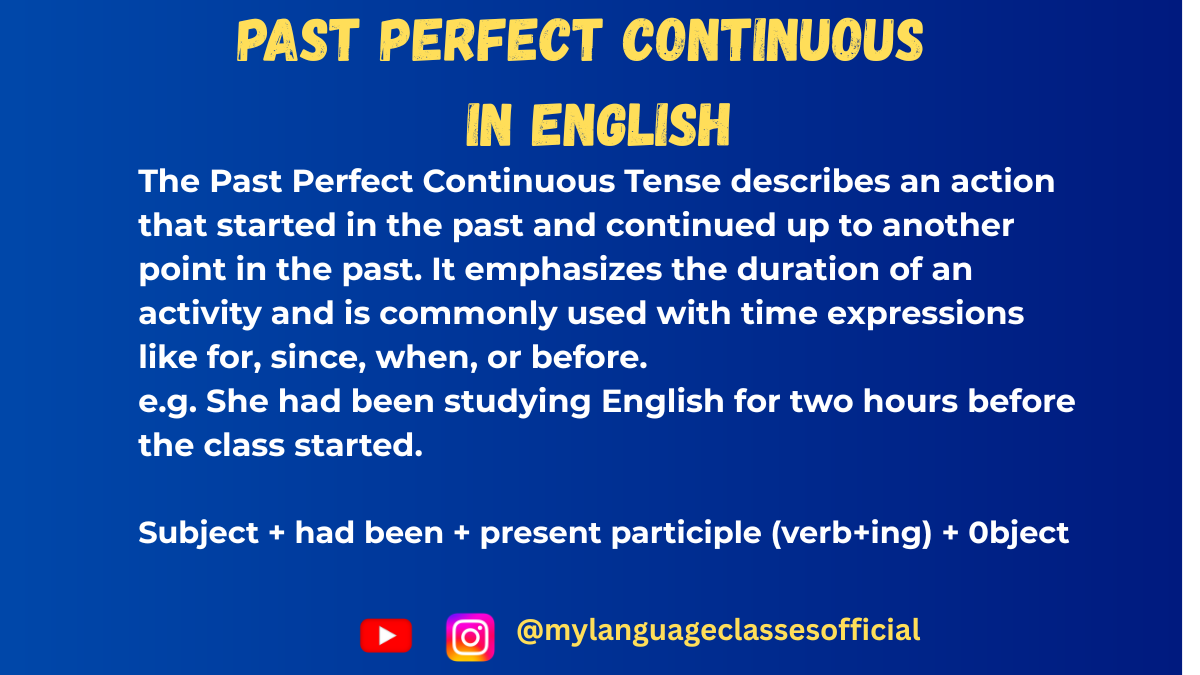
Past Perfect Continuous Tense in English is used to describe an activity that had been continuing for a period of time before a particular point or event in the past. It helps us connect an ongoing past activity with a later past situation, especially when the duration or continuity of the activity matters.
Consider this sentence:
She had been studying for three hours before her friend called.
The studying started earlier and continued for a period of time before the phone call. The Past Perfect Continuous makes that duration clear.
This tense is useful when you want to explain what had been happening before something else happened in the past. It often appears with expressions such as for two hours, since morning, all day, before, when, and by the time.
Learning the tense becomes much easier when you understand the relationship between the activity and the past reference point. The structure is important, but understanding why the speaker chooses the tense is what makes accurate use much more natural.
For learners who want a broader understanding of how English tenses work together, Complete English Tenses Mastery Guide provides a structured reference for studying tense forms, meanings, and their differences.
What Is the Past Perfect Continuous Tense in English?
The Past Perfect Continuous Tense describes an activity that had been in progress before a particular point or event in the past. It places attention on the activity itself and often emphasizes how long that activity had continued.
Consider this example:
She had been working at the company for five years before she moved to another city.
The sentence contains two past points. Her work began earlier and continued for five years. Her move to another city provides the later past reference point. The Past Perfect Continuous connects the earlier activity with that later point.
The tense can also describe an activity that had recently stopped before another past situation, especially when the activity explains a past condition or result.
For example:
He was tired because he had been driving all night.
The driving happened before the past situation in which he was tired. The sentence focuses on the activity and its connection to the resulting condition.
This gives the Past Perfect Continuous two important areas of use. It can emphasize an activity continuing up to a past reference point, or it can emphasize an activity that had recently been taking place and helps explain something that happened or was true at that time.
The tense is therefore closely connected with duration, continuity, and past perspective. Understanding these relationships makes it easier to distinguish the Past Perfect Continuous from the Past Perfect, which usually gives greater attention to completion or the fact that an earlier event had occurred.
For a wider explanation of how English tenses express time, sequence, duration, and completion, Complete English Tenses Mastery Guide provides a useful reference for connecting this tense with the rest of the English tense system.
What Is the Formula for the Past Perfect Continuous Tense?
The basic formula for the Past Perfect Continuous Tense is:
Subject + had been + verb-ing
The structure stays the same for every subject. Whether the subject is I, you, he, she, it, we, or they, the auxiliary sequence remains had been.
For example:
I had been studying.
She had been working.
They had been waiting.
The main verb takes the -ing form because the tense describes an activity in progress or an activity viewed through its duration.
Affirmative Formula
The affirmative structure is:
Subject + had been + verb-ing
Examples:
I had been studying for two hours.
She had been working since early morning.
They had been waiting outside for thirty minutes.
We had been traveling all day.
He had been learning Spanish for several months.
Negative Formula
To make the sentence negative, place not after had:
Subject + had not been + verb-ing
Examples:
I had not been sleeping well.
She had not been working there for very long.
They had not been waiting for more than ten minutes.
We had not been studying since morning.
The contracted form had not can appear as had not in formal writing, while had not is also commonly shortened to had not in speech and informal writing. For a clear grammar reference, the full form makes the structure easier to see.
Yes/No Question Formula
For a Yes/No question, place had before the subject:
Had + subject + been + verb-ing?
Examples:
Had you been waiting long?
Had she been studying before the exam?
Had they been working together?
Had he been driving all night?
WH Question Formula
When a WH word is needed, place it before the Past Perfect Continuous question structure:
WH word + had + subject + been + verb-ing?
Examples:
How long had you been waiting?
Why had she been crying?
Where had they been staying?
What had he been doing before the meeting?
The word how long is particularly common with this tense because the Past Perfect Continuous often emphasizes the duration of an activity.
The formula gives you the structure, but the meaning comes from the relationship between the activity and the past reference point. Understanding that relationship is more important than simply memorizing the sequence of words. Complete English Tenses Mastery Guide can help you study this structure alongside other English tense formulas and understand why each tense is used in different situations.
How Do You Form Affirmative Past Perfect Continuous Sentences?
An affirmative Past Perfect Continuous sentence follows a simple structure:
Subject + had been + verb-ing
The subject can be singular or plural, but the auxiliary structure does not change. Unlike the Present Perfect Continuous, you do not change had according to the subject.
For example:
I had been reading for an hour before dinner.
She had been studying since early morning.
They had been working on the project for several weeks.
We had been waiting for the bus before it finally arrived.
The main verb always takes the -ing form. The choice of verb depends on the activity you want to describe, while the structure shows that the activity had been continuing before a later past point.
Using Different Subjects
The same structure works with all subjects.
I had been working from home before I moved to the office.
You had been studying for several hours before the test began.
He had been running every morning before the weather became colder.
She had been teaching at the school for ten years before she retired.
It had been raining for several hours before the roads flooded.
We had been traveling for two days before we reached the city.
They had been discussing the issue before the manager arrived.
The important point is that had remains unchanged. You do not use has or have with different subjects.
Using Duration With Affirmative Sentences
The Past Perfect Continuous often appears with a period of time to show how long an activity had continued.
For example:
She had been practicing the piano for three hours before the guests arrived.
They had been living in the apartment for five years before they bought a house.
I had been waiting for twenty minutes when the doctor finally called my name.
These sentences focus on the activity and its duration before a later past event.
Using a Starting Point
The tense can also describe when an activity began by using since.
For example:
He had been working there since 2018 before he changed careers.
We had been living in New York since January before we moved to Boston.
The starting point is different from a duration. Since introduces the point when the activity began, while for introduces the length of time.
The affirmative form itself is easy to build. The more important decision is knowing whether the sentence needs to emphasize an ongoing activity or its duration before a past reference point. Complete English Tenses Mastery Guide provides a broader explanation of English tense structures and helps place the Past Perfect Continuous within the larger system of English tenses.
How Do You Form Negative Past Perfect Continuous Sentences?
A negative Past Perfect Continuous sentence shows that an activity had not been continuing before a particular point or event in the past. The structure is formed by placing not after had.
The basic formula is:
Subject + had not been + verb-ing
For example:
I had not been sleeping well before the trip.
She had not been working there for very long.
They had not been waiting for more than ten minutes.
We had not been studying since morning.
The form had not remains the same with every subject. The main verb continues to use the -ing form.
Using Had Not With Different Subjects
Because had does not change according to the subject, the negative structure is consistent.
I had not been feeling well before the meeting.
You had not been paying attention during the discussion.
He had not been working that day.
She had not been practicing regularly before the competition.
It had not been raining for very long.
We had not been traveling for more than a day.
They had not been living there for long.
The sentence can describe an activity that was not in progress, an activity that had not continued for a particular duration, or an activity that had not taken place during a period leading up to a past reference point.
Using Duration in Negative Sentences
The Past Perfect Continuous often works with for when the speaker wants to mention a period of time.
For example:
She had not been working for very long when the company closed.
They had not been living there for five years when they decided to move.
I had not been waiting for more than ten minutes when the bus arrived.
These sentences do not simply say that something did not happen. They focus on the duration of an activity before another past event.
Using Since in Negative Sentences
Since can identify the point from which an activity had not been continuing.
For example:
He had not been working there since January when the manager asked about his experience.
We had not been communicating regularly since the previous year.
The choice between since and for depends on what you want to express. Since identifies a starting point, while for identifies a period of time.
Full and Contracted Forms
In formal writing, had not is clear and straightforward:
She had not been sleeping well.
The contracted form had not is commonly heard in speech and informal writing. However, keeping the full form visible while studying the tense can make the grammatical structure easier to recognize.
The negative form follows the same basic logic as the affirmative form. The only structural change is the addition of not after had. Complete English Tenses Mastery Guide offers a wider reference for understanding how negative structures work across the English tense system and how the Past Perfect Continuous compares with other forms.
How Do You Form Past Perfect Continuous Questions?
Past Perfect Continuous questions ask whether an activity had been continuing before a particular point in the past. The main auxiliary, had, comes before the subject, followed by been and the -ing form of the main verb.
The basic formula is:
Had + subject + been + verb-ing?
For example:
Had you been waiting long?
Had she been studying before the exam?
Had they been working together?
Had he been driving all night?
The structure stays the same regardless of the subject. You do not change had to has or have.
Yes/No Questions
A Yes/No question usually asks whether an activity had been happening before another past event or reference point.
For example:
Had you been working there before you moved?
Had she been feeling tired before the meeting?
Had they been waiting outside when you arrived?
Had he been studying for several hours?
The answer can use had or had not:
Yes, I had.
No, I had not.
The full answer can also repeat the main verb phrase when more detail is needed:
Yes, I had been working there for two years.
No, I had not been waiting for very long.
Questions About Duration
The Past Perfect Continuous is especially useful when asking how long an activity had continued before a past event.
For example:
Had you been waiting for an hour?
Had she been studying for several hours?
Had they been traveling for long?
Had he been working there for many years?
These questions focus on the duration of an activity rather than simply asking whether the activity occurred.
Questions With a Past Reference Point
A Past Perfect Continuous question often includes another past event that establishes the reference point.
For example:
Had you been sleeping when the phone rang?
Had she been working before the manager arrived?
Had they been discussing the issue when you entered the room?
Had he been driving before the accident happened?
The later past event helps explain why the speaker is looking back at the earlier activity.
Avoid Using Did
The Past Perfect Continuous does not use did to form its standard questions.
Incorrect: Did you had been waiting?
Correct: Had you been waiting?
Incorrect: Did she had been working there?
Correct: Had she been working there?
Had already functions as the auxiliary that forms the tense, so adding did creates an incorrect structure.
Once you recognize had as the question-forming auxiliary, the structure becomes straightforward: had comes first, the subject follows, then been and the -ing form. Complete English Tenses Mastery Guide provides a broader reference for understanding how English questions are formed across different tense structures.
How Do You Form WH Questions in the Past Perfect Continuous?
WH questions in the Past Perfect Continuous ask for specific information about an activity that had been continuing before a particular point in the past. The question word comes first, followed by had, the subject, been, and the main verb in its -ing form.
The basic structure is:
WH word + had + subject + been + verb-ing?
For example:
How long had you been waiting?
Why had she been crying?
Where had they been staying?
What had he been doing before the meeting?
The choice of WH word depends on the information you want to know.
How Long for Duration
How long is especially common with the Past Perfect Continuous because the tense often emphasizes the duration of an activity.
For example:
How long had you been studying before the exam started?
How long had she been working there before she resigned?
How long had they been traveling before they reached the hotel?
These questions ask about the length of time an activity had continued before a later past event.
Why for the Reason Behind an Activity
Why can ask about the reason for an earlier activity.
For example:
Why had he been working so late?
Why had she been crying before the meeting?
Why had they been waiting outside?
The answer can explain the circumstances surrounding the earlier activity.
Where for Location
Where can ask about the location associated with an ongoing past activity.
For example:
Where had you been staying before you moved?
Where had they been working before the office closed?
Where had she been living before she returned home?
What for the Activity
What can ask about the activity itself.
For example:
What had you been doing before I called?
What had they been discussing before the manager arrived?
What had she been studying before the class ended?
The question asks the listener to identify the activity that had been taking place.
Who as the Subject
When who is the subject of the question, the structure can be different because who itself takes the subject position.
For example:
Who had been working on the report?
Who had been waiting outside?
Who had been using the computer?
Here, who is the subject, so there is no separate subject between had and been.
The key is to keep the auxiliary sequence intact. The Past Perfect Continuous requires had + been + verb-ing, while the WH word determines what information the question seeks. Complete English Tenses Mastery Guide provides a broader reference for understanding how English question structures change across different tenses and how those structures relate to meaning.
What Is the Role of Had Been in the Past Perfect Continuous?
The structure had been is what places an ongoing activity in a past time frame before another past point. Each part has a different grammatical role, and understanding that relationship makes the tense much easier to use correctly.
Consider this sentence:
She had been studying for three hours before the exam started.
Here, had establishes the past perfect perspective. Been is the past participle of be, and studying is the present participle of the main verb. Together, had been studying creates the Past Perfect Continuous form.
Why Is Had Used?
Had is the auxiliary verb associated with the past perfect. It does not change according to the subject.
For example:
I had been working.
He had been working.
She had been working.
They had been working.
The same had is used in every sentence. This makes the Past Perfect Continuous different from the Present Perfect Continuous, which uses have or has.
Compare:
She has been studying.
She had been studying.
The first sentence connects the activity to the present. The second places the activity before a past reference point.
Why Is Been Used?
Been is the past participle of be. In the Past Perfect Continuous, it comes directly after had.
The structure is:
had + been + verb-ing
For example:
They had been waiting.
I had been reading.
He had been driving.
We had been talking.
Been is essential to the structure. Removing it produces an incorrect sentence.
Incorrect: She had studying for two hours.
Correct: She had been studying for two hours.
Why Does the Main Verb Use -ing?
The -ing form helps present the activity as ongoing or continuing during the relevant period.
For example:
He had been working all morning.
The focus is on the activity of working and the period over which it continued.
Compare this with:
He had completed the work before lunch.
The Past Perfect focuses more directly on the completed action. The Past Perfect Continuous focuses more strongly on the activity and its duration.
Understanding the Complete Structure
It helps to see the tense as a combination of three elements:
Had → places the perspective in the past perfect
Been → connects the perfect structure with the continuous form
Verb-ing → presents the main activity as ongoing
Together:
She had been waiting for an hour before the bus arrived.
The waiting began earlier, continued for a period, and is viewed in relation to the later event of the bus arriving.
Understanding what each part contributes makes the structure easier to remember and use accurately. Complete English Tenses Mastery Guide provides a wider explanation of how auxiliary verbs and verb forms combine to create meaning across the English tense system.
What Is the Role of the -ing Form in the Past Perfect Continuous?
The -ing form is an essential part of the Past Perfect Continuous because it presents the main activity as an ongoing process. It follows had been and identifies the action that was continuing during a period before a past reference point.
The basic structure is:
Subject + had been + verb-ing
For example:
She had been studying before the exam started.
They had been working all morning.
I had been waiting for an hour.
In these sentences, studying, working, and waiting are the main activities. The -ing form allows the speaker to view those activities as ongoing rather than simply as completed events.
The -ing Form Shows the Activity
Compare these two sentences:
She had finished her work before lunch.
She had been working for three hours before lunch.
The first sentence uses the Past Perfect and focuses on completion. The second uses the Past Perfect Continuous and focuses on the activity and its duration.
This difference can change what the listener understands as important. The Past Perfect tells us that something had been completed. The Past Perfect Continuous draws attention to the activity that had been taking place.
The -ing Form Works With Different Verbs
The main verb changes according to the activity, but the structure remains the same.
He had been driving for several hours.
We had been discussing the problem.
They had been preparing for the meeting.
She had been learning Japanese for two years.
The verbs driving, discussing, preparing, and learning all use the -ing form after had been.
Spelling Changes With Some Verbs
Adding -ing sometimes requires a spelling change.
For most verbs, simply add -ing:
work → working
read → reading
study → studying
For verbs ending in silent e, the e is usually removed:
make → making
write → writing
drive → driving
For some short verbs, the final consonant is doubled:
run → running
sit → sitting
stop → stopping
These spelling patterns do not change the tense itself. They simply affect the correct written form of the main verb.
Not Every Verb Normally Works in the Continuous Form
Some verbs generally describe states rather than activities and are not normally used in continuous forms in standard English.
For example, know, believe, understand, own, and belong usually do not appear in the Past Perfect Continuous.
A natural sentence is:
She had known him for many years before they worked together.
The form had been knowing would normally be incorrect in this meaning.
This is an important distinction because the Past Perfect Continuous is built with an -ing form, but that does not mean every English verb can naturally be placed into the continuous structure.
The -ing form therefore does more than complete a formula. It helps present an activity as ongoing and makes the duration or continuing nature of that activity more prominent. Complete English Tenses Mastery Guide provides a broader explanation of how verb forms work across English tenses and why different structures express different kinds of meaning.
When Do You Use the Past Perfect Continuous Tense?
The Past Perfect Continuous is used when you want to show that an activity had been continuing before a particular point or event in the past. The tense often emphasizes the activity itself, the amount of time it had continued, or the connection between that activity and a later past situation.
There are several common situations where this tense is especially useful.
To Show an Activity That Continued Before a Past Event
The Past Perfect Continuous can show that an activity was already in progress before another past event happened.
For example:
She had been studying before her parents arrived.
The studying began earlier and continued until a point close to the parents’ arrival. The sentence places the earlier activity in relation to the later past event.
To Emphasize Duration
The tense is particularly useful when the length of an activity matters.
For example:
They had been waiting for two hours before the bus arrived.
The important detail is not simply that they waited. The sentence emphasizes the two-hour period leading up to the bus arriving.
To Describe an Activity That Had Recently Stopped
The Past Perfect Continuous can also describe an activity that had been happening shortly before another past situation, even when the activity had already stopped.
For example:
He was tired because he had been working all night.
The working may have ended before the speaker described his condition. However, the activity explains why he was tired.
To Connect an Earlier Activity With a Past Result
Sometimes the tense helps explain why a particular condition existed at a past moment.
For example:
Her clothes were wet because she had been walking in the rain.
The walking happened earlier, while the wet clothes were the later result. The Past Perfect Continuous makes the connection between the activity and the past result clear.
To Describe a Temporary Activity Before a Past Point
The tense can describe an activity that had been taking place for a limited period before something else happened.
For example:
I had been staying with my brother before I found my own apartment.
The sentence presents staying with the brother as an activity or situation that continued for a period and ended or changed when another event occurred.
To Emphasize an Ongoing Process Rather Than Completion
The Past Perfect Continuous is useful when the activity itself matters more than whether it was completed.
Compare:
She had completed the report before the meeting.
She had been working on the report for three hours before the meeting.
The first sentence emphasizes completion. The second emphasizes the activity and the time spent on it.
The choice therefore depends on what the speaker wants the listener to notice. If the main idea is an earlier completed event, the Past Perfect may be more suitable. If the main idea is an activity, its duration, or its connection to a past condition, the Past Perfect Continuous can be more precise.
For a broader understanding of how English tense choices change the focus of a sentence, Complete English Tenses Mastery Guide provides a useful reference for comparing tense forms and their meanings.
How Does the Past Perfect Continuous Show an Earlier Ongoing Activity?
The Past Perfect Continuous shows that an activity had already been continuing before another event or reference point in the past. The focus is usually on the activity itself and its connection to that later past moment.
For example:
She had been studying before her brother came home.
The studying started before her brother came home and continued for some period before that event. The sentence does not simply tell us that she studied. It presents studying as an activity that was already in progress during the earlier period.
The Earlier Activity and the Later Event
A useful way to understand this tense is to identify the two parts of the situation.
For example:
They had been waiting for an hour before the train arrived.
The waiting happened first. The train’s arrival happened later. The Past Perfect Continuous places the waiting in the earlier period and shows that it continued for some time before the train arrived.
Another example is:
I had been working when my manager called.
The working was already happening before the manager called. The phone call provides the later past reference point.
The Activity Does Not Have to Continue After the Later Event
The Past Perfect Continuous does not mean that the activity continued after the later past event.
For example:
She had been cooking before the guests arrived.
The cooking may have stopped before the guests arrived, or it may have continued around that time. The sentence itself does not require the activity to continue afterward.
What matters is that the activity occurred over an earlier period and is being viewed in relation to the later past event.
The Activity Can Continue Up to the Reference Point
In other situations, the activity may have continued right up to the later event.
For example:
He had been driving for five hours when they reached the hotel.
The five hours of driving lead directly to the later point when they reached the hotel. The duration gives the listener a clear sense of the ongoing activity before that point.
The Past Reference Point Can Be a Situation
The later reference point does not always have to be a specific action.
For example:
She had been working there for ten years before she became a manager.
The later point is her becoming a manager. Her work at the company began much earlier and continued over a long period before that change in her situation.
The Past Perfect Continuous is therefore useful when the speaker wants to look backward from a past point and describe what had been happening during the period leading up to it. Complete English Tenses Mastery Guide provides a wider framework for understanding how English tenses express sequence, duration, completion, and ongoing activity.
How Do You Use the Past Perfect Continuous to Show Duration?
The Past Perfect Continuous is especially useful when the amount of time an activity had continued is important. It allows the speaker to look back from a point in the past and describe how long an activity had been happening before that point.
For example:
She had been studying for three hours before the exam began.
The sentence does more than tell us that she studied. It tells us that the activity continued for three hours before the later past event.
Using For to Show a Period of Time
For is commonly used when you want to state the length of an activity.
For example:
I had been waiting for thirty minutes when the bus arrived.
They had been traveling for two weeks before they returned home.
He had been working for several hours before he took a break.
We had been living there for five years before we moved.
In each sentence, for introduces the duration of the activity.
Using Since to Show a Starting Point
Since identifies the point when an activity began rather than the length of time it continued.
For example:
She had been working there since 2018 before she changed careers.
They had been living in the city since January before they moved abroad.
I had been studying Japanese since high school before I started university.
The activity may have continued for a long period, but since tells us where that period began.
Duration Does Not Always Mean the Activity Continued After the Reference Point
The Past Perfect Continuous connects the activity to a past reference point. It does not automatically mean that the activity continued beyond that point.
For example:
He had been working for six hours when the manager arrived.
The sentence tells us about six hours of work leading up to the manager’s arrival. It does not tell us exactly what happened to the work afterward.
Similarly:
She had been living there for ten years before she moved.
The ten-year period ended when she moved, so the activity clearly did not continue in that situation.
Duration Can Explain a Past Condition
Duration can also help explain why someone or something was in a particular condition at a past moment.
For example:
They were exhausted because they had been traveling for twenty hours.
She was tired because she had been studying all night.
His clothes were dirty because he had been working in the garden for several hours.
The duration helps explain the later past condition. The tense therefore connects the length of an earlier activity with something that was true at the past reference point.
The important distinction is that the Past Perfect Continuous does not simply tell us when something happened. It gives the listener a view of the activity over a period leading up to a past point. Complete English Tenses Mastery Guide provides a broader explanation of how English tenses express duration, completion, sequence, and ongoing activity.
How Do You Use Since and For With the Past Perfect Continuous?
Since and for are common with the Past Perfect Continuous because the tense often describes an activity that continued over a period before a particular point in the past. The two words provide different information about that period.
Since identifies when the activity began. For identifies how long the activity continued.
How Do You Use For?
Use for when you want to give the length of time.
For example:
She had been studying for three hours before the exam began.
They had been living there for five years before they moved.
I had been waiting for twenty minutes when the bus arrived.
He had been working for several months before he changed jobs.
The expressions three hours, five years, twenty minutes, and several months all describe durations.
How Do You Use Since?
Use since when you want to identify the starting point of an activity.
For example:
She had been studying since morning before the exam began.
They had been living there since 2020 before they moved.
I had been waiting since noon when the bus finally arrived.
He had been working there since January before he changed jobs.
The words morning, 2020, noon, and January identify points when the activities began.
Since and For Express Different Ideas
Compare these sentences:
She had been studying for three hours before the exam.
She had been studying since 7 a.m. before the exam.
The first sentence tells us how long she had been studying. The second tells us when the studying began.
Both sentences can describe the same situation, but they give the listener different information.
Since Can Introduce a Clause
Since can also introduce a clause that describes the starting event.
For example:
They had been living there since they got married.
She had been working from home since she left the company office.
I had been studying Japanese since I started college.
Here, since is followed by a clause rather than a simple time expression. The clause identifies the event that marked the beginning of the activity.
Do Not Confuse Since With Because
Since can have more than one meaning in English. It can refer to time, or it can introduce a reason.
In a sentence such as:
She had been working there since 2019.
since refers to time.
In:
Since the roads were closed, we stayed home.
since introduces a reason.
The context determines which meaning is intended.
The key distinction is simple: for answers the question how long, while since identifies when an activity began. Complete English Tenses Mastery Guide provides a broader reference for understanding how English tense structures work with time expressions such as since and for.
How Do You Use Before and After With the Past Perfect Continuous?
Before and after help establish the relationship between an earlier activity and a later event. When used with the Past Perfect Continuous, they can show that an activity had been continuing for some time before another past event occurred.
However, before and after do not automatically require the Past Perfect Continuous. The choice of tense depends on whether you want to emphasize the earlier activity and its duration.
Using Before With the Past Perfect Continuous
Before can introduce the later past event.
For example:
She had been studying for three hours before the exam began.
They had been waiting outside before the doors opened.
I had been working there for several years before I moved to another city.
In each sentence, the activity happened over a period leading up to the later event.
The Past Perfect Continuous gives attention to the earlier activity, while before makes the sequence between the two situations clear.
Using After With the Past Perfect Continuous
After can introduce the later event or action that follows the earlier activity.
For example:
After she had been studying for several hours, she took a break.
After they had been traveling all day, they stopped at a hotel.
After he had been working there for ten years, he decided to change careers.
Here, the Past Perfect Continuous describes the activity that took place first. The action in the main clause happened afterward.
Before Does Not Always Require the Past Perfect Continuous
When before already makes the sequence clear, the Simple Past can also be natural.
For example:
She studied for three hours before the exam began.
She had been studying for three hours before the exam began.
Both sentences are possible, but they emphasize slightly different things. The Simple Past presents the studying as a completed past activity. The Past Perfect Continuous focuses more strongly on the ongoing activity and the period leading up to the exam.
After Does Not Automatically Require the Past Perfect Continuous
The same principle applies to after.
For example:
After he worked there for ten years, he changed careers.
After he had been working there for ten years, he changed careers.
The second sentence gives greater emphasis to the ongoing period of employment before the career change.
The Past Perfect Continuous is therefore useful when the earlier activity, its continuity, or its duration is important to the meaning. Before and after establish the sequence, while the tense adds information about how the earlier activity is viewed. Complete English Tenses Mastery Guide provides a broader reference for understanding how English tenses work with time expressions and conjunctions such as before and after.
How Do You Use When With the Past Perfect Continuous?
When can connect an earlier ongoing activity with a later event in the past. With the Past Perfect Continuous, it often introduces the point at which another event happened and helps show what had been happening before that moment.
For example:
She had been studying when her friend called.
The studying was already happening before the phone call. The Past Perfect Continuous focuses on the earlier activity, while when introduces the later event.
When With an Activity in Progress
When can show that an activity had been continuing up to the time of another past event.
For example:
I had been working when the manager arrived.
They had been waiting when the doors finally opened.
He had been driving for several hours when the accident happened.
In the third example, the duration of the driving is also important. The sentence shows both the ongoing activity and the period leading up to the later event.
When With Duration
The Past Perfect Continuous becomes especially useful when the speaker wants to mention how long an activity had continued before the later event.
For example:
She had been studying for three hours when her parents came home.
We had been traveling all day when we reached the hotel.
They had been waiting for more than an hour when the bus finally arrived.
The word when establishes the later past event, while the Past Perfect Continuous presents the earlier activity as continuing over a period.
When Does Not Automatically Require the Past Perfect Continuous
When only establishes a time relationship. It does not determine which tense must be used.
Compare:
She was studying when I called.
She had been studying for three hours when I called.
The first sentence describes an activity that was in progress when the call happened. The second looks back at the activity and emphasizes that it had already continued for three hours before the call.
The choice depends on what the speaker wants to communicate.
When With a Past Result
The Past Perfect Continuous can also connect an earlier activity with a condition that existed at the later past point.
For example:
He was exhausted when he arrived because he had been running.
She looked tired when I saw her because she had been working all night.
The activity occurred before the later situation and helps explain it.
When therefore provides a useful past reference point, while the Past Perfect Continuous adds information about the earlier activity, its duration, or its connection to the later situation. Complete English Tenses Mastery Guide provides a broader reference for understanding how English tenses express relationships between earlier activities and later past events.
How Do You Use By the Time With the Past Perfect Continuous?
By the time identifies a later point or event in the past and is often used with the Past Perfect Continuous to show that an activity had already been continuing for a period before that point.
For example:
By the time the meeting started, she had been waiting for thirty minutes.
The meeting started later, while the waiting had already been happening for thirty minutes. The Past Perfect Continuous highlights the duration of the earlier activity.
Showing an Activity Before a Specific Past Point
By the time can introduce a past event that acts as the reference point.
For example:
By the time I arrived, they had been working for two hours.
By the time the teacher entered the classroom, the students had been talking for several minutes.
By the time we reached the hotel, we had been traveling all day.
In each sentence, the activity began earlier and continued over a period leading up to the later event.
Emphasizing Duration
The Past Perfect Continuous works especially well with by the time when the duration of the earlier activity matters.
For example:
By the time the doctor arrived, the patient had been waiting for an hour.
By the time the store opened, people had been standing outside for several hours.
By the time the train arrived, we had been sitting on the platform for forty minutes.
The expressions for an hour, for several hours, and for forty minutes make the duration clear.
By the Time Does Not Mean the Activity Must Have Continued Until That Exact Moment
The sentence can describe an activity that had been happening during the period leading up to the reference point. Context determines whether the activity was still continuing at that exact moment or had recently stopped.
For example:
By the time the manager arrived, the employees had been discussing the problem.
The discussion happened before the manager’s arrival. The sentence does not necessarily establish whether the discussion was still happening at the exact moment the manager arrived.
When the speaker specifically wants to show that an activity continued right up to the reference point, additional context can make that relationship clearer.
Comparing By the Time With When
Both expressions can establish a past reference point, but they can create different emphasis.
Compare:
When the manager arrived, we had been waiting for an hour.
By the time the manager arrived, we had been waiting for an hour.
The first simply identifies the event that occurred during or around the relevant point. The second places stronger emphasis on the situation that had already developed before the manager’s arrival.
By the time is therefore particularly useful when the speaker wants to look back at an activity and describe what had been happening or for how long before a later past point. Complete English Tenses Mastery Guide provides a broader reference for understanding how English tenses work with expressions that establish sequence, duration, and past reference points.
How Does the Past Perfect Continuous Show a Cause or Past Result?
The Past Perfect Continuous can connect an earlier activity with a condition or result that existed at a later point in the past. In these situations, the tense helps explain why something was true, visible, or noticeable at that past moment.
For example:
She was tired because she had been studying all night.
The studying happened before the past condition of being tired. The Past Perfect Continuous shows the activity that helps explain the result.
Explaining a Physical Condition
The tense is often useful when an earlier activity explains a person’s physical condition.
For example:
He was exhausted because he had been running for two hours.
She was hungry because she had been working since early morning.
They were tired because they had been traveling all day.
The later condition is described with the Simple Past, while the earlier activity is presented with the Past Perfect Continuous.
Explaining a Visible Result
The result does not have to be a physical condition. The earlier activity can leave a visible or noticeable result.
For example:
The ground was wet because it had been raining.
Her clothes were dirty because she had been working in the garden.
The kitchen was a mess because they had been cooking for several hours.
In each case, the Past Perfect Continuous gives the background activity that helps explain the later situation.
The Activity May Have Recently Stopped
The Past Perfect Continuous can describe an activity that had been happening shortly before the past result became noticeable.
For example:
His eyes were red because he had been crying.
She looked tired because she had been working late.
The children were covered in mud because they had been playing outside.
The activity does not have to be continuing at the exact moment of the result. It may have stopped shortly before that point.
Duration Can Strengthen the Connection
Adding a duration can make the relationship between the earlier activity and the later result even clearer.
For example:
She was exhausted because she had been studying for six hours.
They were tired because they had been driving for most of the night.
He was frustrated because he had been waiting for more than an hour.
The duration helps explain why the later condition existed.
This use shows why the Past Perfect Continuous is more than a tense for describing something that happened before something else. It can also help the listener understand the connection between an earlier ongoing activity and a later past result. Complete English Tenses Mastery Guide provides a broader reference for understanding how English tenses can express duration, sequence, and the relationship between earlier activities and later results.
How Does the Past Perfect Continuous Describe Recently Stopped Activities?
The Past Perfect Continuous can describe an activity that had been happening for some time before a past reference point and had recently stopped. This use is especially helpful when the earlier activity explains a condition, appearance, or situation that existed at that later point.
For example:
She was tired because she had been working all night.
The work may have stopped before she was described as tired, but the earlier activity explains her condition. The tense connects the activity with the later past situation.
The Activity Can End Before the Past Reference Point
The Past Perfect Continuous does not require the activity to be happening at the exact past moment being discussed.
For example:
He was covered in mud because he had been playing outside.
The playing had happened before the speaker observed him. The activity had stopped, but its result was still visible.
Another example is:
Her eyes were red because she had been crying.
The crying had taken place before the later observation. The Past Perfect Continuous makes that earlier activity relevant to the condition that followed.
The Earlier Activity Can Explain a Past Condition
This use is common when the activity provides a clear reason for something that was true at a past moment.
For example:
They were exhausted because they had been traveling all night.
She looked tired because she had been studying for several hours.
The children were hungry because they had been playing outside all afternoon.
The later condition is expressed in the Simple Past, while the earlier activity is expressed in the Past Perfect Continuous.
The Result Can Be More Important Than the Exact Stopping Time
The speaker does not always need to tell us exactly when the earlier activity stopped.
For example:
The floor was wet because it had been raining.
The important information is that rain had been falling before the speaker observed the wet floor. The sentence focuses on the connection between the earlier activity and the resulting condition.
Similarly:
His hands were dirty because he had been repairing the car.
The repair work happened earlier, and the dirty hands provide evidence of that activity.
Recently Stopped Does Not Mean Immediately Before
The activity can have stopped some time before the later situation, depending on the context.
For example:
She was exhausted because she had been working for twelve hours.
The work may have ended shortly before she became exhausted, but the sentence does not require an exact interval between the activity and the result.
The Past Perfect Continuous is therefore useful when an earlier activity has a continuing connection to a past condition or result, even if the activity itself had already stopped. Complete English Tenses Mastery Guide provides a broader reference for understanding how English tenses express earlier activities, duration, past results, and relationships between different points in time.
How Do You Use Time Expressions With the Past Perfect Continuous?
Time expressions help make the relationship between an earlier activity and a later past reference point clearer. They can tell us how long an activity had continued, when it began, or how the activity relates to another past event.
The Past Perfect Continuous commonly appears with expressions such as for, since, all day, all morning, all night, before, and by the time.
Using For With a Duration
For introduces the length of time an activity had continued.
For example:
She had been studying for three hours before the exam began.
They had been traveling for two weeks before they returned home.
I had been waiting for thirty minutes when the bus arrived.
He had been working for several months before he changed jobs.
The duration can be short or long. What matters is that the speaker is describing the activity over a period leading up to a past reference point.
Using Since With a Starting Point
Since identifies when the activity began.
For example:
She had been working there since 2019 before she moved.
We had been living in the city since January before we relocated.
He had been studying Japanese since high school before he entered college.
Since can also be followed by a clause:
They had been living there since they got married.
I had been working from home since I left the office.
Using All Day, All Morning, and All Night
Expressions such as all day, all morning, and all night can emphasize that an activity continued throughout a substantial period.
For example:
She had been studying all morning before the exam.
They had been working all day when the manager finally sent them home.
He had been driving all night before they reached the hotel.
These expressions do not give an exact duration. Instead, they describe the activity as continuing throughout a period.
Using Before and By the Time
Before and by the time can establish the later past event or reference point.
For example:
She had been working for three hours before the meeting started.
By the time the meeting started, she had been working for three hours.
Both sentences describe the same basic relationship, but the second places the later reference point at the beginning of the sentence.
Using Until Then
Until then can refer to a particular point in the past and help connect earlier activity with that point.
For example:
Until then, they had been working on the same project.
The expression refers back to a point already established in the context. The Past Perfect Continuous describes what had been happening up to that point.
Time Expressions Do Not Determine the Tense by Themselves
A time expression does not automatically require the Past Perfect Continuous. The meaning of the whole sentence determines the appropriate tense.
Compare:
She worked for three hours before the exam.
She had been working for three hours before the exam.
The first sentence simply presents the work as a completed past activity. The second emphasizes the ongoing nature and duration of the activity leading up to the exam.
The time expression supports the meaning, but the tense choice depends on what the speaker wants to emphasize. Complete English Tenses Mastery Guide provides a broader reference for understanding how English tenses interact with expressions of duration, starting points, sequence, and past reference.
When Should You Avoid the Past Perfect Continuous With Stative Verbs?
The Past Perfect Continuous describes activities and processes, so it does not normally work with verbs that describe states rather than actions. These verbs are called stative verbs because they usually describe conditions, thoughts, feelings, possession, relationships, or other states.
For example, know, believe, understand, own, belong, and need are commonly used as stative verbs. In standard English, they generally do not take the continuous form when they describe a state.
Verbs That Usually Describe States
Consider the verb know:
She had known him for many years before they worked together.
The natural form is had known, not had been knowing.
Similarly:
I had understood the problem before the teacher explained it again.
They had owned the house for ten years before they sold it.
The car had belonged to my grandfather before he gave it to my father.
These sentences use the Past Perfect because the verbs describe states rather than ongoing physical activities.
Compare Stative and Action Uses
Some verbs can function as either stative or action verbs depending on their meaning. In those cases, the correct tense depends on what the verb means in the sentence.
For example, think can describe an opinion:
I had thought the meeting was tomorrow.
But think can also describe an activity involving consideration:
I had been thinking about the problem before I found the answer.
In the second sentence, thinking is presented as an ongoing mental activity, so the continuous form is natural.
The same principle applies to other verbs that can have different meanings.
Common Stative Verbs
Some verbs that are commonly used as stative verbs include:
→ know
→ believe
→ understand
→ own
→ belong
→ need
→ want
→ remember
→ mean
→ seem
For example:
She had known the answer before the teacher asked.
He had owned the business for several years before he retired.
We had understood the instructions before the class began.
The Past Perfect is generally more appropriate because these sentences describe states that existed before another past point.
Not Every Verb With a Mental Meaning Is Automatically Stative
It is important not to treat a fixed list of verbs as an absolute rule. Some verbs can have both stative and dynamic meanings.
For example:
I had thought about moving abroad for several months before I made my decision.
Here, thought about describes an ongoing process of consideration, so the continuous form can also be possible:
I had been thinking about moving abroad for several months before I made my decision.
The choice depends on the intended meaning and the way the speaker wants to present the activity.
The main principle is therefore to consider whether the verb describes an ongoing activity or a state. When it describes a state, the Past Perfect is usually more natural than the Past Perfect Continuous. Complete English Tenses Mastery Guide provides a broader reference for understanding how verb meanings affect tense choice and why similar-looking tense structures can communicate different ideas.
Past Perfect Continuous vs Past Perfect
The Past Perfect Continuous and the Past Perfect both describe situations that occurred before a past reference point, but they do not usually place the same emphasis on the earlier event. The Past Perfect generally focuses on completion, result, or the fact that something had happened. The Past Perfect Continuous focuses more on an activity, its duration, or its ongoing nature.
Compare:
She had finished the report before the meeting.
She had been working on the report for three hours before the meeting.
The first sentence tells us that the report was completed. The second focuses on the activity of working and the three-hour period leading up to the meeting.
When the Past Perfect Focuses on Completion
Use the Past Perfect when the important information is that an earlier action had been completed before another past event.
For example:
They had left before we arrived.
She had completed the assignment before the teacher checked it.
I had read the book before the class discussion.
The emphasis is on the completed earlier actions.
When the Past Perfect Continuous Focuses on Duration
Use the Past Perfect Continuous when you want to emphasize how long an activity had been continuing.
For example:
They had been traveling for twelve hours before they arrived.
She had been studying for three hours before the exam.
I had been waiting for thirty minutes before the bus came.
The sentences focus on the activity and the period leading up to the later past event.
Some Sentences Can Use Either Tense
Sometimes both tenses are grammatically possible, but the emphasis changes.
Compare:
He had worked there for ten years before he retired.
He had been working there for ten years before he retired.
The first sentence can present the ten years as a completed period of employment. The second places greater emphasis on the ongoing nature of his work over that period.
Another example:
She had painted the room before the guests arrived.
She had been painting the room before the guests arrived.
The first emphasizes the completed result. The second emphasizes the activity of painting. The second sentence does not necessarily tell us that the room was completely painted.
Past Perfect With Completed Results
The Past Perfect is often more suitable when the result or completion matters.
For example:
The team had completed the project before the deadline.
The train had left before we reached the station.
He had repaired the car before his parents returned.
These sentences focus on what had been completed before the later past event.
Past Perfect Continuous With Activities and Duration
The Past Perfect Continuous is often more natural when the activity itself matters.
For example:
The team had been working on the project for months before the deadline.
We had been waiting at the station for an hour before the train arrived.
He had been repairing the car all afternoon before his parents returned.
Here, the emphasis is on the activity and the period over which it continued.
The key distinction is therefore one of focus. The Past Perfect commonly presents an earlier event as completed or achieved, while the Past Perfect Continuous presents an earlier activity through its duration or continuing nature. Complete English Tenses Mastery Guide provides a broader reference for comparing English tenses and understanding how a change in tense can change the focus of a sentence.
Past Perfect Continuous vs Simple Past
The Past Perfect Continuous and Simple Past both describe past events, but they present those events from different perspectives. The Simple Past normally presents a completed event or past situation, while the Past Perfect Continuous looks back from a past reference point and emphasizes an earlier activity, especially its duration or continuing nature.
Compare:
She studied for three hours before the exam.
She had been studying for three hours before the exam.
The first sentence simply reports the past activity. The second places the studying earlier in relation to the exam and gives more attention to the activity and its duration.
When the Simple Past Is Enough
Use the Simple Past when you are simply describing something that happened in the past.
For example:
I worked at the company for five years.
They traveled to Japan last summer.
She studied all morning.
These sentences present the activities as completed past events or periods. There is no need to establish an earlier past perspective.
When the Past Perfect Continuous Adds a Past Reference Point
The Past Perfect Continuous becomes useful when another past event provides the point from which the earlier activity is viewed.
For example:
I had been working at the company for five years before I moved abroad.
They had been traveling for two weeks before they returned home.
She had been studying all morning before the exam began.
The later events provide a past reference point, while the Past Perfect Continuous describes the activity leading up to that point.
Simple Past for Completed Events
The Simple Past can describe an event that happened after an earlier activity without emphasizing the duration of that earlier activity.
For example:
She studied before she took the exam.
He worked at the company before he moved abroad.
They traveled before they returned home.
These sentences establish a sequence of events without focusing strongly on the continuing nature of the earlier activity.
Past Perfect Continuous for Ongoing Activity and Duration
The Past Perfect Continuous provides more information about the earlier activity.
For example:
She had been studying for three hours before she took the exam.
He had been working at the company for five years before he moved abroad.
They had been traveling for two weeks before they returned home.
The duration makes the earlier activity more prominent.
The Choice Depends on Meaning
The difference is not simply about which tense is more advanced. The speaker chooses the tense according to what needs to be communicated.
Compare:
They waited for an hour before the bus arrived.
They had been waiting for an hour before the bus arrived.
The first sentence reports the waiting as a completed past activity. The second places the waiting in an earlier past period and emphasizes its continuation up to the later event.
The Past Perfect Continuous is therefore most useful when you need to connect an earlier activity with a later past point and want the activity or its duration to receive particular attention. Complete English Tenses Mastery Guide provides a broader reference for comparing the Simple Past with other English tense forms and understanding how tense choice affects meaning.
Past Perfect Continuous vs Past Continuous
The Past Perfect Continuous and Past Continuous both describe activities in progress, but they place those activities at different points in the past. The Past Continuous focuses on an activity that was in progress at a particular past time or when another event occurred. The Past Perfect Continuous looks further back and describes an activity that had already been continuing before a later past point.
Compare:
She was studying when I called.
She had been studying for three hours when I called.
The first sentence focuses on what was happening at the time of the call. The second looks back at the activity and emphasizes that the studying had continued for three hours before the call.
When the Past Continuous Is Appropriate
Use the Past Continuous when you want to describe an activity that was in progress at a particular moment in the past.
For example:
I was working when the manager arrived.
They were eating dinner when the phone rang.
She was studying at eight o’clock.
In these sentences, the focus is on what was happening at a particular past time.
When the Past Perfect Continuous Is Appropriate
Use the Past Perfect Continuous when you want to show that an activity had been continuing before another past event or reference point.
For example:
I had been working for three hours when the manager arrived.
They had been eating for twenty minutes when the phone rang.
She had been studying since morning when her friend visited.
The tense creates an earlier past perspective and often adds information about duration.
Comparing the Two Tenses
Consider these sentences:
They were waiting when the bus arrived.
They had been waiting for an hour when the bus arrived.
The first sentence tells us that the waiting was in progress when the bus arrived. The second tells us that the waiting had already continued for an hour before the bus arrived.
Another comparison:
He was driving when I called.
He had been driving for five hours when I called.
The first focuses on the activity at the time of the call. The second emphasizes the earlier period of driving and its duration.
The Past Continuous Does Not Usually Emphasize Earlier Duration
The Past Continuous can include a duration in some contexts, but its main function is to show an activity in progress at a past time.
For example:
She was studying for three hours that afternoon.
This can describe the activity during that period.
By contrast:
She had been studying for three hours before the exam began.
Here, the three-hour period is presented as leading up to a later past event.
Choosing Between Them
Ask what you want the sentence to emphasize.
If you want to show what was happening at a particular past moment, the Past Continuous is often appropriate.
If you want to look back from a past moment and emphasize an earlier activity or its duration, the Past Perfect Continuous is usually more suitable.
The difference becomes much clearer when you stop treating the two tenses as competing formulas and instead consider the time relationship the speaker wants to communicate. Complete English Tenses Mastery Guide provides a broader reference for comparing the Past Continuous and Past Perfect Continuous with other English tense forms.
Past Perfect Continuous vs Present Perfect Continuous
The Past Perfect Continuous and Present Perfect Continuous both describe activities that continue or have continued over a period of time. The main difference is the reference point. The Present Perfect Continuous connects the activity to the present, while the Past Perfect Continuous connects it to a point in the past.
Compare:
She has been studying for three hours.
She had been studying for three hours before the exam began.
In the first sentence, the activity is connected to the present. In the second, the three-hour period is viewed from a past reference point, the beginning of the exam.
Present Perfect Continuous and the Present
The Present Perfect Continuous is used when an activity began in the past and has a connection with the present.
For example:
I have been working here for five years.
They have been waiting for an hour.
She has been studying since morning.
The reference point is now. The speaker is describing an activity in relation to the present situation.
Past Perfect Continuous and a Past Reference Point
The Past Perfect Continuous shifts that reference point into the past.
For example:
I had been working there for five years before I moved.
They had been waiting for an hour when the bus arrived.
She had been studying since morning before the exam began.
The activity is no longer being viewed from the present. Instead, the speaker looks back from a particular past event or situation.
Compare Since and For in Both Tenses
Both tenses can use since and for, but the reference point changes.
Present Perfect Continuous:
She has been teaching since 2018.
Past Perfect Continuous:
She had been teaching since 2018 before she retired.
Present Perfect Continuous:
They have been living there for ten years.
Past Perfect Continuous:
They had been living there for ten years before they moved.
The expressions since 2018 and for ten years describe the duration or starting point. The tense tells us whether that period is connected to the present or viewed from a past reference point.
The Reference Point Is the Main Difference
Consider these two sentences:
He has been working all day.
He had been working all day when I arrived.
The first sentence looks from the past activity toward the present. The second looks backward from the past event of my arrival.
This difference is fundamental. Both tenses can describe duration, but they organize that duration around different points in time.
Choosing the Correct Tense
If the activity is connected to now, the Present Perfect Continuous is generally appropriate:
She has been studying for three hours.
If the activity is connected to a later point in the past, the Past Perfect Continuous is generally appropriate:
She had been studying for three hours before the exam began.
The most useful question is therefore not simply how long the activity lasted. Ask which point in time the speaker is using as the reference point. Complete English Tenses Mastery Guide provides a broader reference for comparing perfect continuous tenses and understanding how English expresses duration from different points in time.
What Are the Most Common Past Perfect Continuous Mistakes?
The Past Perfect Continuous is easier to use when you keep its structure and time reference clear. Many mistakes happen when learners use the wrong auxiliary, choose the wrong verb form, or use the tense without a clear past reference point.
Using Have or Has Instead of Had
The Past Perfect Continuous always uses had, regardless of the subject.
Correct:
I had been studying for two hours.
She had been working since morning.
They had been waiting outside.
Incorrect:
She has been working since morning.
That sentence uses the Present Perfect Continuous, not the Past Perfect Continuous. It is correct only when the activity is connected to the present.
Using the Wrong Verb Form After Been
The structure is:
Subject + had + been + verb-ing
Correct:
He had been studying.
We had been waiting.
She had been working.
Incorrect:
He had been studied.
We had been waited.
She had been worked.
After had been, the main verb must use the -ing form when forming the Past Perfect Continuous.
Using Did in Questions and Negatives
The auxiliary had already forms the tense, so did is not needed.
Correct:
Had you been studying before the test?
She had not been sleeping well.
Incorrect:
Did you had been studying before the test?
She did not had been sleeping well.
The same principle applies to all subjects. Use had directly for questions and had not for negative sentences.
Using the Tense Without a Clear Past Reference
The Past Perfect Continuous normally needs a past reference point or a context that makes that reference clear.
For example:
She had been working for three hours when I arrived.
The phrase when I arrived establishes the later past point.
Compare this with:
She had been working for three hours.
This sentence can be grammatically possible when the surrounding context already establishes the past reference point. However, without context, the listener may naturally expect more information about the past situation being discussed.
Assuming the Activity Must Have Stopped
The Past Perfect Continuous places an activity before a past reference point, but it does not always mean that the activity stopped at that exact point.
For example:
They had been discussing the problem when the manager entered.
The discussion was already in progress when the manager entered. It may have continued afterward.
The tense establishes the earlier activity and the past reference point. Context determines what happened after that point.
Confusing Duration With the Simple Past
The Simple Past can describe a completed past activity, while the Past Perfect Continuous can emphasize an activity that was continuing before another past point.
Compare:
She studied for three hours before the exam.
She had been studying for three hours when the exam began.
The first sentence presents the three-hour study period as a completed past activity. The second emphasizes the activity as ongoing up to the past reference point.
Confusing Past Perfect Continuous With Past Continuous
These tenses can both describe activities in progress in the past, but they organize time differently.
Past Continuous:
I was studying when he called.
Past Perfect Continuous:
I had been studying for three hours when he called.
The Past Continuous focuses on the activity in progress when the call happened. The Past Perfect Continuous emphasizes that the activity had already been continuing for a period before the call.
Confusing Past Perfect Continuous With Present Perfect Continuous
The reference point also separates these two tenses.
Present Perfect Continuous:
She has been working here for five years.
Past Perfect Continuous:
She had been working there for five years before she moved.
The first sentence connects the activity to the present. The second views the activity from a past point.
Understanding these differences makes the Past Perfect Continuous much easier to use accurately. For a broader reference on English tense structures and the relationships between them, Complete English Tenses Mastery Guide offers a focused guide to the full tense system.
How Can You Use the Past Perfect Continuous Correctly?
Using the Past Perfect Continuous correctly becomes much easier when you first identify the past reference point. The tense describes an activity that was already continuing before that point, often with emphasis on how long the activity had continued.
A reliable way to build the sentence is to check three parts:
→ Identify the past reference point.
→ Identify the activity that happened before that point.
→ Decide whether you want to emphasize the activity itself or its duration.
For example:
She had been studying for three hours when her friend called.
The past reference point is her friend’s call. The studying began earlier and continued up to that point.
The structure should also remain consistent:
Subject + had + been + verb-ing
For example:
I had been waiting for an hour.
They had been traveling all day.
He had been working there since January.
For negative sentences, place not after had:
She had not been feeling well.
For questions, place had before the subject:
Had they been waiting long?
For WH questions, place the question word before had:
How long had you been studying?
Since and for can help show duration, but they serve different purposes. Since introduces a starting point, while for introduces a period of time.
She had been working since Monday.
She had been working for three days.
It is also important to consider whether the verb naturally works in a continuous form. Stative verbs often describe conditions, possession, opinion, knowledge, or relationships rather than ongoing activities, so the Past Perfect may be more appropriate in many cases.
Another important point is that the Past Perfect Continuous does not automatically mean that the activity stopped at the past reference point. The context determines whether the activity continued afterward.
When you understand the relationship between the earlier activity and the past reference point, the tense becomes much more predictable. For a complete reference to English tense structures, Complete English Tenses Mastery Guide provides a broader explanation of how the major English tenses work and how they differ.
Key Takeaway
The Past Perfect Continuous Tense in English describes an activity that had been continuing before a particular point or event in the past. It often emphasizes the duration or ongoing nature of that earlier activity.
Its basic structure is:
Subject + had + been + verb-ing
For example:
She had been studying for three hours before the exam began.
They had been waiting since early morning when the bus finally arrived.
He had been working on the project all week before he submitted it.
The most important points to remember are:
→ Use had for every subject.
→ Use been after had.
→ Use the -ing form of the main verb after been.
→ Use had not for negative sentences.
→ Use had before the subject in questions.
→ Use WH words before had when forming WH questions.
→ Use since for a starting point and for for a period of time.
→ Use the tense when an earlier ongoing activity has a clear relationship with a past reference point.
→ Use the Past Perfect when the completed event is more important than the ongoing activity or duration.
→ Do not assume that the activity necessarily stopped at the past reference point.
→ Be careful with stative verbs because many of them do not normally appear in continuous forms.
The Past Perfect Continuous is especially useful when English needs to connect an earlier activity with a later past event. The tense allows the speaker to show both the sequence of events and the continuing nature of the earlier activity.
A strong understanding of the complete tense system also helps you see why the Past Perfect Continuous differs from the Past Perfect, Simple Past, Past Continuous, and Present Perfect Continuous. Complete English Tenses Mastery Guide provides a structured reference for understanding these tense relationships and using them accurately.
Conclusion
The Past Perfect Continuous Tense in English helps explain an activity that was already continuing before another point or event in the past. It is especially useful when the duration, continuity, or earlier nature of an activity matters.
Its core structure is simple:
Subject + had + been + verb-ing
The main challenge is choosing the tense for the right situation. When you have a past reference point and want to show that an activity had been continuing before it, the Past Perfect Continuous can make that relationship clear.
Compare:
She was tired because she was working.
She was tired because she had been working for several hours.
The second sentence gives a clearer connection between the earlier activity and the later past result. It also emphasizes the duration of the activity.
The tense becomes much easier when you focus on the relationship between events rather than trying to memorize isolated rules. Identify the past reference point, look for the earlier activity, and decide whether its continuity or duration is important.
Once these relationships become familiar, you can use the Past Perfect Continuous naturally in descriptions, narratives, explanations, and other forms of English writing.
For a broader understanding of how this tense fits into the complete English tense system, Complete English Tenses Mastery Guide provides a structured reference to the major English tenses, their forms, uses, and differences.

Vikas Kumar is the founder of My Language Classes, a language learning platform dedicated to helping learners develop practical communication skills in Spanish, Japanese, and English through comprehensive grammar guides, structured learning resources, books, and evidence-informed educational content.
At My Language Classes, we believe that successful language learning is built on clarity, consistency, meaningful practice, and a deep understanding of how languages work. Every article is carefully researched and created to simplify complex concepts, provide practical guidance, and help learners develop confidence through real-world communication.
Inspired by the principles behind How Language Learning Really Works, our mission is to make high-quality language learning accessible to learners around the world by providing accurate, trustworthy, and comprehensive resources that support lasting progress, lifelong learning, and meaningful communication.
Leave a Reply