

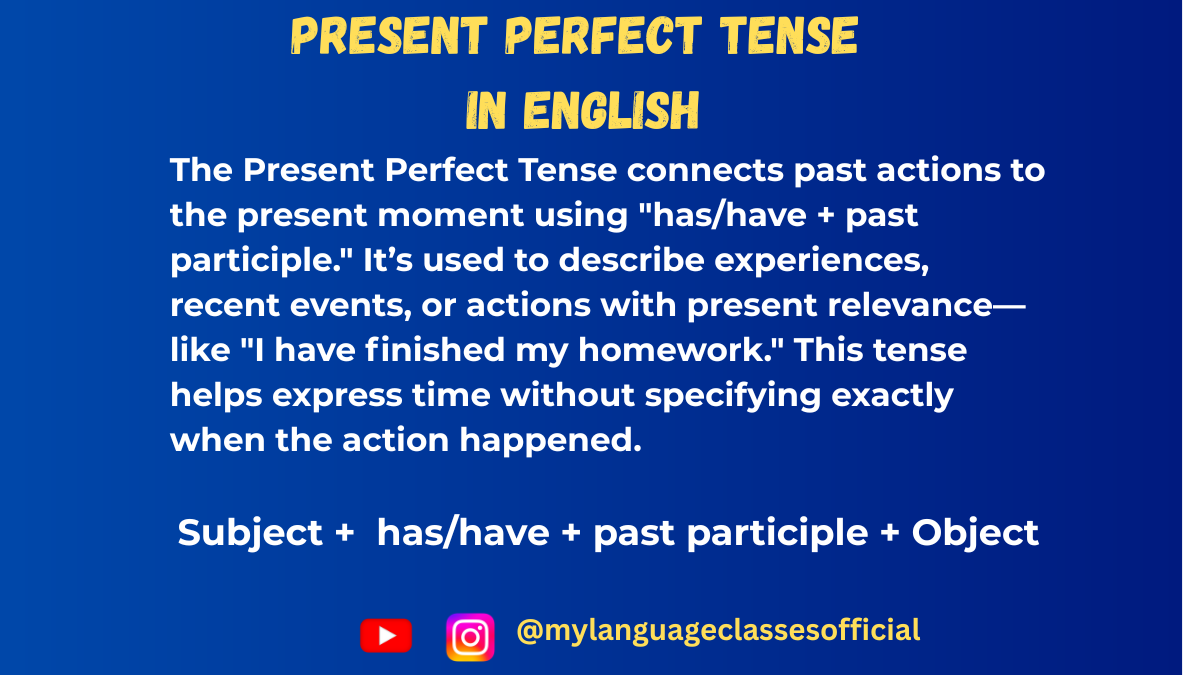
Present Perfect Tense in English helps speakers connect something that happened in the past with the present situation. It is commonly used for experiences, recent events, present results, repeated actions, and situations that began in the past and continue until now. The tense can feel confusing at first because English does not use it simply to identify an action that happened before the present. The relationship between the past event and the present is what makes the tense useful.
Consider these examples:
I have lost my keys.
She has visited Japan.
We have finished the project.
They have lived here for ten years.
Each sentence refers to something connected with the past, but each also has a connection with the present. In the first sentence, the speaker probably does not have the keys now. In the second, the speaker is describing a life experience. In the third, the completed project matters now. In the fourth, the situation began in the past and continues into the present.
This is why the Present Perfect is easier to understand when learners focus on the relationship between time and meaning rather than treating it as a simple past form. Its structure is also important because the tense combines an auxiliary verb, “have” or “has,” with the past participle of the main verb.
A clear understanding of this relationship provides a strong foundation for studying the tense as part of the larger English grammar system. The broader connections between the Present Perfect and the other major English tenses are explained in Complete English Tenses Mastery Guide.
What Is the Present Perfect Tense in English?
The Present Perfect Tense describes a past action, event, or situation that has a meaningful connection with the present. The action itself may be finished, but the speaker is interested in its present result, its connection to the current situation, its occurrence during a period that continues to the present, or the experience it represents.
For example:
I have finished my work.
The work was completed in the past, but the important information is that it is finished now.
Consider another example:
She has visited Japan.
The sentence tells us that visiting Japan is part of her experience. The exact time of the visit is not important in this context.
The Present Perfect can also describe something that started in the past and continues into the present:
They have lived here for ten years.
In this case, they started living there ten years ago and still live there now.
Another common use is to describe repeated events within a time period that has not finished:
I have called him three times today.
The day is still in progress, so the sentence connects those calls with the current time period.
The structure of the Present Perfect combines “have” or “has” with the past participle of the main verb:
I have worked.
She has worked.
They have finished.
He has gone.
The auxiliary verb changes according to the subject, while the main verb appears in its past participle form.
The tense therefore does not simply mean that something happened in the past. The speaker chooses the Present Perfect because the past event, experience, result, or situation has a particular connection with the present. Understanding that relationship is central to using the tense accurately, and it becomes easier when the Present Perfect is studied alongside the other tense patterns in Complete English Tenses Mastery Guide.
What Is the Formula of the Present Perfect Tense?
The basic formula of the Present Perfect Tense is formed with the auxiliary verb “have” or “has” followed by the past participle of the main verb. The subject determines whether we use “have” or “has,” while the main verb remains in its past participle form.
The basic affirmative structure is:
Subject + have/has + past participle + rest of the sentence
Examples:
I have finished my work.
You have visited Japan.
We have completed the project.
They have moved to Chicago.
He has finished his work.
She has visited Japan.
The company has opened a new office.
The choice between “have” and “has” follows the subject. We use “have” with I, you, we, and they. We use “has” with he, she, it, and singular third-person nouns.
Negative sentences use “not” after “have” or “has”:
Subject + have/has + not + past participle + rest of the sentence
Examples:
I have not finished my work.
They have not arrived yet.
She has not called me.
He has not completed the report.
Questions place “have” or “has” before the subject:
Have/Has + subject + past participle + rest of the sentence?
Examples:
Have you finished your work?
Have they arrived?
Has she called you?
Has he completed the report?
The main verb does not change according to the subject. For example, we use “finished” in both “I have finished” and “She has finished.” The change from “have” to “has” carries the subject agreement.
The past participle itself depends on the verb. With regular verbs, it often ends in “-ed”:
work → worked
finish → finished
visit → visited
With irregular verbs, the past participle can have a different form:
go → gone
see → seen
write → written
eat → eaten
This makes the past participle an essential part of the tense. A sentence such as “She has went home” is incorrect because “went” is the Simple Past form of “go.” The correct Present Perfect form is “She has gone home.”
Once the roles of the subject, auxiliary verb, and past participle are clear, the basic structure of the Present Perfect becomes much easier to recognize and produce. These structural patterns also fit into the larger system of English tense formation explained in Complete English Tenses Mastery Guide.
How Do You Form Affirmative Sentences in the Present Perfect Tense?
Affirmative sentences in the Present Perfect Tense follow a clear structure: the subject comes first, followed by “have” or “has,” and then the past participle of the main verb. The rest of the sentence provides additional information about the action, event, experience, or situation.
With I, you, we, and they, use “have”:
I have finished the report.
You have learned a lot.
We have visited several countries.
They have moved to a new apartment.
With he, she, it, and singular third-person nouns, use “has”:
He has finished the report.
She has learned a lot.
The company has opened a new branch.
My brother has moved to a new apartment.
The main verb stays in the past participle form regardless of the subject. For example:
I have written the email.
She has written the email.
They have written the email.
The verb “write” becomes “written” in every case. Only the auxiliary changes from “have” to “has.”
Regular verbs are often straightforward because their past participle is formed with “-ed”:
work → worked
clean → cleaned
finish → finished
study → studied
For example:
I have finished my homework.
She has cleaned the kitchen.
They have studied the material.
Irregular verbs require more attention because their past participles can have different forms:
go → gone
see → seen
take → taken
write → written
eat → eaten
For example:
He has gone home.
We have seen that movie.
She has taken the wrong train.
I have written three emails.
One common error is using the Simple Past form instead of the past participle:
Incorrect: She has went home.
Correct: She has gone home.
Incorrect: I have saw that movie.
Correct: I have seen that movie.
The structure becomes easier to control when learners identify the three main parts of the sentence: the subject, the auxiliary “have” or “has,” and the past participle. Keeping these roles separate helps prevent errors and provides a strong foundation for understanding the wider tense system in Complete English Tenses Mastery Guide.
How Do You Form Negative Sentences in the Present Perfect Tense?
Negative sentences in the Present Perfect Tense are formed by placing “not” after “have” or “has” and before the past participle. The choice between “have” and “has” still depends on the subject.
The basic structure is:
Subject + have/has + not + past participle + rest of the sentence
Use “have not” with I, you, we, and they:
I have not finished the report.
You have not answered my question.
We have not seen that movie.
They have not arrived yet.
Use “has not” with he, she, it, and singular third-person nouns:
He has not finished the report.
She has not answered my question.
It has not stopped raining.
The company has not announced the results.
The main verb remains in the past participle form after “have not” or “has not”:
She has not written the email.
They have not written the email.
We do not change “written” according to the subject.
In everyday English, the contracted forms “haven’t” and “hasn’t” are very common:
I haven’t finished my work.
They haven’t arrived yet.
She hasn’t called me.
He hasn’t seen the message.
The negative Present Perfect is often used when something expected or relevant to the present has not happened:
I have not received the package yet.
She has not finished the assignment.
We have not decided what to do.
They have not found a solution.
The word “yet” is particularly common in negative Present Perfect sentences when the speaker expects something to happen:
I have not finished yet.
She has not arrived yet.
They have not made a decision yet.
The past participle remains essential in every case. For example, “She has not went home” is incorrect because “went” is the Simple Past form. The correct sentence is “She has not gone home.”
Once the relationship between “have” or “has,” “not,” and the past participle is clear, negative sentences become predictable rather than something learners need to memorize individually. This structure is part of the larger Present Perfect system explained in Complete English Tenses Mastery Guide.
How Do You Form Questions in the Present Perfect Tense?
Questions in the Present Perfect Tense are formed by placing “have” or “has” before the subject, followed by the past participle of the main verb. The auxiliary verb carries the tense, while the main verb remains in its past participle form.
The basic structure is:
Have/Has + subject + past participle + rest of the sentence?
Use “have” with I, you, we, and they:
Have I made a mistake?
Have you finished your work?
Have we met before?
Have they arrived?
Use “has” with he, she, it, and singular third-person nouns:
Has he finished his work?
Has she called you?
Has it stopped raining?
Has the teacher arrived?
The main verb remains in the past participle form regardless of the subject:
Have you seen this movie?
Has she seen this movie?
Have they seen this movie?
The verb “see” remains “seen” in all three questions.
Present Perfect questions are often used to ask whether an event has happened by the present time:
Have you finished the report?
Has she submitted the application?
Have they received the package?
They can also ask about experiences:
Have you ever visited Japan?
Has he ever tried sushi?
Have they ever traveled abroad?
Questions can include time expressions that describe an unfinished period:
Have you spoken to her today?
Has he called you this week?
Have they completed the project this month?
Short answers normally repeat the auxiliary verb:
Have you finished?
Yes, I have.
No, I have not.
Has she arrived?
Yes, she has.
No, she has not.
A common mistake is using the Simple Past form instead of the past participle:
Incorrect: Have you went there?
Correct: Have you gone there?
Incorrect: Has she saw the movie?
Correct: Has she seen the movie?
The question structure becomes much easier when learners remember that “have” or “has” comes before the subject and the past participle follows the subject. This consistent pattern forms an important part of the complete tense system presented in Complete English Tenses Mastery Guide.
How Do You Form WH-Questions in the Present Perfect Tense?
WH-questions in the Present Perfect Tense begin with a question word such as “what,” “where,” “why,” “how,” “when,” or “who.” The question word is followed by “have” or “has,” then the subject and the past participle of the main verb.
The basic structure is:
WH-word + have/has + subject + past participle + rest of the sentence?
For example:
What have you done?
Where have they gone?
Why has she left?
How have you completed the work so quickly?
When has he visited the office?
Use “have” with I, you, we, and they:
What have you learned?
Where have you traveled?
Why have they changed their plans?
How have we reached this point?
Use “has” with he, she, it, and singular third-person nouns:
What has she written?
Where has he gone?
Why has the company changed its policy?
How has the situation improved?
The main verb must remain in the past participle form:
What have you written?
Where has she gone?
Why have they chosen this option?
The WH-question can also focus on the result of an action that has happened before the present:
What have you decided?
How have you solved the problem?
What has she achieved?
These questions ask about something that is relevant now, rather than simply asking about a completed event at a specific point in the past.
A common mistake is to use the Simple Past form after “have” or “has”:
Incorrect: What have you did?
Correct: What have you done?
Incorrect: Where has she went?
Correct: Where has she gone?
Incorrect: What have they saw?
Correct: What have they seen?
The same basic rule applies to every WH-question: “have” or “has” comes after the question word, the subject follows the auxiliary, and the main verb appears in the past participle form. Understanding this structure makes it easier to use the Present Perfect accurately across different types of questions. The complete relationship between these forms and the other English tenses is covered in Complete English Tenses Mastery Guide.
What Is the Past Participle in the Present Perfect Tense?
The past participle is the main verb form used after “have” or “has” in the Present Perfect Tense. The basic structure is:
Subject + have/has + past participle
For example:
I have finished my work.
She has written an email.
They have gone home.
The past participle is sometimes the same as the Simple Past form, especially with regular verbs. For regular verbs, the past participle is usually formed by adding “-ed” to the base verb:
work → worked → worked
finish → finished → finished
visit → visited → visited
For example:
I have worked here for five years.
She has finished the report.
They have visited several countries.
With irregular verbs, the past participle often has a different form from the Simple Past:
go → went → gone
write → wrote → written
see → saw → seen
eat → ate → eaten
take → took → taken
For example:
He has gone to the store.
She has written three books.
We have seen this movie before.
They have eaten lunch.
One of the most common mistakes with the Present Perfect is using the Simple Past form instead of the past participle:
Incorrect: She has went home.
Correct: She has gone home.
Incorrect: I have saw that movie.
Correct: I have seen that movie.
Incorrect: They have wrote the report.
Correct: They have written the report.
The past participle does not change according to the subject. The auxiliary verb changes instead:
I have written the letter.
She has written the letter.
They have written the letter.
The form “written” stays the same in each sentence.
Understanding common irregular past participles is therefore important for accurate Present Perfect sentences. However, learners should also understand how these forms function within the larger tense system instead of treating them as isolated vocabulary items. Complete English Tenses Mastery Guide provides a broader explanation of English verb forms and tense structures.
How Do You Use Have and Has in the Present Perfect Tense?
“Have” and “has” are auxiliary verbs in the Present Perfect Tense. They work together with the past participle to form the tense. The choice between them depends on the subject of the sentence.
Use “have” with I, you, we, and they:
I have finished my work.
You have learned a lot.
We have completed the project.
They have arrived.
Use “has” with he, she, it, and singular third-person nouns:
He has finished his work.
She has learned a lot.
It has stopped raining.
The student has completed the assignment.
The company has announced the results.
The main verb must appear in the past participle form after both “have” and “has”:
I have written the report.
She has written the report.
They have written the report.
The verb “write” does not change according to the subject. The auxiliary verb changes from “have” to “has.”
The same pattern applies to irregular verbs:
I have gone home.
He has gone home.
We have seen the movie.
She has seen the movie.
They have taken the test.
The teacher has taken the test.
“Have” and “has” can also appear in negative sentences:
I have not finished the work.
She has not finished the work.
They have not received the message.
He has not received the message.
They are also used at the beginning of Present Perfect questions:
Have you finished the work?
Have they arrived?
Has she called you?
Has he completed the assignment?
A useful way to remember the pattern is to separate the roles of the two verbs. “Have” or “has” shows the Present Perfect structure, while the past participle identifies the main action or state. The subject determines whether “have” or “has” is required.
Using these auxiliary verbs correctly is essential because changing “have” to “has,” or using the wrong main verb form, can make a Present Perfect sentence grammatically incorrect. The complete system of auxiliary verbs and English tense structures is explained in Complete English Tenses Mastery Guide.
When Do We Use the Present Perfect Tense?
The Present Perfect Tense is used when a past action, event, or situation has a meaningful connection with the present. The exact time of the past event is often not important. Instead, the speaker is interested in the experience, result, change, repetition, or situation that relates to now.
One common use is to describe a past action when its present relevance matters:
I have lost my keys.
The action of losing the keys happened in the past, but the situation matters now because the speaker does not have the keys.
The Present Perfect is also commonly used for life experiences:
She has visited Japan.
The sentence tells us about an experience in her life. It does not say exactly when she visited Japan.
Another important use is to describe something that has happened recently:
They have just arrived.
The arrival happened shortly before the present moment, and the event is relevant now.
The tense can also describe a present result:
He has broken his glasses.
The breaking happened in the past, but the result is still relevant because his glasses are now broken.
The Present Perfect can describe repeated actions that have happened up to the present:
I have read this book three times.
She has called me several times today.
It can also describe a situation that began in the past and continues into the present:
We have lived here for ten years.
They have known each other since 2015.
The time relationship is especially important when deciding whether to use the Present Perfect or another tense. Compare:
I have visited London.
I visited London in 2022.
The first sentence focuses on the experience without identifying a completed past time. The second sentence identifies a specific finished time, so the Simple Past is appropriate.
The Present Perfect is therefore best understood through the relationship between a past event and the present. This relationship can involve experience, result, recent activity, repetition, change, or continuation. Understanding these different meanings provides the foundation for using the tense accurately throughout English. A broader explanation of how these meanings connect with the other English tenses appears in Complete English Tenses Mastery Guide.
How Do We Use the Present Perfect for Past Actions With Present Relevance?
The Present Perfect is often used when an action happened in the past but the speaker is connecting that action to the present situation. The exact time of the action is usually not the main focus.
For example:
I have lost my wallet.
The action of losing the wallet happened before the present moment. However, the important information now is that the wallet is still missing.
Similarly:
She has broken her phone.
The breaking happened in the past, but the result affects the present because her phone is now damaged.
We have finished the meeting.
The meeting ended before the present moment, but its completion is relevant now.
They have changed the schedule.
The change happened in the past, but the new schedule affects the current situation.
This use becomes clearer when the Present Perfect is compared with the Simple Past. Consider these sentences:
I lost my keys yesterday.
I have lost my keys.
The Simple Past sentence identifies a finished past time, “yesterday.” The Present Perfect sentence does not identify when the keys were lost. Instead, it focuses on the present situation caused by the past action.
Another example is:
She broke her arm last week.
She has broken her arm.
The first sentence gives a specific past time. The second emphasizes the current condition resulting from the past event.
The Present Perfect can also describe actions whose consequences are important in the present even when the result is less obvious:
The company has opened a new office.
The team has completed the project.
Scientists have discovered a new method.
In each case, the past action creates information or a situation that is relevant at the time of speaking.
This does not mean that every past action with a consequence must use the Present Perfect. The choice depends on what the speaker wants to emphasize and whether a finished past time is being identified. When a specific completed time is important, the Simple Past is normally more appropriate.
Understanding this connection between past actions and present relevance is central to using the Present Perfect naturally. The same principle also helps explain why the tense differs from the Simple Past and other English tenses in Complete English Tenses Mastery Guide.
How Do We Use the Present Perfect for Life Experiences?
The Present Perfect is commonly used to talk about experiences that have happened at some point in a person’s life. The speaker focuses on whether the experience has happened, rather than on the exact time when it happened.
For example:
I have visited Japan.
She has traveled to several countries.
They have tried Indian food.
He has seen that movie before.
These sentences describe experiences without saying exactly when they happened. The Present Perfect allows the speaker to present the experience as part of the person’s life up to the present.
We can also use the Present Perfect to ask whether someone has had a particular experience:
Have you visited Japan?
Has she traveled abroad?
Have they tried sushi?
Has he seen this movie?
The words “ever” and “never” are especially common when talking about life experiences. “Ever” asks whether something has happened at any time up to the present:
Have you ever visited Japan?
Has she ever driven a car?
Have they ever eaten sushi?
“Never” indicates that an experience has not happened at any time up to the present:
I have never visited Japan.
She has never driven a car.
They have never eaten sushi.
The Present Perfect can also be used when the speaker gives the number of times an experience has happened:
I have visited Japan three times.
She has seen that movie twice.
We have eaten at that restaurant several times.
The focus remains on the experience up to the present. However, if the speaker identifies a specific completed time, the Simple Past is normally used:
I visited Japan in 2023.
She saw that movie last month.
We ate at that restaurant yesterday.
Compare:
I have visited Japan.
I visited Japan in 2023.
The first sentence describes a life experience without specifying when it happened. The second identifies a completed past time.
This distinction is important because the Present Perfect does not simply mean that something happened in the past. It presents an experience as part of the period leading up to the present. Learning to recognize this time relationship makes it easier to choose between the Present Perfect and the Simple Past. The wider tense system and these distinctions are covered in Complete English Tenses Mastery Guide.
How Do We Use the Present Perfect for Recent Events?
The Present Perfect is commonly used to describe events that happened recently and are still relevant to the present. The exact time may not be given because the main focus is on the event and its current significance.
For example:
I have just finished my work.
She has arrived at the office.
They have completed the project.
We have received the message.
The word “just” is especially common with the Present Perfect when an action happened a short time before the present moment:
He has just left.
I have just spoken to Sarah.
The students have just finished the lesson.
The Present Perfect can also describe a recent event without using “just”:
The train has arrived.
The meeting has ended.
The company has announced the results.
Someone has taken my seat.
In each case, the event occurred before the present moment, but the speaker is presenting it as relevant to the current situation.
Compare the Present Perfect with the Simple Past:
The train has arrived.
The train arrived at 8:30.
The first sentence focuses on the current situation. The train is now here. The second sentence reports the event at a specific past time.
Similarly:
She has just left.
She left ten minutes ago.
The Present Perfect emphasizes the recent event and its relevance now. The Simple Past places the event within a completed past time.
The Present Perfect is particularly useful in announcements and updates:
The company has released a new product.
The school has changed the schedule.
The government has announced a new policy.
The team has won the match.
These sentences present new information that matters at the time of speaking.
However, “recent” does not automatically require the Present Perfect. If the speaker gives a finished and specific past time, the Simple Past is normally used:
I finished the report this morning.
She arrived five minutes ago.
They completed the project yesterday.
The choice depends on whether the speaker is presenting the event as connected to the present or placing it within a completed past time. This distinction is an important part of understanding how the Present Perfect functions within the larger English tense system in Complete English Tenses Mastery Guide.
How Do We Use the Present Perfect for Present Results?
The Present Perfect can describe an action that happened in the past when its result is important in the present. The action itself is completed, but its effect or outcome can still be seen, felt, or understood now.
For example:
I have lost my wallet.
The loss happened before the present moment, but the important result is that I do not have my wallet now.
Similarly:
She has broken her glasses.
The glasses were broken in the past, but they are still broken now.
He has forgotten his password.
The forgetting happened earlier, but he does not remember the password now.
We have finished the report.
The report was completed before the present moment, and its completion is relevant to the current situation.
The Present Perfect can also describe changes that have produced a current state:
The company has opened a new office.
The city has built a new hospital.
Technology has changed the way people communicate.
The team has improved its performance.
In these examples, the changes began or occurred before the present, but the new situation exists now.
The tense can also be used when the present result is important in a practical situation:
Someone has taken my seat.
The speaker is concerned because the seat is occupied now.
The students have completed the assignment.
The teacher can now review the completed work.
The store has closed.
The store is not open now.
The Present Perfect can therefore help speakers give updates about situations that have changed because of a previous action.
Compare these sentences:
I broke my phone yesterday.
I have broken my phone.
The first sentence focuses on the completed past event and gives a specific past time. The second focuses on the current result. The phone is broken now.
Another comparison is:
She lost her keys last night.
She has lost her keys.
The first sentence reports a past event at a specified time. The second emphasizes the current problem caused by the loss.
This use of the Present Perfect is especially important in everyday communication because speakers often need to report what has happened and explain why the situation is different now. Understanding the connection between completed actions and their present results also helps learners distinguish the Present Perfect from the Simple Past, a distinction developed further in Complete English Tenses Mastery Guide.
How Do We Use the Present Perfect for Repeated Actions Up to Now?
The Present Perfect can describe an action that has happened several times during the period leading up to the present. The exact times of the individual actions are usually not important. The focus is on the repetition and the total experience up to now.
For example:
I have visited Japan three times.
She has called me several times.
We have watched this movie twice.
They have traveled abroad many times.
The Present Perfect can be used with expressions that indicate the number of occurrences:
I have read this book five times.
He has played that game several times.
She has written three articles this week.
The exact occasions are not identified. Instead, the speaker gives the total number of times something has happened.
The tense is also useful when an action has occurred repeatedly during an unfinished period:
I have answered ten emails today.
We have had three meetings this week.
She has visited the library twice this month.
They have scored four goals this season.
Words such as “several times,” “many times,” “twice,” and “three times” can make the repeated nature of the action clear.
The Present Perfect can also describe repeated events without giving a number:
He has called me repeatedly.
We have discussed this issue several times.
The company has changed its policy more than once.
The situation has happened before.
The important point is that the repeated activity is connected with the present period or present situation.
Compare:
I have visited London three times.
I visited London three times last year.
The first sentence presents the visits as part of the speaker’s experience up to the present. The second places all three visits inside a completed past period, “last year,” so the Simple Past is appropriate.
Similarly:
She has called me five times today.
She called me five times yesterday.
“Today” can still be continuing when the speaker is talking, so the Present Perfect can describe the number of calls up to the present. “Yesterday” refers to a completed past period, so the Simple Past is normally used.
This use of the Present Perfect is particularly important when the speaker is counting events that have occurred during a period that has not yet ended. The tense connects the repeated past events with the present point in time. The broader relationship between tense, time periods, and completed or unfinished actions is explained in Complete English Tenses Mastery Guide.
How Do We Use the Present Perfect for Unfinished Time Periods?
The Present Perfect can describe actions or events that have happened during a period of time that is still continuing. The speaker focuses on what has happened up to the present rather than treating the time period as completely finished.
Common unfinished time expressions include “today,” “this week,” “this month,” “this year,” and “so far.”
For example:
I have spoken to three clients today.
She has written two articles this week.
We have had several meetings this month.
They have traveled to three countries this year.
In each sentence, the time period is still open when the speaker is talking. More actions may happen before the period ends.
The Present Perfect is also common with “so far,” which emphasizes what has happened from the beginning of a period until the present:
We have completed five lessons so far.
She has received ten applications so far.
I have read three chapters so far.
The company has sold many products so far this year.
The same principle applies to “until now” and “up to now”:
I have not received a response until now.
She has completed everything up to now.
They have made good progress up to now.
The Present Perfect can be contrasted with the Simple Past when the time period has finished:
I have read three books this month.
I read three books last month.
“This month” may still be continuing, while “last month” is a completed period.
Similarly:
We have had two meetings this week.
We had two meetings last week.
The first sentence describes events within a period that is still connected to the present. The second describes events within a completed past period.
However, the choice can depend on the actual time of speaking. For example, if someone says “I have had three meetings today” while today is still in progress, the Present Perfect is natural. If the speaker is discussing that day later as a completed period, the Simple Past may be appropriate.
This is why learners should not memorize a fixed list of time expressions without considering their meaning. The important question is whether the time period is still continuing or is being treated as finished.
Understanding unfinished time periods helps explain why the Present Perfect can describe repeated actions, recent events, and experiences that connect with the present. These relationships are part of the broader English tense system presented in Complete English Tenses Mastery Guide.
How Do We Use Since and For With the Present Perfect?
“Since” and “for” are commonly used with the Present Perfect to describe situations that began in the past and continue up to the present. The two expressions have different meanings, so they cannot always be used interchangeably.
“Since” identifies the starting point of an action or situation. It tells us when the period began.
For example:
I have lived here since 2018.
She has worked at the company since January.
They have known each other since childhood.
We have studied English since last year.
The starting point can be a specific year, month, day, time, event, or another point in the past:
He has been sick since Monday.
I have known her since 2015.
She has worked here since she graduated.
“Since” can also be followed by a clause that identifies the event when the situation began:
I have lived here since I moved to this city.
She has worked there since she finished college.
They have known each other since they were children.
“For,” on the other hand, identifies the duration of an action or situation. It tells us how long something has continued.
For example:
I have lived here for ten years.
She has worked at the company for five years.
They have known each other for a long time.
We have studied English for two years.
The duration can be expressed with minutes, hours, days, weeks, months, years, or longer periods:
He has been sick for three days.
I have known her for twenty years.
She has worked here for several months.
They have lived together for a long time.
The difference can be seen clearly in these two sentences:
I have lived here since 2018.
I have lived here for eight years.
“Since 2018” identifies the starting point. “For eight years” identifies the duration.
A common mistake is using “since” with a duration:
Incorrect: I have lived here since ten years.
Correct: I have lived here for ten years.
Another common mistake is using “for” with a starting point:
Incorrect: She has worked here for 2020.
Correct: She has worked here since 2020.
Both expressions are especially useful for situations that began in the past and continue into the present. The Present Perfect makes this connection clear by presenting the past starting point or duration in relation to now. The wider use of time expressions across English tenses is covered in Complete English Tenses Mastery Guide.
How Do We Use Already, Yet, and Just With the Present Perfect?
“Already,” “yet,” and “just” are commonly used with the Present Perfect to show when an action has happened in relation to the present moment. Each word has a different function.
“Already” indicates that something happened before the expected or assumed time. It is commonly placed between “have” or “has” and the past participle:
I have already finished my work.
She has already left.
They have already completed the project.
We have already seen that movie.
“Already” can also appear at the end of a sentence, especially in informal speech:
I have finished my work already.
She has left already.
The meaning remains similar. The speaker is emphasizing that the action has happened sooner than expected or that there is no need to wait for it to happen.
“Yet” is commonly used in negative sentences and questions. It refers to something that is expected to happen but has not happened by the present time.
In negative sentences, “yet” usually comes at the end:
I have not finished yet.
She has not arrived yet.
They have not made a decision yet.
We have not received the package yet.
In questions, “yet” asks whether something expected has happened:
Have you finished yet?
Has she arrived yet?
Have they announced the results yet?
“Just” indicates that something happened a very short time ago. It normally appears between “have” or “has” and the past participle:
I have just finished my work.
She has just arrived.
They have just left.
We have just received the message.
Compare the three expressions:
She has already finished the report.
The report was finished before the expected time or before now.
She has not finished the report yet.
The report remains unfinished, but it is expected to be completed.
She has just finished the report.
The report was completed very recently.
These expressions are useful because they add information about the relationship between an event and the present moment. However, they do not change the basic structure of the Present Perfect. “Have” or “has” is still followed by the past participle.
A common mistake is using the Simple Past after these expressions when the intended meaning is connected to the present:
Incorrect: She already finished the report.
Correct: She has already finished the report.
The Simple Past sentence can be correct in an appropriate context, but the Present Perfect is commonly used when the speaker is emphasizing the current status of the action.
Understanding “already,” “yet,” and “just” makes the timing and meaning of Present Perfect sentences much clearer. These small words are part of the wider system of time relationships explained in Complete English Tenses Mastery Guide.
How Do We Use Ever and Never With the Present Perfect?
“Ever” and “never” are commonly used with the Present Perfect when talking about experiences up to the present time. They help speakers describe whether something has happened at any point in a person’s life or during the period leading up to now.
“Ever” is mainly used in questions. It means “at any time” and asks whether an experience has happened at some point before now:
Have you ever visited Japan?
Has she ever traveled abroad?
Have they ever tried sushi?
Has he ever worked in another country?
The question does not ask for a specific time. It asks whether the experience has happened at any point up to the present.
“Never” means that something has not happened at any time up to the present. It is normally placed between “have” or “has” and the past participle:
I have never visited Japan.
She has never traveled abroad.
They have never tried sushi.
He has never worked in another country.
Because “never” already has a negative meaning, we do not normally use “not” with it:
Incorrect: I have not never visited Japan.
Correct: I have never visited Japan.
“Ever” and “never” are especially useful when discussing life experiences:
Have you ever eaten Mexican food?
I have never eaten Mexican food.
Has she ever driven a truck?
She has never driven a truck.
Have they ever seen snow?
They have never seen snow.
The Present Perfect keeps the focus on the experience up to the present rather than on a particular past occasion. If the speaker asks about or identifies a specific time, the Simple Past is normally used:
Have you ever visited Japan?
Yes, I visited Japan in 2024.
The first sentence asks whether the experience has occurred at any point up to now. The second gives the specific time of the experience, so the Simple Past is appropriate.
“Ever” can also appear in questions about situations that may have occurred repeatedly or under different circumstances:
Have you ever made a serious mistake at work?
Has she ever spoken to a large audience?
Have you ever forgotten an important appointment?
The central idea remains the same: “ever” asks about an experience at any time up to the present, while “never” states that the experience has not occurred during that period. These expressions become much easier to use when the Present Perfect is understood as a tense that connects past experience with the present. The wider system of English tense usage is developed in Complete English Tenses Mastery Guide.
What Is the Difference Between the Present Perfect and Simple Past?
The Present Perfect and Simple Past both describe events that happened before the present, but they present those events differently. The main difference is whether the speaker connects the past event with the present or places it within a finished past time.
The Present Perfect is formed with “have” or “has” plus the past participle:
I have visited Japan.
She has finished the report.
The Simple Past uses the past form of the main verb:
I visited Japan.
She finished the report.
The Present Perfect is commonly used when the exact time is not stated because the focus is on the experience, result, or present relevance:
I have visited Japan.
She has finished the report.
We have seen this movie before.
The Simple Past is normally used when the speaker identifies a specific finished time:
I visited Japan in 2024.
She finished the report yesterday.
We saw this movie last week.
Compare these sentences:
I have lost my keys.
I lost my keys yesterday.
The first sentence focuses on the present situation. The keys are still missing. The second sentence reports the past event and identifies when it happened.
Another example is:
She has visited Spain.
She visited Spain last summer.
The Present Perfect describes the experience without specifying a completed past time. The Simple Past places the visit in a particular finished period.
The difference also applies to questions:
Have you seen this movie?
Did you see this movie last night?
The first question asks about the experience up to the present. The second asks about a particular past occasion.
Time expressions can therefore help determine which tense is appropriate. The Present Perfect commonly occurs with expressions such as “ever,” “never,” “already,” “yet,” “just,” “so far,” and “this week” when the period remains connected to the present.
The Simple Past commonly occurs with finished past-time expressions such as “yesterday,” “last week,” “in 2020,” “two days ago,” and “when I was a child.”
However, the distinction is based on meaning rather than simply memorizing lists of words. A time expression referring to a completed past period generally calls for the Simple Past, while the Present Perfect is used when the past event remains connected to the present or belongs to an unfinished period.
Understanding this difference is one of the most important steps in using the Present Perfect accurately. A broader comparison of the major English tenses is provided in Complete English Tenses Mastery Guide.
Can We Use the Present Perfect With Specific Past Time Expressions?
The Present Perfect is generally not used when the sentence identifies a specific, finished time in the past. When the speaker gives a definite past time, the Simple Past is normally the appropriate tense.
For example:
Incorrect: I have visited Japan in 2024.
Correct: I visited Japan in 2024.
Incorrect: She has finished the report yesterday.
Correct: She finished the report yesterday.
Incorrect: They have arrived two hours ago.
Correct: They arrived two hours ago.
Expressions such as “yesterday,” “last week,” “last year,” “in 2020,” and “two days ago” normally refer to completed past periods. Because the speaker places the event at a definite point or period in the past, the Simple Past is used.
Compare:
I have visited Japan.
I visited Japan in 2024.
The first sentence describes a life experience without identifying when it happened. The second gives a specific completed time.
The same distinction applies to “ago”:
I have seen that movie before.
I saw that movie three years ago.
The Present Perfect can also be used with some time expressions that sound specific but refer to a period that is still continuing:
I have spoken to three clients today.
She has written two articles this week.
We have had several meetings this month.
Here, “today,” “this week,” and “this month” can still include the present moment. The time period has not necessarily finished.
Compare:
I have spoken to three clients today.
I spoke to three clients yesterday.
The first sentence refers to a period that is still connected to the present. The second refers to a completed day.
There are also situations where a speaker may use the Present Perfect with a broader time reference because the focus is on an experience rather than a particular completed event:
I have visited many countries in my life.
She has read several books this year.
The important distinction is whether the time reference is being treated as finished or still connected to the present.
Therefore, the rule is not simply that the Present Perfect cannot appear with any time expression. The key question is whether the expression identifies a completed past time. If it does, the Simple Past is normally used. If the period is unfinished or the expression does not identify a specific past occasion, the Present Perfect may be appropriate. This distinction is an important part of the tense comparisons explained in Complete English Tenses Mastery Guide.
What Is the Difference Between the Present Perfect and Present Perfect Continuous?
The Present Perfect and Present Perfect Continuous can both connect a past action or situation with the present. However, they usually emphasize different aspects of that connection.
The Present Perfect uses:
Subject + have/has + past participle
For example:
I have read three chapters.
She has written five emails.
The Present Perfect Continuous uses:
Subject + have/has + been + present participle
For example:
I have been reading for two hours.
She has been writing emails all morning.
The Present Perfect often emphasizes a completed action, a result, or the number of times something has happened:
I have cleaned the kitchen.
She has written three reports.
They have visited Japan twice.
The Present Perfect Continuous often emphasizes the activity itself, its duration, or the fact that it has been happening repeatedly or continuously:
I have been cleaning the kitchen for an hour.
She has been writing reports all morning.
They have been traveling for several weeks.
Compare:
I have painted the room.
I have been painting the room.
The first sentence emphasizes the completed result. The room has been painted. The second emphasizes the activity. It does not necessarily tell us whether the room is completely finished.
The distinction is also clear with duration:
She has lived here for ten years.
She has been living here for ten years.
Both sentences can describe a situation that began in the past and continues now. The Present Perfect can present the situation as a fact or state, while the Present Perfect Continuous places more emphasis on the ongoing activity.
The Present Perfect is also more natural when the speaker focuses on a completed quantity:
I have written five pages today.
The Present Perfect Continuous is more natural when the focus is on the activity:
I have been writing all morning.
Some verbs are normally not used in continuous forms when they describe states. In these cases, the Present Perfect is generally used:
I have known her for ten years.
She has owned the house since 2018.
They have believed this for a long time.
The Present Perfect Continuous would not normally be used with these verbs in their usual stative meanings.
The choice between the two tenses therefore depends on what the speaker wants to emphasize. The Present Perfect commonly highlights completion, results, experiences, or quantities. The Present Perfect Continuous commonly highlights duration, ongoing activity, or the process itself. These distinctions form part of the broader tense system explained in Complete English Tenses Mastery Guide.
What Is the Difference Between the Present Perfect and Past Perfect?
The Present Perfect and Past Perfect both use “have” and a past participle, but they connect past events to different reference points. The Present Perfect connects a past event with the present. The Past Perfect connects an earlier past event with another point or event in the past.
The Present Perfect is formed with:
Subject + have/has + past participle
For example:
I have finished my work.
She has visited Japan.
They have left the office.
The Past Perfect is formed with:
Subject + had + past participle
For example:
I had finished my work.
She had visited Japan.
They had left the office.
The Present Perfect relates an event to the present:
She has finished the report.
This tells us that the report is finished now.
The Past Perfect relates an earlier event to a later past event:
She had finished the report before the meeting started.
Both actions happened in the past. Finishing the report happened first, and the meeting started later.
Another example shows the difference clearly:
I have eaten dinner.
I had eaten dinner before they arrived.
In the first sentence, the completed meal is connected with the present. In the second sentence, eating dinner happened before another past event.
The Past Perfect is particularly useful when the order of two past events needs to be made clear:
When I arrived, they had already left.
She had completed the assignment before the teacher collected it.
The train had departed before we reached the station.
The Present Perfect cannot normally perform this same function because its reference point is the present:
They have already left.
This sentence tells us that they are no longer here now.
The Past Perfect version changes the reference point:
They had already left when I arrived.
Here, their departure happened before another event in the past.
The auxiliary verb also differs. The Present Perfect uses “have” or “has” according to the subject, while the Past Perfect uses “had” with all subjects:
I have finished.
She has finished.
They have finished.
I had finished.
She had finished.
They had finished.
The key distinction is therefore the reference point. The Present Perfect looks from the present back toward an earlier event or situation. The Past Perfect looks from a past reference point further back to an earlier event. Understanding this relationship makes it easier to choose between the two tenses and to understand the wider English tense system in Complete English Tenses Mastery Guide.
How Do We Use the Present Perfect With State Verbs?
The Present Perfect is commonly used with state verbs when a state began in the past and continues into the present. State verbs describe conditions, relationships, opinions, possession, knowledge, or feelings rather than actions that are normally viewed as ongoing physical activities.
Common state verbs include “know,” “believe,” “understand,” “like,” “love,” “own,” “have,” and “want.”
For example:
I have known her for ten years.
She has owned this house since 2018.
They have lived here for a long time.
We have believed this for many years.
The Present Perfect works naturally with these verbs because it can connect a state that began in the past with the present.
“For” can show the duration:
I have known him for twenty years.
She has owned the business for five years.
They have had this car for a long time.
“Since” can identify the starting point:
I have known her since college.
He has owned the company since 2015.
We have lived here since 2020.
Many state verbs are not normally used in the Present Perfect Continuous when they describe a continuing state. For example:
Correct: I have known her for ten years.
Less natural in standard usage: I have been knowing her for ten years.
Correct: She has owned the house since 2018.
Incorrect: She has been owning the house since 2018.
The same principle applies to verbs such as “believe” and “understand”:
I have believed this for many years.
She has understood the problem since the beginning.
These verbs describe states rather than activities, so the Present Perfect is generally the appropriate form.
However, some verbs can have both stative and dynamic meanings. The appropriate tense can therefore depend on the intended meaning:
I have had this car for five years.
I have been having problems with my car recently.
In the first sentence, “have” expresses possession. In the second, “having” is part of an expression describing repeated problems.
The important point is that the Present Perfect is not limited to completed actions. It can also describe states that started in the past and remain true now. Recognizing whether a verb expresses a state or an activity helps learners choose naturally between the Present Perfect and Present Perfect Continuous. These distinctions are part of the broader tense system explained in Complete English Tenses Mastery Guide.
What Are the Common Mistakes With the Present Perfect Tense?
Learners often make mistakes with the Present Perfect because its meaning depends on the relationship between past events and the present. Most errors involve the auxiliary verb, the past participle, time expressions, or choosing the wrong tense.
One common mistake is using the wrong auxiliary verb:
Incorrect: She have finished the report.
Correct: She has finished the report.
Incorrect: They has arrived.
Correct: They have arrived.
Remember that “have” is used with I, you, we, and they, while “has” is used with he, she, it, and singular third-person nouns.
Another common mistake is using the Simple Past form instead of the past participle:
Incorrect: I have went there.
Correct: I have gone there.
Incorrect: She has saw the movie.
Correct: She has seen the movie.
Incorrect: They have wrote the report.
Correct: They have written the report.
The verb after “have” or “has” must be in the past participle form.
A third mistake is using the Present Perfect with a specific finished past time:
Incorrect: I have visited Japan in 2024.
Correct: I visited Japan in 2024.
Incorrect: She has finished the report yesterday.
Correct: She finished the report yesterday.
When a sentence identifies a completed past time, the Simple Past is normally used.
Another common mistake is using “since” and “for” incorrectly:
Incorrect: I have lived here since ten years.
Correct: I have lived here for ten years.
Incorrect: She has worked here for 2020.
Correct: She has worked here since 2020.
“For” describes a duration, while “since” identifies a starting point.
Learners also sometimes use the Present Perfect when the speaker is clearly referring to a completed past period:
Incorrect: I have seen him yesterday.
Correct: I saw him yesterday.
The word “yesterday” identifies a finished past period, so the Simple Past is appropriate.
Another mistake is adding “did” to a Present Perfect question:
Incorrect: Did you have finished the work?
Correct: Have you finished the work?
The Present Perfect uses “have” or “has” as its auxiliary. “Did” belongs to the Simple Past.
Learners may also confuse the Present Perfect with the Present Perfect Continuous:
I have written five pages.
I have been writing for two hours.
The first sentence emphasizes the completed quantity. The second emphasizes the activity and its duration.
Finally, learners sometimes treat the Present Perfect as simply another way to describe any past event. This can lead to incorrect choices between the Present Perfect and Simple Past. The Present Perfect is normally used when the past event has a connection with the present, while the Simple Past is used for completed past events viewed within a finished past time.
The most reliable way to avoid these mistakes is to consider the subject, verb form, time reference, and intended meaning before choosing the tense. These relationships are brought together in Complete English Tenses Mastery Guide.
How to Use the Present Perfect Tense Correctly in English
Using the Present Perfect correctly requires more than remembering the formula “have/has + past participle.” The tense expresses a relationship between a past event, experience, or situation and the present.
Start by choosing the correct auxiliary verb. Use “have” with I, you, we, and they, and use “has” with he, she, it, and singular third-person nouns.
I have finished my work.
She has finished her work.
They have finished their work.
Next, use the past participle after “have” or “has.” Regular verbs often end in “-ed,” while irregular verbs have different forms:
I have worked here for five years.
She has written three reports.
They have gone home.
Avoid using the Simple Past form after “have” or “has”:
Incorrect: She has went home.
Correct: She has gone home.
The next step is to consider the time relationship. Use the Present Perfect when the past event has a connection with the present:
I have lost my keys.
The important point is that the keys are still missing.
Use the Simple Past when you identify a specific completed past time:
I lost my keys yesterday.
Also pay attention to whether a time period is still continuing:
I have spoken to three clients today.
I spoke to three clients yesterday.
“Today” can still be in progress, while “yesterday” is a completed past period.
Use “since” for a starting point and “for” for a duration:
I have lived here since 2020.
I have lived here for six years.
Use common Present Perfect expressions according to their meaning:
I have already finished the report.
She has not arrived yet.
They have just left.
Have you ever visited Japan?
I have never visited Japan.
Finally, remember that the Present Perfect can describe several different relationships with the present. It can express a life experience, a recent event, a present result, repeated actions, an unfinished time period, or a situation that began in the past and continues now.
The most reliable approach is therefore to consider four things: the subject, the verb form, the time reference, and the connection with the present. When these elements work together, the Present Perfect becomes a predictable part of English grammar rather than a tense that depends on memorized rules. The complete system of English tense structures is explained in Complete English Tenses Mastery Guide.
Key Takeaway
→ The Present Perfect is formed with “have” or “has” plus the past participle of the main verb.
→ Use “have” with I, you, we, and they. Use “has” with he, she, it, and singular third-person nouns.
→ The Present Perfect commonly connects a past action, event, or situation with the present.
→ It can describe life experiences, recent events, present results, repeated actions, and situations that began in the past and continue into the present.
→ Use the past participle after “have” or “has,” including the correct irregular form when necessary.
→ Use “since” for a starting point and “for” for a duration.
→ “Already,” “yet,” and “just” help describe when an event has happened in relation to the present.
→ “Ever” and “never” are commonly used to discuss experiences up to the present.
→ The Present Perfect is normally not used with a specific completed past time such as “yesterday,” “last year,” or “in 2020.”
→ The Simple Past generally describes completed past events within a finished past time, while the Present Perfect emphasizes a connection with the present.
→ The Present Perfect and Present Perfect Continuous can both describe situations continuing into the present, but they often emphasize different aspects of the situation.
→ The Present Perfect differs from the Past Perfect because the Present Perfect connects the past with the present, while the Past Perfect places one past event before another past reference point.
→ Understanding the time relationship and intended meaning is more useful than memorizing isolated rules. Complete English Tenses Mastery Guide brings these tense relationships together in a structured reference.
Conclusion
The Present Perfect Tense in English is used to connect past events, experiences, and situations with the present. Its meaning becomes clearer when learners focus on this relationship rather than treating it simply as a way to describe something that happened before now.
The basic structure is straightforward: “have” or “has” followed by the past participle. However, using the tense accurately requires attention to the subject, verb form, time expression, and intended meaning.
The Present Perfect is especially useful for describing life experiences, recent events, present results, repeated actions, unfinished time periods, and situations that began in the past and continue into the present. Expressions such as “since,” “for,” “already,” “yet,” “just,” “ever,” and “never” provide additional information about these relationships.
The most important distinction is between the Present Perfect and the Simple Past. The Present Perfect normally connects the past with the present, while the Simple Past generally presents an event within a completed past time. Once this difference becomes clear, many of the tense choices that initially seem difficult become much easier to understand.
Learning the Present Perfect is also part of understanding how the English tense system works as a whole. Its relationship with the Present Perfect Continuous, Past Perfect, and other tenses helps learners see how English expresses different relationships between events and time. For a broader reference covering these structures, Complete English Tenses Mastery Guide provides a systematic guide to all 12 English tenses.

Vikas Kumar is the founder of My Language Classes, a language learning platform dedicated to helping learners develop practical communication skills in Spanish, Japanese, and English through comprehensive grammar guides, structured learning resources, books, and evidence-informed educational content.
At My Language Classes, we believe that successful language learning is built on clarity, consistency, meaningful practice, and a deep understanding of how languages work. Every article is carefully researched and created to simplify complex concepts, provide practical guidance, and help learners develop confidence through real-world communication.
Inspired by the principles behind How Language Learning Really Works, our mission is to make high-quality language learning accessible to learners around the world by providing accurate, trustworthy, and comprehensive resources that support lasting progress, lifelong learning, and meaningful communication.
Leave a Reply