
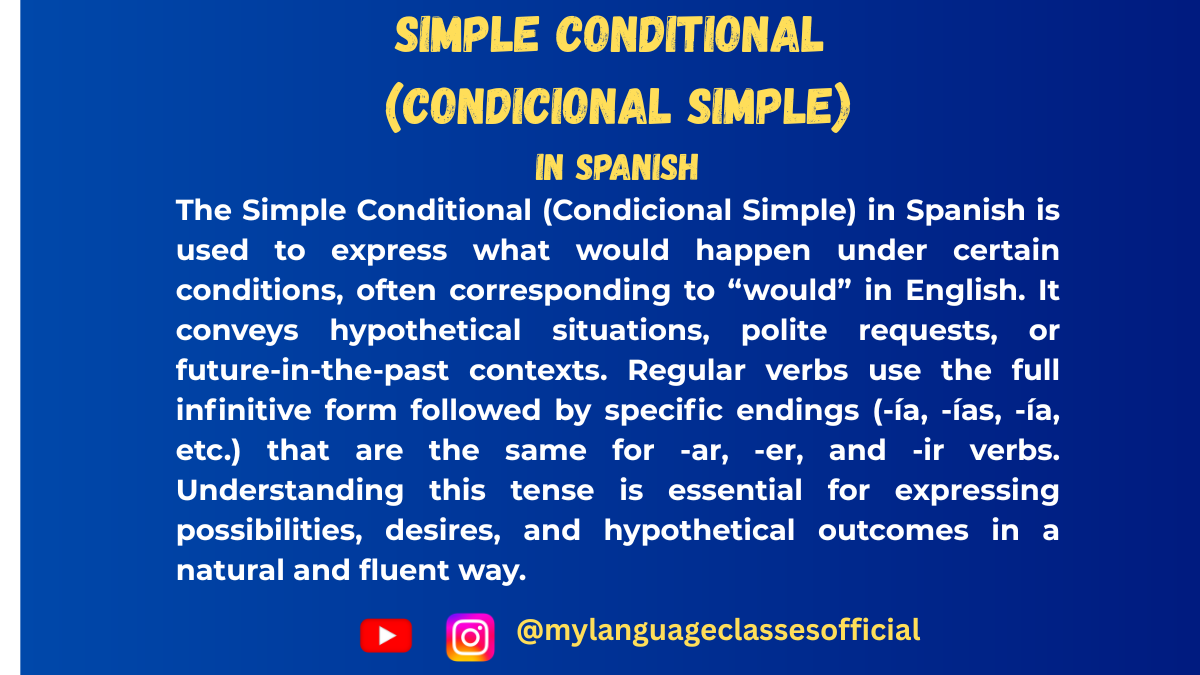
The Simple Conditional tense, known as “Condicional Simple” in Spanish, is used to express actions that would happen under certain conditions. It is equivalent to the English “would” form of verbs. This tense is commonly used to express hypothetical situations, polite requests, desires, and conjectures about the past. Understanding the Simple Conditional is essential for fluency in Spanish as it appears frequently in everyday conversations and formal writing.
Common Expressions Using Simple Conditional
Here are some common expressions that use the Simple Conditional tense in Spanish along with their meanings:
- Me gustaría – I would like
- Podrías ayudarme? – Could you help me?
- Deberías estudiar más. – You should study more.
- Sería mejor si… – It would be better if…
- Me encantaría ir contigo. – I would love to go with you.
- Habría sido un buen día. – It would have been a good day.
- Tendrías tiempo para hablar? – Would you have time to talk?
- Querría saber más sobre esto. – I would like to know more about this.
- Si fuera posible, viajaría por todo el mundo. – If it were possible, I would travel around the world.
- No harías eso, ¿verdad? – You wouldn’t do that, right?
Things to Keep in Mind
- Articles and Gender: As with other tenses in Spanish, the gender and number of nouns remain unchanged in the conditional tense.
- Pronouns: Indirect and direct object pronouns are placed before the conjugated verb.
- Regular vs. Irregular Verbs: While most verbs follow a predictable conjugation pattern, there are several irregular verbs that require memorization.
- Plural Forms: The conditional tense applies to singular and plural subjects without changing the verb stem.
- Politeness: This tense is commonly used for polite requests and suggestions.
When to Use
The Simple Conditional is used in the following situations:
- Hypothetical Situations:
- Si tuviera más dinero, compraría un coche. (If I had more money, I would buy a car.)
- Polite Requests:
- Podrías cerrar la ventana, por favor? (Could you close the window, please?)
- Suggestions and Advice:
- Deberías dormir más. (You should sleep more.)
- Desires and Preferences:
- Me encantaría visitar España. (I would love to visit Spain.)
- Speculation about the Past:
- Sería alrededor de las 8 cuando llegó. (It must have been around 8 when he arrived.)
Conjugation of Regular Verbs
To form the Simple Conditional tense, take the infinitive verb and add the following endings for all three verb categories (-AR, -ER, -IR):
| Subject | Ending |
|---|---|
| Yo | -ía |
| Tú | -ías |
| Él/Ella/Usted | -ía |
| Nosotros/as | -íamos |
| Vosotros/as | -íais |
| Ellos/Ellas/Ustedes | -ían |
Example of Regular Verb Conjugation:
- Hablar (to speak) → hablaría, hablarías, hablaría, hablaríamos, hablaríais, hablarían
- Comer (to eat) → comería, comerías, comería, comeríamos, comeríais, comerían
- Vivir (to live) → viviría, vivirías, viviría, viviríamos, viviríais, vivirían
Irregular Verbs and Their Conjugation
Some verbs have irregular stems in the Simple Conditional tense. Here are common irregular verbs:
| Infinitive | Stem Change | Example (Yo form) |
| Tener (to have) | tendr- | tendría |
| Poder (to be able to) | podr- | podría |
| Hacer (to do/make) | har- | haría |
| Decir (to say) | dir- | diría |
| Venir (to come) | vendr- | vendría |
| Poner (to put) | pondr- | pondría |
| Saber (to know) | sabr- | sabría |
| Salir (to leave) | saldr- | saldría |
| Querer (to want) | querr- | querría |
| Haber (to have – auxiliary) | habr- | habría |
Example Sentences:
- Tendría más tiempo si terminara mi trabajo temprano. (I would have more time if I finished my work early.)
- Diría la verdad si me preguntaras. (I would tell the truth if you asked me.)
Regular Verbs in Simple Conditional
| Verb | Meaning | Example 1 (Spanish) | Meaning (English) | Example 2 (Spanish) | Meaning (English) |
|---|---|---|---|---|---|
| Hablar | To speak | Hablaría con ella. | I would speak with her. | Hablaríamos sobre el tema. | We would talk about the topic. |
| Comer | To eat | Comeríamos en un restaurante. | We would eat in a restaurant. | Comería menos azúcar. | I would eat less sugar. |
| Vivir | To live | Viviríamos en España. | We would live in Spain. | Viviría en la playa. | I would live at the beach. |
| Trabajar | To work | Trabajaría más horas. | I would work more hours. | Trabajaríamos juntos. | We would work together. |
| Estudiar | To study | Estudiaría francés. | I would study French. | Estudiaríamos historia. | We would study history. |
| Viajar | To travel | Viajaría a México. | I would travel to Mexico. | Viajaríamos en verano. | We would travel in summer. |
| Escuchar | To listen | Escucharía música. | I would listen to music. | Escucharíamos el concierto. | We would listen to the concert. |
| Aprender | To learn | Aprendería a nadar. | I would learn to swim. | Aprenderíamos japonés. | We would learn Japanese. |
| Escribir | To write | Escribiría una carta. | I would write a letter. | Escribiríamos un libro. | We would write a book. |
| Comprar | To buy | Compraría un coche. | I would buy a car. | Compraríamos una casa. | We would buy a house. |
More Example Sentences
- Me encantaría viajar a Japón el próximo año. (I would love to travel to Japan next year.)
- Si tuvieras tiempo, iríamos al cine juntos. (If you had time, we would go to the movies together.)
- ¿Qué harías si fueras el presidente del país? (What would you do if you were the president of the country?)
- Juan dijo que llamaría más tarde. (Juan said he would call later.)
- En su lugar, yo no diría nada. (In his place, I wouldn’t say anything.)
- Mis abuelos vivirían en la playa si pudieran. (My grandparents would live at the beach if they could.)
- ¿Podrías ayudarme con esta tarea? (Could you help me with this homework?)
- Nosotros compraríamos una casa más grande si tuviéramos más dinero. (We would buy a bigger house if we had more money.)
- Ella nunca mentiría a sus amigos. (She would never lie to her friends.)
- Si hiciera sol, saldríamos a caminar. (If it were sunny, we would go for a walk.)
Fill in the Blanks:
- Si tuviera más dinero, ______ (comprar) un coche nuevo.
- ¿Qué ______ (hacer) tú si ganaras la lotería?
- Nosotros ______ (viajar) por todo el mundo si pudiéramos.
- Ella dijo que ______ (venir) a la fiesta, pero no pudo.
- En tu lugar, yo no ______ (decir) nada sobre el asunto.
- Mis padres me prometieron que me ______ (dar) un regalo especial para mi cumpleaños.
- Si fueras famoso, ¿con quién ______ (trabajar)?
- Ustedes ______ (poder) aprender español más rápido si practicaran todos los días.
- Juan ______ (querer) aprender otro idioma, pero no tiene tiempo.
- Si hiciera buen tiempo, nosotros ______ (salir) a pasear.
Answers
- compraría
- harías
- viajaríamos
- vendría
- diría
- darían
- trabajarías
- podrían
- querría
- saldríamos
Conclusion
Mastering the Simple Conditional tense in Spanish is crucial for expressing hypothetical situations, politeness, and speculations. By understanding its conjugations, irregular forms, and common expressions, you can enhance your fluency and confidence in Spanish conversations.
Happy learning! 😊

Vikas Kumar is the founder of My Language Classes, a language learning platform dedicated to helping learners develop practical communication skills in Spanish, Japanese, and English through comprehensive grammar guides, structured learning resources, books, and evidence-informed educational content.
At My Language Classes, we believe that successful language learning is built on clarity, consistency, meaningful practice, and a deep understanding of how languages work. Every article is carefully researched and created to simplify complex concepts, provide practical guidance, and help learners develop confidence through real-world communication.
Inspired by the principles behind How Language Learning Really Works, our mission is to make high-quality language learning accessible to learners around the world by providing accurate, trustworthy, and comprehensive resources that support lasting progress, lifelong learning, and meaningful communication.
Leave a Reply