
Spanish Conditional Tense (Condicional Simple)
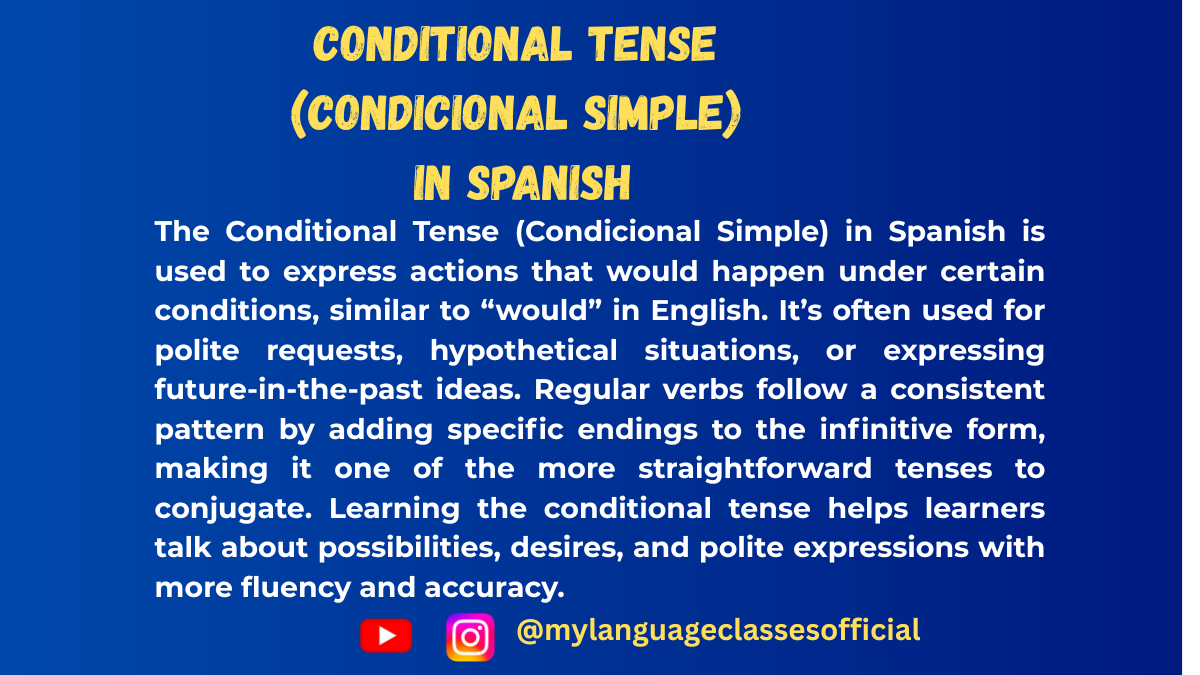
The Conditional tense in Spanish, also known as Condicional Simple, is essential for expressing hypothetical situations, polite requests, advice, or possibilities. It is equivalent to “would” in English and plays a crucial role in day-to-day conversations.
Situations Where Conditional Tense is Used
- Hypothetical Situations
Express unreal or imagined scenarios.
Example:- Si tuviera dinero, viajaría por el mundo.
(If I had money, I would travel the world.)
- Si tuviera dinero, viajaría por el mundo.
- Polite Requests
Used to make polite or formal requests.
Example:- ¿Podrías ayudarme con esto?
(Could you help me with this?)
- ¿Podrías ayudarme con esto?
- Suggestions and Advice
To give recommendations in a softer tone.
Example:- Yo que tú, estudiaría más.
(If I were you, I would study more.)
- Yo que tú, estudiaría más.
- Expressing Desires or Wishes
When talking about what one would like.
Example:- Me gustaría aprender a bailar salsa.
(I would like to learn how to dance salsa.)
- Me gustaría aprender a bailar salsa.
- Future in the Past
When talking about a future action from the perspective of the past.
Example:- Dijo que llamaría después.
(He said he would call later.)
- Dijo que llamaría después.
How to Form the Conditional Tense
1. Regular Verbs
The Conditional tense for regular verbs is formed by adding specific endings to the infinitive form of the verb. These endings are the same for all three conjugations (-ar, -er, -ir).
Endings:
-ía, -ías, -ía, -íamos, -íais, -ían
Examples:
- Hablar (to talk)
- Yo hablaría (I would talk)
- Tú hablarías (You would talk)
- Él/Ella/Usted hablaría (He/She/You would talk)
- Nosotros hablaríamos (We would talk)
- Vosotros hablaríais (You all would talk)
- Ellos/Ellas/Ustedes hablarían (They/You all would talk)
- Comer (to eat)
- Yo comería (I would eat)
- Vivir (to live)
- Yo viviría (I would live)
2. Irregular Verbs
Irregular verbs in the Conditional tense have stem changes, but they use the same endings as regular verbs.
Common Irregular Verbs:
| Infinitive | Stem Change | Conditional Form Example |
|---|---|---|
| Tener | Tendr- | Tendría (I would have) |
| Poder | Podr- | Podría (I could) |
| Venir | Vendr- | Vendría (I would come) |
| Decir | Dir- | Diría (I would say) |
| Hacer | Har- | Haría (I would do/make) |
| Querer | Querr- | Querría (I would want) |
| Saber | Sabr- | Sabría (I would know) |
Common Expressions in Conditional Tense
- Polite Phrases:
- ¿Podrías ayudarme? (Could you help me?)
- Me encantaría ir contigo. (I would love to go with you.)
- Suggestions:
- Deberías estudiar más. (You should study more.)
- Yo que tú, lo haría. (If I were you, I would do it.)
- Hypotheticals:
- Si fuera rico, viajaría mucho. (If I were rich, I would travel a lot.)
- ¿Qué harías en mi lugar? (What would you do in my place?)
- Future in the Past:
- Ella prometió que vendría temprano. (She promised she would come early.)
Key Considerations:
- Articles and Gender:
Ensure agreement between articles and nouns:- El coche sería rápido. (The car would be fast.)
- La casa estaría lista. (The house would be ready.)
- Plurality:
Match subjects and verbs in number:- Singular: Ella diría. (She would say.)
- Plural: Ellos dirían. (They would say.)
Practice Sentences
- Si tuviera más tiempo, leería más libros.
(If I had more time, I would read more books.) - Nos encantaría visitar España algún día.
(We would love to visit Spain someday.) - ¿Qué harías si ganaras la lotería?
(What would you do if you won the lottery?) - Yo en tu lugar, hablaría con el jefe.
(If I were you, I would talk to the boss.)
Mastering the Conditional tense in Spanish opens up a world of nuanced expression. With practice, you’ll be able to convey politeness, share hypotheticals, and provide advice effortlessly!

Vikas Kumar is the founder of My Language Classes, a language learning platform dedicated to helping learners develop practical communication skills in Spanish, Japanese, and English through comprehensive grammar guides, structured learning resources, books, and evidence-informed educational content.
At My Language Classes, we believe that successful language learning is built on clarity, consistency, meaningful practice, and a deep understanding of how languages work. Every article is carefully researched and created to simplify complex concepts, provide practical guidance, and help learners develop confidence through real-world communication.
Inspired by the principles behind How Language Learning Really Works, our mission is to make high-quality language learning accessible to learners around the world by providing accurate, trustworthy, and comprehensive resources that support lasting progress, lifelong learning, and meaningful communication.
Leave a Reply