

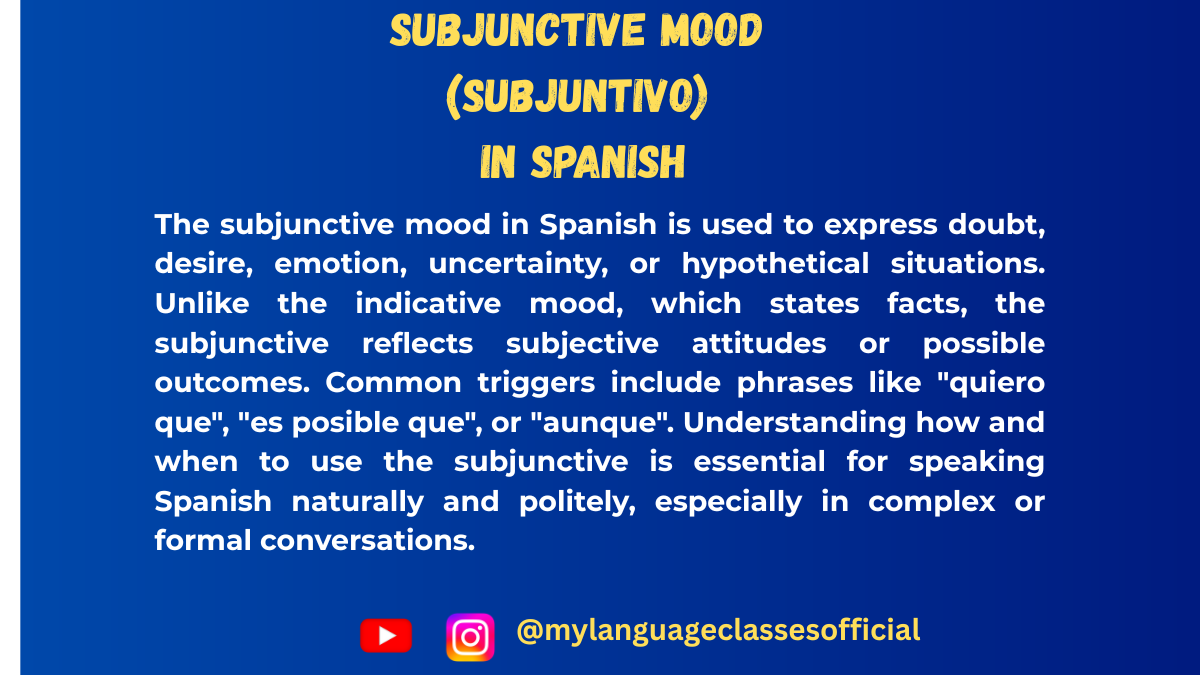
Understanding the Subjunctive Mood in Spanish
The subjunctive mood is one of the most challenging yet fascinating aspects of Spanish for learners. Unlike the indicative mood, which deals with facts, realities, and concrete statements, the subjunctive is used to express uncertainty, subjectivity, emotions, desires, hypothetical situations, and more. Mastering when to use the subjunctive mood is essential for sounding natural and fluent in Spanish.
Key Characteristics of the Subjunctive Mood
- Subjectivity and Uncertainty The subjunctive mood is used when the speaker expresses doubt, uncertainty, or subjectivity. It contrasts with the indicative, which conveys certainty and objective facts.
- Dependent on Context Subjunctive verbs often appear in subordinate clauses introduced by conjunctions like que (that). The verb in the main clause typically triggers the subjunctive in the subordinate clause.
Situations Where the Subjunctive Mood is Used
1. Wishes, Desires, and Requests
Use the subjunctive when expressing a wish or desire about someone or something else. Common verbs that trigger this usage include querer (to want), esperar (to hope), and desear (to wish).
- Example:
- Indicative: Quiero que tú vienes. (Incorrect)
- Subjunctive: Quiero que tú vengas. (I want you to come.)
Note: The subject in the main clause is different from the subject in the subordinate clause.
2. Emotions
When expressing feelings such as joy, sadness, surprise, or fear about something, the subjunctive is used.
- Example:
- Indicative: Me alegra que tienes tiempo. (Incorrect)
- Subjunctive: Me alegra que tengas tiempo. (I’m glad you have time.)
3. Doubt and Denial
The subjunctive is required when there is doubt, denial, or disbelief about an action or state. Verbs like dudar (to doubt) and negar (to deny) often signal this.
- Example:
- Indicative: Dudo que es verdad. (Incorrect)
- Subjunctive: Dudo que sea verdad. (I doubt it is true.)
Note: If there is no doubt, use the indicative:
- No dudo que es verdad. (I don’t doubt it’s true.)
4. Impersonal Expressions
Certain impersonal expressions followed by que require the subjunctive. These include expressions of necessity, possibility, or subjective judgment.
- Common expressions:
- Es importante que… (It’s important that…)
- Es posible que… (It’s possible that…)
- Es extraño que… (It’s strange that…)
- Example:
- Indicative: Es posible que él tiene razón. (Incorrect)
- Subjunctive: Es posible que él tenga razón. (It’s possible he’s right.)
5. Hypothetical Situations
Use the subjunctive to describe hypothetical or non-existent situations, especially in sentences starting with si (if).
- Example:
- Subjunctive: Si tuviera dinero, viajaría más. (If I had money, I would travel more.)
6. Conjunctions of Contingency and Purpose
The subjunctive follows certain conjunctions that imply purpose, condition, or a future action. These include:
- para que (so that)
- a menos que (unless)
- antes de que (before)
- Example:
- Indicative: Estudio para que puedo aprender. (Incorrect)
- Subjunctive: Estudio para que pueda aprender. (I study so that I can learn.)
7. Unrealized Actions
Use the subjunctive when the action hasn’t yet been completed or is anticipated.
- Example:
- Indicative: Cuando llegas, hablamos. (Incorrect)
- Subjunctive: Cuando llegues, hablaremos. (When you arrive, we’ll talk.)
Subjunctive vs. Indicative: A Quick Comparison
| Indicative | Subjunctive |
|---|---|
| Expresses certainty and facts. | Expresses doubt, subjectivity, or uncertainty. |
| Example: Sé que él viene. (I know he’s coming.) | Example: No creo que él venga. (I don’t think he’s coming.) |
Gender, Articles, and Agreement in Subjunctive Sentences
- Articles: Use definite articles (el, la, los, las) when referring to something specific and indefinite articles (un, una, unos, unas) for non-specific references.
- Example: Es importante que el profesor explique bien.
- Gender and Plurality: Adjectives and nouns in the subjunctive sentence must agree in gender and number.
- Example: Es raro que las niñas estén calladas. (It’s strange that the girls are quiet.)
- Pronoun Placement: Pronouns like me, te, lo, la, nos, os, los, las must be placed correctly depending on verb forms in subjunctive sentences.
Things to Keep in Mind
- Always pay attention to the trigger verb or expression in the main clause.
- The subjunctive is usually required when there’s a change in subject between clauses.
- Don’t confuse formal subjunctive structures with casual, everyday Spanish, which might omit the subjunctive in informal speech.
By understanding the situations where the subjunctive mood is required and practicing it in real-life contexts, you’ll be able to express yourself more naturally in Spanish. Remember, the subjunctive isn’t just a grammar rule—it’s a way of capturing the nuances of emotions, possibilities, and perspectives in communication!

Vikas Kumar is the founder of My Language Classes, a language learning platform dedicated to helping learners develop practical communication skills in Spanish, Japanese, and English through comprehensive grammar guides, structured learning resources, books, and evidence-informed educational content.
At My Language Classes, we believe that successful language learning is built on clarity, consistency, meaningful practice, and a deep understanding of how languages work. Every article is carefully researched and created to simplify complex concepts, provide practical guidance, and help learners develop confidence through real-world communication.
Inspired by the principles behind How Language Learning Really Works, our mission is to make high-quality language learning accessible to learners around the world by providing accurate, trustworthy, and comprehensive resources that support lasting progress, lifelong learning, and meaningful communication.
Leave a Reply