

How to Use Reflexive Verbs in Spanish: Rules, Examples & Exercises
“What are reflexive verbs in Spanish?” “How do I know when to use ‘me’ or ‘se’ with Spanish verbs?” If you’ve ever asked these questions while learning Spanish, you’re not alone. Reflexive verbs can feel tricky at first—but once you understand how they work, you’ll find they’re not only useful but also easy to master with a little practice.
In this complete beginner-to-advanced guide, you’ll learn exactly how reflexive verbs work in Spanish, why they’re used, and when to use pronouns like me, te, se, nos, and os. You’ll also see plenty of real-life examples, easy conjugation tables, common mistakes to avoid, and practice exercises to test your skills.
Whether you’re brushing up for travel, studying for an exam, or building your fluency, reflexive verbs are essential for everyday Spanish. From “me llamo” to “se despierta”, these verbs show how the action affects the subject—yourself or someone else.
👉 According to the Royal Spanish Academy (RAE), reflexive constructions are especially common in describing daily routines, emotions, and personal care—making them a must-know for real-world Spanish conversations.
So, what are we waiting for? Let’s jump into reflexive verbs and start making Spanish feel more natural, expressive, and fun!
What Are Reflexive Verbs in Spanish? Explanation and Overview
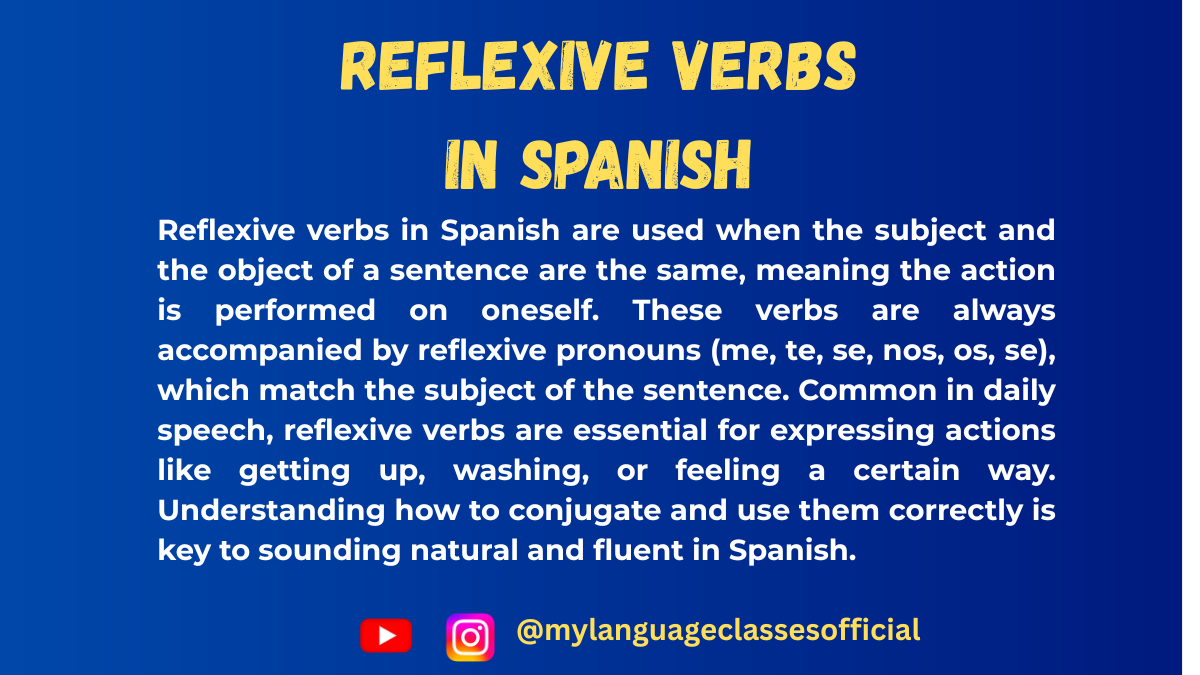
Reflexive verbs in Spanish are verbs that reflect the action back onto the subject. In simple terms, when someone does something to themselves, we use a reflexive verb.
For example:
- Me baño – I bathe myself
- Te despiertas – You wake yourself up
- Se peina – He/She combs their own hair
These verbs are used with reflexive pronouns (me, te, se, nos, os, se) to show that the subject and the object of the action are the same person.
✅ Key Definition:
A reflexive verb in Spanish is a verb that uses a reflexive pronoun to indicate that the subject performs and receives the action. In English, we often use “myself,” “yourself,” “himself,” etc., but Spanish has its own special system.
🧠 Why Are They Called “Reflexive”?
Think of a mirror. When you look in it, the image reflects back at you. Reflexive verbs work the same way—the action reflects back to the one doing it. The subject is doing something to themselves, not to someone else.
🔁 Reflexive Verb vs. Regular Verb
Let’s compare:
| Verb | Regular Usage | Reflexive Usage |
|---|---|---|
| lavar (to wash) | Lavo el coche – I wash the car | Me lavo las manos – I wash my hands (myself) |
| despertar (to wake up) | Despierto al niño – I wake the child | Me despierto temprano – I wake up early |
| vestir (to dress) | Visto al bebé – I dress the baby | Me visto rápido – I dress myself quickly |
See the difference? Reflexive verbs are about your own actions—what you do to yourself or how you feel.
📌 Common Reflexive Pronouns (You’ll Use These a Lot!):
| Subject | Pronoun | Example |
|---|---|---|
| yo | me | me ducho (I shower) |
| tú | te | te cepillas (you brush) |
| él / ella / usted | se | se levanta (he/she/you get up) |
| nosotros / nosotras | nos | nos acostamos (we go to bed) |
| vosotros / vosotras | os | os peináis (you all comb) |
| ellos / ellas / ustedes | se | se enojan (they/you all get angry) |
🧩 What Makes a Verb Reflexive?
Look for the “se” at the end of the infinitive form:
- levantarse – to get up
- ducharse – to shower
- sentirse – to feel
- llamarse – to be called
These are not just regular verbs—they’re reflexive because they end in -se, and that little se makes a big difference.
💡 Reflexive Verbs Are Often Used for:
- Daily routines: me despierto, me visto, me acuesto
- Emotions and feelings: me siento, se enoja, nos alegramos
- Changes of state: me enfermo, se cansa, te aburres
- Accidental or unexpected actions: se cayó, se rompió
You’ll see these verbs constantly in conversations, books, and media—so it’s important to get comfortable using them.
Everyday Sentences Using Reflexive Verbs in Spanish: 10 Common Examples
Learning reflexive verbs becomes much easier when you see them in action. These are real-life, everyday sentences that Spanish speakers use all the time. Whether you’re talking about your morning routine or expressing how you feel, reflexive verbs are a big part of natural Spanish conversations.
Below are 10 common reflexive verb sentences used in daily life, with English translations and notes to help you understand the structure and meaning.
✅ 10 Real-Life Reflexive Verb Examples
- Me levanto a las seis de la mañana.
I get up at six in the morning.
➤ Action: You’re getting yourself up. - Te cepillas los dientes después del desayuno.
You brush your teeth after breakfast.
➤ Using “te” to show the subject is you (tú). - Se ducha antes de ir al trabajo.
He/She showers before going to work.
➤ “Se” marks it as reflexive for él/ella/usted. - Nos acostamos temprano entre semana.
We go to bed early during the week.
➤ Common in family or roommate conversations. - ¿A qué hora os levantáis los domingos?
What time do you all get up on Sundays?
➤ In Spain, “os” is used with vosotros (you all). - Se enojan cuando no los escuchan.
They get angry when they’re not listened to.
➤ Reflexive verbs can express emotional reactions. - Me siento feliz hoy.
I feel happy today.
➤ “Sentirse” is a go-to verb for emotions. - ¿Cómo te llamas?
What’s your name?
➤ Literally: How do you call yourself? (Common greeting!) - Mi hermana se maquilla cada mañana.
My sister puts on makeup every morning.
➤ Self-care routines often use reflexive forms. - Nos divertimos mucho en la fiesta.
We had a lot of fun at the party.
➤ “Divertirse” means to enjoy oneself.
🔍 Language Tip:
Notice that many of these reflexive verbs are linked to personal routines, feelings, and daily habits. These are the types of verbs you’ll use every single day while speaking Spanish.
When learning Spanish, mastering this set of everyday reflexive verbs will help you speak more naturally and sound more fluent in casual conversations.
When to Use Reflexive Verbs in Spanish: All the Key Situations
Knowing when to use reflexive verbs in Spanish is just as important as knowing how to use them. Reflexive verbs aren’t random—they appear in specific, repeated situations across daily life. Once you learn these, you’ll start spotting reflexive patterns everywhere!
Below are the most common situations where reflexive verbs are naturally used in Spanish. Think of these like reflexive “zones”—any time you’re in one of them, it’s likely you’ll need a reflexive verb.
✅ 1. Daily Routines and Self-Care Activities
Spanish reflexive verbs are essential when talking about things you do to yourself, like getting ready or taking care of your body.
Examples:
- Me despierto – I wake (myself) up
- Te duchas – You shower
- Se afeita – He shaves
- Nos vestimos – We get dressed
✅ 2. Personal Emotions and Feelings
Feelings are often described with reflexive verbs, especially when the emotion is happening within the person.
Examples:
- Me siento cansado – I feel tired
- Se enoja fácilmente – He/She gets angry easily
- Nos alegramos de verte – We’re glad to see you
✅ 3. Physical or Mental State Changes
Whenever there’s a change in your condition, whether physical or emotional, reflexive verbs are used.
Examples:
- Me enfermé – I got sick
- Te cansaste – You got tired
- Se deprimió – He/She became depressed
✅ 4. Reciprocal Actions (Doing Something to Each Other)
In plural subjects, reflexive verbs can show actions that are shared between two or more people.
Examples:
- Nos abrazamos – We hug each other
- Se besaron – They kissed each other
- Os peleáis mucho – You all fight a lot (Spain)
✅ 5. Talking About Accidents or Unintentional Actions
Reflexive forms are often used to show that something happened accidentally or unexpectedly—a very natural way of saying things in Spanish.
Examples:
- Se me cayó el vaso – The glass fell (on me / from me)
- Se rompió el celular – The phone broke (itself)
- Se perdió la llave – The key got lost
✅ 6. Describing Identity or Personal Names
One of the most common reflexive expressions: “¿Cómo te llamas?”
Examples:
- Me llamo Ana – My name is Ana (lit. I call myself Ana)
- Se llama Carlos – His name is Carlos
✅ 7. Reflexive Verbs with Idiomatic Meanings
Some verbs change meaning when used reflexively. These aren’t just self-actions—they carry unique meanings.
Examples:
- Ir (to go) → Irse (to leave, to go away)
➤ Me voy – I’m leaving - Dormir (to sleep) → Dormirse (to fall asleep)
➤ Se durmió – He fell asleep - Quedar (to remain) → Quedarse (to stay)
➤ Me quedo en casa – I’m staying at home
💬 If you’re asking:
- “When do I use reflexive verbs in Spanish?”
- “Do I need ‘me’ or ‘se’ in this sentence?”
👉 Use reflexive verbs when the subject does something to themselves, feels something internally, experiences a change, or acts reciprocally with others.
These verbs bring clarity, emotion, and personal meaning to your Spanish—and using them right will instantly level up your communication skills.
Reflexive Verb Conjugation Rules: Beginner-Friendly Tables and Logic
Reflexive verbs follow the same basic conjugation rules as regular Spanish verbs—but with one key difference: you always include a reflexive pronoun that matches the subject.
To master reflexive verb conjugation, you need to know two things:
- How to conjugate the verb itself
- Which reflexive pronoun to use
Let’s break it down step by step. Don’t worry—it’s easier than it sounds!
✅ Step 1: Know Your Reflexive Pronouns
These come before the conjugated verb (except when using infinitives or gerunds — more on that soon).
| Subject Pronoun | Reflexive Pronoun | Example |
|---|---|---|
| yo | me | me baño (I bathe myself) |
| tú | te | te levantas (You get up) |
| él / ella / usted | se | se viste (He/She/You get dressed) |
| nosotros / nosotras | nos | nos acostamos (We go to bed) |
| vosotros / vosotras | os | os ducháis (You all shower) |
| ellos / ellas / ustedes | se | se peinan (They/You all comb their hair) |
✅ Step 2: Remove the “-se” Ending from the Infinitive
When a verb ends in -se, it’s reflexive.
Examples:
- levantarse → levantar
- ducharse → duchar
- afeitarse → afeitar
You’ll conjugate the verb as normal, then add the matching reflexive pronoun.
✅ Step 3: Conjugate the Verb in the Desired Tense
Let’s see how it works in the Present Tense with three common reflexive verbs:
🌞 Example 1: Levantarse (to get up)
| Subject | Reflexive Form |
|---|---|
| yo | me levanto |
| tú | te levantas |
| él/ella/usted | se levanta |
| nosotros/nosotras | nos levantamos |
| vosotros/vosotras | os levantáis |
| ellos/ellas/ustedes | se levantan |
🌞 Example 2: Ducharse (to shower)
| Subject | Reflexive Form |
|---|---|
| yo | me ducho |
| tú | te duchas |
| él/ella/usted | se ducha |
| nosotros/nosotras | nos duchamos |
| vosotros/vosotras | os ducháis |
| ellos/ellas/ustedes | se duchan |
🌞 Example 3: Sentirse (to feel) – Stem-Changing Verb (e → ie)
| Subject | Reflexive Form |
|---|---|
| yo | me siento |
| tú | te sientes |
| él/ella/usted | se siente |
| nosotros/nosotras | nos sentimos |
| vosotros/vosotras | os sentís |
| ellos/ellas/ustedes | se sienten |
🧠 Note: With stem-changing verbs like sentirse, the change applies inside the verb, but the pronoun stays the same.
🧭 Where Do Reflexive Pronouns Go?
Here’s a quick guide:
- Before the conjugated verb:
- Me levanto temprano. (I get up early.)
- Attached to the end of an infinitive:
- Voy a levantarme temprano. (I’m going to get up early.)
- Attached to the end of a gerund (with accent):
- Estoy levantándome ahora. (I’m getting up now.)
- Attached to commands (affirmative):
- ¡Levántate! (Get up!)
⚠️ Tip for Learners:
Start by practicing daily routine verbs in the present tense. These are the most common reflexive verbs, and getting used to their pattern will help you feel confident as you move into other tenses later (like preterite or future).
Reflexive Verbs Grammar Rules You Need to Know
When it comes to using reflexive verbs in Spanish correctly, it’s not just about memorizing conjugations—you also need to understand the grammar rules behind them. These rules help you avoid mistakes and speak more naturally.
Below are the essential grammar rules every learner should know when using reflexive verbs in Spanish—explained in a clear, simple way.
✅ Rule #1: The Subject and Object Must Be the Same Person
Reflexive verbs are only used when the subject does the action to themselves.
- ✅ Correct: Me lavo las manos. (I wash my hands.) → I’m doing it to myself.
- ❌ Incorrect: Lavo las manos a mi hermano. → This is not reflexive because I’m washing someone else’s hands.
✅ Rule #2: Reflexive Pronouns Always Match the Subject
Each subject pronoun has a specific reflexive pronoun that goes with it. They must match in both person and number.
| Subject | Reflexive Pronoun |
|---|---|
| yo | me |
| tú | te |
| él/ella/usted | se |
| nosotros/nosotras | nos |
| vosotros/vosotras | os |
| ellos/ellas/ustedes | se |
🧠 Tip: Mixing them up is one of the most common beginner errors—make sure they always match!
✅ Rule #3: Reflexive Pronouns Go Before the Verb (Usually)
In most cases, the reflexive pronoun goes directly before the conjugated verb:
- Me despierto temprano.
- Se viste rápidamente.
However, they can also be attached to the end of:
- Infinitives: Voy a vestirme.
- Gerunds: Estoy vistiéndome.
- Affirmative commands: ¡Lávate las manos!
But with negative commands, they go before the verb:
- ¡No te vayas! (Don’t leave!)
- No se preocupe. (Don’t worry.)
✅ Rule #4: Reflexive Verbs Can Be Used Idiomatically
Some reflexive verbs don’t seem reflexive in English, but they are in Spanish due to idiomatic use or emotion-related meaning.
Examples:
- Me voy. – I’m leaving.
- Se queja mucho. – He/She complains a lot.
- Me doy cuenta. – I realize.
These don’t always involve “self-action,” but they follow the reflexive pattern grammatically.
✅ Rule #5: Use Definite Articles with Reflexive Verbs
Unlike English, which uses possessives (“my hands,” “your face”), Spanish often uses definite articles with reflexive verbs:
- ✅ Me lavo las manos. (I wash my hands.)
- ❌ Me lavo mis manos.
This is one of the most important grammar differences between English and Spanish reflexive use.
✅ Rule #6: Some Verbs Change Meaning When Used Reflexively
Spanish verbs often mean something different in reflexive form.
| Non-Reflexive | Reflexive |
|---|---|
| Dormir – to sleep | Dormirse – to fall asleep |
| Ir – to go | Irse – to leave |
| Llevar – to carry | Llevarse – to take away |
| Quedar – to remain | Quedarse – to stay |
💡 Example:
- Voy al parque. – I’m going to the park.
- Me voy. – I’m leaving (going away).
✅ Rule #7: Reflexive Verbs Can Be Reciprocal
In plural forms, reflexive verbs can describe shared actions between people.
Examples:
- Nos abrazamos – We hug each other.
- Se escriben cartas – They write letters to each other.
- Os peleáis mucho – You all fight a lot. (Spain)
These are grammatically reflexive but conceptually reciprocal.
✅ Rule #8: Use With “a” for Emphasis or Clarity
In third-person forms, especially with se, we often add “a + person” for clarity.
Example:
- Se peina Juan. → Juan combs his own hair.
- Se peinan las niñas. → The girls comb their hair.
You can also say:
- Juan se peina a sí mismo. – Juan combs himself. (for emphasis)
✅ Quick Recap of Key Reflexive Grammar Rules:
- Use reflexive verbs when the subject = object.
- Pronouns must match the subject.
- Pronouns go before the verb, except in infinitives/commands.
- Use definite articles, not possessives.
- Learn the verbs that change meaning in reflexive form.
- Reflexives can also be reciprocal.
Important Tips for Using Reflexive Verbs Correctly
Now that you know the rules, it’s time to sharpen your instincts with practical tips and real learner insights. These are the small things that make a big difference—things most Spanish learners miss, but native speakers use naturally.
These tips go beyond the basics and will help you:
- Sound more fluent
- Avoid awkward phrasing
- Understand Spanish the way native speakers actually use it
Let’s explore the subtle tricks and expert-backed strategies that will make reflexive verbs second nature to you.
✅ Tip #1: Many Reflexive Verbs Are Used Without “Self” in English
In English, we often skip the word “myself,” “yourself,” etc., but in Spanish, the reflexive structure still applies.
Examples:
- Me ducho = “I shower” (not “I shower myself”)
- Se sienta = “He sits down” (not “He sits himself”)
👉 So don’t wait for English clues—Spanish requires reflexive form even when English doesn’t.
✅ Tip #2: Reflexive Verbs Are Often Used in Instructions and Schedules
When giving daily instructions (like in classrooms, parenting, or routines), Spanish prefers reflexive verbs.
Examples:
- Acuéstate temprano. – Go to bed early.
- Despiértense a las siete. – Wake up at seven.
💡 These are especially common in school settings, yoga classes, or any kind of routine guidance.
✅ Tip #3: Some Reflexive Verbs Show a Shift in Focus, Not Just Action
In some cases, reflexive verbs create a change in perspective or emphasis, making the action feel more personal or internal.
Examples:
- Comer (to eat) vs. Comerse (to eat up / finish everything)
➤ Se comió todo el pastel. – He ate the entire cake. - Beber vs. Beberse
➤ Me bebí el café. – I drank up the coffee (completely).
🎯 Using the reflexive adds intensity or completeness to the action.
✅ Tip #4: Some Verbs Are Always Reflexive—No Non-Reflexive Form Exists
Not every reflexive verb has a matching non-reflexive version.
Examples:
- Quejarse – to complain
- Arrepentirse – to regret
- Atreverse – to dare
You can’t say “quejar” or “arrepentir” by themselves in Spanish—it just doesn’t exist without the reflexive form.
📘 According to academic guides (like the Real Academia Española), these verbs are inherently reflexive.
✅ Tip #5: Use Reflexive Constructions to Sound More Natural and Emotionally Rich
In casual and expressive Spanish, native speakers use reflexive structures to make emotional connections.
Examples:
- ¡Me muero de risa! – I’m dying of laughter!
- Se volvió loco. – He went crazy.
- Nos quedamos sin palabras. – We were speechless.
These expressions feel intensely human and help your Spanish sound less robotic and more alive.
✅ Tip #6: Spanish Often Uses Reflexives to Show Respect or Formality
In formal speech, especially with usted, reflexives are often used in a more gentle or respectful tone.
Examples:
- ¿Cómo se siente hoy? – How are you feeling today?
- ¿Se ha preparado para la reunión? – Have you prepared for the meeting?
🗣️ This is especially important in customer service, medicine, and polite conversation.
✅ Tip #7: Don’t Rely on Direct Translations—Learn Reflexive Expressions As They Are
Trying to translate reflexive verbs word-for-word from English can confuse you. Instead, memorize common reflexive expressions as complete phrases.
Examples:
- Me doy cuenta = I realize (NOT “I give myself account”)
- Se trata de… = It’s about…
- Me cae bien/mal = I like/dislike someone (personality-wise)
✅ Learning phrases as chunks will help you speak more naturally and avoid translation traps.
These advanced usage tips will push your reflexive verb skills to the next level—and help you sound more like a confident Spanish speaker, not just a learner.
Common Mistakes with Reflexive Verbs and How to Fix Them
Even intermediate and advanced Spanish learners make mistakes with reflexive verbs. Why? Because they often seem simple—but reflexive verbs behave differently than regular verbs in structure, meaning, and tone.
Below are the most frequent reflexive verb mistakes, with clear examples and quick fixes to make your Spanish cleaner, clearer, and more confident.
❌ Mistake #1: Forgetting the Reflexive Pronoun Altogether
Many learners conjugate the verb but forget to add the reflexive pronoun.
Wrong: Levanto a las siete.
Right: Me levanto a las siete. (I get up at 7)
💡 Fix: Always double-check that your sentence includes both the verb and the correct reflexive pronoun.
❌ Mistake #2: Placing the Reflexive Pronoun in the Wrong Position
Incorrect pronoun placement is a very common error—especially with infinitives, gerunds, and commands.
Wrong: Voy me a duchar.
Right: Voy a ducharme. (I’m going to shower)
Wrong: Dúchate te ahora.
Right: Dúchate ahora. (Shower now)
💡 Fix: When using infinitives or affirmative commands, attach the pronoun to the end of the verb.
❌ Mistake #3: Using Possessive Adjectives Instead of Definite Articles
This error is often made by English speakers who try to say “my hands,” “your face,” etc., the same way as in English.
Wrong: Me lavo mis manos.
Right: Me lavo las manos. (I wash my hands)
💡 Fix: Use definite articles (el, la, los, las) with body parts and clothing after reflexive verbs—not possessives.
❌ Mistake #4: Making a Verb Reflexive When It Shouldn’t Be
Sometimes learners add a reflexive pronoun where it’s not needed, especially with verbs that already have a direct object.
Wrong: Me llamo mi amigo Pedro.
Right: Llamo a mi amigo Pedro. (I’m calling my friend Pedro)
💡 Fix: If the action is directed at someone else, don’t use a reflexive pronoun.
❌ Mistake #5: Overusing Reflexive Verbs in Translations
Trying to translate everything directly from English leads to odd or incorrect use of reflexives.
Wrong: Se piensa mucho sobre eso.
Right: Se reflexiona mucho sobre eso. OR Se considera mucho eso.
💡 Fix: Don’t assume English expressions with “oneself” always require a reflexive in Spanish. Choose verbs commonly used in context, not by logic alone.
❌ Mistake #6: Using Reflexive Verbs Without Clarifying the Subject
In third person, “se” can refer to he, she, they, or you (formal)—so failing to clarify the subject can lead to confusion.
Unclear: Se fue.
(Who? He? She? You? They?)
Clear: Mi hermano se fue. (My brother left.)
Also Clear: Usted se fue temprano. (You left early.)
💡 Fix: When the subject isn’t obvious, add a name or noun for clarity.
❌ Mistake #7: Forgetting Subject-Verb Agreement in Plural Forms
When reflexive verbs are used in plural (like nos or se), the verb still needs to agree with the subject.
Wrong: Nos levanta a las seis.
Right: Nos levantamos a las seis. (We get up at 6)
💡 Fix: Reflexive pronouns change, but the verb still needs correct person/number conjugation.
❌ Mistake #8: Using Reflexives Too Literally
Sometimes learners overanalyze reflexive verbs and try to find a one-to-one match in English.
For example:
- Me voy doesn’t mean “I go myself”—it means “I’m leaving.”
- Se trata de doesn’t mean “It treats itself”—it means “It’s about…”
💡 Fix: Memorize common reflexive expressions as phrases, not word-by-word definitions.
Fixing these small errors will make your Spanish sound clearer, smarter, and more native-like. You’ll be amazed how much smoother your sentences flow once these slip-ups are gone.
20 Reflexive Verb Example Sentences for Better Understanding
To truly internalize reflexive verbs, you need to see them in context. Below are 20 practical, easy-to-understand example sentences using reflexive verbs in Spanish, each paired with an English translation.
These examples cover:
- Daily activities
- Emotions
- Idiomatic phrases
- Common real-life situations
Each sentence helps you build your instinct for when and how reflexive verbs are used.
✅ Daily Routines & Habits
- Me levanto a las siete todos los días.
I get up at seven every day. - Te cepillas los dientes después de comer.
You brush your teeth after eating. - Se ducha antes de ir al trabajo.
He/She showers before going to work. - Nos vestimos rápido los lunes.
We get dressed quickly on Mondays. - ¿A qué hora os acostáis?
What time do you all go to bed? (Spain)
✅ Emotions & Feelings
- Me siento muy cansado hoy.
I feel very tired today. - Se enojan cuando pierden el partido.
They get angry when they lose the game. - Nos alegramos de verte.
We’re happy to see you. - ¿Te aburres en clase?
Do you get bored in class? - Se emociona fácilmente con las películas.
He/She gets emotional easily with movies.
✅ Unexpected or Involuntary Actions
- Se cayó por las escaleras.
He/She fell down the stairs. - Se me rompió el vaso.
I broke the glass (accidentally). - Nos perdimos en el bosque.
We got lost in the forest. - ¿Se durmieron en la reunión?
Did they fall asleep in the meeting? - Me olvidé de llamarte.
I forgot to call you.
✅ Idiomatic & Natural Phrases
- Me llamo Juan.
My name is Juan. (Lit: I call myself Juan) - Se fue sin decir nada.
He/She left without saying anything. - Nos llevamos muy bien con ellos.
We get along very well with them. - ¿Te das cuenta del problema?
Do you realize the problem? - Me quedo en casa hoy.
I’m staying at home today.
Reflexive Verbs Fill-in-the-Blank Exercise: Test Your Knowledge
Ready to check how much you’ve learned? Below are 20 fill-in-the-blank questions using reflexive verbs. These cover present tense, routine activities, and emotions, and are perfect for beginner to intermediate learners.
👉 Your task: Fill in the correct reflexive pronoun and conjugated verb form.
Make sure the subject, pronoun, and verb form all agree!
📝 Reflexive Verb Practice Questions
- Yo siempre __________ (levantarse) temprano los domingos.
- ¿Tú __________ (ducharse) por la mañana o por la noche?
- Mi hermana __________ (maquillarse) antes de salir.
- Nosotros __________ (divertirse) mucho en las fiestas.
- Ellos __________ (acostarse) tarde los sábados.
- ¿A qué hora __________ (despertarse) ustedes?
- Vosotros __________ (afeitarse) con máquina eléctrica.
- Yo __________ (sentirse) cansado después de correr.
- ¿Tú __________ (llamarse) Ana o Andrea?
- Los niños __________ (vestirse) solos.
- Clara y yo __________ (verse) en la cafetería.
- El gato __________ (limpiarse) después de comer.
- Nosotros __________ (enojarse) cuando hay mucho ruido.
- Ellas siempre __________ (irse) antes de que empiece la clase.
- ¿Por qué no __________ (lavarse) las manos antes de comer?
- Yo nunca __________ (olvidarse) de hacer la tarea.
- Tú __________ (peinarse) muy rápido.
- ¿Ustedes __________ (quedarse) en casa durante el fin de semana?
- Juan __________ (dormirse) en clase otra vez.
- Los estudiantes __________ (prepararse) bien para el examen.
Check Your Answers for the Reflexive Verb Exercise
Below are the correct answers to each of the 20 fill-in-the-blank reflexive verb questions. Each sentence includes the properly conjugated verb and the reflexive pronoun that matches the subject.
✅ Bold text highlights the correct verb forms and reflexive pronouns.
✅ Answer Key
- Yo siempre me levanto temprano los domingos.
- ¿Tú te duchas por la mañana o por la noche?
- Mi hermana se maquilla antes de salir.
- Nosotros nos divertimos mucho en las fiestas.
- Ellos se acuestan tarde los sábados.
- ¿A qué hora se despiertan ustedes?
- Vosotros os afeitáis con máquina eléctrica.
- Yo me siento cansado después de correr.
- ¿Tú te llamas Ana o Andrea?
- Los niños se visten solos.
- Clara y yo nos vemos en la cafetería.
- El gato se limpia después de comer.
- Nosotros nos enojamos cuando hay mucho ruido.
- Ellas siempre se van antes de que empiece la clase.
- ¿Por qué no te lavas las manos antes de comer?
- Yo nunca me olvido de hacer la tarea.
- Tú te peinas muy rápido.
- ¿Ustedes se quedan en casa durante el fin de semana?
- Juan se duerme en clase otra vez.
- Los estudiantes se preparan bien para el examen.
Frequently Asked Questions (FAQs) About Reflexive Verbs in Spanish
Reflexive verbs can feel tricky at first, especially because they’re not used the same way in English. Here are the most commonly asked learner questions—answered clearly and simply to boost your confidence.
❓1. How do I know if a verb is reflexive in Spanish?
You’ll know a verb is reflexive if its infinitive ends in -se, like levantarse, ducharse, or sentirse. This shows the action is done to oneself.
But remember, not all actions with “-se” are obvious in English, so check a reliable dictionary or grammar guide to confirm.
❓2. What’s the difference between “duchar” and “ducharse”?
- Duchar means “to shower someone else.”
➤ Yo ducho al bebé. – I shower the baby. - Ducharse means “to shower oneself.”
➤ Yo me ducho. – I shower (myself).
💡 If the subject and object are the same, use the reflexive form.
❓3. Can all Spanish verbs be reflexive?
Not all verbs, but many can be used both ways depending on context.
Examples:
- Llamar (to call someone) vs. llamarse (to call oneself = to be named)
- Ir (to go) vs. irse (to go away / to leave)
Some verbs are always reflexive, like:
- Quejarse (to complain)
- Arrepentirse (to regret)
❓4. Where should I place the reflexive pronoun in a sentence?
✅ Before a conjugated verb:
- Me despierto temprano.
✅ Attached to an infinitive:
- Voy a ducharme.
✅ Attached to a gerund (add an accent):
- Estoy duchándome.
✅ Attached to affirmative commands:
- ¡Lávate las manos!
✅ Before negative commands:
- ¡No te vayas!
❓5. Why is it “me lavo las manos” and not “me lavo mis manos”?
In Spanish, body parts and clothes with reflexive verbs use definite articles (el, la, los, las), not possessives.
Correct: Me lavo las manos.
Incorrect: Me lavo mis manos.
🧠 Think: The “me” already shows whose hands they are, so no need for “mis.”
❓6. What if I forget the reflexive pronoun—is it still correct?
No. Leaving out the pronoun changes the meaning or makes the sentence incomplete.
- Levanto a las seis → “I lift at six” (What are you lifting?)
- Me levanto a las seis → “I get up at six” ✅
💡 Always include the correct reflexive pronoun with reflexive verbs.
❓7. How do I know when a reflexive verb is used reciprocally?
Reciprocal actions happen when two or more people do something to each other. It usually occurs with plural subjects (nos, os, se).
Examples:
- Nos abrazamos – We hug each other.
- Se escriben todos los días – They write to each other.
✅ Context usually shows whether the action is reciprocal or truly reflexive.
❓8. Can reflexive verbs be used in all tenses?
Yes! Reflexive verbs can be used in any tense (present, past, future, subjunctive, etc.)—just remember to adjust both the verb and the pronoun.
Examples:
- Present: Me levanto.
- Preterite: Me levanté.
- Future: Me levantaré.
- Subjunctive: Espero que te levantes temprano.
❓9. Can I use two pronouns together—like “me lo”?
Yes, but that’s for when a reflexive verb is combined with an object pronoun.
Example:
- Me lo compré. – I bought it for myself.
➤ “me” = reflexive (for myself)
➤ “lo” = the thing I bought
💡 These structures follow special rules (called double object pronouns)—learn them once you’re comfortable with basic reflexives.
❓10. Why do some reflexive verbs seem emotional or idiomatic?
Because in Spanish, reflexive verbs often express:
- emotional changes (enojarse, ponerse triste)
- internal processes (sentirse, darse cuenta)
- natural transitions (irse, quedarse, dormirse)
English often uses adjectives or helper verbs instead, which is why the Spanish forms feel more personal or expressive.
✅ Final Tip for FAQs:
When in doubt, ask yourself:
👉 “Is the subject doing the action to themselves?”
👉 “Would a native speaker include ‘me’, ‘te’, or ‘se’ here?”
👉 “Does the verb carry a different meaning when reflexive?”
Reflexive verbs are a powerful part of Spanish—you’ll use them daily, so the better you understand them, the more fluent and confident you’ll become.
Key Takeaways: Reflexive Verbs Summary and Important Points
- Reflexive verbs show that the subject and the object are the same person.
- They always include a reflexive pronoun: me, te, se, nos, os, se.
- Reflexive verbs are marked with -se at the end of the infinitive (e.g., levantarse).
- The reflexive pronoun usually comes before the conjugated verb.
- For infinitives, gerunds, and affirmative commands, attach the pronoun to the end of the verb.
- Use definite articles (not possessives) with body parts and clothing.
- Some verbs are always reflexive (quejarse, arrepentirse), while others change meaning when used reflexively (irse, quedarse, dormirse).
- Reflexive verbs can also express emotions, idiomatic actions, or reciprocal interactions between people.
- Proper subject–pronoun–verb agreement is key to using reflexive verbs correctly.
- Common errors include forgetting the pronoun, using incorrect placement, or adding reflexives where they don’t belong.
Conclusion: Mastering Reflexive Verbs in Spanish | My Language Classes
Reflexive verbs are one of the most essential and commonly used parts of Spanish grammar. From daily routines like me levanto (I get up) to emotional expressions like me siento bien (I feel good), they help you speak more personally, naturally, and fluently.
By understanding how reflexive verbs work—where to place the pronouns, how to conjugate them, and when to use them—you unlock a whole new layer of real Spanish communication.
Whether you’re a beginner just learning llamarse or an advanced learner refining idiomatic uses like darse cuenta, this guide gives you everything you need to grow with confidence.

Vikas Kumar is the founder of My Language Classes, a language learning platform dedicated to helping learners develop practical communication skills in Spanish, Japanese, and English through comprehensive grammar guides, structured learning resources, books, and evidence-informed educational content.
At My Language Classes, we believe that successful language learning is built on clarity, consistency, meaningful practice, and a deep understanding of how languages work. Every article is carefully researched and created to simplify complex concepts, provide practical guidance, and help learners develop confidence through real-world communication.
Inspired by the principles behind How Language Learning Really Works, our mission is to make high-quality language learning accessible to learners around the world by providing accurate, trustworthy, and comprehensive resources that support lasting progress, lifelong learning, and meaningful communication.
Leave a Reply