
Ser vs. Estar in Spanish
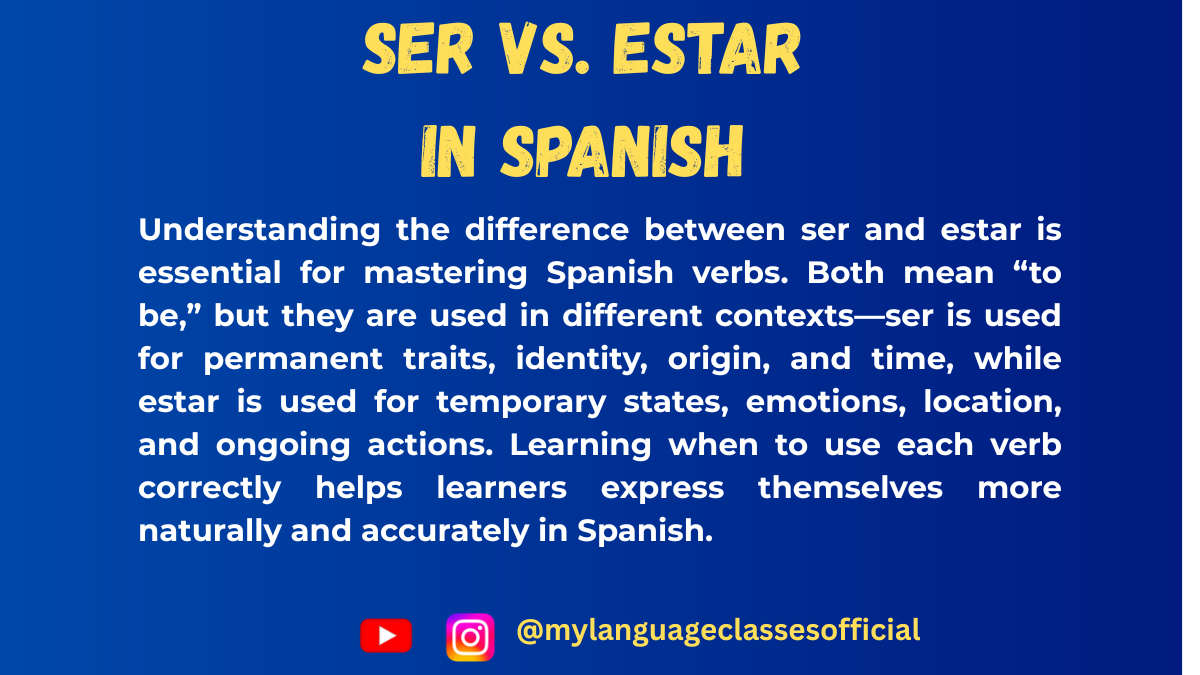
One of the first challenges for English speakers learning Spanish is understanding the difference between ser and estar, two verbs that both translate to “to be” in English. While they may seem interchangeable at first glance, their uses are distinct and crucial for speaking Spanish correctly.
Let’s dive into their differences, common expressions, and practical tips to master them.
The Core Difference
Ser
Ser is used to describe essential characteristics, identity, and things that are inherent or permanent.
Estar
Estar is used to describe temporary states, locations, and conditions.
When to Use Ser
- Identity & Characteristics
- To identify someone or something:
- Soy estudiante. (I am a student.)
- To describe physical or personality traits:
- Ella es alta y simpática. (She is tall and friendly.)
- To identify someone or something:
- Origin and Nationality
- To talk about where someone is from:
- Somos de México. (We are from Mexico.)
- To talk about where someone is from:
- Time and Dates
- For time expressions:
- Son las tres. (It is three o’clock.)
- For dates:
- Hoy es lunes. (Today is Monday.)
- For time expressions:
- Professions
- To state occupations:
- Él es doctor. (He is a doctor.)
- To state occupations:
- Possession
- To indicate ownership:
- Este libro es mío. (This book is mine.)
- To indicate ownership:
- Events
- To say where or when an event occurs:
- La reunión es en la oficina. (The meeting is in the office.)
- To say where or when an event occurs:
When to Use Estar
- Temporary States and Conditions
- To express emotions or physical conditions:
- Estoy feliz. (I am happy.)
- Ellos están cansados. (They are tired.)
- To express emotions or physical conditions:
- Location
- To describe where something or someone is (except events):
- El libro está en la mesa. (The book is on the table.)
- Estamos en casa. (We are at home.)
- To describe where something or someone is (except events):
- Ongoing Actions
- To form the present progressive:
- Estoy estudiando. (I am studying.)
- Están bailando. (They are dancing.)
- To form the present progressive:
- Result of Actions
- To indicate the result of a previous action:
- La ventana está abierta. (The window is open.)
- To indicate the result of a previous action:
Common Expressions Using Ser and Estar
Here’s a list of expressions frequently used in daily Spanish conversation:
Expressions with Ser
- Ser pan comido – To be a piece of cake (easy)
- Este examen es pan comido. (This exam is a piece of cake.)
- Ser un/a cabezota – To be stubborn
- Eres un cabezota. (You are stubborn.)
- Ser buena/mala gente – To be a good/bad person
- Mi abuela es buena gente. (My grandmother is a good person.)
- Ser el colmo – To be the last straw
- ¡Esto es el colmo! (This is the last straw!)
Expressions with Estar
- Estar de acuerdo – To agree
- ¿Estás de acuerdo? (Do you agree?)
- Estar en las nubes – To be daydreaming
- Hoy estás en las nubes. (Today you are daydreaming.)
- Estar de buen/mal humor – To be in a good/bad mood
- Estoy de buen humor. (I’m in a good mood.)
- Estar hasta las narices – To be fed up
- Estoy hasta las narices de esto. (I’m fed up with this.)
Tips for Mastering Ser and Estar
- Context is Key
Always ask yourself: Is this describing a permanent trait (ser) or a temporary state (estar)? - Gender and Plurality Agreement
Both ser and estar must agree with the subject in gender and number:- Ella es inteligente. (She is intelligent.)
- Ellos están contentos. (They are happy.)
- Articles and Adjectives
When describing something, ensure articles (e.g., el, la, los, las) and adjectives agree with the subject:- La casa es grande. (The house is big.)
- Las puertas están cerradas. (The doors are closed.)
- Practice Set Phrases
Memorizing idiomatic expressions with ser and estar will help you sound natural.
Example Sentences
- Ser
- Mi hermano es médico. (My brother is a doctor.)
- El cielo es azul. (The sky is blue.)
- Estar
- La comida está fría. (The food is cold.)
- Estoy en el parque. (I am in the park.)
By mastering the nuances of ser and estar, you’ll be able to express yourself with clarity and confidence in Spanish. Keep practicing, and soon these distinctions will feel natural!

Vikas Kumar is the founder of My Language Classes, a language learning platform dedicated to helping learners develop practical communication skills in Spanish, Japanese, and English through comprehensive grammar guides, structured learning resources, books, and evidence-informed educational content.
At My Language Classes, we believe that successful language learning is built on clarity, consistency, meaningful practice, and a deep understanding of how languages work. Every article is carefully researched and created to simplify complex concepts, provide practical guidance, and help learners develop confidence through real-world communication.
Inspired by the principles behind How Language Learning Really Works, our mission is to make high-quality language learning accessible to learners around the world by providing accurate, trustworthy, and comprehensive resources that support lasting progress, lifelong learning, and meaningful communication.
Leave a Reply